



The banner ads you saw today were mostly sold in an auction you never saw. It lasted less than a blink. EMARKETER reports that about 92% of US digital display spend now runs through automated buying, which is well over $180 billion a year. A big chunk of that money passes through one marketplace, Google’s.
Table of Contents
- What is Google AdExchange?
- Main Benefits of Google AdExchange for Publishers
- How Google AdExchange Works
- How to Earn More with Google AdExchange
- Common Hurdles with Google AdExchange
- Comparing Google AdExchange to Other Ad Platforms
- Google AdExchange vs OpenX vs Amazon Publisher Services: Which platform should I choose?
- Tools and Resources to Improve Google AdExchange Performance
- Is Google AdExchange Right for Your Publishing Business?
- FAQ
- Conclusion: Getting the Most from Google AdExchange
So, what is Google exchange, and does a publisher really need it? If your site has outgrown AdSense, probably yes. Date you don’t have to sign up for tomorrow Before you proceed, however, be sure to understand how the Google Ad Exchange works and what it asks of you, as well as how it stacks up against OpenX and Amazon Publisher Services.
What is Google AdExchange?
Think of it as a stock market for ad slots. A reader opens your page. Your slot goes up for sale. They see it, they bid on it and most wins. The ad loads, and nobody signed a contract or sent an email. That whole loop is Google’s exchange, also called AdX, and it handles millions of these sales every second.
A classic ad network buys space in bulk and resells it at set prices. AdX is different. Every impression is priced on its own, and you get to say who may buy, at what minimum price, and in which formats. You also see far more data about each sale, which matters once ads become a real income line.
Overview of Google AdExchange
At the backend, Google Ad Exchange is an ad exchange for programmatic advertising. They sell through real-time bidding (RTB). On the sell-side, buyers plug into a demand-side platform (DSP), publishers plug in through their ad server or seller-side platform (SSP)
Google runs the biggest advertising exchange, but not the only one. OpenX operates a large independent marketplace. Amazon Publisher Services opens your slots to Amazon’s advertisers. Xandr, now part of Microsoft, runs its own as well. Most mid-size publishers connect to several of them at once, because a crowded auction usually pays more than a quiet one.
There’s also fresh legal news here. In April 2025, a US federal court ruled that Google illegally held a monopoly in publisher ad servers and ad exchanges. The remedies decision came in September 2026. Google keeps AdX, but it must open its tools to Prebid and share more bid data with publishers, under a court monitor for six years, AdExchanger reports.
How Google AdExchange Differs from AdSense
AdSense is the starter kit. You copy-paste a piece of code, Google fills up your slots, and the money rolls in every single month. Simple, and for many new blogs, enough. The catch is control. You get very few dials to turn, and you can’t see much about who bought what or why.
AdX gives you the dials. Floor prices, blocked brands, private deals, format rules. All of it is yours to set. The price is setup time and a person who understands programmatic. If AdSense is a rental car, AdX is owning one. You choose the route, and you also change the oil.
Main Benefits of Google AdExchange for Publishers
Why do publishers make the move? Just go ask a handful of ad ops managers what they get in exchange for their access to an ad exchange, and the same four benefits will enter any conversation:
- Bigger buyer pool. This creates increased competition for each slot, and prices go up.
- Fair prices per impression. Each view is priced on its own, instead of one flat rate.
- Sharper targeting. Buyers can find the readers they want, so they bid more for them.
- More control. But you dictate the prices, brands, and formats.
Well each of these feeds into the next. Larger purchasers are attracted to better targeting, and larger buyers bid prices up (155). It takes effect and has a slow, slowly grows by stacking. A site that gets all four right usually sees its average price climb month after month, even with flat traffic. Here’s each one up close. These are the benefits of ad exchange access: more competition, better pricing, and greater control.
Access to Premium Advertisers
The demand is huge. Large brands and agencies buy through Google’s own tools and through third-party DSPs that connect to the exchange. When more serious buyers look at the same slot, someone has to pay more to win it. That’s the whole game, really.
Higher Revenue with Real-Time Bidding (RTB)
A fixed-rate deal sells a great impression and a weak one for the same price. RTB doesn’t. A reader that advertisers want badly can fetch five times the price of an average visit. For buyers, this tends to improve Return on Ad Spend (ROAS). To you, well , that translates as an improved ROI on the same traffic.
Sharper Targeting and Audience Segments
Consumers are able to purchase readers based on location, device, interests and even behaviors which will be labeled for you through a data management platform (DMP). If the ad matches the person, CTR and CVR increase. Happy advertisers come back next month. And they bid harder.
Greater Control Over Ad Inventory
You decide the minimum amount that you will accept, the brands whose ads are not shown and what kind of formats you allow. These are laid down for you to A/B Testing on layouts that earn more. That control is also your brand safety net. A family recipe blog does not want casino ads next to grandma’s apple pie, and with AdX it doesn’t have to show them.
How Google AdExchange Works
From the outside, an ad just appears. Inside, a small relay race runs in well under a second. There’s the auction, the ad server that hosts it, and the SSP that brings extra buyers. If you know your runners, then spotting a slow one is easy , and easy to correct before it steals a week of revenue.
Programmatic Advertising and Real-Time Auctions
A reader opens your page. Your ad server makes a request and describes the slot and the visit. The buyer systems then see if it fits into their campaigns, and those that do bid. The exchange picks the top offer and the ad loads. No calls, no insertion orders, no waiting. A good setup does all of this before the reader has scrolled past your headline.
Integration with Google Ad Manager
AdX exists as part of Google Ad Manager, the ad server used by Google publishers. If you’re actively using Ad Manager, that is convenient , line items, pacing, and reports all stay in one place. You can now monitor various number or test Dynamic Creative Optimization (DCO) without switching between tabs like Cost per action (CPA). Not sure which numbers to watch first? Our guide to programmatic metrics is a good place to start.
Understanding the Role of SSP (Supply-Side Platform)
An SSP is basically your sales desk without the commissioned havoc. With this model your inventory will reach across many DSPs and exchanges, opening each impression up to finding its best buyer. Google’s stack covers part of that job. An independent SSP brings demand that Google doesn’t. Running both is common, and in most setups it pays for itself within a quarter.
Want an exchange with your own name on it? The BidsCube White Label AdExchange lets you run a full marketplace under your brand, with bid responses in under 2 ms. Let’s talk about your setup.
How to Earn More with Google AdExchange
The easy part is getting approved. Earning well takes steady, slightly boring work. The only good news is that it works all over again. After you operate it as a weekly ritual with some reports and mini-tests, it takes an hour or two , not a full day. Of all the habits, four really matter more than others.
Smarter Ad Placement and Layout
Placement beats almost everything. Ad next to the paragraph they read: seen Ad in a sidebar nobody looks at: just sits there Experiment with some locations and sizes, compare them for two or three weeks whilst keeping the winners. I would rather employ 3 well-placed ads than 7 crowded ones. Readers stay longer too.
Use Your Data to Know Your Readers
Dig into your reports and find nanoscale patterns. Which pages, countries and devices get the most. Most of the time, a few pages are responsible for the majority of revenue. Put your best slots there. DMP massively assists, but even with low-level analytics (implemented stat-stores, running people through basic type tests) if you used them every week instead of quarterly you would learn a lot.
Experiment with Floor Pricing Strategies
A floor price is the lowest bid you’ll accept. Too high, and slots go unsold. Pricing too low results in leaving money on the table. The trick is to start low, increase stepwise, and closely monitor fill rate and revenue in parallel. If revenue falls, move one step down. Floors are a dial not a switch.
Use Ad Refresh to Increase Impressions
Ad refresh, for example, removes the ad from a slot after 30 or 60 seconds and normalizes another ad. That = impressions on long pages people linger on, like long reads, calculators. Go easy, though. Readers hate fast refreshes, many buyers loathe them and you still must comply with GDPR consent regulations.
Common Hurdles with Google AdExchange
AdX isn’t for every site. Three hurdles trip up publishers most often. None of these are deal breakers, but each takes its toll in time and a few also cost money. Seeing them early in the process is better than finding them out during your second month when the first payout has less now that you had hoped for.
Meeting Eligibility Requirements
Google requires a minimum volume, and quality before it grants you entry, thin pages, copied text or dishevelled sites will hold you back. Do not chase shortcuts even if you do not qualify yet. Real traffic, tidy up old content and reapply in a couple of months when the figures are looking steady.
Learning the Platform
Working within Ad Manager is not so easy. Line items, priorities, pricing rules, and reports are all learnt over time. A small team can lose weeks just figuring out why a campaign isn’t serving. This is why a lot of the publishers attempt to employ an ad ops expert or released via a google partner for the first year.
Staying Within Google’s Policies
Google doesn’t let its content and ad guidelines slide. Break them, and you put yourself at risk of either paceless ads, or having your account closed. Watch out for user comments, privacy settings and consent banners A single lousy page can bring down an entire domain, so sniff out new sections before they go live not after a warning email arrives.
Comparing Google AdExchange to Other Ad Platforms
Google is the biggest name in the room. It’s still one among the many options. Your traffic, niche and team all affect which mix is best. A news site with global readers needs different buyers than a recipe blog in one country. Here’s how Google stacks up against the usual alternatives.
AdExchange vs. AdSense: Which is Better for Publishers?
AdSense wins on ease. More control, better demand and greater earning potential = win in AdX We will use Adsense for a small blog with several thousand visits monthly. AdX only starts to make sense once you have traffic in the door to review and ad income paying for some real bills. Plenty of sites start on one and move to the other later. Nothing wrong with that path.
Google AdExchange vs. Third-Party SSPs
Third-party SSPs and exchanges bring buyers who don’t always bid through Google. OpenX runs one of the largest independent exchanges and is known for open fee reporting. Amazon Publisher Services connects you to Amazon’s advertisers, many of them retail brands with rich shopping data. Xandr, owned by Microsoft, has its own buyer base and its own deal tools.
No need to choose just one. Header bidding is a solution that allows multiple exchanges to compete for the same impression in real-time, with the highest bid winning. That’s how most serious publishers run things today, and the September 2026 court order should make Prebid setups with Google easier, not harder.
Google AdExchange vs OpenX vs Amazon Publisher Services: Which platform should I choose?
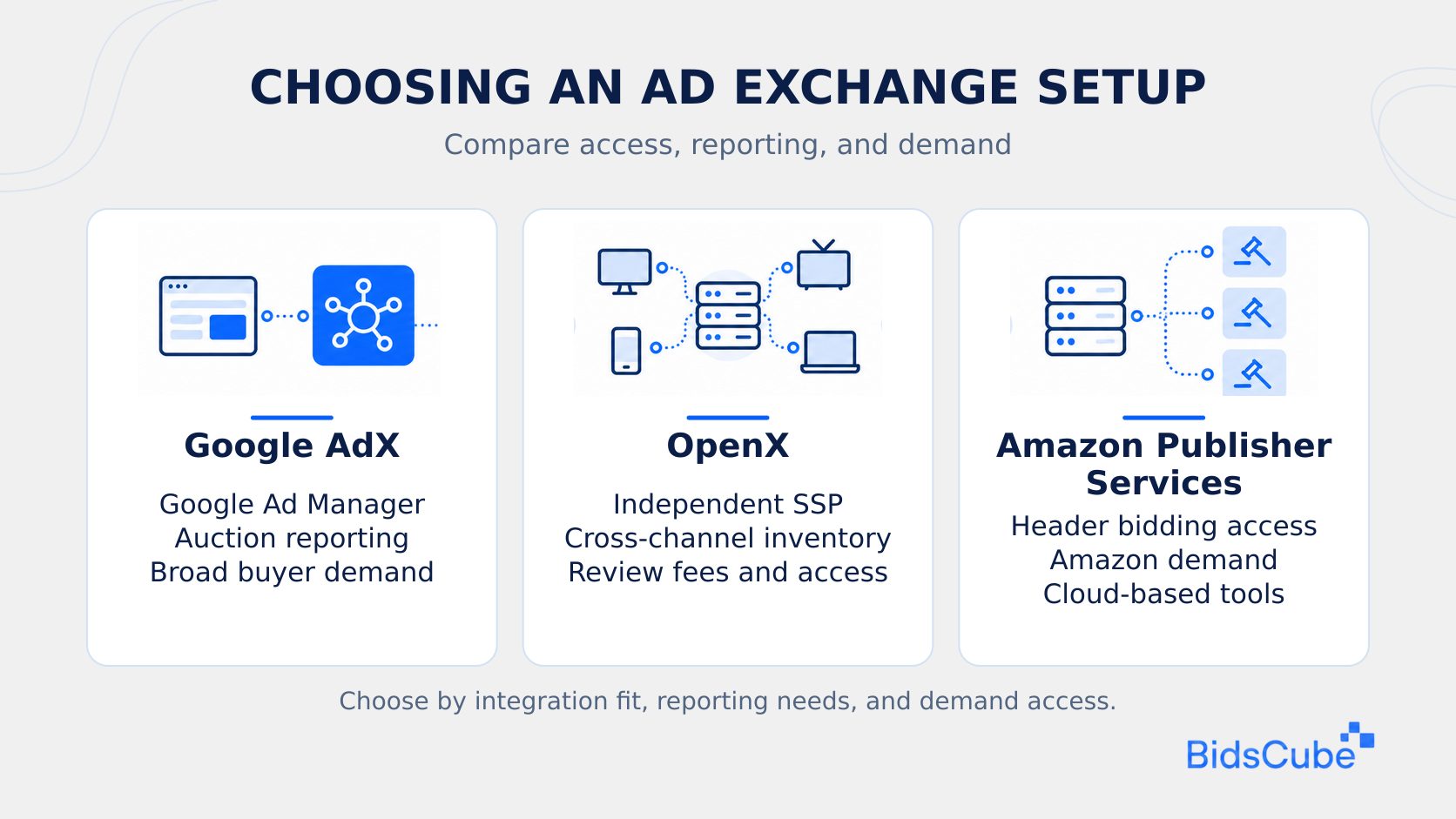
No platform wins on every line. Here’s a fair look at setup effort, reporting, and demand, the three things publishers ask about most:
| Platform | Integration complexity | Reporting transparency | Demand quality |
| Google AdExchange | Medium. Runs inside Ad Manager and needs approval. | Detailed in Ad Manager. Fee breakdowns are limited. | Very broad global demand, including Google’s own buyers. |
| OpenX | Medium. Connects through Prebid or a direct setup. | High. Known for open reports and clear fees. | Strong independent demand with a focus on clean supply. |
| Amazon Publisher Services | Low to medium. Uses Amazon’s own header bidding wrapper. | Moderate. Reports center on Amazon demand. | Retail brands backed by Amazon’s shopping data. |
Google’s exchange is the natural pick if you already run Ad Manager and want the widest buyer pool. Expect more setup work and thinner fee detail. OpenX is for publishers that want fee transparency, and are looking for Google³ as a meaningful independent partner. It fits neatly into Prebid.
Amazon works best as an extra bidder. Don’t make it your only one. The retail-facilitated buyers can raise prices on shopping, tech, and lifestyle pages. This means that most publishers have two or three of these running. Install them one after the other for 30 days, and then see how eCPM, fill rate and revenue compares.
Tools and Resources to Improve Google AdExchange Performance
The exchange is only one part of your stack. A few helper tools get more out of it, and most are cheap or free to start with. You will not need all of them from the day 1. You can create reports first, and introduce header bidding after you have onboarded at least 2 demand partners, and enforce ad quality checks as soon as you see strange creatives.
Analytics and Reporting Platforms
Good reports answer plain questions. Which pages earn the most? Which ad sizes sell best? Where does revenue suddenly drop? Check them every week. Month-end is too late. Small problems are cheap to fix on Tuesday and expensive to fix three weeks later.
Header Bidding Integration
ContentsOnce, only one ad exchange could signal to an ad server, so if you wanted … Header bidding allows multiple exchanges to compete at the same time, and not sequentially for each individual impression. More bidders, higher prices. Prebid.js is the most popular open-source option, and it runs side by side with Ad Manager. If you’re starting from zero, set up two or three bidders first, then add more.
Ad Quality Monitoring Tools
Bad ads hurt you twice. Malware, auto-redirects, and heavy creatives push readers away and slow your pages. A quality tool catches and blocks these ads before readers complain. Some publishers learn this the hard way, after a redirect ad sends half their mobile visitors to a fake prize page on a Friday night.
Is Google AdExchange Right for Your Publishing Business?
There’s no single answer here. Its up to your traffic, your team and how much ad money matters to you. For example, a site that relies heavily on subscriptions might not require the additional labor. A site that lives on ads probably does. Two checks below should help you decide.
Factors to Consider: Scale, Audience, and Revenue Goals
Ask yourself three questions:
- Traffic. Do you have enough steady, real traffic to meet Google’s bar?
- People. Is there someone, in-house or outside, who can run Ad Manager?
- Money. Is ad revenue a big enough part of your business to justify the work?
Three yeses? Then at least give Google ad exchange for publishers of your stature a real run. The majority of sites that have consistent traffic pull back the additional effort required in a couple of months. Two or fewer? AdSense or a managed partner may serve you better for now, and that’s a fine place to be while you grow.
Case Studies of Successful Publishers Using AdExchange
Now imagine a lifestyle blog which then transitioned from AdSense over to use AdX. So it got rid of two under-performing slots, increased floor prices in dribs and drabs, and added two additional exchanges through header bidding. Six months later, monthly earnings had doubled. Another site, built around Connected TV (CTV) content, added header bidding and saw far more buyers fight over each video break.
Neither result came from one big switch. Both came from small, steady tests and the patience to read the reports. That’s the unglamorous truth about Google ad exchange for publishers. It rewards the ones who keep tweaking, and it punishes the ones who set it up once and forget about it for a year.
Our tech staff and AdOps are formed by the best AdTech and MarTech industry specialists with 10+ years of proven track record!

FAQ
What is an ad exchange?
It is an online marketplace where publishers offer to ‘sell’ ad space and buy it, usually performing real-time auctions. In short, if you’ve ever wanted to know what is an ad exchange in one line: the place where each impression goes for the best price at blink of an eye.
What is Google AdX?
Google AdX is Google’s ad exchange. It runs inside Google Ad Manager and connects publishers with a very large pool of advertisers and DSPs. When people type “what is Google exchange” into search, this is almost always the platform they mean.
How does an ad exchange work?
When a page loads, the publisher’s ad server or SSP sends a bid request to the exchange. DSPs bid for the impression on behalf of advertisers. Last the highest bid wins, and then all in less than 1000 milliseconds, display your ad. The publisher has set the low bar, whilst above that is a tussle between buyers.
Is Google Ad Exchange free to use for publishers?
There’s no sign-up fee. Google keeps a share of each sale instead. You’ll also need Google Ad Manager, and many smaller publishers get access through a certified Google partner, who may take a cut too. So “free” means no upfront cost, not zero cost.
What is the difference between an ad exchange and an ad network?
An ad exchange that we have discussed previously is another player in this convoluted world where an ad network will purchase space from many different sites and sell blocks of it to others, frequently at fixed prices. An ad exchange for publishers is an open market where each impression is sold on its own. Our guide on ad exchange vs ad network has the details. New to this? Start with what is an ad network.
Can small publishers use Google Ad Exchange?
Sometimes. Google sets traffic and quality bars, so very small sites rarely get in on their own. Many get access through a Google partner. Even then, it’s usually worth the effort only once traffic is steady and ad income matters to the business, otherwise AdSense is simpler.
Conclusion: Getting the Most from Google AdExchange
AdX can lift your revenue through bigger demand, fair per-impression prices, and tighter control over your slots. You expect a lot more of you than AdSense. You will need an ad manager, a clean website, and the patience to test iteratively.
Our advice is short. Don’t treat Google as your only door. Google ad exchange is the ultimate core but additional bidders bring more integrity Use OpenX, Amazon or a third-party SSP via header bidding, crunch the numbers weekly and only keep what works.
Not sure which mix of exchanges fits your traffic? Our AdOps team has 10+ years in AdTech and MarTech and works with the BidsCube SSP every day. Let’s map your setup together.
This Article's Ad Tech terms
- Ad Exchange
- Real-Time Bidding (RTB)
- Seller-Side Platform
- AdSense
- Return on Ad Spend (ROAS)
- Return on Investment (ROI)
- Data Management Platform (DMP)
- Click-Through Rate (CTR)
- Conversion Rate (CVR / CR)
- A/B Testing
- Dynamic Creative Optimization
- Cost per action (CPA)
- General Data-Protection Regulation (GDPR)
- Connected TV (CTV)


