



TL;DR
- FAST stands for free ad-supported streaming TV. It’s free to watch and paid for by ads.
- FAST channels run on a schedule, like cable. Viewers tune in. They don’t pick titles.
- EMARKETER expects 131.4 million US FAST users in 2026. That’s 54% of all CTV viewers.
- FAST differs from AVOD (on demand), SVOD (paid subscription), and linear TV (paid cable).
- Ads are sold directly or programmatically through SSPs and DSPs over OpenRTB.
- Audiences are growing faster than ad demand. That keeps competition for inventory lower.
- The main hurdles are a split market, thin metadata, and mixed measurement.
Table of Contents
- What is a FAST channel?
- How does a FAST channel work?
- FAST vs AVOD: what's the difference
- FAST vs AVOD: comparison table
- FAST vs SVOD: what's the difference
- FAST vs linear TV: what's the difference
- How do FAST channels make money? (FAST channel monetization)
- How programmatic FAST TV advertising works: step-by-step
- FAST channel advertising formats
- FAST channel examples: which platforms lead the market
- FAST channel audience targeting
- Benefits of programmatic FAST advertising for advertisers
- Challenges of buying FAST inventory
- How BidsCube Can Help
- Summary
-
FAQ
- 1. What is a FAST channel?
- 2. What does FAST stand for in streaming?
- 3. What is the difference between FAST and AVOD?
- 4. Is FAST the same as SVOD?
- 5. How do FAST channels make money?
- 6. How does programmatic advertising work on FAST TV?
- 7. What are some examples of FAST channels?
- 8. How is FAST different from linear TV?
FAST used to be the backup plan for cord-cutters. Not anymore.
Today, scheduled services are a mainstream way to watch TV. Audiences are growing faster than advertisers can keep up. That gap is good news for buyers who move early. The idea is simple. FAST gives viewers the lean-back feel of cable: set channels, a schedule, no browsing. But it streams over the internet to a connected TV. No subscription. No bill.
The audience is already big. EMARKETER forecasts 131.4 million FAST users in the US in 2026. That’s 54% of all CTV viewers and 5.8% more than in 2025. So, what is fast tv, and how do you buy it? Let’s go step by step.
What is a FAST channel?
What is a fast channel? It’s a free streaming channel that runs only on ads. It follows a set schedule, just like linear TV. That’s the core fast channel meaning: free ad-supported streaming television. You don’t sign up. You don’t pay. You open an app on your connected TV (CTV) and start watching.
How does a FAST channel work?
Here’s how fast channels work. Content is grouped into channels by genre, topic, or brand. Think a 24/7 cooking channel, a classic sitcom channel, or a true crime channel. Each one plays on a schedule. The viewer doesn’t pick an episode from a library. They tune in and watch what’s on.
Well-known platforms include the Roku Channel, Tubi, Pluto TV, and Samsung TV Plus. Many are built right into smart TVs. That’s a big part of how fast channels work at scale: the channel is there the moment the TV turns on.
FAST vs AVOD: what’s the difference
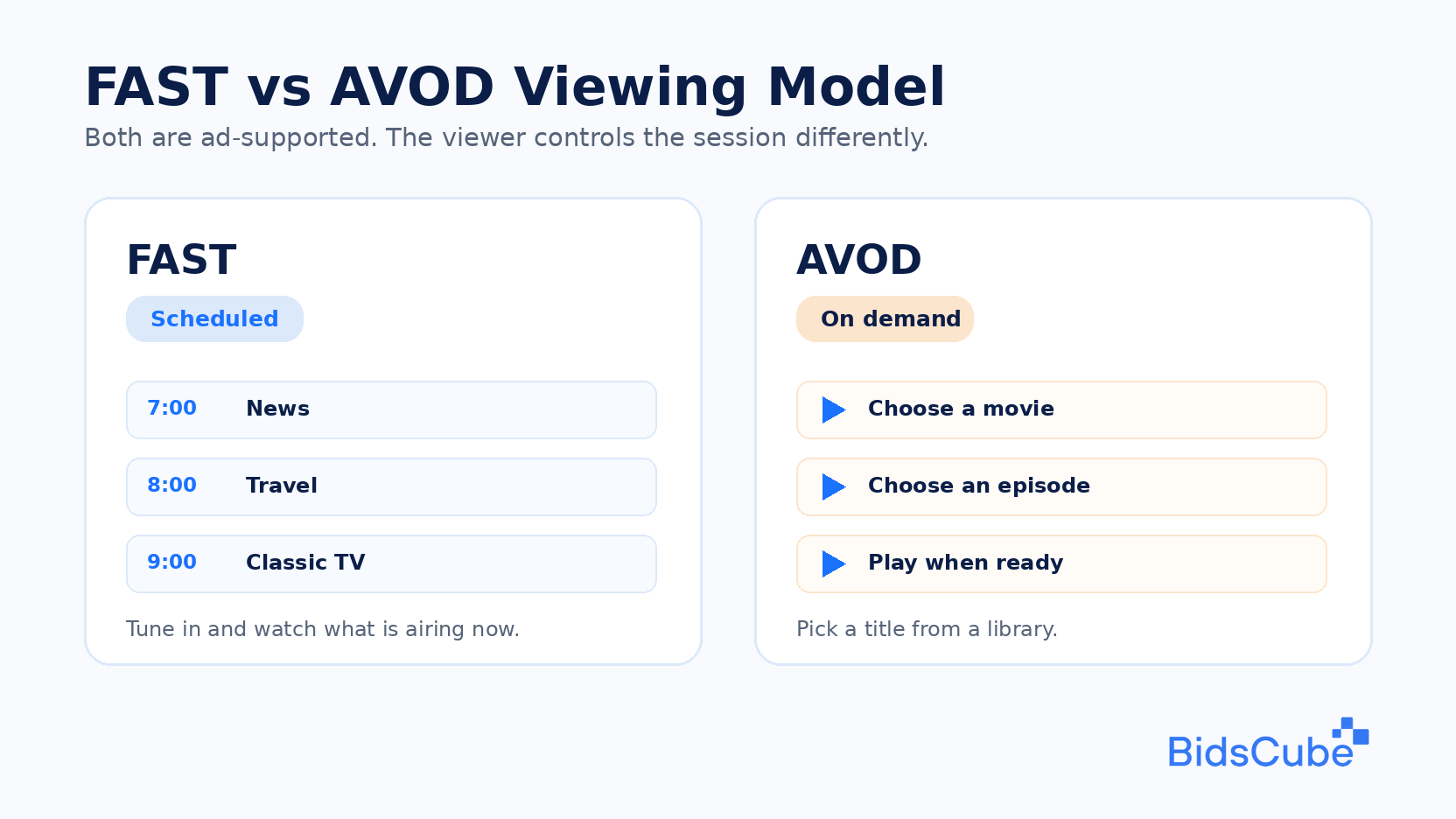
The fast vs avod question comes up a lot. Both are free. Both run on ads. The difference is how people watch. FAST copies linear TV. You tune in to a channel and watch what’s playing right now. AVOD is on demand. You pick a specific title from a library and press play.
Many platforms do both. Tubi and Pluto TV, for example, offer scheduled streams and an on-demand library in the same app.
FAST vs AVOD: comparison table
Here’s avod vs fast side by side:
| Parameter | FAST | AVOD |
|---|---|---|
| Viewing style | Scheduled, lean-back channels | On demand, viewer picks a title |
| Cost to viewer | Free | Free |
| Ad placement | Scheduled ad breaks, like TV | Pre-roll and mid-roll around chosen titles |
| Session behavior | Long, passive sessions | Shorter, intent-led sessions |
| Examples | Pluto TV channels, Samsung TV Plus | Tubi on-demand library, YouTube |
FAST vs SVOD: what’s the difference
The fast vs svod gap is about money. SVOD means subscription video on demand. You pay monthly. Most plans show few or no ads. Think Netflix, Disney+, or Amazon Prime Video on their base plans. FAST is the opposite. It’s fully free and fully funded by ads.
In short, fast vs svod comes down to who pays: the viewer or the advertiser.
FAST vs linear TV: what’s the difference
On linear tv vs fast channels, start with what they share. Both offer scheduled channels. In both, the viewer doesn’t pick a title. Now the difference. Linear TV is cable or satellite. You pay for it, and it’s tied to one provider. FAST is the streaming version. It’s free and works on any CTV device with internet.
For buyers, linear tv vs fast channels also means a data gap. Linear TV offers broad ratings. FAST offers digital signals you can target and measure.
How do FAST channels make money? (FAST channel monetization)
How do fast channels make money? Only through ads. Ads play during breaks in the channel’s schedule, much like on cable TV. The fast tv ad inventory is sold in two main ways:
- Direct deals. The platform sells slots straight to a brand or agency.
- Programmatic. Slots are sold in real time through SSPs and DSPs, based on the OpenRTB standard.
Premium placements often go through a private marketplace (PMP). A PMP limits who can bid. That gives buyers more control over quality and brand safety. So fast channel monetization looks a lot like the rest of OTT advertising. For more ideas on the sell side, see our guide to OTT monetization strategies.
How programmatic FAST TV advertising works: step-by-step
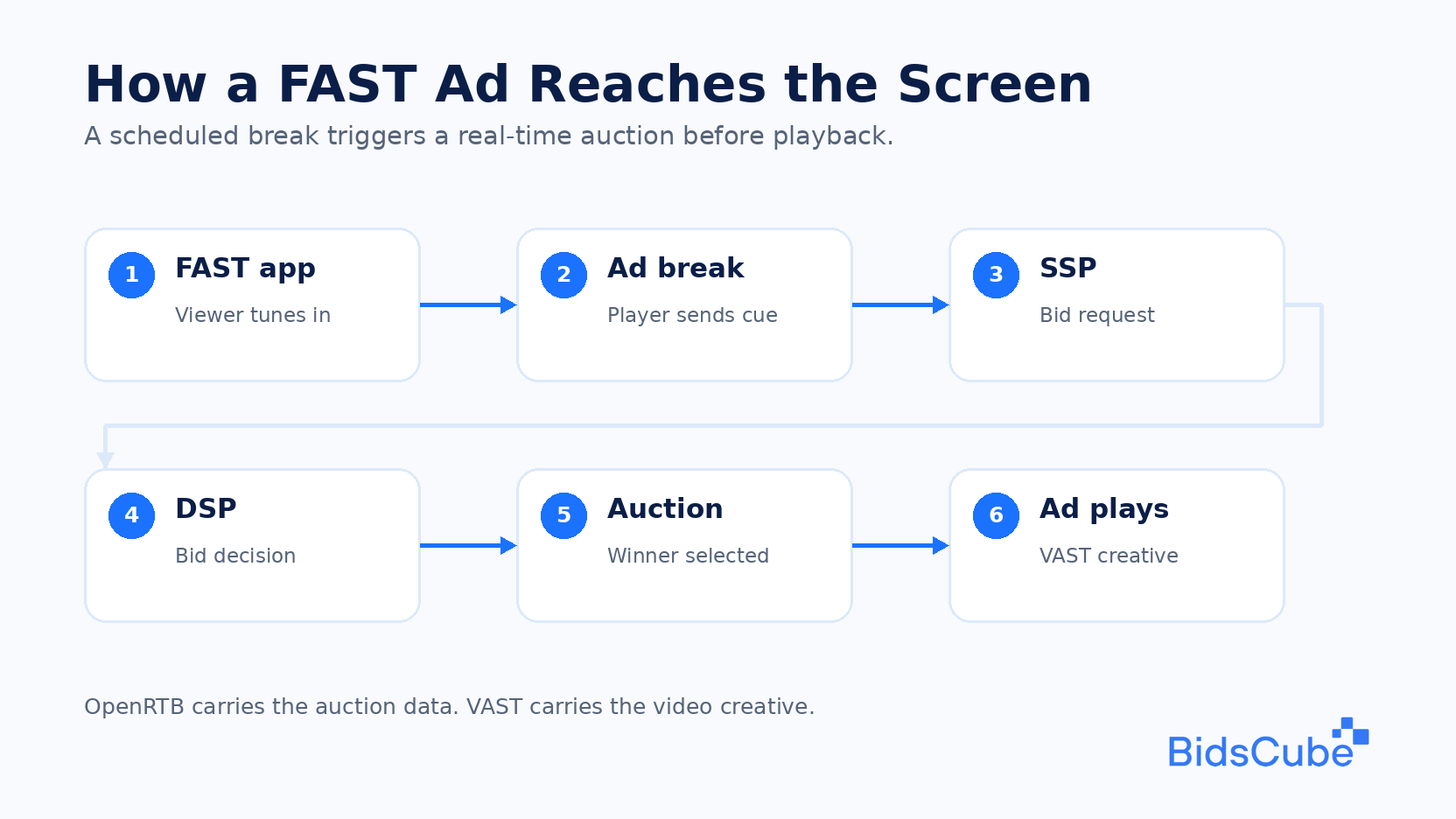
Here’s how programmatic fast tv advertising runs in a few seconds:
- A viewer tunes in. They open a FAST app on their CTV and pick a channel.
- An ad break comes up. The player nears a scheduled break.
- The SSP sends a bid request. It goes out to connected DSPs with details about the slot.
- DSPs bid. Each one reads the device, geo, and channel context, then places a bid.
- The winner plays. The top bid wins, and the creative loads into the break.
Breaks often hold several ads in a row. This is called an ad pod. Each slot in the pod can go to a different buyer.
Want to buy FAST inventory programmatically? Check out the BidsCube DSP and start testing CTV campaigns.
FAST channel advertising formats
The main fast channel advertising formats are:
- Non-skippable video breaks. They play on schedule, just like TV.
- Standard 15 and 30 spots. The same lengths buyers know from TV.
- Interactive overlays and QR codes. Viewers scan with a phone to visit a site or buy.
- Channel sponsorships. A brand sponsors a full channel or a themed block.
QR codes deserve a quick note. They used to feel dated. On a big screen with a phone in hand, they work well. Most fast channel advertising formats now support them.
FAST channel examples: which platforms lead the market
Here are the top fast channel examples by US reach in 2026, per EMARKETER:
| Platform | US viewers (2026) |
|---|---|
| Roku Channel | 97.3 million |
| Tubi | 92.5 million |
| Pluto TV (Paramount) | 68.6 million |
| Samsung TV Plus | Growing, built into Samsung TVs |
These fast channel examples show how much of the market sits with a few names. Samsung TV Plus is a bit different. It ships on every new Samsung TV, so reach grows with TV sales.
FAST channel audience targeting
Fast channel audience targeting is much sharper than classic TV. FAST runs on CTV, so buyers get household-level data. That allows deterministic targeting that linear TV can’t match.
Common signals include:
- geography
- device type
- time of day
- channel context or genre
Household targeting lets you reach a home, not just a broad age group. That’s a big step up from ratings-based TV buys. Done right, fast channel audience targeting cuts waste on viewers who would never buy.
Benefits of programmatic FAST advertising for advertisers
Why look at fast tv advertising now? Five reasons stand out.
- Less competition. The audience grows faster than ad demand. Fewer buyers chase the same slots.
- Good prices. Fill rates in FAST are still below balance. That keeps bids competitive.
- Household targeting. CTV data lets you reach specific homes.
- Premium context. Ads play on the big screen, in a brand-safe setting. That beats a small phone feed.
- Easy to combine. You can add FAST to CTV campaigns next to OTT and SVOD ad tiers.
For a wider view, read about the rising importance of connected TV in digital marketing.
Challenges of buying FAST inventory
Fast channel advertising isn’t perfect. Keep these limits in mind:
- A split market. There are thousands of free streaming channels. Picking where to run a campaign takes work.
- Thin metadata. Some platforms share little about what’s on screen. That makes contextual targeting harder.
- No shared measurement. Each platform reports in its own way. Comparing results takes extra effort.
- Low loyalty. Most content isn’t exclusive. Viewers switch services easily.
None of these are deal-breakers. They just mean you need good partners and clear goals.
How BidsCube Can Help
BidsCube supports programmatic buying and selling of CTV and FAST inventory.
- For advertisers: the BidsCube DSP lets you buy FAST and CTV slots in open auctions based on OpenRTB. You can also join PMP deals for premium placements.
- For streaming platforms: the BidsCube SSP helps you sell fast tv ad inventory to a wide pool of buyers, with PMP support and real-time reports. Learn more on our page for streaming platforms.
BidsCube has 10+ years in programmatic and 230+ clients. You can read what they say on Clutch.
Summary
FAST brings the ease of cable TV to free streaming. Its audience is huge and still growing. For buyers, programmatic fast tv advertising offers household targeting, a premium screen, and less competition than most CTV channels. The market is messy, so pick partners who give you control. Start small, test, and scale what works in fast tv advertising.
Talk to BidsCube about buying or selling FAST inventory.
Our tech staff and AdOps are formed by the best AdTech and MarTech industry specialists with 10+ years of proven track record!

FAQ
1. What is a FAST channel?
A FAST channel is a free streaming TV channel that runs on a schedule and is paid for by ads.
2. What does FAST stand for in streaming?
FAST stands for free ad-supported streaming tv. It’s also written as free ad-supported streaming television. That’s the full fast channel meaning.
3. What is the difference between FAST and AVOD?
In avod vs fast, FAST is scheduled, like TV. AVOD lets viewers pick a title on demand. Both are free and run on ads. That’s the difference between the two models in one line.
4. Is FAST the same as SVOD?
No. SVOD needs a paid subscription and shows few ads. FAST is free and fully ad-funded.
5. How do FAST channels make money?
They earn revenue through ad breaks, sold directly or programmatically. That’s the full fast channel monetization model.
6. How does programmatic advertising work on FAST TV?
An SSP sends a bid request to DSPs when an ad break nears. DSPs bid in real time, and the winner’s ad plays. Many buyers start fast channel advertising this way.
7. What are some examples of FAST channels?
The Roku Channel, Tubi, Pluto TV, and Samsung TV Plus lead the US market. All offer scheduled free TV streams across many genres.
8. How is FAST different from linear TV?
Both run on a schedule. Linear TV is paid cable or satellite. FAST is free and streams over the internet. If you’re still asking what is fast tv, think of it as free cable on a smart TV.
This Article's Ad Tech terms


