
Ad technology is the collection of systems (platforms), data, and technology (infrastructure) that allows companies to plan, purchase, distribute, and track digital advertising. That sounds dry. In practice, it’s the reason a sneaker brand can reach a runner reading a race report in Lisbon, and the reason that small running blog gets paid for the space, all in less time than the page takes to load.
Table of Contents
The money involved is huge. According to the IAB/PwC Internet Advertising Revenue Report, U.S. digital advertising revenue reached $294.6 billion in 2025. Almost all of it flows through some kind of ad tech. This article explains how the main pieces connect advertisers and publishers, how they automate buying and measurement, and where walled gardens fit in. No history lecture, promise. Well, a short one.
How Advertising Technology Connects the Market
Online ads started simply. Digital advertising began in the early 1990’s when ad servers were developed that allowed publishers to place banners on their sites and track how often users clicked those banners. By the early 2000’s, digital advertising had grown so much that there was now an option for publishers to create their own digital ad exchanges. These exchanges allowed publishers to sell unused space on their websites to multiple advertisers simultaneously. If you want to know all about the history of digital advertising, you can read our article about the history of digital advertising from its first banner until today.
Today the chain looks like this. An advertiser or agency establishes their objectives and spending limits within a demand-side platform (DSP). A DSP communicates with both ad exchange platforms and supply-side platforms (SSPs) who provide access to publishers’ ad inventory (i.e., website, app, streaming service). Data providers assist with identifying the appropriate audience; verification tools confirm that ads were delivered in accordance with established parameters; and measurement tools demonstrate the value generated from the investment. Each piece of advertising technology does one job. Together, they turn a messy market into something that can be bought and sold in milliseconds.
How RTB Changed Media Buying
Real-time bidding (RTB) revolutionized the way people buy digital advertising in the early 2010s. Prior to RTB, advertisers had to book ad space weeks in advance. With RTB, however, advertisers are able to bid on a single ad impression as it’s being served to a user, which allows for instant purchasing. It’s still the engine behind most programmatic buying. Our piece on RTB vs programmatic explains how the two terms relate.
Three platforms do most of the work:
- DSP. The demand-side platform belongs to buyers. The DSP determines who will see an ad, how much they will pay, evaluates every single time someone views an ad, and submits a bid for that view.
- SSP. A supply side platform is owned by the publisher. It will package the publishers ad space, set a minimum price for the ad space (floor price) and then provide the ad space to the buyer.
- Ad Exchange. The Ad Exchange is a middleman’s market place where buyer’s bids are matched with seller’s offers, then the auction process begins.
The process is simple. When a user loads a page, the publisher’s SSP (or ad exchange) sends out a bid request. Each DSP examines the impression opportunity and determines if they want to place a bid and what amount. Then, the SSP (or ad exchange) holds an auction to select the winning DSP. Finally, the winning DSP returns its ad creative to the page to be displayed. Our guide to DSP, SSP and ad exchange goes deeper into each role.
How the Open Programmatic Ecosystem Works Today
RTB was the start. Now there are multiple layers of technology built upon that foundation. With header bidding, publishers can simultaneously request bid requests from several SSPs to provide more accurate pricing. PMPs allow selected buyers to purchase high-quality inventory on agreed-upon conditions. CTV brings the same auction logic to streaming screens, and DOOH brings it to outdoor screens in stations and malls.
Around all of this sit two layers that didn’t matter much ten years ago. The first layer is a verification process for fraudulent activity, brand protection (brand safety), and the ability of an user to view the advertisement (viewability). These are done at both the pre-bid and post-bid stages. The second layer is the use of Artificial Intelligence (AI) to optimize bidding, budget allocation, and the design/creation of the advertisements themselves in real-time across multiple auction sites each second. Each part feeds the next. Our walkthrough on how programmatic advertising works and our map of the adtech ecosystem show how the pieces link up.
Advertising technology connects brands with publishers and their audiences.
Benefits of Using Advertising Technology
Programmatic tools help both sides of the market, in different ways. Here are the main programmatic advertising benefits.
For advertisers:
- Precise targeting. Connect with users based on their interests, locations, devices and/or context – not solely on the sites they visit.
- Less wasted budget. Bid only on impressions that fit the goal, and cap how often one person sees the ad.
- Live data. See results as the campaign runs and change course mid-flight.
- Wider reach. One dashboard can cover web, apps, CTV, and DOOH.
For publishers:
- More demand. Many buyers compete for each slot, which usually lifts prices.
- Less manual work. Sales run automatically, so small teams can monetize large sites.
- Price control. Floor prices and private deals protect the value of premium space.
- Clearer reports. Publishers see who bought what and at which price
The data that is used to make this happen. Marketers take the data that comes out of web analytics, apps, and their own CRM, and then apply AI models to try and figure out what is going to be successful. Screens beyond the browser count too. DOOH ads, for example, are much harder to skip or block than online banners, since they sit in physical spaces people walk past every day. For a broader look at the advantages of programmatic advertising for the whole market, see our piece on programmatic ecosystem benefits.
Walled Gardens Phenomenon
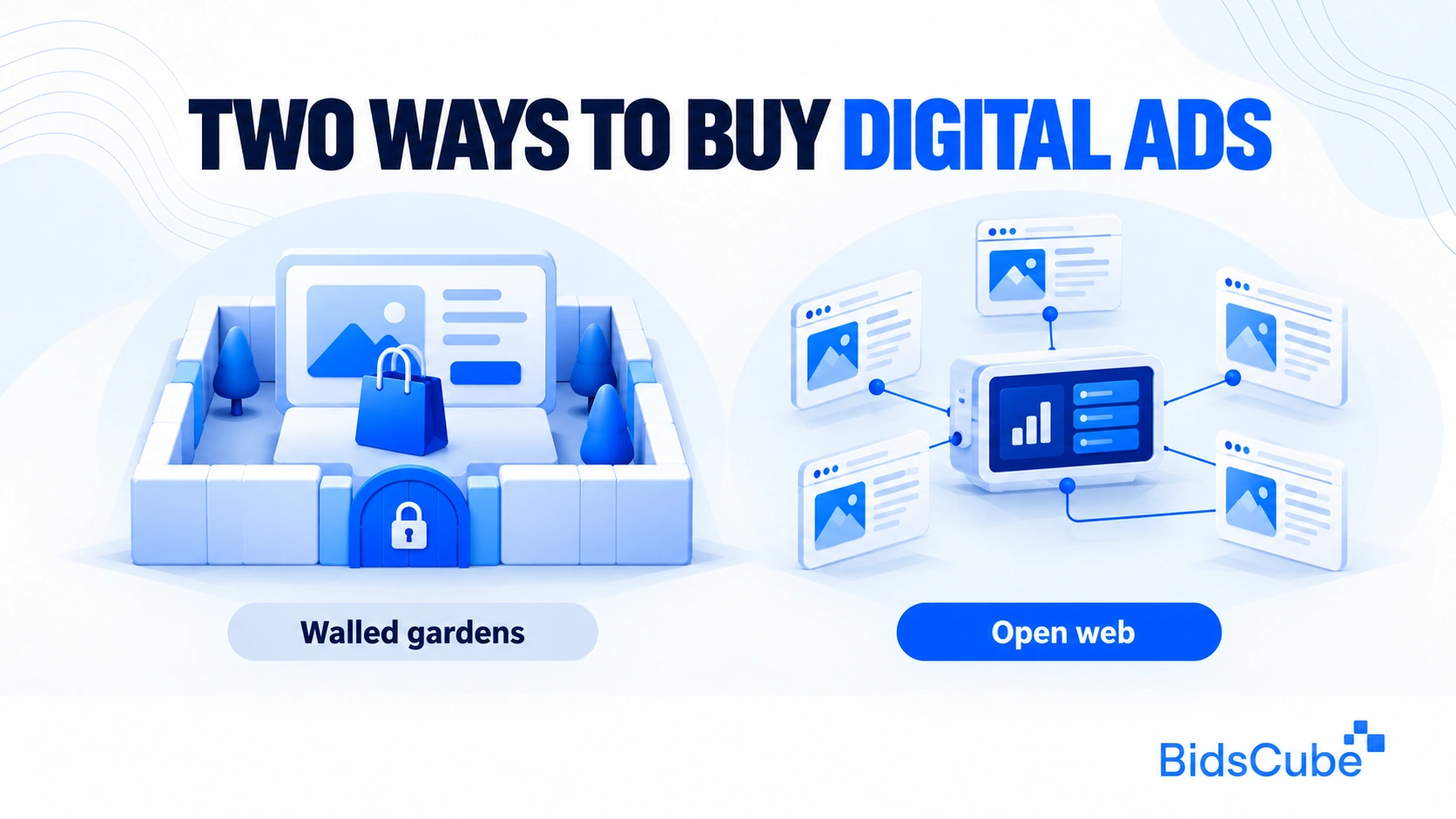
A walled garden is a closed ecosystem that is controlled by a single company. This company owns the technology used to create the platform, the data collected from users of the platform, and the product/service offerings available through the platform. Think of Google, Meta, Apple, and Amazon. You buy their ad space with their tools, measured by their numbers. That’s the walled garden meaning in a sentence, and it explains both the appeal and the frustration.
The appeal is scale. These companies hold a large share of global ad spend, and their logged-in users give them rich data. Walled garden advertising can be easy to start and hard to beat on reach. On the other hand, the disadvantage of walled garden advertising is the lack of control. These platforms only report the amount of information they wish to disclose. Data collected by the platform is rarely allowed to leave the garden. Most settings on the platform are one size fits all.
That’s why many teams also work with independent adtech companies. The usual reasons:
- Transparent reporting. You see where ads ran and what each step cost.
- Real support. A team that knows your account, not a ticket queue.
- Custom setups. Settings and integrations built around your business.
At BidsCube, we think digital advertising should be open to everyone, from the biggest spenders to a two-person agency. That’s why we build tools that both can run without a team of engineers.
Open Web vs Walled Gardens: How to Choose
Open web advertising and walled gardens aren’t enemies. They do different jobs. Here’s an honest side-by-side view:
| Criterion | Walled garden | Independent adtech |
| Reporting transparency | Limited to the platform’s own metrics | Impression-level reports and clear fees |
| Data ownership | Data stays inside the platform | Advertisers and publishers keep more control of their data |
| Setup flexibility | Standard settings for everyone | Custom targeting, deals, and integrations |
| Support | Mostly self-serve | Direct support from a dedicated team |
| Reach | Huge logged-in audiences | Wide reach across the open web, apps, CTV, and DOOH |
Walled garden advertising makes sense when you need scale fast and value simple setup. On the other hand, independent platforms are a better fit if you want to understand exactly what your advertising budget is being spent on, if you want to be able to access all of your own data, or if you require an advertising solution that the larger platforms cannot provide. Most mature teams use both.
Our tech and AdOps teams comprise experienced AdTech and MarTech specialists with 10+ years in the field. Talk to BidsCube about a setup that fits your business.
Current AdTech Priorities
The ground keeps moving, but a few priorities are clear today:
- Cookies and privacy. Chrome kept third-party cookies with user choice, while Safari and Firefox block them by default. GDPR and US state privacy laws set the rules on consent either way.
- Contextual targeting. Matching ads to page content, not personal data, is back, and newer language tools make it far sharper.
- ID graphs. A company links a person’s device(s) and login(s) together in order to see their target audience without having to rely solely upon cookies.
- CTV. As streaming is continuing to grow rapidly, programmatic advertising is becoming available through many of the largest streaming applications.
- AI. AI is already used for conducting bidding and creative tests, and it is also being used to automate many routine buying and ad ops tasks.
All of them operate together. Privacy rules shape identity, and identity shapes how you target and measure. For a deeper look at where the market is heading, read our take on current programmatic trends.
FAQ
What is advertising technology?
Ad technology is a collection of technology that allows companies to create, purchase, distribute, and track digital advertising campaigns. The technology used in ad tech can include demand-side platforms (DSPs), supply-side platforms (SSPs), ad exchanges, ad servers, data management systems (DMS), and verification software.
How do DSPs, SSPs and ad exchanges work together?
An ad exchange or a publisher’s SSP (sell-side platform) makes a bid request for an impression. DSPs judge it and bid. An auction determines which DSP has won the bid, and the winning DSP will have its creative sent back to the page/app where it was requested to be displayed.
What is a walled garden in advertising?
It is a closed system (such as Google, Meta, Apple or Amazon) which controls its own technology, data and advertising inventory. You buy and measure inside its walls, using its tools and numbers.
What are the benefits of programmatic advertising for publishers and advertisers?
Programmatic advertising provides advertisers with precise targeting, reduced waste, real-time data access and large audience coverage. For publishers, programmatic advertising creates increased demand for their inventory, reduces manual labor, gives them greater control over pricing and produces clearer reports. Those are the core programmatic advertising benefits for both sides.
Why work with independent adtech companies instead of walled gardens?
In general terms, organizations are looking for more control over their data, more transparency in reporting, and better support. Many teams use walled gardens for scale and independent platforms for control.
To sum up
The relationship between technology and advertising is not new. It’s been around for quite some time, and just like other long-term relationships, it works because both partners do what they need to do. Ad technology links buyers and sellers, automates the deal, and measures the result. Walled gardens offer scale. Independent platforms provide transparency and control. Those companies that succeed will be able to determine when to utilize one or the other, while keeping an eye on the trends that are occurring in the advertising industry (i.e., privacy, context, connected TV, artificial intelligence). Curious how BidsCube fits in? Contact us and let’s talk.
Our tech staff and AdOps are formed by the best AdTech and MarTech industry specialists with 10+ years of proven track record!