



This RTB programmatic guide separates the wider buying category from one auction method. Programmatic advertising vs RTB is not a choice between equal systems: RTB advertising sits inside programmatic buying.
Table of Contents
RTB programmatic advertising uses software to assess and bid on individual impressions. When teams ask what is RTB advertising, the clearest RTB advertising meaning is an automated impression auction. Programmatic RTB can support open auctions and private deals, while a DSP RTB connection represents the buyer.
A programmatic advertising vs RTB review should compare deal type, inventory access, price rules, and delivery guarantees. RTB in advertising is useful when buyers need impression-level decisions and auction access.
Grand View Research estimates that the global real-time bidding market will reach $21.2 billion in 2026, up from $14.4 billion in 2023. The report projects $39.6 billion by 2030, with a 15.6% compound annual growth rate from 2024 to 2030.
New technologies of Internet advertising have opened extra opportunities. Programmatic tools brought many benefits – from controlling what audience the ad is demonstrated to the simplicity of the whole publishing process.
The names in the title are widely spread terms in the digital advertising industry. The distinctive features are so subtle that they need to be clarified even for many experts in the field. Both approaches have a lot in common. These methods use multi-channel purchase models, user behavior parameters, and quick processing.
Looking ahead, programmatic advertising is a broader concept. RTB is one of its types and can be part of it. But let’s focus on each idea separately and examine into the subject to understand how these systems work.
Programmatic Advertising Definition
A general definition of the concept usually revolves around purchasing and selling internet marketing space. But this is a very rough explanation. Ad exchanges, SSPs, and DSPs lead the market today. They are the link between people wanting to advertise something and those ready to publish these ads. Both parties willingly use computerized platforms to achieve better results and make the transaction faster.
The key to a quick deal is algorithmic software. This tool speeds up the whole process, reducing the duration to seconds. But that’s not all. The base system considers the target audience’s demographics, user behavior, age, and other criteria. This analysis of potential customers significantly improves conversion. And it means a mutual benefit for all parties.For a broader walkthrough, see how programmatic advertising works.
How Does Programmatic Ad Buying Work?
Programmatic media-buying means using specialized software and algorithms to automatically buy digital ad space, such as display ads, banners, and videos.
There are different ways to do programmatic media-buying:
- Programmatic direct. Advertisers and publishers agree to the media campaign’s terms and use software to manage the delivery and reporting of the ads.
- Real-time bidding (RTB). Advertisers can buy ad space one impression at a time through auctions on the open market. Any advertiser can bid for ad space on a publisher’s website.
- Private marketplace (PMP). This is a form of RTB, but the ad inventory is only available to selected advertisers, usually for premium sites and large brands.
Programmatic media-buying is more efficient than traditional methods because it automates the process and deals with increasing digital channels and publishers. What makes programmatic even more powerful is the use of data about customer behavior, geography, time of day, and other factors. This data helps advertisers target specific audiences more effectively with their ads.
What Is RTB?
Considering everything we said previously, it is easier to get the meaning of RTB. Real-time bidding is a part and type of programmatic advertising. What is its main idea? Advertisers compete for valuable ad placement in an online auction. The essential advantage is that one may pick where impressions are served. All procedures are automated, and no human participation is required.
Let’s take a closer look at how RTB works.
- First, a user clicks on a website that has ad space available.
- Then, the website owner puts the ad impression up for auction via a supply-side platform (SSP).A BidsCube SSP can help publishers manage inventory, demand connections, and reporting before the auction.
- Advertisers then bid on the ad impression using a demand-side platform (DSP).
- The highest bidder wins the auction, displaying their ad on the website for the user to see.
- If the user is interested and clicks on the ad, they may convert and complete a desired action.
- Despite the various steps involved, this process occurs in hundreds of milliseconds, thanks to algorithms and analytics that calculate competing bids and determine the most cost-effective option.The bidstream data guide explains the auction information that moves between platforms during this process.
For instance, suppose the user who clicked on the website is an ideal potential customer for your ad based on their online browsing history and profile. In that case, the bid for your ad impression will likely be higher to maximize the chances of conversion.
So RTB is a name for a process type during which you can buy needed media space on the most favorable terms. Participants set their bet prices. All steps are transparent and clear. A user is provided with a report at the end of each campaign. So an advertiser has all the tools for future improvements.Header bidding can add more demand sources before an impression reaches the final auction.
Put RTB into practice
Use the BidsCube DSP to manage auction buying, targeting, budgets, and reporting from one platform.
Similar And Distinctive Features
Both systems automate the acquisition and sale of advertisements. Both are internet tools that connect ad buyers and sellers. That is all they have in common. Here come the differences.
Programmatics is a broader concept. This system includes many ways to achieve desired targets. In addition to sales at the auction, transactions can be conducted directly with the site. The system offers a choice between having a guarantee for impressions number (Preffered Guaranteed) or no guarantees (Preffered Deal).
RTB is merely one kind of programmable ad purchase, which is part of the Programmatic. This method is always based on an auction. In RTB, the tender is not about an advertising place but about showing particular materials to specific visitors. The user pays for ad impressions. And one can be sure it will be shown to specific target audiences.
RTB vs Programmatic Advertising: Quick Comparison
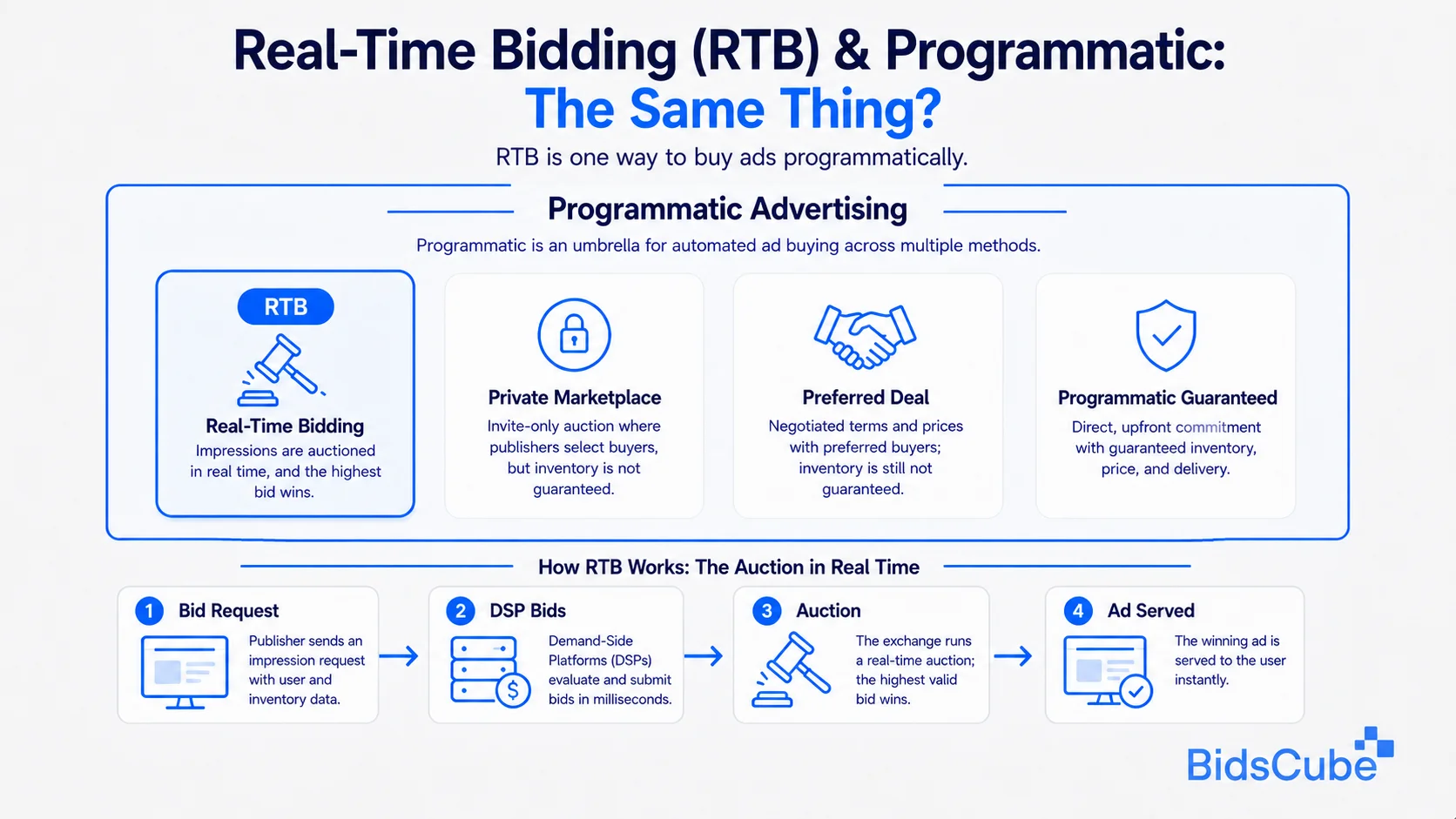
Programmatic advertising covers several software-based buying methods. RTB is one auction method inside that wider category. Programmatic direct can automate agreed delivery without holding an impression auction.For auction pricing rules, see first-price and second-price auctions.
| Parameter | Programmatic Advertising | RTB |
|---|---|---|
| Scope | Broad category for automated media buying and selling | Auction method used within programmatic buying |
| Auction model | May use auctions, preferred deals, or guaranteed delivery | Runs an auction for each eligible impression |
| Inventory access | Open exchange, private marketplace, preferred deal, and guaranteed inventory | Open or invite-only auction inventory |
| Guarantees | Can include guaranteed volume and fixed terms | Usually does not guarantee volume |
| Typical use case | Managing automated media across several deal types | Buying individual impressions based on campaign rules |
To Sum Up
Programmatic and real-time bidding (RTB) are often confused. These concepts have a lot in common, but in fact, they are different. The first one is a system uniting many methods of placing ads. RTB is just one of them.
All mentioned tools help automate the purchase of promotional spaces. There is no possibility of human mistakes. Another advantage is less of a routine associated with tracking sites and an opportunity to improve performance by analyzing reports.
Our tech staff and AdOps are formed by the best AdTech and MarTech industry specialists with 10+ years of proven track record!

FAQs
What Does RTB Stand for in Advertising?
RTB stands for real-time bidding. It is an automated auction where eligible buyers bid on an advertising impression while a page or app loads.
What Is the Difference Between Programmatic Advertising and RTB?
Programmatic advertising is the wider use of software to buy and sell digital media. RTB is one auction-based method within programmatic advertising.
Is RTB the Same as Programmatic Buying?
No. RTB is part of programmatic buying, while programmatic buying also includes preferred deals and programmatic guaranteed transactions.
What Is RTB Advertising in Simple Terms?
RTB advertising lets advertisers compete for one eligible impression at a time. The platform checks campaign rules, receives bids, selects a winner, and serves the ad within milliseconds.
How Does a DSP Use RTB?
A DSP receives an impression request, checks it against campaign rules, and calculates a bid. The DSP submits the bid before the auction deadline and records the outcome for reporting.
What Is the Role of an SSP in RTB?
An SSP represents publisher inventory and sends eligible impression opportunities to buyers. It also applies selling rules, price floors, demand access, and reporting controls.


