

In today’s business environment, what does the term “white-label” refer to? White label meaning, in short: one company makes a product or service, and another company sells it under its own brand. The buyer sees one name. The maker stays invisible.
Table of Contents
- Understanding White Labeling
- Key Advantages of White Labeling for Businesses
- Challenges of White Labeling
- Common Applications of White Label Solutions
- White Label vs. Private Label: Key Differences
- How to Choose the Right White Label Partner
- Benefits of White Labeling for Specific Business Types
- Is White Labeling Right for Your Business?
- FAQ
- Conclusion: Using White Label Solutions to Grow
You probably purchased/used a white labeled product last week and had no idea! Store-brand cereal, the “in house” software that your company provided for you, possibly even your cell phone plan. This guide covers the white labeling meaning, where it’s used, what it’s good and bad at, and how to tell whether it fits your business. We also cover how it differs from private label and co-branding, and what white label looks like in ad tech.
Understanding White Labeling
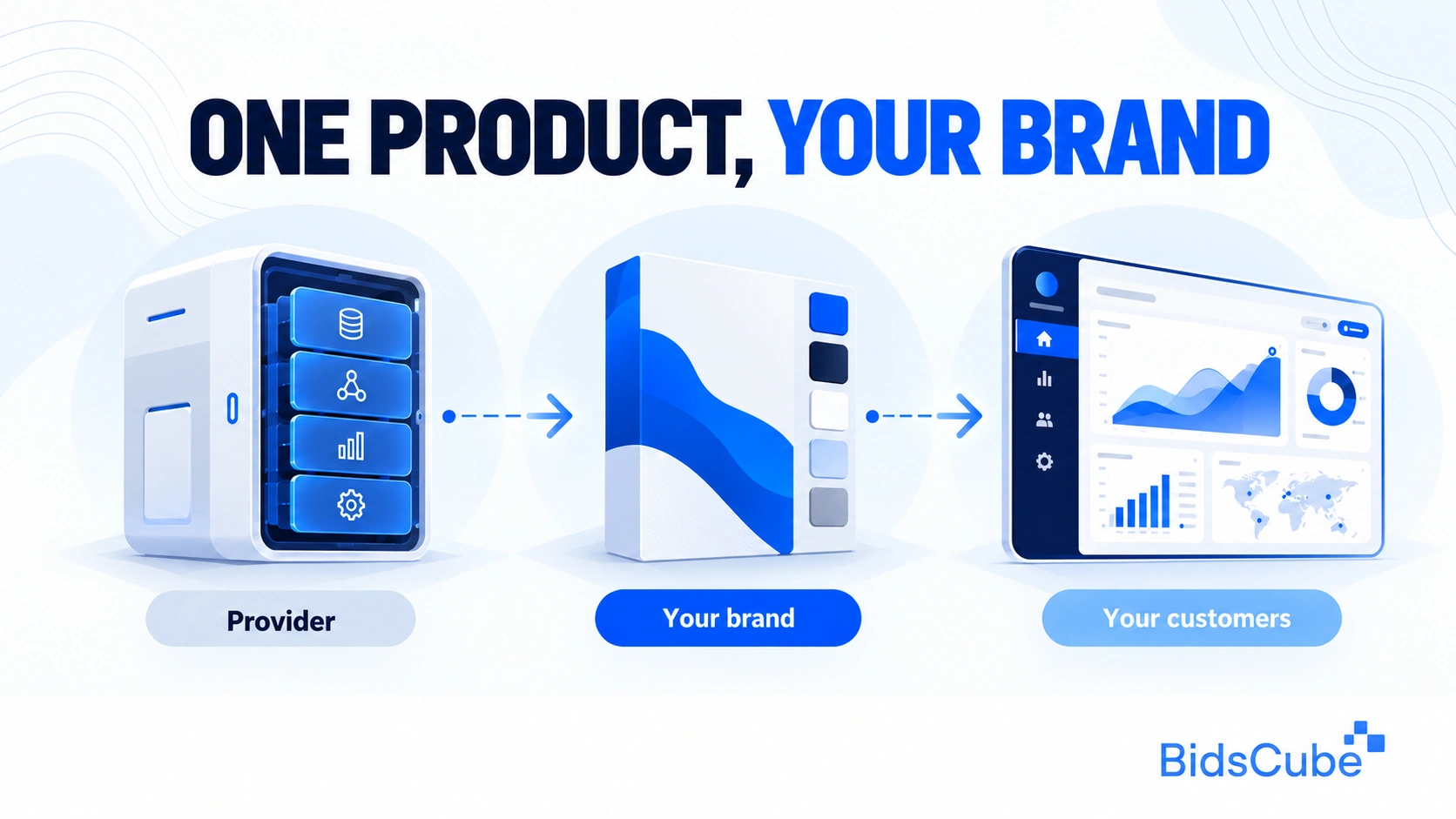
In plain terms, the white label meaning covers any deal where one company creates a product or service and another sells it under its own brand. It’s a fast way into a market, because you skip most of the building, testing, and fixing that a new product normally needs.
What Does a White Label Mean?
Here’s a working white label definition: a ready-made product or service, built by a provider, that resellers put their own name, logo, and design on before selling it. For example, think about a website template. It is essentially the same underlying structure, however, you can use your color scheme, your logo, and your content (copy) to create your unique online presence.
What sets this apart from a generic product? A generic product has its maker’s own simple label on the package and sits on the shelf. A white label product is developed so that it can be labeled with the buyer’s brand and the same basic product is typically used by multiple sellers simultaneously. Therefore, if you are wondering “What is a white label product?”, the briefest response would be: a product that was created to be marketed with another company’s label.
White Label Program and White Label Website: What They Mean
Two related terms come up a lot. In a “white label” program, a company provides a completed software application and its partners market and sell the application as if it were developed by them. The provider handles development and updates. The partner company is responsible for selling the software, setting prices for the software, and building relationships with customers. Many software firms run these programs to reach markets they couldn’t cover alone.
A white label website (or white label platform) is an already-built site or software platform which can be used by a business to create their own branded version of it. Agencies use them for client dashboards. Fintech startups use them for banking apps. Ad tech companies use them for DSPs and exchanges. When you are looking at different options, our guide on how to choose a white label reseller program will help you identify what you should be evaluating.
How White Labeling Works in Different Industries
White label products can be found across many industries, including software and retail. For example, some online retailers offer white label apparel and accessories produced by a single supplier. Similarly, some technology-based marketing companies use white label SaaS platforms and market them as their own products. In both cases, the product was created by another company and then branded and sold under the name of the purchasing company.
Key Advantages of White Labeling for Businesses
Five benefits make white labeling attractive:
I. Faster Market Delivery
Speed is the big one. Since you are not researching, building, and testing everything from scratch, you will be able to launch within weeks rather than years. Timing can determine which company gets the contract and which company gets there a quarter too late.
II. Cost Savings and Efficiency
The product development phase is an expensive time in the process of creating a product. The use of white-labeling can transfer most of this cost to the provider. This provides additional funding for the marketing, sales, and customer service departments. By transferring some of the costs to the provider, small businesses can effectively compete with larger organizations.
III. Focus on What You Do Best
Leave the building of products to professionals that are involved with this task daily. The rest of your team can use their time to focus on customer acquisition, branding, and sales; these areas are generally where most of the worth lies.
IV. Access to Expertise
A specialized provider offers years of expertise. Hiring and training an entire product team takes time and money. You can simply use their knowledge. This will reduce your risk of making rookie mistakes, which can cost a lot.
V. Scalability
Need to serve twice as many clients next quarter? With a white label product, growing is mostly the provider’s problem. That’s handy when demand jumps without warning.
Challenges of White Labeling
The model isn’t perfect. Here are the trade-offs to plan for:
- Quality control. Your products will only be as good as those of the company providing your products. Establish quality control standards for yourself, and then review them regularly.
- Dependence on one supplier. When there are problems with your supplier, your customer base also suffers. Therefore, always have an alternative available.
- Limited customization. Most products will allow you to make only superficial changes to your product. Therefore, you may have trouble distinguishing yourself from other businesses. It would be best to choose a supplier who provides flexibility when making changes to the settings of your products.
- Little say in product plans. The provider makes decisions about the changes to the product. Before major updates occur, agree with the provider on how they will consult with you.
- Customer perception. Some buyers see rebranded products as less genuine. Having an excellent brand image and providing high-quality service will assist in making buyers feel better about their purchase.
- Provider stability. If your provider goes out of business or stops offering the service, you will be at risk. It is recommended to check on the financial status of your provider and its overall reputation.
- Integration problems. White label products may not always integrate seamlessly with your systems. Test early, and read our notes on white label integration.
Common Applications of White Label Solutions
Here are a few white label examples, written as field, what gets rebranded, and who supplies it:
- Software and SaaS. The agency re-brands the CRM or SEO software/tool as its own client platform. The software vendor creates and supports the platform.
- Retail and consumer goods. The retail and consumer goods industry includes businesses that sell items such as food, clothing and cosmetics. Grocery chains and e-commerce websites can produce their own private label products. Contract manufacturers create products for numerous companies.
- Financial services. When a bank or fintech develops a payments application or checkout process with their own name on it. A payments provider or core banking provider operates the backend.
- Telecommunications. A business that provides either cellular or data plans to customers using its brand name, but does not own a network. An example of this would be a mobile virtual network operator (MVNO), which purchases access to the network from a carrier and then sells that access as if it was its own. This is generally referred to as white label connectivity.
- Advertising technology. An agency or ad network launches its own DSP or ad exchange under its brand. An ad tech provider such as BidsCube supplies and runs the platform.
These white label products examples share one pattern. The brand owns the customer. The provider owns the build.
Want your own branded ad platform without years of development? BidsCube’s white label solutions can go live under your name in days. Let’s talk about your launch.
White Label vs. Private Label: Key Differences
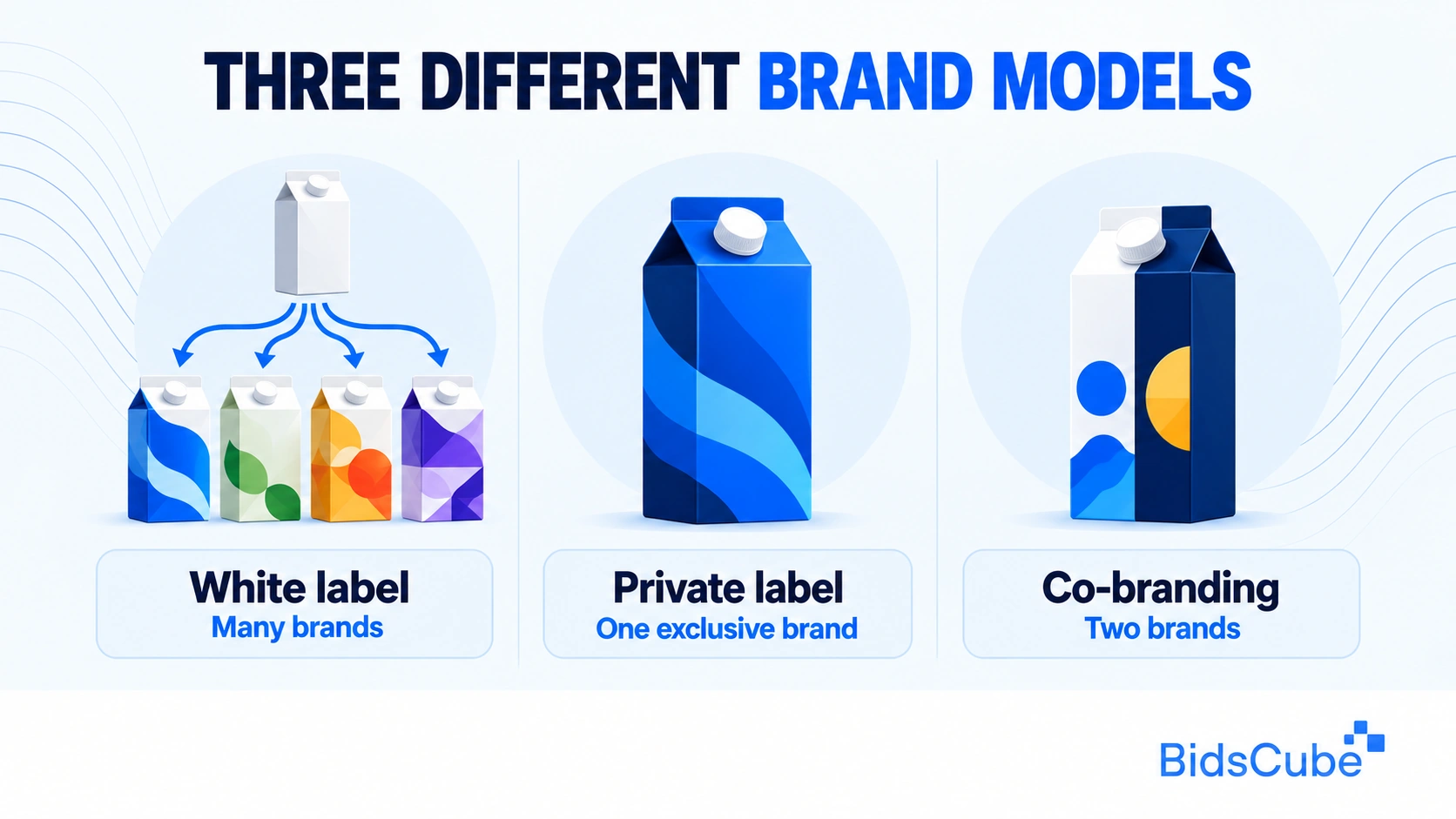
All three of these terms are often confused, as well as another term. Quick definitions first. White label is when a company sells a product that is sold under the company’s brand, and that same product can be sold to multiple companies. Private label is when a company manufactures a product solely for one retailer or company. Co-branding is when two companies place their logos on the same product, for example, a credit card that has both a bank’s and an airline’s logo.
| Aspect | White label | Co-branding | Private label |
| Ownership | Available to multiple companies | Shared between two partner brands | Made exclusively for one retailer or brand |
| Customization | Limited, mostly branding | Agreed by both partners | High, built to the brand’s spec |
| Branding | Only the seller’s brand is shown | Both brands are visible | Only the retailer’s brand is shown |
| Market exclusivity | Non-exclusive | Exclusive to the partnership | Exclusive |
| Development involvement | Minimal | Shared | Tailored product creation |
For a deeper comparison, read our article on white label vs private label.
How to Choose the Right White Label Partner
The selection of the proper business partner will determine if your use of “white labeling” is successful. Three areas deserve a close look.
Evaluating Vendor Reliability and Reputation
Your partner’s problems become your problems, with your logo on them. You should try to find a list of happy customers, certifications, and reliable reviews from reputable sites. Also ask for references and make sure you contact those people.
Assessing Product Quality and Scalability
The product needs to be compatible with your current needs, but also able to support your business as it expands. Find out how the company can handle the sudden increases in customer demand, and how they handled the situation when one of their clients increased in size by two fold.
Checking Support and Communication
When things break in the middle of the night, what does the vendor do? Try to use the vendor’s help desk while you’re evaluating their product. Observe how quickly they respond, and how helpful the responses are. Your vendor’s service reflects directly on your company’s image, so make sure you pick one that will reflect positively on you.
Benefits of White Labeling for Specific Business Types
Different businesses get different things out of white labeling:
Startups and Small Businesses
With white labeling, startups can enter markets that they could never afford to. Ready made products let small teams compete with larger ones without having to spend an entire year developing their own product.
Established Companies Looking to Expand Services
Bigger companies use white labeling to add services fast. Instead of building something new, they rebrand a proven product and offer more to the clients they already have.
Agencies and Resellers
Agencies benefit most from white label marketing because they are able to provide campaign management tools, analytical capabilities, or advertising delivery platforms with their company’s name on them. This creates a sense that the agency provides a complete package of services. For instance, a white label company in the area of advertising technology can provide an agency with its own branded Demand Side Platform (DSP).
Is White Labeling Right for Your Business?
White labeling can be a great move, but it isn’t for everyone.
Factors to Consider
Before you commit, weigh these points:
- Your budget and available financial resources.
- Current market demand for the product.
- How fast you need to launch.
- Whether building in-house would cost more than using an existing solution.
- How much control you need over features and future updates.
- The reliability and reputation of the provider.
- How far the product can be customized to fit your white label brand.
When you need to make decisions about developing products or services, if you prioritize speed and expense above having total control over the process, then white labeling will typically be the best option. However, if the development of your product/service is considered one of your greatest advantages, then you should consider building the product/service yourself.
FAQ
What does white label mean in business?
The white label meaning in business is simple: one company makes a product or service, and another sells it under its own brand. Customers will only recognize the seller’s name.
What is a white label product?
If you wonder what is a white label product, it’s a ready-made item built to be rebranded and sold by other companies. Some common types of white-label products include store-brand grocery items, rebranded computer software, and advertising platforms that have been given a brand identity.
What is the difference between white label and private label?
A white label product can be sold by many brands, with limited changes. A private label product is made exclusively for one retailer or brand, often to its own spec. Our white label vs private label guide covers the details.
What is a white label program?
The provider creates and updates the finished product while the partner sells and provides support for the customers. The provider builds and updates. The partner sells and supports customers.
What is white label connectivity?
It’s when a company sells internet or mobile services under its own brand while using another provider’s network. Mobile virtual network operators are a well-known example.
Is white labeling a good business model for startups?
This is generally true, as this reduces development time and costs. However, you will have less control of your product and depend on the company that provides the service; therefore, you should select an established, dependable partner.
Conclusion: Using White Label Solutions to Grow
Back to the white label definition for a moment: someone else builds, you brand and sell. This basic concept makes it possible for companies to get their products or services out to market faster, save money, and concentrate on meeting customer needs. However, finding the right company to work with as a partner is key.
In advertising, the same model powers branded ad platforms. If you’re new to the space, start with our guide to programmatic advertising. BidsCube offers a white label DSP that you can run under your own brand:
- Fast launch. Your branded platform can go live in about two days.
- Dedicated infrastructure. Your platform runs on its own servers.
- 24/7 support. A team is on hand when you need help.
BidsCube offers over 55 campaign settings and a community of 250+ active partners. It’s built for advertisers, publishers, and RTB partners who want a flexible platform without in-house development costs. Our guide to white label adtech solutions goes further.
Ready to talk? Visit BidsCube and get in touch.
Our tech staff and AdOps are formed by the best AdTech and MarTech industry specialists with 10+ years of proven track record!