



- OTT describes how video content reaches a viewer through the internet.
- CTV describes the internet-connected television device used to watch video.
- OTT can appear on televisions, phones, tablets, laptops, and other devices.
- CTV viewing usually happens on a large screen inside a household.
- Which can be purchased through programmatic systems such as open auctions or PMP deals.
- Buying for CTV inventory [The large screen, TV-like viewing] tends to be more competitive for buyers.
- By using both, you can reach viewers across multiple screens without over treating CTV and OTT as one in the same.
Table of Contents
- What Is OTT?
- What Is CTV?
- The Main Difference: Device vs Delivery Method
- CTV vs OTT: Comparison Table
- Programmatic Buying for CTV and OTT
- When to Use CTV vs OTT
- CTV and OTT Buying Risks
- How BidsCube Can Help
- Final Thoughts
-
FAQs
- Is CTV the Same as OTT?
- What Is the Main Difference Between CTV and OTT Advertising?
- Which Delivers Better Reach: CTV or OTT?
- Why Do CTV Ads Typically Have Higher Completion Rates Than OTT Ads?
- Should Advertisers Choose CTV, OTT, or Both?
- Is Programmatic CTV and OTT Inventory Bought Via Open Exchange or PMP?
CTV & OTT are commonly used interchangeably. They do not.
According to the findings from the Pew Research Center, 83% of US adults use streaming services, while only 36%of US adults subscribe to cable or satellite TV at home. Line another 55% stream even if not having a cable or satellite subscription. With cord-cutting, linear TV use lessens, and the balance of more viewers move towards streaming.
That shift makes the CTV vs OTT advertising distinction worth getting right. OTT refers to internet video delivery. CTV refers to the connected television screen or device receiving it.
A common shortcut says all CTV viewing is OTT, but not all OTT viewing happens on CTV. A more straightforward comparison is CTV vs OTT: one describes the delivery (i.e. over-the-top), the other deals with device.
That is CTV vs OTT advertising explained without treating the two terms as interchangeable.
What Is OTT?
Additionally, OTT, short for over-the-top refers to the video content delivered over the internet instead of through a traditional cable or satellite connection.
Many of OTT service like Netflix, Hulu, Disney+, Amazon Prime Video and others. An OTT service can be used by a viewer on television, phone, tablet or laptop.
OTT is therefore not a screen type.
A person who is watching a streaming show on a device like a phone is occupying OTT. It is still OTT if the same person watched the same service through a smart TV but because it is now for CTV, the viewing device has changed.
See the BidsCube OTT glossary and OTT Platform glossary for related definitions.
What Is CTV?
CTV or connected TV is a television screen that connects to the internet either directly or indirectly through an ancillary device.
CTV can include:
- Smart TVs
- Streaming boxes
- Streaming sticks
- Internet-connected gaming consoles
- Other devices used to stream video on a television
IAB material defines CTV as a television connected to the internet either natively or through a device, including smart TVs, gaming consoles, and streaming devices.
The important point is physical viewing. CTV usually means a TV-sized screen rather than a phone or laptop.
For a BidsCube definition, see the Connected TV glossary and Advanced TV glossary.
The Main Difference: Device vs Delivery Method
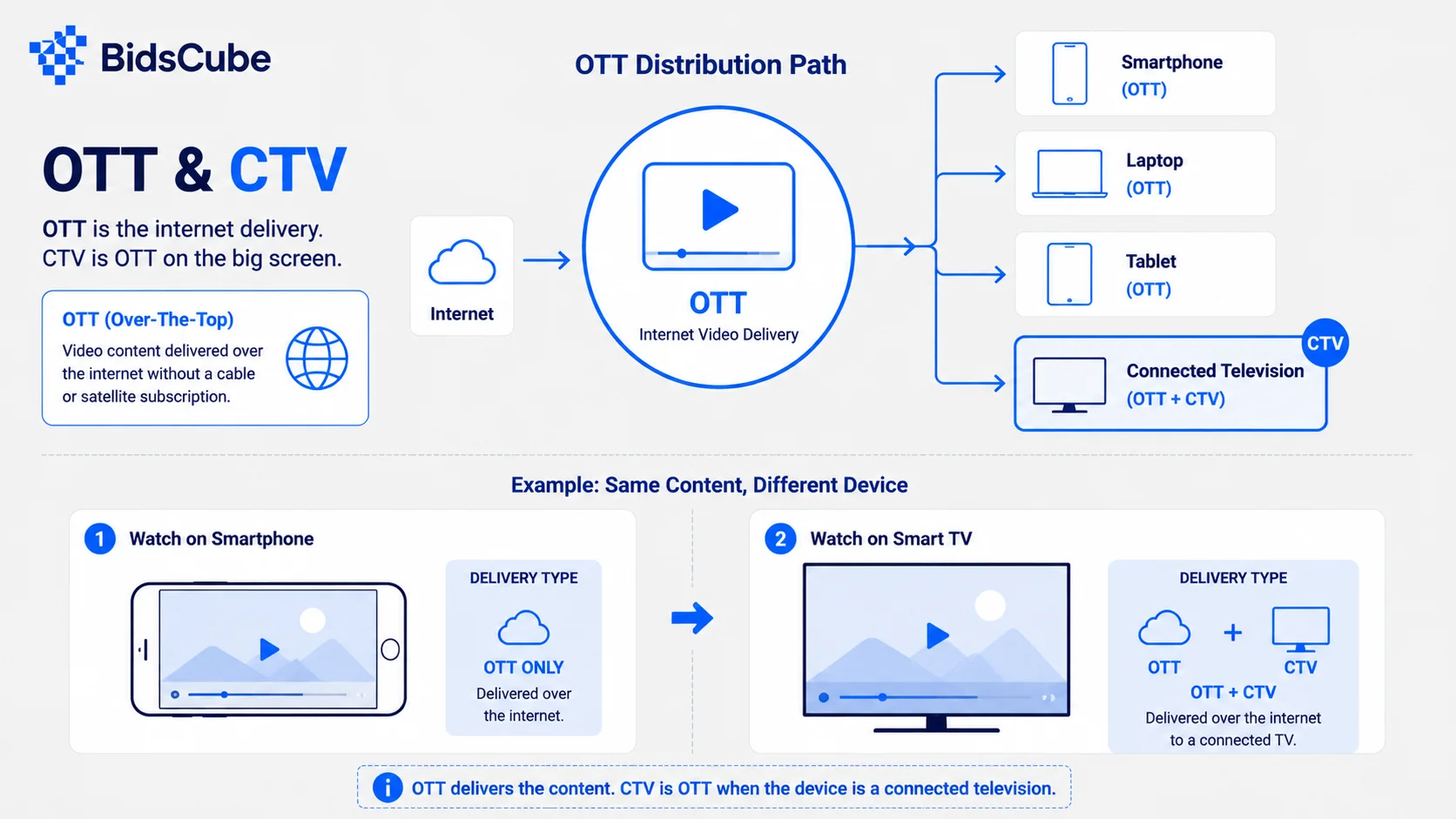
The easiest way to understand OTT vs CTV is to use one streaming service on two screens.
A person watches Disney+ on a smartphone. That is OTT viewing, but it is not CTV viewing.
Later, the same person opens Disney+ on a smart television. The content still arrives through OTT delivery, while the device now falls into the CTV category.
These simple CTV vs OTT examples show why advertisers should not use the terms as synonyms.
A practical CTV vs OTT comparison asks two separate questions:
- How did the video reach the viewer?
- Which device displayed it?
The first question points to OTT. The second determines whether CTV is involved.
CTV vs OTT: Comparison Table
The second CTV vs OTT comparison becomes clearer when device, targeting, creative, and buying conditions sit side by side.
| Parameter | CTV | OTT |
| What it describes | Connected television device | Internet delivery method |
| Screen | Television | TV, phone, tablet, laptop, or other supported device |
| Typical targeting level | Often household or device based | Can vary by device, account, household, or service |
| Common ad format | Video, including ad breaks and newer CTV formats | Video plus formats available on the specific service and device |
| Viewing setting | Usually large-screen, TV-like viewing | Can happen at home or on mobile devices |
| Typical CPM | Often higher for sought-after large-screen inventory | Wider range based on device, publisher, format, and deal |
| Buying route | Open programmatic, PMP, direct, and other CTV deals | Depends on platform, device, and available inventory |
The table also helps with an ott vs ctv reach comparison. OTT can cover more device types, while CTV narrows delivery to connected television environments.
Programmatic Buying for CTV and OTT
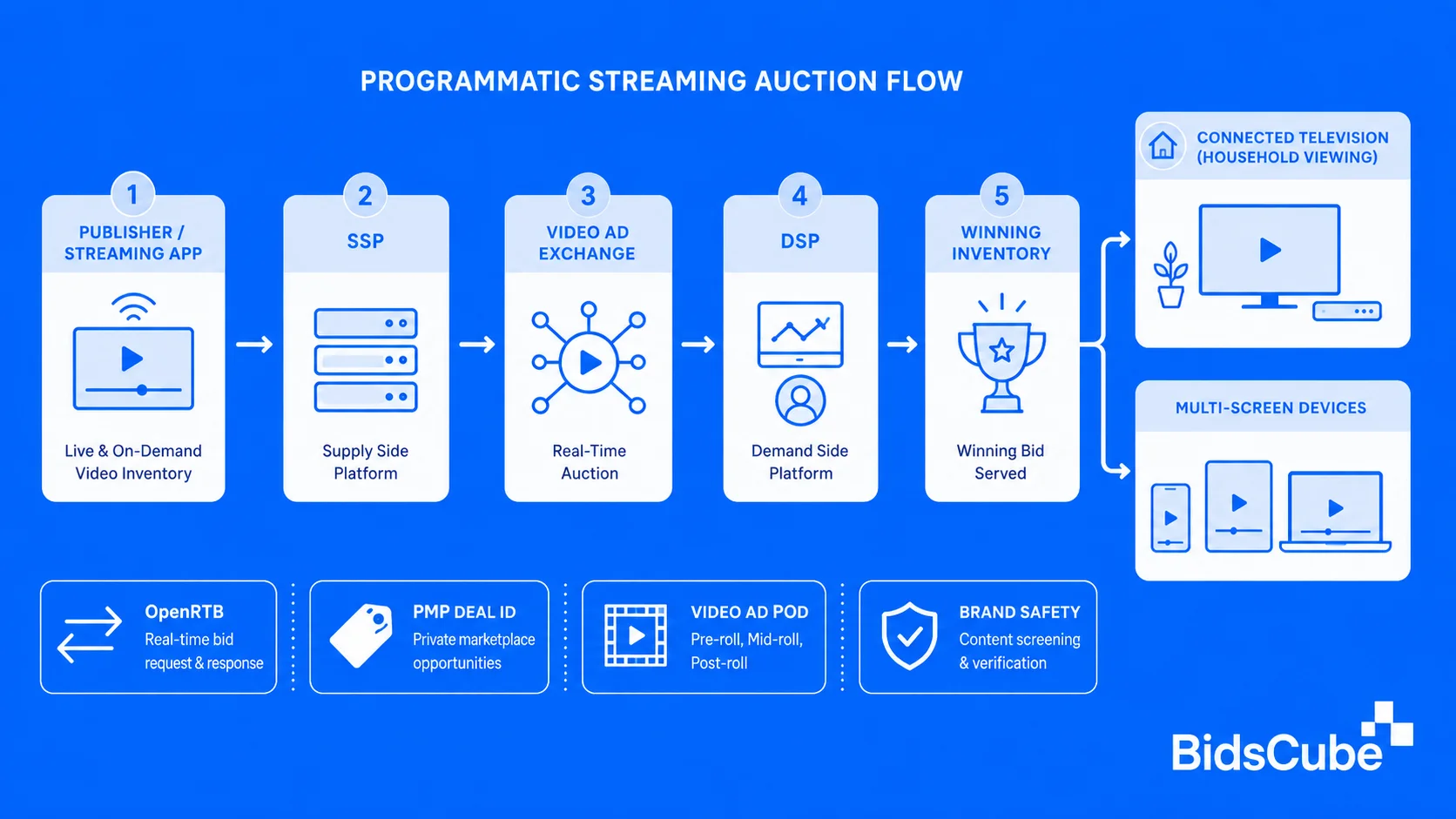
Both types of inventory can move through programmatic buying systems.
IAB Tech Lab lists OpenRTB 2.6 among the standards used for CTV trading. Its current programmatic CTV guidance also covers ad pods, playback information, device details, content data, fraud controls, and other signals used in streaming auctions.
A common path looks like this:
- A streaming publisher makes an ad opportunity available.
- An SSP or exchange passes information about the impression.
- A DSP checks campaign rules.
- Eligible buyers submit bids.
- The winning creative enters the video stream or ad break.
Read the BidsCube OpenRTB glossary for the protocol behind many of these transactions.
Premium television inventory may also be offered through a private marketplace. A Deal ID can restrict access to selected buyers or inventory packages.
See the BidsCube Private Marketplace glossary for those deal mechanics.
For ott vs ctv advertising, the buying route depends on the publisher and screen. Some OTT supply is available through open auctions. Other streaming inventory sits behind direct deals or closed platforms. A video ad exchange can sell open inventory, while a walled garden may keep supply inside a closed platform.
Check the Viewing Environment
Buying video inventory is only the first step. Confirm whether the impression runs on a television, mobile device, desktop screen, or another playback environment before comparing results.
When to Use CTV vs OTT
CTV fits campaigns where the large television screen matters.
It works for household targeting, longer long-form viewing and high video completion or TV-like creative opportunities that advertisers have been seeking. Completion rates depend on publisher, ad format and if the viewer is able to skip it so one should not assume or expect a 100% completion rate.
OTT has a wider device range. It can reach someone streaming during a commute, watching on a laptop, or using a connected television at home.
An ott vs ctv reach comparison should therefore start with the audience rather than the channel label.
Choose CTV when:
- Large-screen viewing matters
- Household targeting fits the campaign
- The creative was made for a TV-like environment
- Selected premium publishers or PMP deals justify the media cost
Use broader OTT buying when:
- Reach across several device types matters
- Mobile and desktop streaming are part of the plan
- The audience moves between screens
- The campaign needs a wider set of streaming placements
The second set of CTV vs OTT examples comes from everyday viewing: a family streaming a film on a smart TV is CTV and OTT, while a commuter watching the same service on a phone is OTT without CTV.
CTV and OTT Buying Risks
Any ott vs ctv advantages and disadvantages review should include supply quality and measurement. Buyers also need brand safety controls.
Fragmentation is one issue. Inventory can sit across publishers, SSPs, DSPs, device makers, streaming services, and closed platforms.
Device spoofing is another. Fraudsters can misrepresent lower-quality traffic as CTV traffic to collect higher CPMs.
Measurement can also become difficult when the same household watches content on several devices. One identifier rarely follows every viewing environment cleanly.
Common concerns include:
- Device spoofing
- Invalid traffic
- Repeated ads inside the same pod
- Limited cross-device measurement
- Supply-path complexity
- Different reporting methods between publishers
BidsCube covers these issues in CTV Measurement: Tools, Standards, and Challenges.
Creative also needs attention. Read 5 Creative Tips for Successful CTV Advertising for format-specific considerations.
How BidsCube Can Help
BidsCube provides buying and selling technology for programmatic video inventory.
The BidsCube DSP lists Connected TV among its supported advertising formats and provides campaign settings for targeting, bidding, budgets, frequency, and reporting.
On the sell side, the BidsCube SSP supports VAST connections for video and CTV inventory, along with reporting and several publisher connection methods.
For an ott vs ctv advertising plan, buyers should confirm which connected supply is available, how the platform labels the device, which publishers expose Deal IDs, and what measurement fields return after delivery.
The same check applies to CTV vs OTT advertising. A campaign name saying “CTV” does not prove every impression reached a television. Device, app, publisher, and supply-path reporting need to support the classification.
Independent client feedback is available on the BidsCube Clutch profile.
Final Thoughts
The ott vs ctv distinction is small on paper but important when media is bought and measured. OTT tells advertisers how content arrives. CTV tells them what type of screen receives it.
A useful ott vs ctv advantages and disadvantages review should compare device reach, household access, media price, supply quality, measurement, and creative fit.
The second CTV vs OTT advertising explained rule is equally simple: do not buy a label. Check the inventory behind it.
Our tech staff and AdOps are formed by the best AdTech and MarTech industry specialists with 10+ years of proven track record!

FAQs
Is CTV the Same as OTT?
The answer is no latest OTT simply refers to the way in which video is delivered over the Internet and CTV refers to a device that has or can connect to your television via the Internet. OTT content can also come on mobile phones, tablets and computers.
What Is the Main Difference Between CTV and OTT Advertising?
Connected TV advertising (CTV) are those ads seen on connected television devices. Streaming ads are any ad format that reaches viewers through the internet using various device types, and OTT (over-the-top) advertising includes streaming ads.
Which Delivers Better Reach: CTV or OTT?
OTT (Over the Top) can cover a greater number of devices, as it encompasses television, mobile, tablet and desktop streaming. CTV concentrates on television screens.
Why Do CTV Ads Typically Have Higher Completion Rates Than OTT Ads?
Using TV-like ad breaks, with non-skippable placement for many CTV video ads. Complete rates naturally differ by publisher, creative length, ad format and rules of playback.
Should Advertisers Choose CTV, OTT, or Both?
Many campaigns can use both. CTV can take care of big screen in-house views, whilst more relevant OTT inventory expands to streaming audiences with ease across devices.
Is Programmatic CTV and OTT Inventory Bought Via Open Exchange or PMP?
Both routes can be used. Open auctions allow for more access while PMP deals can limit an approved buyer to certain streaming or CTV inventory.
This Article's Ad Tech terms


