



- A PMP is an invitation-only programmatic deal where selected buyers compete for chosen publisher inventory.
- Deal IDs identify the agreement and carry its rules into the buying platform.
- PMPs usually give buyers more supply detail and publishers more control over access and floor prices.
- Open exchange inventory is available to a much wider buyer pool.
- Preferred Deals use a fixed price without guaranteed volume.
- Programmatic Guaranteed fixes both price and reserved volume.
- PMP campaigns often cost more than open exchange media because the inventory is more selective.
Table of Contents
- What Is a Private Marketplace (PMP)?
- What Is a Deal ID and Why Does It Matter?
- How a PMP Auction Works: Step-by-Step
- PMP vs Open Exchange: Comparison Table
- PMP vs Preferred Deals vs Programmatic Guaranteed
- Why Buyers and Publishers Use PMPs
- Limits of PMP Buying
- When to Use a PMP
- How BidsCube Can Help
- Final Thoughts
-
FAQs
- What Is a Private Marketplace in Programmatic Advertising?
- How Does a PMP Auction Work?
- What Is a Deal ID and Why Is It Important in a PMP?
- What Is the Difference Between a PMP and the Open Exchange?
- What Is the Difference Between a PMP and Programmatic Guaranteed?
- Is a Private Marketplace More Expensive Than the Open Exchange?
Publishers do not always want every buyer competing for every impression. Advertisers do not always want to bid across unknown supply.
That is the gap private marketplace advertising is meant to cover. A publisher selects inventory, sets commercial rules, and invites chosen buyers. The transaction still runs through programmatic pipes, but access is restricted.
A 2026 statistics roundup from Amra & Elma, citing Advertiser Perceptions, reports that PMP and programmatic direct deals account for 93.8% of US programmatic display spend. The same roundup lists an average PMP CPM of $14.70 versus $3.20 for open exchange inventory. These figures come from the secondary roundup, so they should be checked against any primary report available during final editorial review. Source: Amra & Elma
For a wider introduction to automated buying, see Programmatic Advertising 101.
What Is a Private Marketplace (PMP)?
What is a private marketplace? It is a restricted programmatic trading environment where a publisher allows selected buyers to bid on specified inventory.
The basic private marketplace model still uses automated buying. The difference is access. An open exchange can accept bids from any connected, eligible buyer. A PMP limits participation to buyers approved for the deal.
With PMP advertising, the publisher can package inventory by site, app, section, format, audience, or other deal terms. Buyers then activate the agreed Deal ID in a DSP.
For teams asking what is a PMP in advertising, think of a controlled auction between open RTB and a traditional direct order.
See the BidsCube Private Marketplace glossary for a shorter definition.
What Is a Deal ID and Why Does It Matter?
A Deal ID is the identifier attached to a programmatic agreement between a buyer and seller. It tells participating systems which deal rules apply to an eligible impression.
Google Ad Manager describes Deal ID as a system-generated number used to identify a deal between a buyer and publisher. Google uses Deal IDs across Private Auctions, Preferred Deals, and Programmatic Guaranteed transactions.
In PMP digital advertising, the ID can connect a buyer to a specific inventory package, floor price, priority, or other negotiated conditions.
The Deal ID does not guarantee that every eligible impression will be bought. It makes the agreement recognizable inside the auction.
Read the BidsCube Deal ID glossary for more on this identifier.
How a PMP Auction Works: Step-by-Step
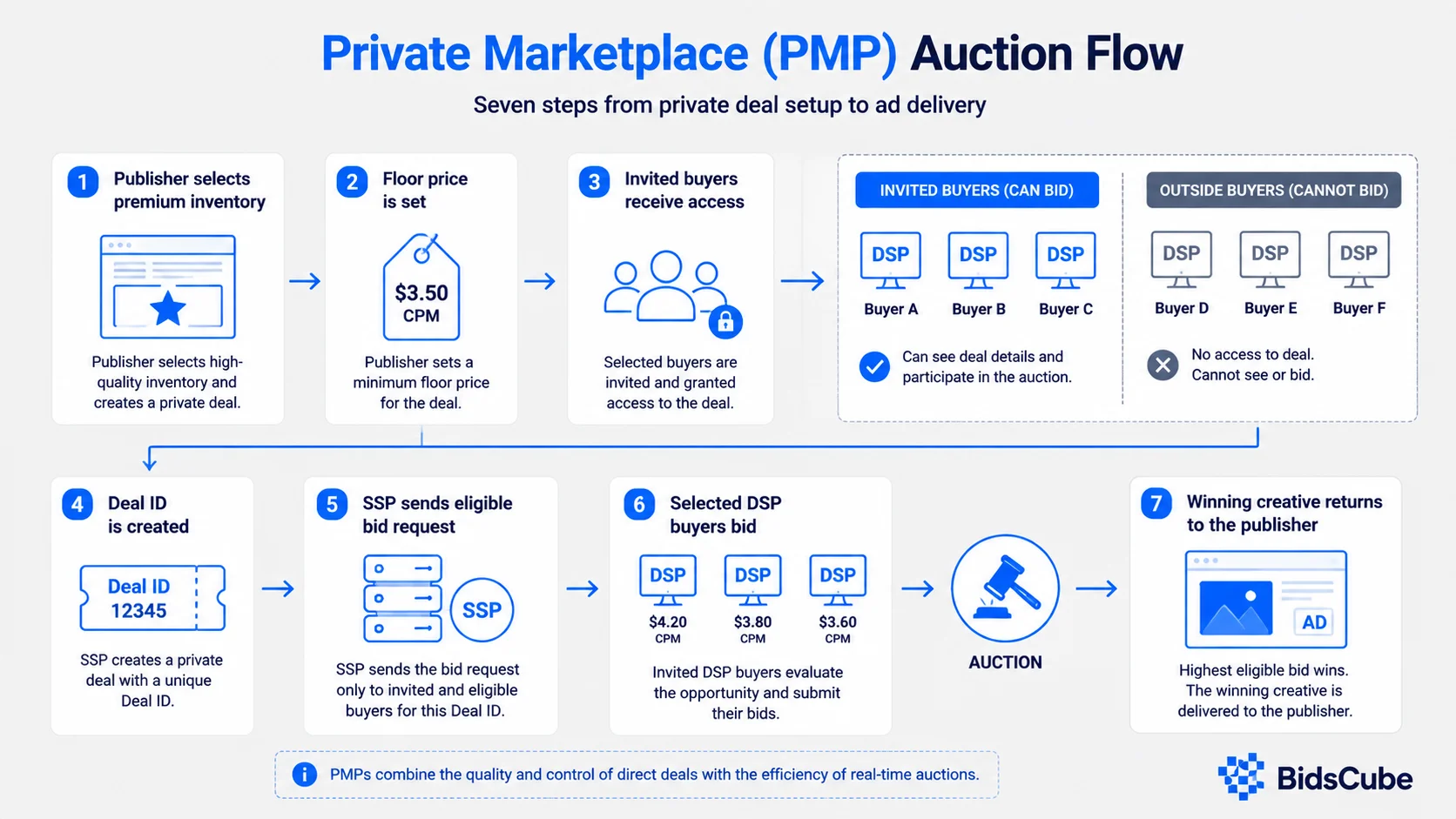
The question how does a PMP work becomes clearer when one impression is followed through the auction.
- The publisher selects inventory and sets a floor price, format, audience, geography, or other rules.
- The publisher invites one or more advertisers, agencies, or DSP seats.
- A Deal ID is created and added to the relevant DSP campaign.
- The SSP recognizes an impression that matches the deal.
- Invited buyers receive the bid request.
- Eligible bids return, and the auction checks price, creative, policy, and deal rules.
- If a valid bid wins, the creative returns to the publisher.
A PMP private marketplace transaction keeps auction-based pricing while narrowing who can take part.
Google classifies Private Auctions as auction-based transactions with selected buyers. Preferred Deals are also treated as a type of PMP, but they use a fixed negotiated price rather than an auction floor.
PMP vs Open Exchange: Comparison Table
The table shows where private marketplaces differ most from open exchange buying.
| Parameter | Private Marketplace (PMP) | Open Exchange |
| Access | Invited buyers through a deal | Broad pool of eligible connected buyers |
| Inventory | Selected publisher inventory | Wider mix of supply |
| Price | Publisher-defined floor or deal terms | Auction and seller floor rules |
| Supply detail | Publisher and deal are known before activation | Detail varies by supply path |
| Competition | Restricted buyer group | Broad buyer competition |
| Setup | Deal creation and buyer activation required | Faster access once platform connections exist |
| Typical use | Selected publishers, video, CTV, audience packages | Broad reach and testing |
The higher CPM often associated with private marketplace advertising is not automatically a problem. A buyer may accept a higher media price for known supply or publisher first-party audience packages.
Compare Private Deal Types
Read How PMP and Programmatic Guaranteed Deals Work before setting prices, inventory rules, and buyer access.
PMP vs Preferred Deals vs Programmatic Guaranteed
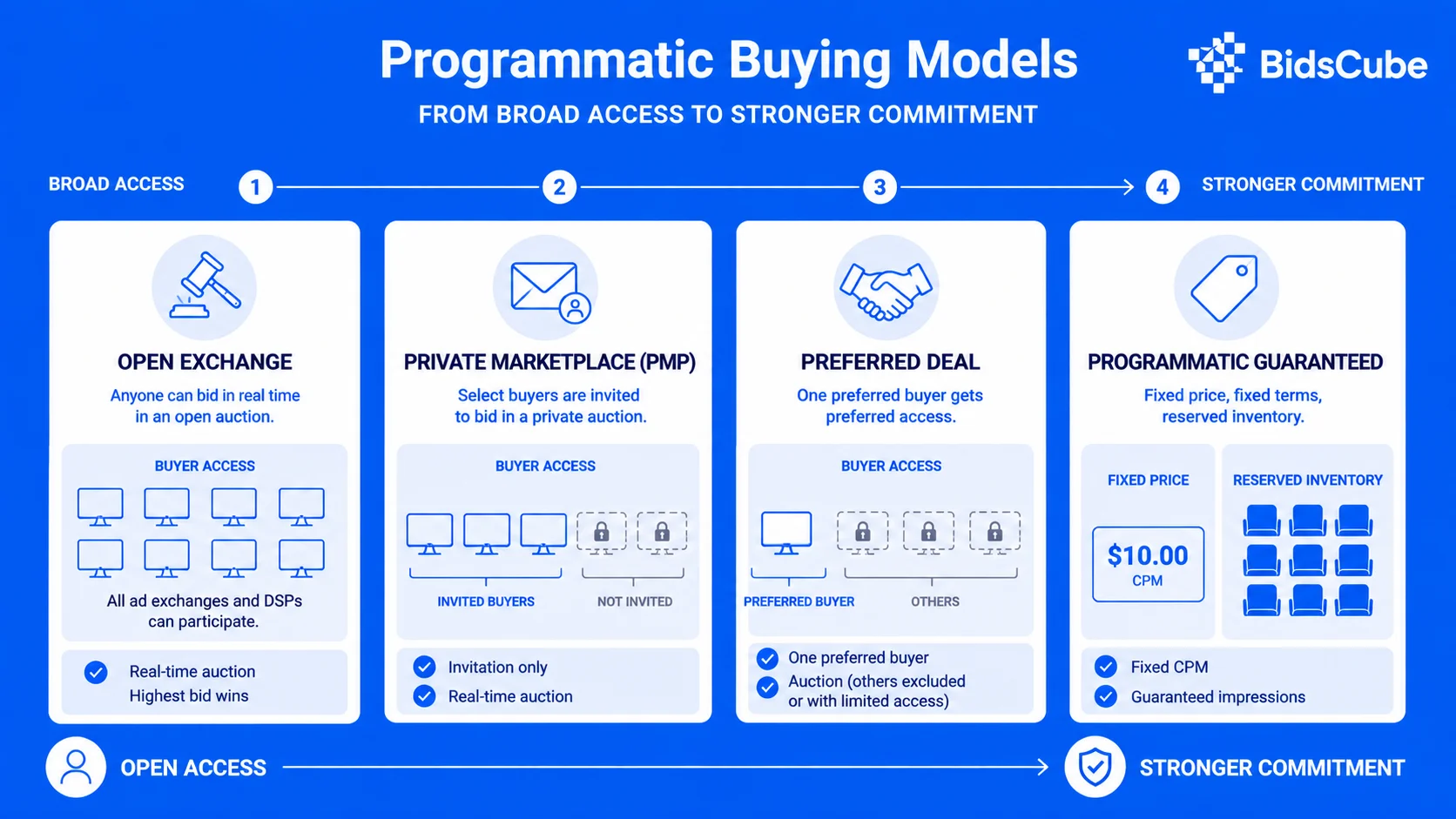
Deal names can sound similar, but the commitment changes.
Open exchange: Access is broad, and the auction decides the price.
PMP: Invited buyers compete for eligible impressions. The publisher can set a floor.
Preferred Deal: One buyer gets an early chance to buy at a negotiated fixed CPM, but neither side guarantees volume.
Programmatic Guaranteed: Buyer and publisher agree on a fixed price and reserved volume before delivery.
Google confirms that Preferred Deals are non-guaranteed, while Programmatic Guaranteed inventory is reserved for the agreed buyer.
BidsCube also has a Programmatic Guaranteed glossary entry.
Why Buyers and Publishers Use PMPs
For advertisers, PMP advertising can narrow supply to known publishers or inventory packages. This can help when placement quality matters more than buying the broadest possible pool. A real-time bidding (RTB) deal can package premium inventory with stronger brand safety controls.
Publishers use PMPs to decide which buyers can access selected inventory and under what price rules. Premium video, CTV, homepage placements, or audience packages often fit this model.
Common reasons include:
- Known publisher relationships
- Higher publisher floor prices
- First-party audience packages
- Smaller buyer groups
- More control over accepted creatives
- RTB buying instead of manual insertion orders
The second use of PMP digital advertising is often tied to publisher data. A seller can package an audience or content section without putting the same access into the open auction.
Limits of PMP Buying
PMP access comes with trade-offs.
Higher CPMs can make a deal unattractive for early testing. Deal setup also takes time because buyer and seller need to agree on inventory, price rules, formats, targeting, and the Deal ID setup.
Volume can be another issue. A PMP is normally non-guaranteed. The publisher may not produce enough matching impressions, or the buyer may not bid often enough.
Smaller publishers can face a tougher sales problem. A buyer may not set up a private deal unless the inventory, audience, or format is hard to replace elsewhere.
This is why private marketplaces work best when there is a clear reason for restricted access.
When to Use a PMP
Use a PMP when the campaign needs known publisher supply, selected placements, tighter creative rules, or access to inventory that is not offered broadly.
A PMP can also make sense when a publisher has a first-party audience package that a buyer specifically wants.
The phrase what are PMPs often appears beside questions about open exchange buying. The practical distinction is control. PMPs restrict access, while open exchanges are built for broader participation.
The second how does a PMP work test is commercial. Ask whether the inventory deserves the extra setup and higher floor. If not, open exchange buying may be enough.
How BidsCube Can Help
BidsCube supports private deal workflows on both sides of programmatic buying.
The BidsCube DSP lists PMP Deal among its campaign settings. Buyers can combine deal access with bid price, budget, geography, device, frequency, and other campaign rules.
On the sell side, the BidsCube SSP gives publishers control over inventory and price floors, plus real-time reporting. BidsCube also states that its SSP and ad exchange infrastructure supports deal creation, pricing, data integration, and Deal ID management for PMP and Programmatic Guaranteed transactions.
A PMP private marketplace setup still needs testing. Buyers should check bid rate, win rate, CPM, placement quality, and conversions. Publishers should watch fill, net revenue, buyer participation, and deal delivery.
See BidsCube for Publishers and read SSP vs DSP for the two sides of the transaction.
Independent client reviews are available on the BidsCube Clutch profile.
Our tech staff and AdOps are formed by the best AdTech and MarTech industry specialists with 10+ years of proven track record!

Final Thoughts
The second private marketplace question is not whether private deals are always better. They are not.
PMPs make sense when both sides have a reason to restrict access. Known supply, selected buyers, publisher data, stronger price rules, or premium formats can justify the extra setup.
If readers are still left wondering what is a PMP in advertising, the short answer is straightforward: programmatic buying put through the guest list.
FAQs
What Is a Private Marketplace in Programmatic Advertising?
A private marketplace (or PMP) is a programmatic deal in which select buyers are invited to bid on pre-determined publisher inventory under specified rules.
How Does a PMP Auction Work?
A publisher creates a deal, invites buyers, and assigns a Deal ID. Eligible impressions are then offered to the invited buyers under the deal rules.
What Is a Deal ID and Why Is It Important in a PMP?
A Deal ID relates to the deal in a transaction. It connects eligible bid requests with the price, inventory, buyer, and other terms attached to the deal.
What Is the Difference Between a PMP and the Open Exchange?
A PMP restricts participation to selected buyers. An open exchange enables more connected eligible buyers to be in competition.
What Is the Difference Between a PMP and Programmatic Guaranteed?
A PMP is generally non-guaranteed and can use auction pricing. Programmatic Guaranteed uses an agreed fixed price and reserved impression volume.
Is a Private Marketplace More Expensive Than the Open Exchange?
Often, yes. Selected inventory and higher publisher floors can raise CPM. The buyer should compare the extra media cost with supply quality and campaign results. For teams asking what are PMPs, that price difference is part of the decision, not proof that one buying method is always better.
This Article's Ad Tech terms


