



- Display advertising is an ad format. Programmatic advertising is a method for buying and selling media.
- You can buy a banner through an automated auction or from a manual publisher agreement.
- Programmatic display is designed to provide audience targeting, flexible budgets, quick testing, and real-time adjustments.
- This is where premium placements, sponsorships, and exclusive publisher partnerships excel: in the land of direct-sold display.
- Private marketplace deals marry elements of handpicked publisher inventory with automation in the buying process.
- Most programmatic buying happens with video, native, CTV, audio, and digital out-of-home inventory.
- BidsCube connects buyers and publishers through its DSP and SSP.
Table of Contents
- What Is Display Advertising?
- What Is Programmatic Advertising?
- The Programmatic Ads vs Display Ads Core Distinction: Format vs. Buying Method
- Programmatic Display vs. Direct-Sold Display
- Use Cases for Programmatic Display Ads
- Use Cases for Direct-Sold Display Ads
- How BidsCube Can Help
- Final Thoughts
-
FAQs
- What Is the Difference Between Programmatic Ads and Display Ads?
- Is All Display Advertising Programmatic?
- What Is the Difference Between Programmatic Display and Direct-Sold Display?
- When Should I Use Direct-Sold Display Instead of Programmatic?
- Can Display Ads Be Bought Without Programmatic Technology?
- What Formats Besides Display Can Be Bought Programmatically?
Programmatic media is often compared to display by uninformed marketers as if they were competing products. They are not. Display is what the audience sees, be it as a banner, responsive image or rich media unit. Programmatic is about how the advertiser buys the impression and how the publisher sells it. The discussion on display ads vs programmatic is an everlasting one and it comes with a point of confusion.
The confusion has a simple cause. Most display spending now passes through automated systems. When calculating how big programmatic would be in 2025, eMarketer predicted it would account for 96.8% of new global display ad dollars in 2025, up from 91.8% in 2023. That same projection predicted automated purchasing will account for 90% of global display budgets in 2026.
Not every display campaign is thus programmatic, simply because this shift has taken place. Nevertheless, an advertiser may always negotiate with a publisher, bid, and purchase an insertion order for a dedicated position. In both cases, the creative might be exactly the same. The path to purchase, targeting, pricing, and reporting are all different.
What Is Display Advertising?
Display advertising consists of visual units placed on websites, mobile apps and other properties. Some common examples would be static banner ads, responsive ads, animated units, and rich media creatives with interactive elements.
An online ad may notify a pricing, aid attention, or return a new visitor to site online. Visible above a post, besides content, in-app and between pages.
CPM (Cost Per Thousand) is a pricing model that is common for buying display inventory among advertisers.
Publishers can sell the same display slot in several ways:
- Through a direct agreement.
- Through an ad network.
- Through an open RTB auction.
- Through a private marketplace.
- Through a programmatic guaranteed deal.
This distinction matters when teams compare display ads vs programmatic. A display unit can sit inside a programmatic campaign, a direct campaign, or a hybrid deal. Read Native Advertising vs. Display Advertising to see how banners differ from units that follow the surrounding content layout.
What Is Programmatic Advertising?
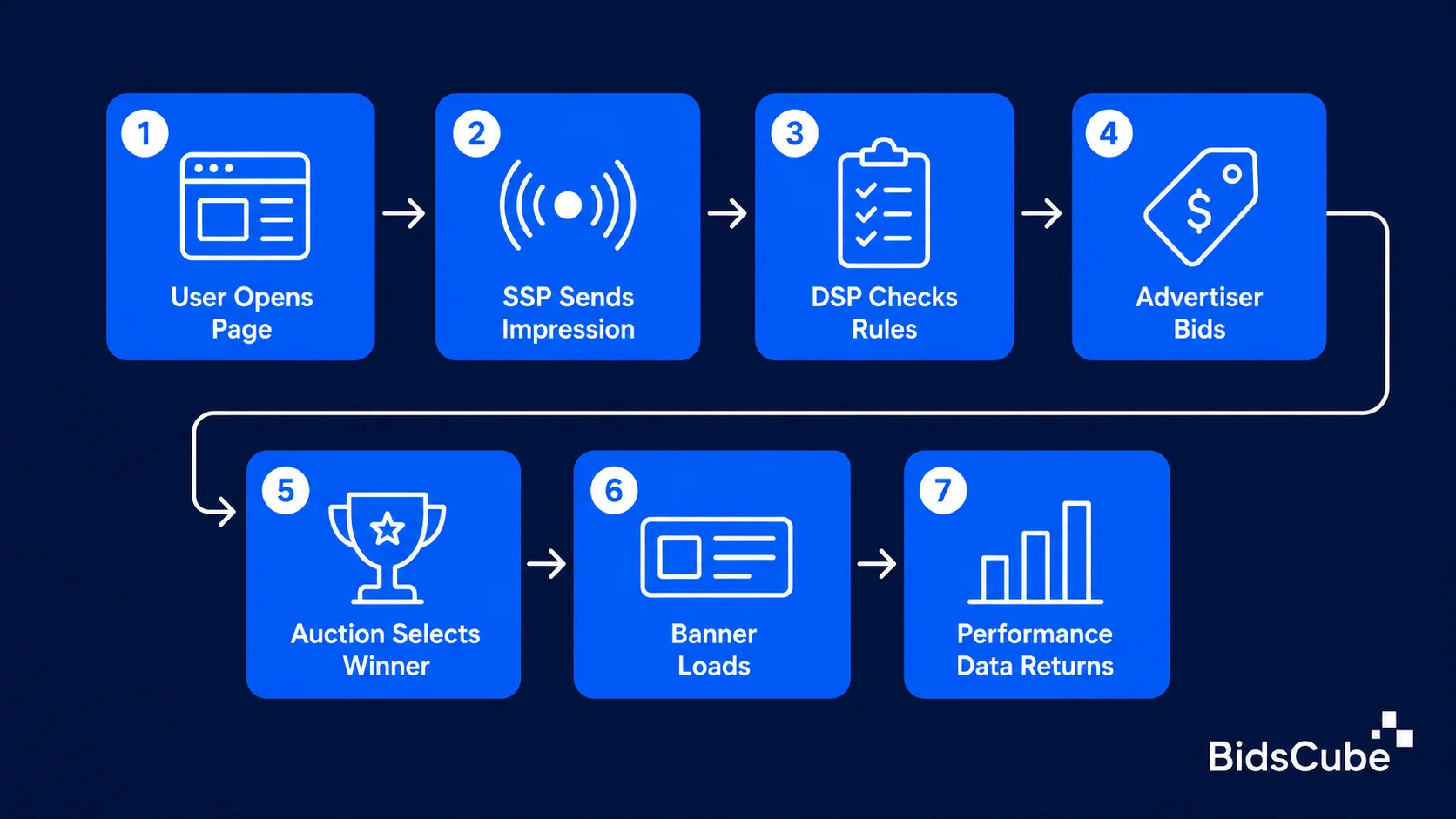
Programmatic advertising refers to the use of software to buy or sell media. An online advertisement is a DSP which we call a demand side platform which helps advertisers to asses to purchase impressions. A supply-side platform, or SSP, is used by publishers for managing and selling their inventory. An ad exchange can connect both sides and run auctions.
In an RTB transaction, a page or app sends an ad opportunity to the sell side. The DSP checks the impression against campaign rules, budget, audience criteria, frequency, and price limits. It can then return a bid within milliseconds.
The seller may apply floor prices, deal priority, quality rules, and creative checks. A high bid can still lose if it fails those requirements.
Programmatic systems can buy more than standard banners:
- Online video
- Native units
- Connected TV
- Digital audio
- Mobile app inventory
- Digital out-of-home screens
The IAB OpenRTB guidance defines RTB as a process that places individual impressions into real-time auctions. OpenRTB also gives buying and selling platforms a common protocol for automated media trading.
For a full transaction walkthrough, read How Does Programmatic Advertising Work?.
The Programmatic Ads vs Display Ads Core Distinction: Format vs. Buying Method
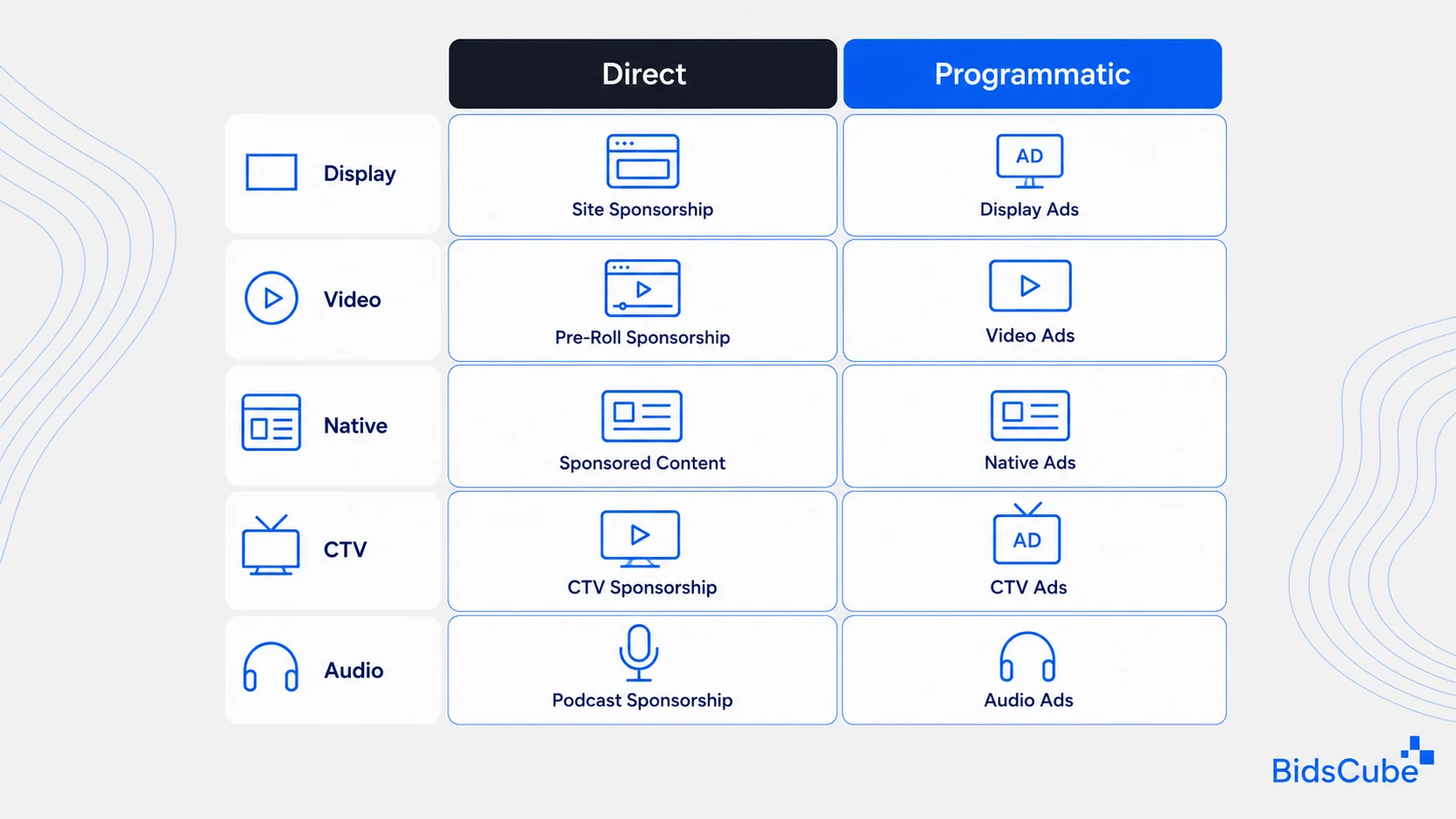
The easiest way to understand display vs programmatic ads is to place format and buying method on separate axes. One axis answers the question, “What kind of ad will the audience see?” The other answers, “How will the advertiser purchase it?”
| Ad Format | Direct Buying | Programmatic Buying |
| Display | A negotiated banner placement on a selected site | A banner bought through RTB, a PMP, or a programmatic direct deal |
| Video | A direct video sponsorship | Video inventory bought through a DSP |
| Native | A custom sponsored content agreement | Asset-based native inventory bought through automated systems |
| CTV | A direct streaming publisher agreement | CTV impressions bought through a DSP or deal |
| Audio | A fixed streaming package | Digital audio inventory bought through automated supply |
Display plus direct buying may involve a publisher sales team, a fixed price, and an insertion order. Display plus programmatic buying can use the same banner, but software evaluates each impression before bidding.
Video, native, CTV, and audio can also use automated buying. Programmatic is a transaction method, while display is a format.
The display vs programmatic ads question can therefore mislead media teams. The phrase programmatic vs display advertising can do the same. A better question is whether a display campaign should use open auctions, PMPs, programmatic guaranteed, direct sales, or a mix.
Programmatic Display vs. Direct-Sold Display
Both models can place visual ads on publisher properties. Their main differences appear behind the creative.
| Parameter | Programmatic Display | Direct-Sold Display |
| Targeting | Audience, device, geography, context, behavior, and time | Usually based on the publisher, section, or agreed audience |
| Speed to launch | Minutes or hours after setup | Often days or weeks for negotiation and approval |
| Transparency | Can include impression, domain, app, placement, and viewability data | Depends on the publisher and may use aggregated reports |
| Minimum spend | Often flexible | May require a minimum campaign commitment |
| Real-time optimization | Bids, budgets, audiences, and creative can change during delivery | Terms usually stay fixed for the campaign period |
| Pricing | Auction CPM, fixed deal price, or guaranteed rate | Negotiated CPM, flat fee, or sponsorship price |
| Scale | Many sites and apps through one platform | The contracted publisher or media group |
| Placement guarantee | Depends on the deal type | Often stronger for reserved positions |
Programmatic display offers speed and broad access, but advertisers still need supply rules, frequency limits, quality checks, and reliable measurement. Direct-sold display offers certainty and publisher cooperation, but it needs more manual work and offers fewer live adjustments.
A private marketplace (PMP) sits between the models. A publisher invites selected buyers into an automated auction. The advertiser gets controlled access, while both sides keep automated delivery and reporting.
Compare manual agreements, open auctions, PMPs, and automated deals in Direct vs. Programmatic Advertising.
Use Cases for Programmatic Display Ads
Programmatic display works best when advertisers need flexible decisions across many impressions.
Retargeting Previous Visitors
Retargeting reaches people who visited a website, viewed a product, started a form, or completed another tracked action. The DSP can apply recency windows, frequency caps, exclusions, and different messages.
A retailer might show a product reminder, while a software company might promote a case study after a service-page visit. Consent and signal availability still shape what is possible.
Prospecting Across Many Publishers
Programmatic buying lets advertisers reach potential customers across many sites and apps without signing a separate agreement with every publisher.
Buyers can combine context, location, device, time, and first-party segments. They can remove weak placements and move budget toward stronger sources.
This approach suits awareness and prospecting campaigns that need more reach than one publisher can provide. It also gives buyers one place to control spending across several inventory sources.
Dynamic Creative Optimization
Dynamic creative optimization can assemble different images, headlines, products, prices, or calls to action. The selected version can reflect available campaign signals. DCO fits product catalogs, travel offers, local services, and campaigns with several audience groups. It still needs clean feeds and sound templates.
A system should not create endless versions without a clear goal. Teams need to decide which elements can change, which metric defines success, and how long each test should run.
Private Marketplace Deals
PMPs help advertisers access selected publishers while keeping automated execution. They can support premium inventory, agreed floor prices, tighter seller lists, and clearer placement rules. A PMP does not guarantee quality by itself. Buyers still need to review viewability, delivery, pricing, and site suitability.
PMPs work well when open-auction scale feels too broad, but a manual direct deal would take too much time. They offer a middle route between control and automation.
Rapid Testing and Budget Changes
Teams can test audiences, bids, and creative versions without rebuilding the full campaign. Real-time reporting helps them find waste and move spending. For example, a buyer can reduce bids on placements with poor viewability. The buyer can also move budget toward devices, locations, or creative versions that produce stronger results.
This flexibility explains why display and programmatic advertising often work together. Automated buying turns a fixed media booking into a campaign that can respond during delivery.
Use Cases for Direct-Sold Display Ads
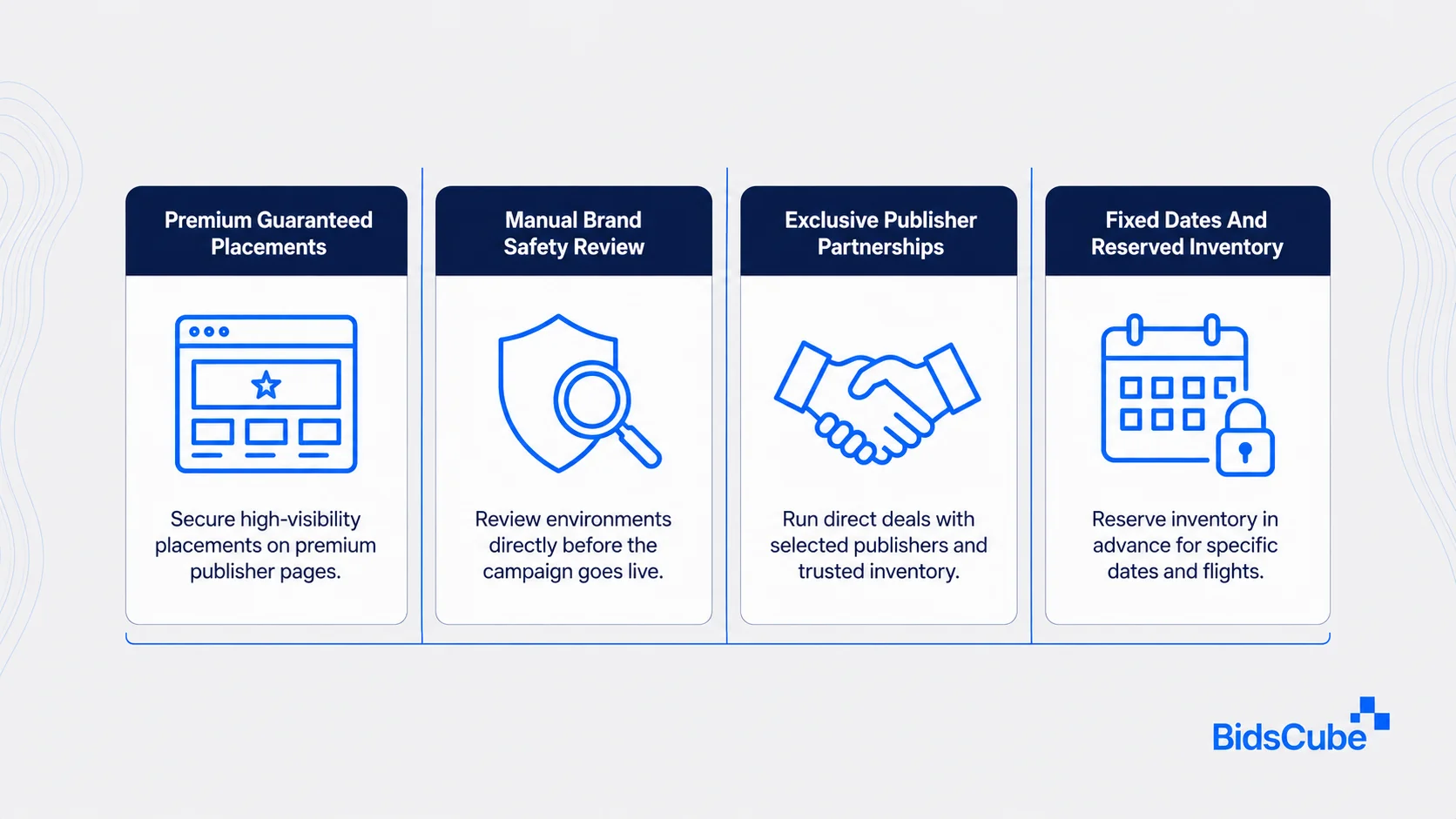
Direct buying remains useful when a campaign depends on a known publisher relationship or a guaranteed media position.
Premium Guaranteed Placements
Homepage takeovers, section sponsorships, roadblocks, high-impact launch packages, and more, many of which require you to coordinate directly. The ad buyer is not bid on an impression-by-impression basis but buys a known unit for a defined length of time. They can help with launches, major events, and even temporary awareness pushes.
A premium placement may also include custom sizes, fixed dates, and category exclusivity. These terms are difficult to secure through a standard open auction.
Manual Brand Safety Review
Some advertisers want to approve the exact site, section, page type, and surrounding content before launch. A direct agreement can make this review easier. The advertiser should still check disclosure, data handling, delivery, and reporting. A familiar publisher name does not replace clear terms.
Direct buying also gives advertisers a clear contact when a page, placement, or creative creates a problem. That can matter in regulated or brand-sensitive sectors.
Exclusive Publisher Partnerships
A brand may sponsor a research series, newsletter, event, or editorial project with one publisher. Display placements can form one part of a wider partnership. The value comes from audience access, context, promotion, and publisher support, not only from impressions.
A direct deal may also include social posts, email placements, branded content, or event exposure. Programmatic media can support the partnership, but it cannot replace every custom element.
Fixed Dates and Reserved Inventory
A company may need guaranteed delivery during a product release, conference, seasonal sale, or major announcement. A direct agreement can reserve inventory before competitors buy it. The cost may be higher, and the terms may be less flexible. In return, the buyer receives more certainty about timing and position.
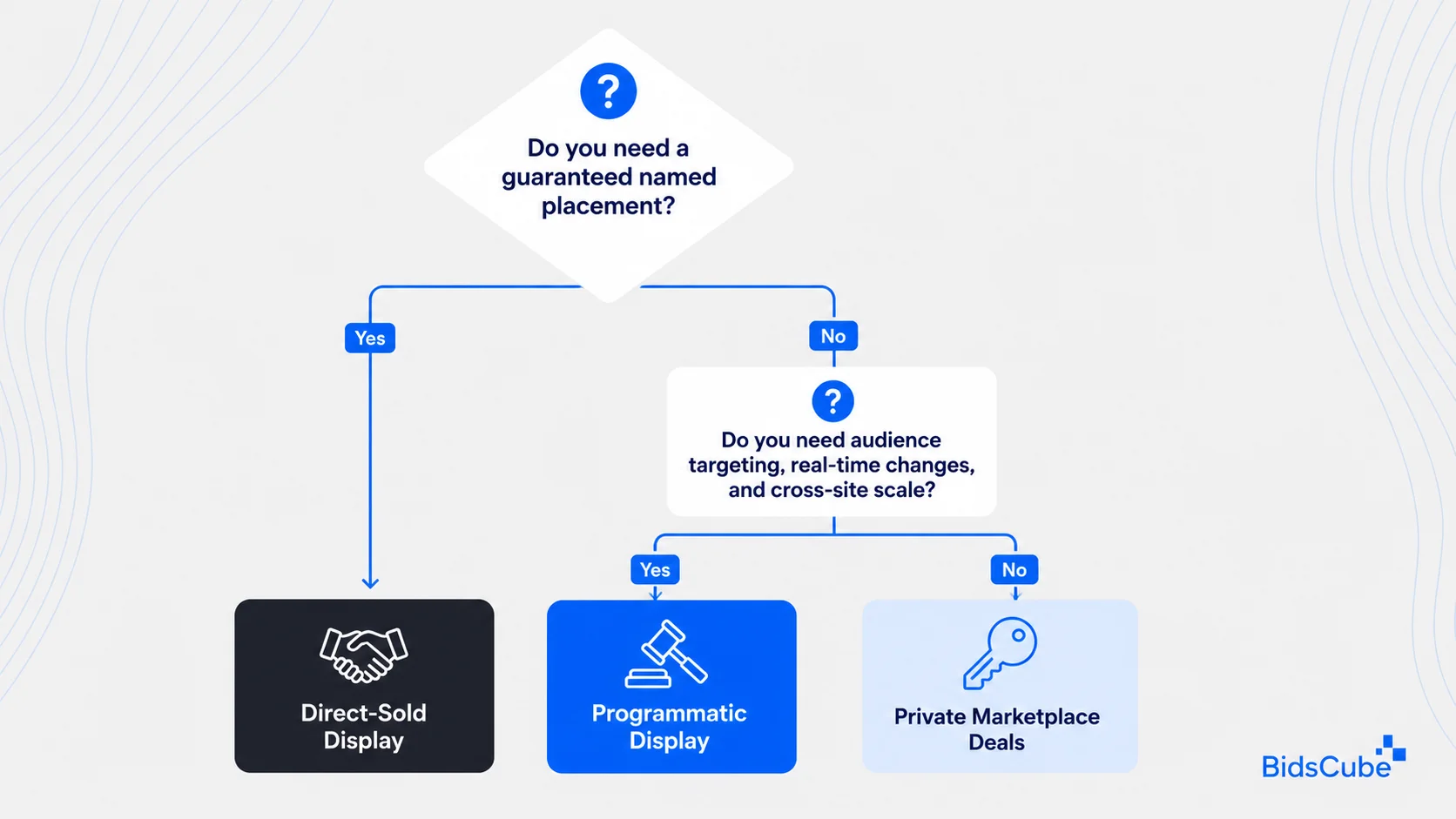
Start with “Do you need a guaranteed named placement?” If yes, lead toward direct-sold display. If no, ask about audience targeting, real-time changes, and cross-site scale. Add a middle result for PMP.
See how display fits beside native, video, audio, CTV, and DOOH in Top Programmatic Advertising Types and Formats.
How BidsCube Can Help
BidsCube provides connected technology for companies buying and selling programmatic inventory. Its products include a DSP for advertisers and a white-label SSP for publishers.
The BidsCube DSP lets advertisers manage display campaigns with targeting settings, bidding controls, budgets, campaign rules, and real-time reporting. Current product materials also list bidstream data access, an issues inspector, system monitoring, geo-targeting, retargeting, frequency caps, PMP deals, and support for several devices and formats.
Advertisers can use the DSP for prospecting, retargeting, placement tests, and selected deals. Multi-format support helps teams coordinate display with video, native, audio, and CTV.
The BidsCube SSP helps publishers manage, sell, and report on inventory. Publishers can connect demand, set monetization rules, work with several formats, and monitor results through real-time data. Publisher teams need to balance CPM, fill rate, latency, viewability, ad quality, and the site or app experience. The SSP supports those decisions.
Companies that need branded programmatic infrastructure can also use BidsCube to control more of their partner setup. Teams can review the company on Clutch during vendor research.
Expert View
Display advertising gives brands a clear visual format across many digital channels. The quote explains how programmatic buying adds pricing, targeting, and auction controls.
Display remains a practical way to carry a clear visual message. Programmatic technology makes the format more responsive by helping buyers decide which impression is worth buying, at what price, and under which rules.
Roman Vasyukov, CEO and Founder of BidsCube
The main point is simple: strong creative carries the message, while programmatic rules decide where, when, and at what price the ad appears.
Final Thoughts
The comparison of programmatic vs display advertising becomes clear once teams separate format from transaction. Display tells you what kind of ad runs. Programmatic tells you how software buys and sells the opportunity.
Use automated display for audience targeting, cross-site reach, testing, retargeting, and real-time changes. Use direct-sold display for guaranteed premium positions, fixed dates, and deeper publisher partnerships.
Many plans combine display and programmatic advertising with direct publisher deals. Start with the outcome, then choose the format, inventory, deal type, and measurement plan.
Use BidsCube to buy or sell display inventory through connected programmatic tools. Contact us to get a detailed planning and execution plan for your particular project.
Our tech staff and AdOps are formed by the best AdTech and MarTech industry specialists with 10+ years of proven track record!

FAQs
What Is the Difference Between Programmatic Ads and Display Ads?
Display ads are visual formats, such as banners and rich media units. Programmatic advertising is a method for buying and selling display, video, native, CTV, audio, and other inventory through software.
Is All Display Advertising Programmatic?
Display advertising is not always programmatic You develop insertion orders, sponsorships, reserved packages, and other agreements whereby advertisers may directly buy impressions from publisher sites.
What Is the Difference Between Programmatic Display and Direct-Sold Display?
At its core, programmatic display leverages software, auctions, and automated deal tools to buy inventory and adjust delivery. Direct-sold display involves an agreement between an advertiser and publisher, usually on a specific placement, price, and campaign period.
When Should I Use Direct-Sold Display Instead of Programmatic?
Direct-sold display should be used when a campaign requires a guaranteed homepage position, fixed sponsorship, exclusive partnership with a specific publisher, or manual review of an environment. For campaigns where the publisher creates unique creative or provides editorial support, direct buying works too.
Can Display Ads Be Bought Without Programmatic Technology?
You purchase display ads straight from a publisher with no DSP, SSP, or real-time auctions. Placement, dates, price, creative requirements, reporting, and delivery are all negotiated in an insertion order or contract.
What Formats Besides Display Can Be Bought Programmatically?
Programmatic buying platforms can purchase inventory from a variety of channels: videos, native, connected TV, digital audio, mobile app, and digital out-of-home. Depending on the DSP, SSPs, exchanges, publishers and deal term, the types of available formats may vary.


