



- First-party data comes from readers, subscribers, app users, as well as site visitors.
- Publishers collect first-party data via registrations, newsletters, paywalls, surveys, loyalty programs, and behaviour signals.
- Consent management matters because GDPR, CCPA, and other privacy rules shape how data can be used.
- CDPs, DMPs, CMPs, and SSPs help store, manage, and activate audience data.
- Private marketplace deals and direct deals can help publishers sell audience value without selling raw user data.
- A first-party data marketing strategy works best when the reader gets a fair value exchange.
Table of Contents
- What Is a First Party Data Strategy?
- How to Build a First-Party Data Strategy: Step by Step
- How Publishers Collect First-Party Data
- Benefits of First-Party Data Strategy for Publishers
- First-Party Data Marketing Strategy: How to Monetize
- Tools and Platforms for First-Party Data Roadmap
- How BidsCube Can Help
- Summary
-
FAQs
- What Is a First-Party Data Strategy?
- How Do I Build a First-Party Data Strategy as a Publisher?
- What Are the Benefits of a First Party Data Strategy?
- How Does a First Party Data Marketing Strategy Help Monetize Inventory?
- What Tools Do I Need for a First Party Data Strategy?
- How Is First-Party Data Different From Third-Party Data?
The old ad model asked publishers to rent identity signals from someone else. The new model rewards publishers that own the audience relationship.
That shift did not happen overnight.
- GDPR raised the bar for consent and data rights in Europe.
- California privacy laws keep expanding user control in the US.
- Chrome’s third-party cookie plan also changed several times, but Google still tells developers to prepare for a web where users can block third-party cookies by choice.
Google’s Privacy Sandbox guidance says teams should test for third-party cookie breakage and move toward privacy-preserving options.
For publishers that need more control over audience segments, private deals, and programmatic revenue, BidsCube supports ad businesses with SSP, DSP, and marketplace tools.
IAB’s 2025 State of Data report frames signal loss as a major force behind the move toward first-party data, alternative IDs, and data clean rooms.
According to our experts, publishers should not wait for one final browser deadline. The business reason already exists: Advertisers want trusted audiences, clean permissions, and better proof of value.
This article answers what a first-party data strategy is, explains how to collect data, and shows how publishers can turn audience signals into revenue without damaging trust.
What Is a First Party Data Strategy?
A first-party data framework is a plan to collect, store, govern and activate audience data that comes from your own property. Those are websites, apps, newsletters, paywalls, events and account systems for publishers.
The goal is not to gather every possible signal. This is the quest for (clean) data, transformative consent, transformational content, advertising products of the future, and stronger publisher monetization.
Here is the short version:
| Data Type | What It Means | Publisher Example | Main Risk |
| First-party data | Data collected directly from your own audience. | Registrations, newsletter clicks, article views, scroll depth, subscriptions. | Weak consent, poor data quality, or unclear purpose. |
| Second-party data | Another company’s first-party data shared through a direct agreement. | A brand shares loyalty segments with a publisher for a campaign. | Contract limits, privacy duties, and matching quality. |
| Third-party data | Data bought from outside aggregators. | Broad audience segments from external data brokers. | Signal loss, lower trust, and weaker availability in cookieless environments. |
Publishers need their own strategy because rented data does not build long-term value. A publisher that knows its own audience can create clearer audience segmentation, stronger direct deals, and better content decisions.
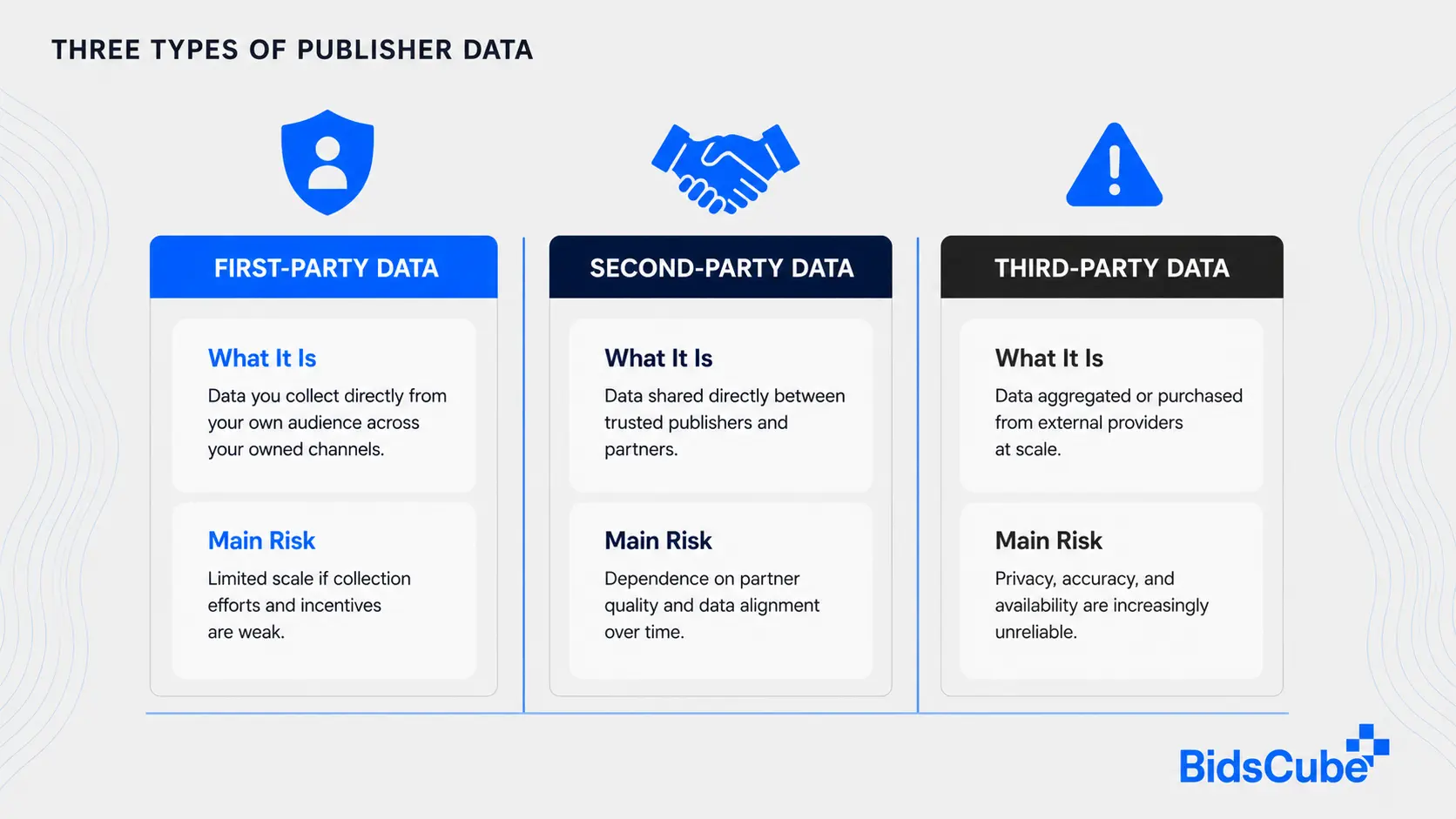
The answer to what is a first party data strategy is simple: It is the operating plan for turning trusted audience relationships into usable data assets.
How to Build a First-Party Data Strategy: Step by Step
A data plan fails when teams start with tools instead of purpose. The preferable path is to start with business objectives, then move into collection, consent assuming activation and measurement.
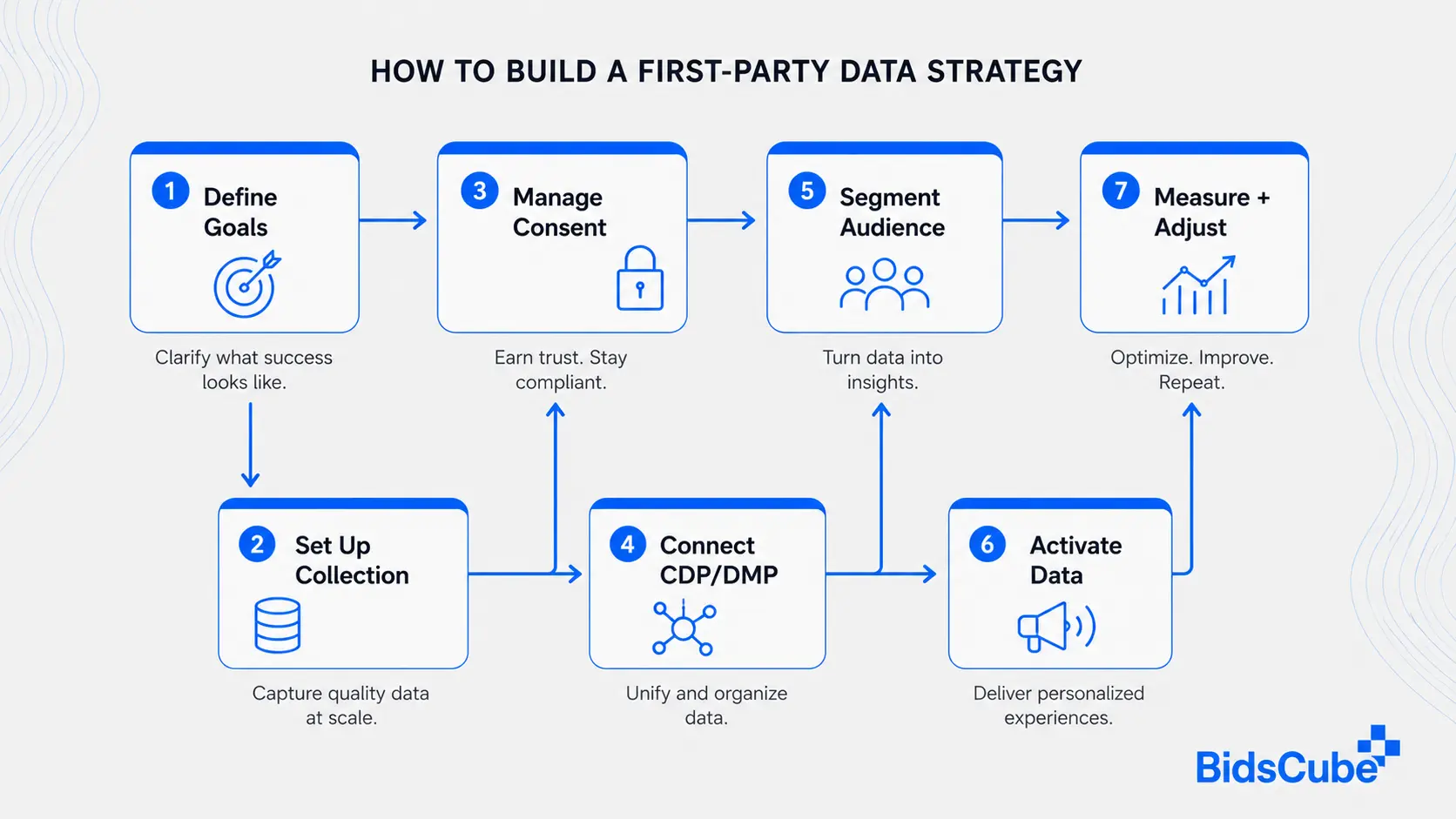
Step 1. Define what data you need and why.
Start with use cases. Do you need audience segments to drive ad sales, content personalization, newsletter growth or subscriber retention? One data may not be needed by a sports publisher, finance publisher, and lifestyle publisher.
Step 2. Set up data collection points.
Use registration walls, newsletters, loyalty programs, surveys, comments, app events, and on-site behavior. Keep forms short. Ask for more information only when you can explain the value.
Step 3. Handle consent management.
GDPR gives us a lens for how lawful processing and the rights of users will work, while California is busy expanding consumer privacy controls. There are also new and higher CCPA-ready thresholds and penalties being announced by the California Privacy Protection Agency to take effect in 2025.
Step 4. Connect a CDP or DMP.
A CDP helps gather and unify user-level data for content, subscriptions, and marketing. A DMP still helps manage audience segments for programmatic advertising.
Step 5. Segment the audience.
Build segments by topic interest, frequency, subscription status, device, geography, engagement, and purchase intent. For example, “weekly personal finance readers” has more value than “all visitors.”
Step 6. Activate data through media channels.
Leverage an SSP, Private Marketplace, Direct deals or Programmatic Guaranteed campaigns. This allows advertisers to purchase access to an audience without being provided with raw personal data.
Step 7. Measure and adjust.
Metrics to track: revenue, CPM, match rate, consent rate and churn (to gauge the effectiveness of your ASU), newsletter signups, advertiser renewal rate. A strategy is not finished after launch. It needs regular cleanup.
This is the real work behind how to build a first-party data strategy: collect less, explain more, and make every signal useful.
How Publishers Collect First-Party Data
Publishers collect first-party data through direct audience interactions. The best methods feel natural because they offer readers a clear reason to share information.
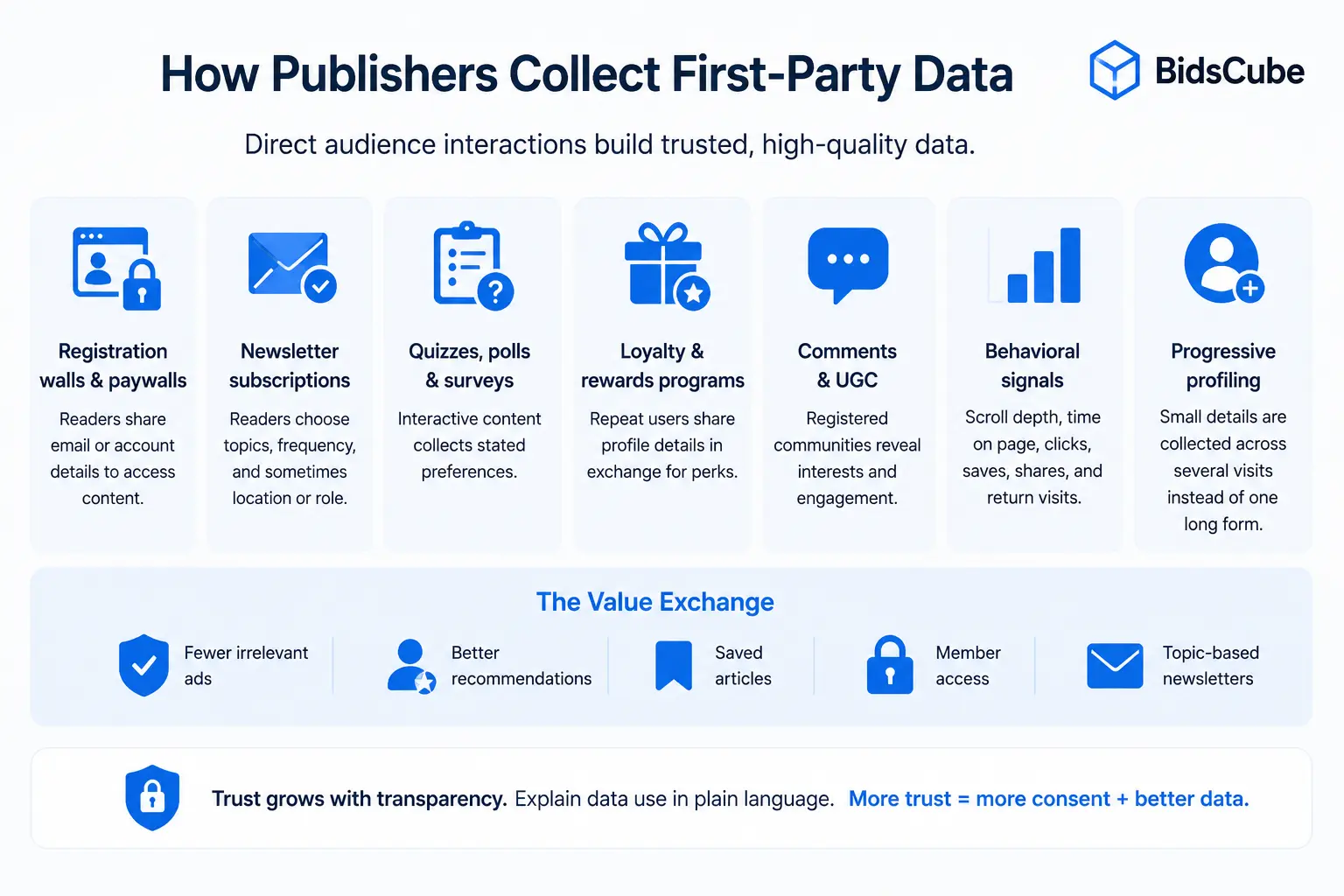
Common collection methods include:
- Registration walls and paywalls: Readers share an email or account details to access content.
- Newsletter subscriptions: Readers choose topics, frequency, and sometimes location or role.
- Quizzes, polls, and surveys: Interactive content collects stated preferences.
- Loyalty and rewards programs: Customers disclose information about their profiles in return for benefits, thanks to return visits.
- Comments and UGC: Half of registered communities tell you what topics people are interested in & engaged with, while others share the passion from content creation only through UGC.
- Behavioral signals: Scroll depth, time on page, clicks, saves and shares and return visits.
- Progressive profiling: Instead of using one long form, the publisher asks a few small details over multiple visits.
The value exchange matters. Data is shared by the users when they receive something, of value in return. Which could translate into less spammy ads, improved suggestions, saved articles, members-only access or newsletters by topic?
A registration wall should not feel like a toll booth in the middle of a dark road. It should explain the trade: “Create a free account to save articles, follow topics, and receive fewer repeated prompts.”
According to our experts, trust grows when publishers explain data use in plain language. If readers understand the benefit, consent rates and profile quality usually improve.
Benefits of First-Party Data Strategy for Publishers
The advantages of first-party data framework start with control. Publishers can not rely solely on external data providers, browser IDs or third-party cookies to explain the audience anymore.
First, first-party data minimizes reliance on third-party cookies. Despite the change of timeline by Chrome, user supply decisions, personal privacy tools that help to stop finger printing usages and requirement on the platform lead to reduce old monitoring techniques.
Second, better audience data can support higher CPMs. Advertisers pay more for clear segments, trusted context, and clean permissions.
Third, publishers gain unique audience insight. A niche publisher may know more about its readers’ intent than any outside data seller.
Fourth, first-party data helps with compliance to privacy regulations. Implementing a consent-based data program can allow publishers to comply with GDPR, CCPA, and other similar laws.
Fifth, it strengthens advertiser relationships. Direct deals and PMP campaigns become easier when the publisher can explain the audience and prove delivery.
Sixth, it improves reader experience. Publishers can show better content recommendations, smarter newsletters, and less irrelevant messaging.
The main point: The pros of first-party data framework show up in both revenue and trust. Those two outcomes need each other.
First-Party Data Marketing Strategy: How to Monetize
The strategy in question turns audience signals into paid media value. Publishers can use data to sell better campaigns without handing advertisers uncontrolled access to users.
The main monetization paths include:
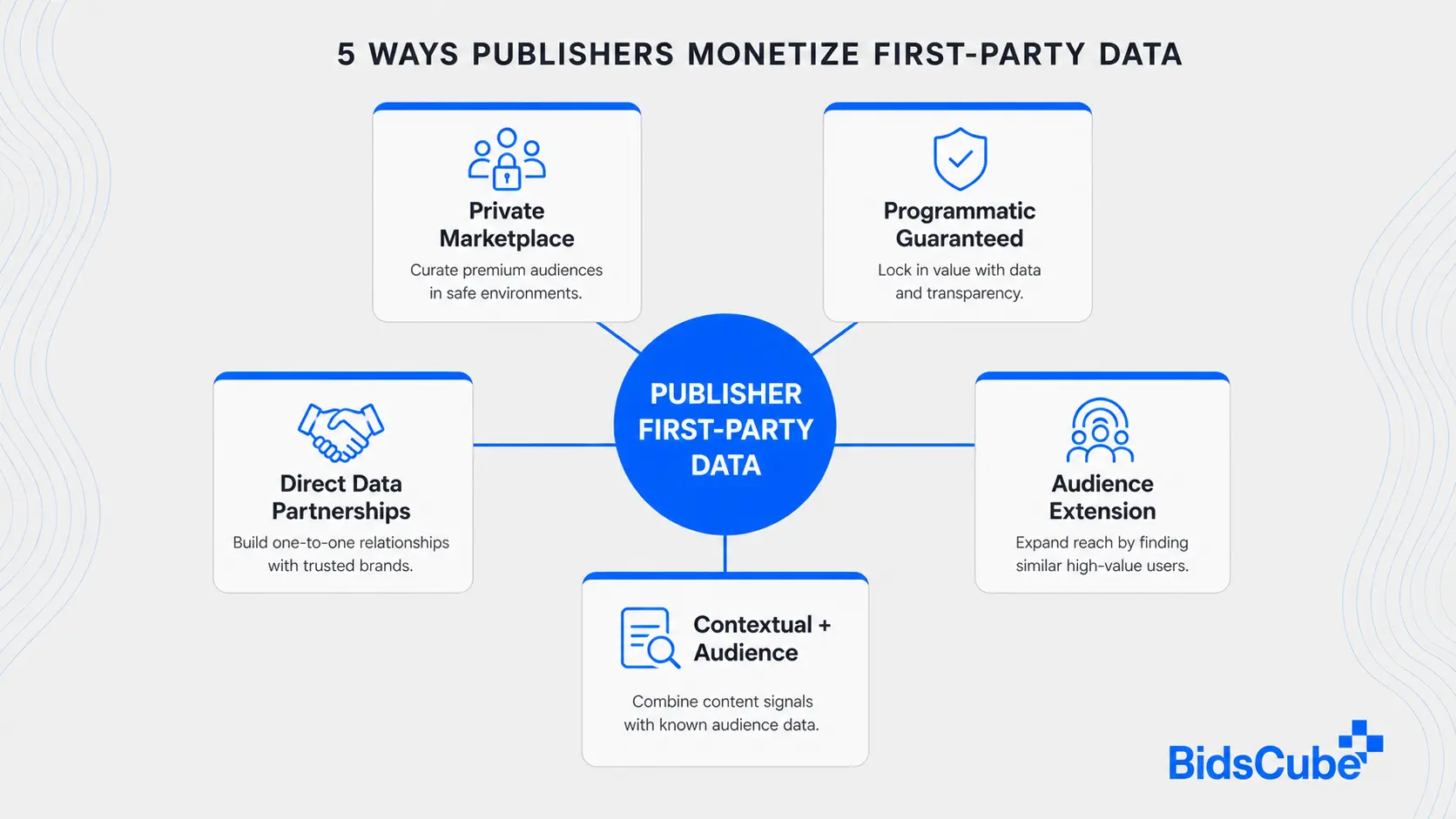
Private Marketplace Deals
Publishers package audience segments and sell access through deal IDs. A buyer can bid on “auto intenders” or “high-engagement finance readers” in a controlled buying path.
Programmatic Guaranteed
Inventory, audience, price and volume are agreed upon between publishers and advertisers ahead of time. This works best with premium campaigns requiring predictable delivery.
Direct Data Partnerships
A publisher can form a second-party data partnership with a brand. This needs clear contracts, consent review, and strict rules for use.
Audience Extension
A publisher uses its audience data to reach the same audience outside its own site through an SSP or approved partners. This can add revenue beyond owned inventory.
Contextual Plus Audience Targeting
Publishers combine content context with audience data. For example, a travel publisher can package “readers of Japan guides who returned twice this week.”
A strong SSP matters here. The platform should support audience segments, deal setup, reporting, demand access, and clear controls. BidsCube SSP can support publisher-side inventory and monetization workflows when teams need more control over how demand reaches their supply.
For broader format planning, publishers can also review BidsCube’s guide to programmatic advertising types and formats.
Tools and Platforms for First-Party Data Roadmap
The tool stack should match the publisher’s maturity. A small publisher may start with newsletter, analytics, and consent tools. A larger media company may need CDP, DMP, CMP, identity tools, clean rooms, and SSP integrations.
CDP: Customer Data Platform
A CDP collects and unifies user data across properties. Segment, Tealium, and mParticle are common examples. A CDP helps content, subscription, and marketing teams work from a shared user view.
DMP: Data Management Platform
A DMP manages audience segments for advertising. It can help publishers package users by behavior, interest, and campaign value for programmatic buyers.
CMP: Consent Management Platform
A CMP stores user consent preferences and helps teams manage GDPR, CCPA, and regional privacy duties. OneTrust and Quantcast Choice are common examples.
SSP With First-Party Audience Support
An SSP helps publishers sell inventory through programmatic channels. For first-party audiences, the SSP should support segment activation, deal IDs, private marketplace setup, and reporting.
Data Clean Rooms
Clean rooms let partners compare or model data without directly exposing raw user-level data. IAB’s 2025 State of Data materials point to data clean rooms as one of the tools rising in response to signal loss.
According to our experts, the best stack is the one your team can actually maintain. Unused tools do not protect data, create revenue, or improve advertiser trust.
How BidsCube Can Help
First-party data becomes more valuable when publishers can package and sell audiences with clear rules. That requires the right pipes between inventory, demand, and reporting.
- BidsCube White-Label AdExchange can support companies that want to manage their own marketplace layer between buyers and sellers.
- BidsCube SSP can support publisher monetization, traffic controls, and demand access.
- BidsCube DSP can support buyer-side activation and campaign management when teams also work from the demand side.
For vendor checks, teams can review BidsCube on Clutch as part of due diligence.
“Publishers do not need more random data. They need cleaner audience signals and a clear way to sell those signals without breaking user trust. First-party data works when consent, segmentation, and deal setup move together.”
Roman Vasyukov, CEO and Founder, BidsCube.
Our experts at BidsCube indicate that the publishers should connect data strategy with monetization early. If the ad sales team cannot explain the segment, the buyer will not pay a premium for it.
Summary
First-party data gives publishers a better path through privacy changes, signal loss, and weaker third-party data. The work starts with consent, clear value exchange, and useful collection points. It then moves into segmentation, programmatic activation, private deals, and measurement. Publishers that build this capability now can sell audience value with more confidence and less dependence on rented signals.
A strong first-party data framework is not just a privacy response. It is a publisher revenue asset. Need help turning audience data into programmatic revenue? Contact us to discuss how BidsCube can support your data activation and monetization setup.
Our tech staff and AdOps are formed by the best AdTech and MarTech industry specialists with 10+ years of proven track record!

FAQs
What Is a First-Party Data Strategy?
A first party data strategy is a plan for collecting, managing, and using audience data that comes directly from a publisher’s own readers, subscribers, and site visitors. The strategy should define data sources, consent rules, audience segments, and monetization paths.
How Do I Build a First-Party Data Strategy as a Publisher?
Building a first-party data roadmap: start with the business goals, choose valuable data points, establish consent management, integrate relevant tools and activate with segments, either directly or in compliance via programmatic deals. For publishers, revenue, consent rate, segment quality and advertiser demand should be the part of key metrics that they should measure.
What Are the Benefits of a First Party Data Strategy?
The main benefits of first-party data strategy include less dependence on third-party cookies, stronger audience segments, better direct deals, and clearer privacy control. Publishers can also use first-party data to improve content recommendations and user experience.
How Does a First Party Data Marketing Strategy Help Monetize Inventory?
Employ first party data framework for publishers to package their audience segments for direct Private Marketplace deals, Programmatic Guaranteed Deals and Audience Extension. You get an entire strategy, actually turning reader relationships into ad products without the need for advertisers at any stage to have raw data or free access.
What Tools Do I Need for a First Party Data Strategy?
Typically, a CMP for consent, a CDP or DMP for audience management and an SSP for programmatic activation. Big publishers may also leverage data clean rooms and identity tools, where partnerships with advertisers mandate more secure data matching.
How Is First-Party Data Different From Third-Party Data?
First party data comes from the publisher’s owned audience, third-party data is sourced from external aggregators. In cookieless advertising, first-party data tends to provide higher levels of trust, clearer consent and stronger longer-term value.


