



Consumer habits change, devices change, and page layouts change with them. A placement that worked on a desktop news site may fail inside a mobile app or a short video feed.
Table of Contents
- Ad Placement Solutions: Tips for Publishers and Advertisers
- Ad Placement Channels: Quick Reference Table
- Six Ad Placement Tips for Advertisers
- Five Emerging Technologies and Trends in Ad Placement
- Consider Bidscube, Your Trusted Partner
- Conclusion
-
FAQs
- What Are the Best Ad Placement Solutions for Publishers?
- How Does Digital Placement Advertising Improve ROI?
- What Should Advertisers Look for in Ad Placement Partners?
- How Do You Avoid Ad Blindness When Placing Ads?
- Which Performance Metrics Matter Most for Ad Placement?
- How Does Programmatic Advertising Affect Conversion Rates?
Ad placement used to mean choosing a banner slot. It now includes the channel, format, screen, page area, load order, frequency, and buying route. Publishers also need to protect reading flow and site speed. Advertisers need enough visibility to give the message a fair chance.
The phrase digital placement advertising covers both sides of that decision. Publishers set the physical slot, while buyers choose inventory, formats, audiences, and bids through their chosen ad placement partners.
Research shows that strategically placed ads can improve engagement, highlighting the importance of placement in digital advertising. This article will explore key strategies for effective ad placement. We’ll cover three things.
This guide covers three areas:
- How publishers and advertisers can choose placements
- Which formats fit each channel
- How testing and reporting can guide later changes
Readers searching for top strategies for article buy placements often mix two decisions. Media buying decides which impressions to purchase. Page placement decides where the publisher puts the ad.
Ad Placement Solutions: Tips for Publishers and Advertisers
Publishers want ad revenue and little or no fluff on the page. Advertisers are looking for placements that are both visible and legible. The proper configurations needs to satisfy the dual objectives.
Use Programmatic Advertising
In programmatic buying, an advertiser purchases impressions with a DSP on the open market, and a publisher supplies the inventory through an SSP or ad exchange. The auction happens while a page or app loads.
Publishers can connect one slot with several demand sources. Buyers can set rules for audience, device, geography, format, price, and frequency. The physical slot still belongs to the publisher.
Four practical gains come from this setup:
- More buyers can compete for publisher inventory
- Buyers can change bids and budgets while the campaign runs
- Reports can separate domains, apps, devices, and formats
- Private marketplace deals can limit supply to chosen partners
Read how programmatic advertising works for a full auction walkthrough.
Understand Your Audience Segmentation
Begin with traffic records, Page behavior, device use, type of content, and consent status. These records illustrate where everyone halts, scrolls, returns, or departs.
Been doing a lot of work with publishers who want to group readers by category of page, by device, by session depth, by whether or not they appear on some kind of subscription list. First-party groups, contextual categories, and retargeting lists can be leveraged by advertisers where allowed. Segmentation also affects brand awareness. A first-time visitor may require a more direct introduction, while a returning visitor may benefit from a product suggestion or a case study.
Avoid dozens of tiny groups. A segment needs enough traffic to produce a useful test.
Choose the Right Advertising Formats
Format and placement should work together. A wide banner may fit a desktop article but fail on a narrow phone. A native card may sit naturally inside a feed but look out of place in a dashboard.
Display suits short offers and recall. Native suits feeds and content pages. Video needs enough screen space and a sensible start point. Interstitials work only at natural breaks.
Keep the message readable at the actual served size. A design that looks clear on a large monitor may become cramped inside a mobile slot.
Place Your Ads in the Right Formats and Environments
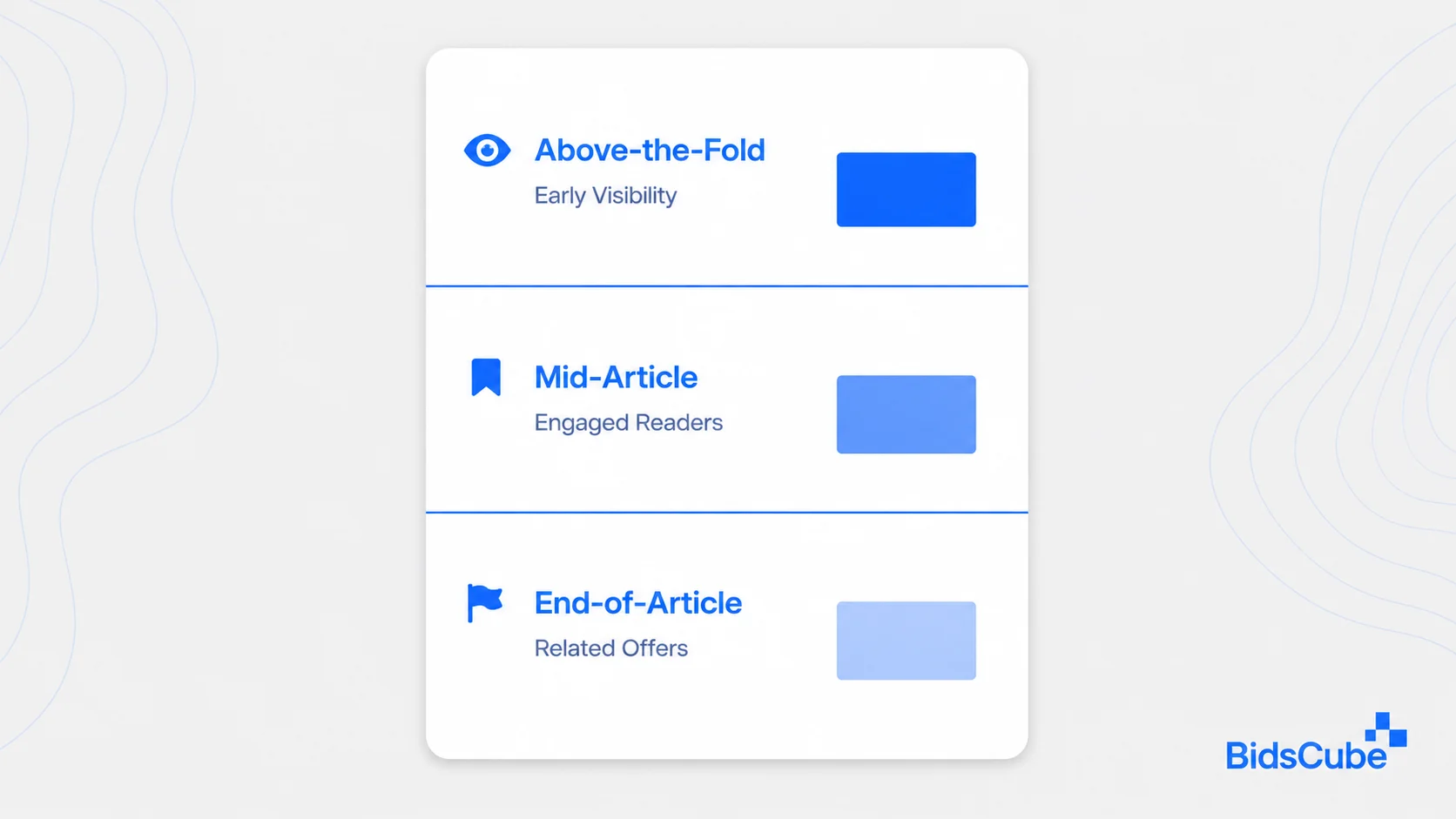
Publishers control the location of each slot. Buyers can still influence the setting by choosing formats, domains, apps, page categories, devices, and deal types.
Above-the-fold placements gain early visibility but can push content down. Mid-article units reach readers who have already shown interest. End-of-article units get fewer impressions but may suit related offers or native recommendations.
The best ad placement on website pages depends on scroll depth, page length, device mix, and the role of the page. Use ad viewability strategies to check whether a loaded ad had a real chance to appear on screen.
Conduct A/B Testing and Optimization
A/B tests compare two controlled versions. A publisher might compare a sidebar unit with a mid-article unit. An advertiser might compare two headlines within the same audience and supply rules.
Change one item per test. If the team changes the format, audience, bid, and landing page together, the winner does not explain what caused the result.
Ad placement optimization should use agreed performance metrics before the test starts. Publishers may watch viewability, revenue per session, and page speed. Advertisers may watch qualified visits, CPA, sales, and frequency.
The guide to programmatic metrics that define campaign success explains how media figures and business records fit together.
Review the BidsCube SSP for publisher inventory, demand connections, and real-time reports.
Ad Placement Channels: Quick Reference Table
Channels impose different limits on format, size, timing, and user control. Mobile screens punish oversized units. Video players need clear rules for sound and skipping. Content sites need room for reading, while social feeds rely on native cards and short clips.
Use the table as a starting point, not a fixed rule. The same placement can behave differently by page type, device, and traffic source. These ad placements solutions work best when the team checks the real slot rather than relying on a channel label alone.
| Channel | Best Ad Format | Main Consideration |
| Mobile Apps | In-app native, rewarded video, and interstitial | Keep the placement away from core controls and use natural breaks |
| Video Platforms | In-stream and outstream video | Check viewability, sound rules, completion, and skip timing |
| News and Content Sites | Display, native, and outstream video | Protect reading flow and test above-the-fold against mid-article slots |
| Social Media | Native cards and short video | Match the feed format and separate prospecting from retargeting |
| Games | Rewarded video, playable, and intrinsic units | Make the reward clear and avoid interrupting active play |
| CTV | Full-screen video | Check household reach, frequency, and device-level reporting |
Not sure which ad placement strategy fits your inventory?
Talk to BidsCube. Our team will help you match formats and channels to your audience
Six Ad Placement Tips for Advertisers
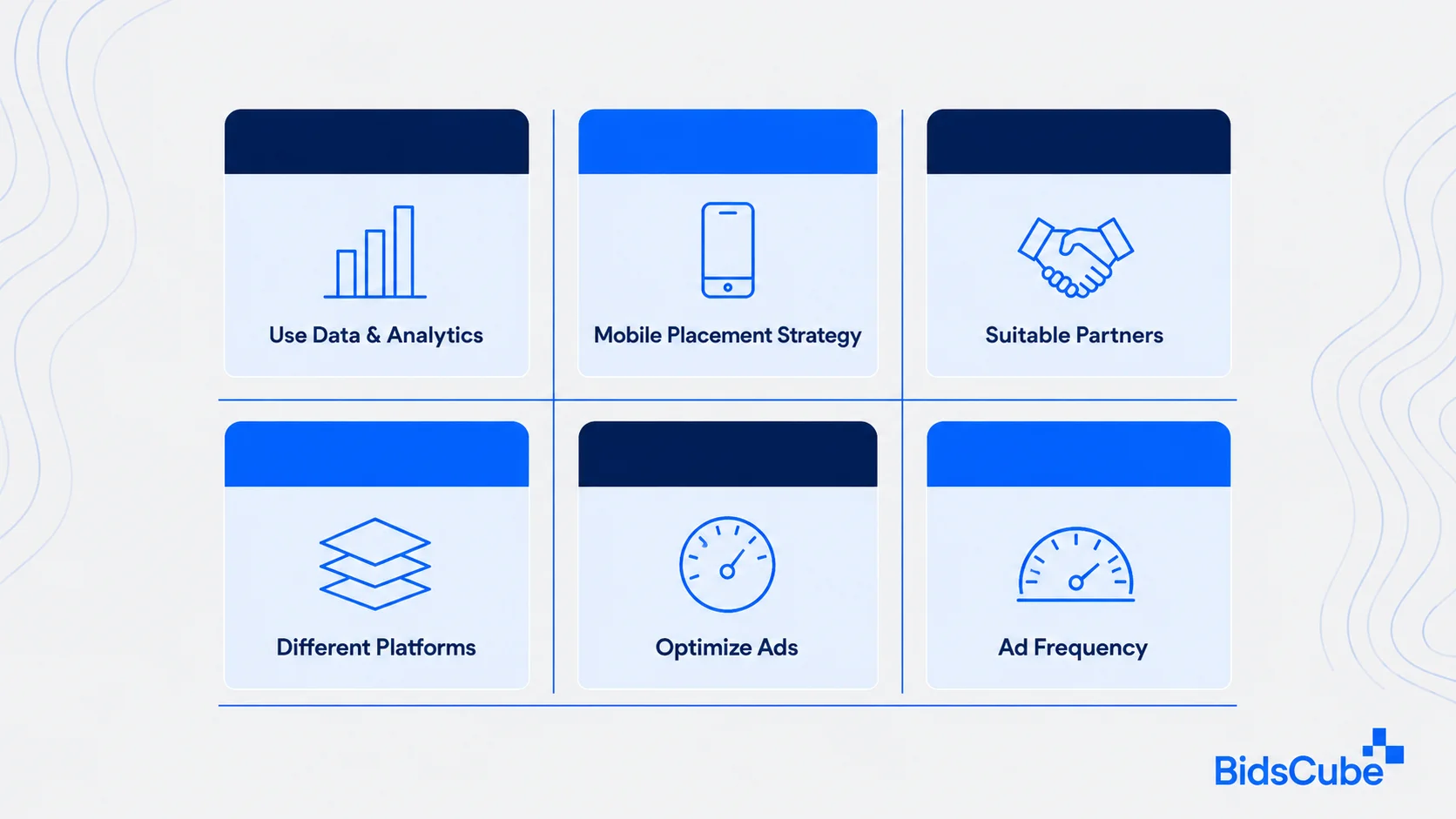
Tip 1. Use Data and Analytics
Start with placement-level reports, not campaign totals. Split results by domain, app, device, format, audience, and creative.
Compare media numbers with site and sales records. A cheap placement may send accidental clicks, while a higher CPM placement may bring longer visits or more purchases.
The best practices for verifying ad placements include checking domain and app names, viewability, invalid traffic flags, frequency, landing-page behavior, and conversion quality.
Tip 2. Consider a Mobile Ad Placement Strategy
A mobile ad placement strategy must account for small screens, fast scrolling, navigation bars, keyboards, and portrait mode. Test real devices instead of relying only on a desktop preview.
Native feed cards, anchored banners, rewarded video, and interstitials can all work on mobile. Timing matters. An interstitial before a visitor sees any content will often create a poor first impression.
The in-app advertising guide covers banners, video, native units, rewarded formats, and app-specific placement rules.
Tip 3. Work With Suitable Advertisers or Ad Networks
Choose partners based on inventory access, reporting, fees, quality checks, and support. A large network is not automatically a good match.
Ask whether reports show domains, apps, placements, devices, and fees. Check how the partner handles invalid traffic, blocked creatives, private deals, and billing differences.
The BidsCube guide to what is an Ad Network explains how networks package supply. Good ad placement partners should also explain where inventory comes from and which controls the buyer or publisher keeps.
Tip 4. Place Ads on Different Platforms
A mixed plan can use search for active demand, display for retargeting, native for content discovery, and video for product explanation.
Do not copy one creative across every screen. Each platform has different dimensions, controls, and viewing conditions.
Cross-device advertising can help teams plan reach and frequency across desktop, mobile, apps, and connected devices. Device matching is never perfect, so reports should state which identifiers and methods support the count.
Tip 5. Optimize Your Ads
Revise the following in combination headline image offer call to action landing page The target page ad- click must match the promise.
Study placement, device, audience, and creative-based conversion rates. If you have a high click rate with a low conversion rate, this may be due to accidental clicks, the page not matching the ad, or the traffic not being of good quality
Do not judge every campaign by clicks. Awareness campaigns may need reach, viewability, and later site activity, while sales campaigns need revenue and order quality.
Tip 6. Pay Attention to Ad Frequency
Frequency shows how often the same person or device receives an ad during a set period. Too little repetition can limit recall. Too much can waste budget and annoy the audience. Repeated exposure to the same creative can cause ad blindness. People stop noticing the unit even though the impression still appears in the report.
Set caps by campaign, creative, audience, and time window where the platform permits it. Rotate creative before response drops sharply.
Ready to put these tips into action?
Join the BidsCube Community and connect with the right ad placement partners today
Five Emerging Technologies and Trends in Ad Placement
Here are five emerging trends reshaping how ads are placed and consumed.
I. Artificial Intelligence
Machine learning can score impressions, predict response, adjust bids, and flag unusual campaign activity. It can also help group placements by prior results.
The model still needs clean events and strict limits. A system trained on clicks may favor placements that attract accidental taps. Human review must check whether the chosen metric matches the business goal.
Read more about AI in programmatic advertising.
II. Video Content
Video placements now appear across websites, apps, streaming services, CTV, social feeds, and games. Each setting uses different controls. In-stream video runs inside a player. Outstream video opens within page content. Rewarded video gives an app or game user something in return for watching.
Check start position, sound settings, skip rules, completion, and viewability. A two-second view does not mean the viewer reached the main message.
III. Gamification
Gamified ads ask the user to complete a small action, quiz, or playable task. The format often appears in mobile apps and games. The task should be easy to understand and quick to finish. Rewards, if offered, must be clear before the interaction begins.
A playable ad can show how an app or game works before the install. It should not imitate buttons or hide the close control.
IV. AR and VR
Augmented reality supplements your camera view with digital objects. With VR, you step into a digital space. Retailers using AR for products preview, while entertainment or gaming brands may use VR spaces for branded objects or events.
Production cost and device support limit reach. Test loading time, controls, comfort, and measurement before committing a large budget.
V. Blockchain
Blockchain-based ad tools have been proposed for transaction records, seller checks, and payment tracking. Adoption remains limited compared with standard programmatic pipes.
A ledger alone does not prove that a person saw an ad. Buyers still need viewability, invalid traffic checks, seller records, and placement reports.
Use blockchain only when it solves a defined record-keeping problem. Do not treat it as a substitute for media quality checks.
Consider Bidscube, Your Trusted Partner
Working with BidsCube gives publishers, advertisers, and AdTech firms access to connected programmatic products. The BidsCube Community links buyers and sellers, while the white-label products let companies run buying or selling under their own brand.
The current article lists:
- More than 100 BidsCube technology users.
- More than 200 industry partners.
- No revenue share for supply sources inside the stated Community setup.
BidsCube also offers a White Label SSP for companies that want control over traffic, demand connections, formats, reporting, and branding.
The SSP supports web and app inventory across banner, video, native, audio, desktop, mobile, and CTV. Teams can also use the platform to connect selected demand sources and review live reports.
Conclusion
Good ad placements solutions connect the right format, channel, audience, and page location. Publishers should protect the page while checking revenue and viewability. Advertisers should judge placements by business records, not impression volume alone.
A clear test plan matters more than constant changes. The BidsCube guide to how programmatic advertising works can help teams connect placement decisions with the auction path.
Contact BidsCube today to discuss your ad placement strategy and get a free consultation on raising ad revenue.
Our tech staff and AdOps are formed by the best AdTech and MarTech industry specialists with 10+ years of proven track record!

FAQs
What Are the Best Ad Placement Solutions for Publishers?
The best ad placements solutions marry page type, device, content length, and reader behavior. Slot combination, outline, speed, viewability, income per meeting and speed of page ought to be tried together.
How Does Digital Placement Advertising Improve ROI?
Digital placement advertising grows the ROI by shifting spending to placements that generate sufficient qualified visits, leads, or sales. These placement-level reports also help buyers eliminate inventory causing low-quality traffic.
What Should Advertisers Look for in Ad Placement Partners?
It is critical for advertisers to collect the following info from their ad placement partners: where the inventory is coming from, the level of reporting detail, fees, quality checks, private deals, and data export capabilities. The partner should tell buyers which controls are retained and how disputes are managed.
How Do You Avoid Ad Blindness When Placing Ads?
When the same format or creative is seen too much, ad blindness sets in. This issue can be mitigated by setting frequency caps, also by rotating creatives, putting them in appropriate page context or just limiting the repeated units.
Which Performance Metrics Matter Most for Ad Placement?
The most useful metrics used for measuring performance is dependent on the campaign goal. On its own, viewability, frequency, CPA, revenue, qualified lead rate, and post-click behavior typically say more than impressions or CTR.
How Does Programmatic Advertising Affect Conversion Rates?
The ability to tailor conversion rates by managing audience, supply, device, frequency, and bid rules at the impression level gives programmatic buying an edge. Bad data or poor inventory can appear to be shrinking the rate so buyers need to weigh the events on the platform against site and sales records.


