



AI analytics in AdTech can classify audiences, assess impressions, detect unusual activity, and summarize campaign results. AI in AdTech companies only creates value when teams connect models with accurate events, clear campaign goals, privacy controls, and human review.
Table of Contents
- The Emergence of Artificial Intelligence in Advertising
- The Role of AI in AdTech
- Artificial Intelligence in Advertising
- Key AI Applications in AdTech
- 1. Programmatic Advertising
- 2. Real-Time Bidding (RTB)
- 3. Audience Segmentation
- 4. Personalization
- How AI Enhances White Label Solutions
- Improved Data Analysis and Audience Targeting
- Personalization and User Experience
- Automation and Operational Efficiency
- Predictive Analytics for Better Decision-Making
- Traditional Workflow vs AI-Assisted White-Label Workflow
- Apply AI to campaign decisions
- Best Practices for Implementing AI in White Label Solutions
- Practice 1. Evaluating Business Needs and Goals
- Practice 2. Selecting the Right AI Tools and Partners
- Practice 3. Employee Training and Change Management
- Conclusion
- FAQ
- What Role Does Automation Play in Modern AdTech Solutions?
- What Is AI Analytics in AdTech?
- How Does AI Improve White-Label Ad Tech Solutions for Enterprises?
- Is AI Replacing Human Media Buyers?
- What AI Applications Matter Most for White-Label Platforms?
- How Much Does an AI-Powered White-Label Solution Cost?
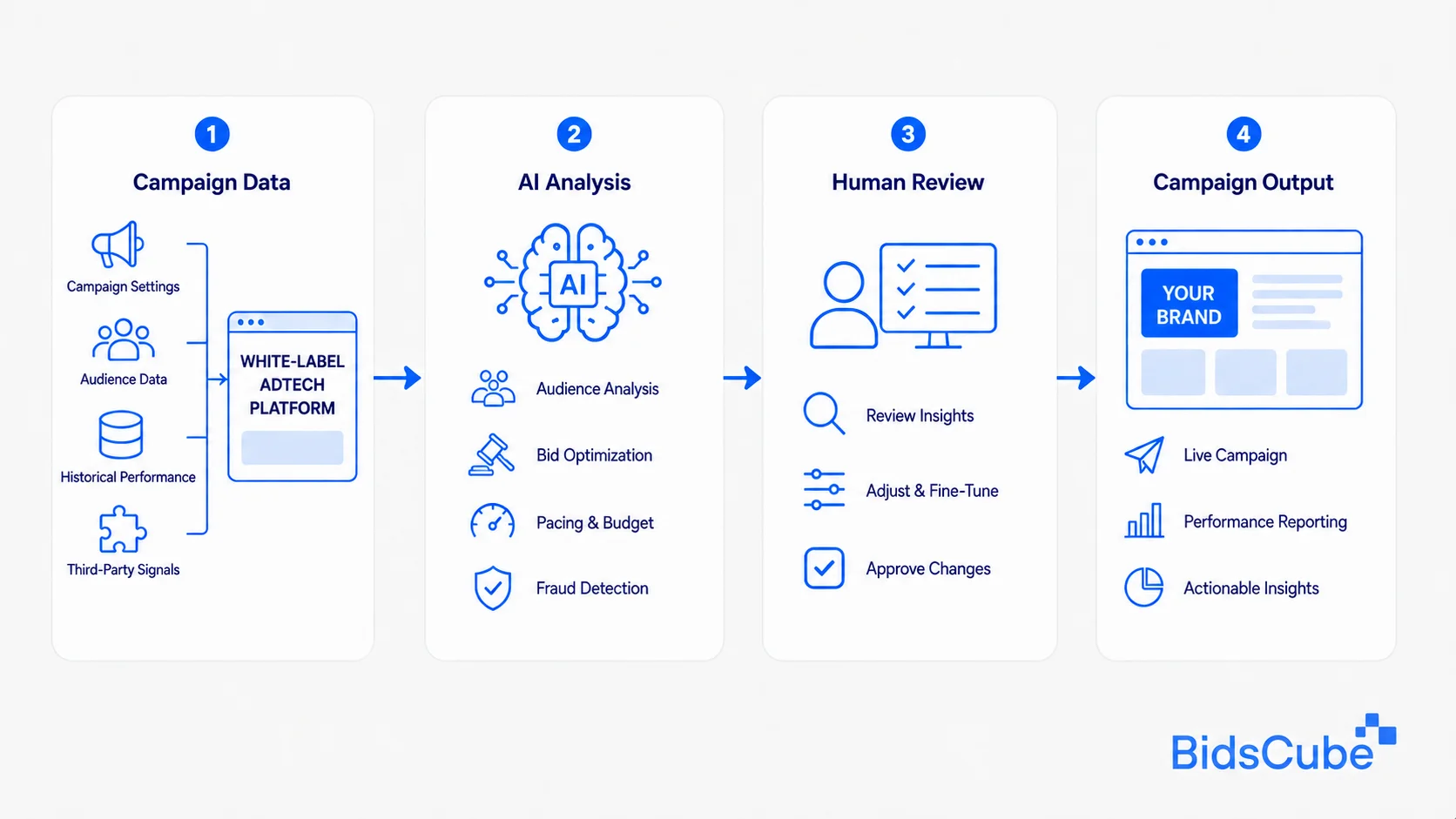
AI-powered ad-tech solutions can assist with bids, pacing, creative selection, forecasting, and fraud checks. A white label ad tech solution for enterprises should also explain data access, model limits, account controls, and the role of automation in modern AdTech solutions.
AI in AdTech companies can support faster analysis, but teams remain responsible for goals and high-impact decisions. AI-powered ad-tech solutions should show how recommendations were produced, tested, and approved.
Learn how AI transforms white-label technology in the AdTech industry. Explore the benefits of integrating the technology of artificial intelligence in advertising through AI white-label solutions and how partnering with platforms like Bidscube can give your business a competitive edge.
The Emergence of Artificial Intelligence in Advertising
Grand View Research estimates the global artificial intelligence market at $539.5 billion in 2026 and projects it to reach about $3.5 trillion by 2033, a 30.6% compound annual growth rate. For AdTech teams, that investment supports broader use of AI in analysis, bidding support, reporting, and creative workflows.
AdTech AI applications improve everything from audience segmentation and personalized content delivery to real-time bidding and performance analytics. For instance, AI-powered tools can automatically optimize ad placements based on real-time performance data, ensuring maximum ROI with minimal manual intervention.
When integrated into white-label technology, AI empowers businesses to offer sophisticated advertising solutions under their brand. This accelerates time-to-market and provides clients with cutting-edge tools that drive results. Therefore, the convergence of AI and white-label solutions is a game-changer, opening up new horizons for companies eager to lead in the competitive AdTech arena.
The Role of AI in AdTech
In an era where data is the new currency, integrating artificial intelligence (AI) into advertising technology (AdTech) is revolutionizing the industry. The fusion of AdTech AI and white-label technology is improving the efficiency of advertising strategies and empowering businesses to offer sophisticated solutions under their brand. Let’s explore how artificial intelligence in advertising transforms the landscape and the critical applications driving this change.
Artificial Intelligence in Advertising
The advent of AI technologies like machine learning, natural language processing (NLP), and predictive analytics has ushered in a new era of innovation in advertising. According to a PwC report†www.pwc.com, AI can bring $15.7 trillion to the economy by 2030. Of course, with a significant portion impacting the advertising sector. This monumental growth underscores the critical role of AI in shaping advertising strategies and campaign management.
Machine Learning (ML) algorithms analyze vast datasets to uncover patterns and insights humans might miss. In advertising, machine learning enables real-time optimization of campaigns by adjusting bids, budgets, and targeting parameters based on performance data.
Natural Language Processing (NLP) allows computers to understand and interpret human language. In
advertising, NLP is used for sentiment analysis, chatbots, and voice-activated assistants. Brands utilize NLP to gauge customer opinions on social media, enabling them to adjust their messaging effectively.
Predictive Analytics uses statistical algorithms. It also taps into machine learning (ML) to forecast future outcomes. In advertising, predictive analytics helps anticipate user behavior, optimize promotions, and improve rates.For a practical marketing view, see predictive analytics in digital marketing.
By integrating these AI technologies into white-label technology, businesses can offer advanced advertising solutions without significant development resources. This synergy allows companies to stay competitive while focusing on their core competencies.
Key AI Applications in AdTech
The application of AdTech AI extends across various facets of digital advertising, improving efficiency and effectiveness. Here are some key areas where AI is making a significant impact:
1. Programmatic Advertising
Programmatic advertising automates ad inventory buying and selling in real time. AI supports the process by analyzing user behavior, estimating impression value, adjusting bids, and monitoring placements and pacing.Teams that need a branded buying platform can review the BidsCube DSP alongside their AI workflow requirements.
2. Real-Time Bidding (RTB)
RTB is a subset of programmatic advertising where ad impressions are sold through real-time auctions. AI technologies enable RTB platforms to process millions of transactions per second, optimizing bids based on predicted user engagement.
3. Audience Segmentation
AI allows for more precise audience segmentation by analyzing demographic, psychographic, and behavioral data. This granular segmentation ensures ads are more relevant to the audience, improving engagement rates. A study by Salesforce†www.salesforce.com found that 52% of consumers expect offers always to be personalized.The guide to targeted advertising algorithms explains how campaign systems use approved signals to support audience decisions.
4. Personalization
Personalization is at the heart of effective advertising. AI enables dynamic content creation configured to individual user preferences, improving the user experience. Netflix and Amazon are prime examples. These companies use AI-driven personalization to recommend content and products, significantly boosting user engagement and sales.Teams can also review generative AI in advertising when planning creative support and governance.
Businesses can offer state-of-the-art advertising services under their brand by incorporating these applications into AI white-label solutions. This integration not only elevates the capabilities of their white-label technology but also provides clients with cutting-edge tools to drive their marketing efforts.
The role of AI in advertising is undeniably transformative. From optimizing campaign strategies to delivering personalized user experiences, AdTech AI is reshaping the industry.
How AI Enhances White Label Solutions
The fusion of artificial intelligence in advertising with white-label technology is redefining the capabilities of businesses in the AdTech space. By embedding AdTech AI into AI white-label solutions, companies can unlock advanced features that drive efficiency, engagement, and revenue. Let’s explore how AI is elevating white-label solutions to new heights.
Improved Data Analysis and Audience Targeting
Understanding consumer behavior is crucial for effective advertising in today’s data-driven world. By integrating AI into white-label platforms, businesses can achieve more precise targeting.
For example, an AI-powered white-label solution can analyze user interactions across multiple channels – such as social media, website visits, and purchase history – to accurately segment audiences.
Key Benefits:
- Deeper Insights. AI analyzes complex datasets to reveal patterns humans might miss.
- Real-Time Targeting. Adjust campaigns on the fly based on live data.
- Higher ROI. More precise targeting leads to better campaign performance and cost efficiency.
Personalization and User Experience
Personalization is a cornerstone of successful advertising. Artificial intelligence in advertising allows for dynamic content creation, delivering personalized ads that resonate with individual users. In AI white-label solutions, this capability enhances the user experience by making interactions more relevant and engaging.
Consider this scenario: A streaming service uses an AI-improved white-label platform to recommend movies and shows based on a user’s viewing history and preferences. This personalized approach keeps users engaged longer and increases customer satisfaction.
Key Benefits:
- Increased Engagement. Personalized content captures user attention more effectively.
- Better Conversion Rates. configured messages are more likely to prompt desired actions.
- Customer Loyalty. improved experiences encourage repeat interactions and brand loyalty.
Automation and Operational Efficiency
One of the significant advantages of integrating AdTech AI into white-label technology is the automation of routine tasks. AI reduces steps in processes such as ad placement, bidding strategies, and performance monitoring, allowing businesses to operate more efficiently.
For instance, an advertising agency using an AI-powered white-label platform can automate bid adjustments based on real-time market conditions. This saves time and optimizes ad spend by ensuring that budgets are allocated to the highest-performing opportunities.
Key Benefits:
- Time Savings. Automation reduces manual workload, freeing up staff for strategic tasks.
- Cost Efficiency. Optimized bidding and ad placements reduce wasted spend.
- Consistency. AI ensures tasks are performed accurately and consistently.
Predictive Analytics for Better Decision-Making
AI’s predictive capabilities enable businesses to anticipate market trends and consumer behaviors. Predictive analytics helps optimize advertising strategies within white-label platforms by forecasting which campaigns will perform best.
Key Benefits:
- Informed Strategies. Make data-driven decisions based on predictive insights.
- Proactive Adjustments. Anticipate changes and adapt strategies before competitors.
- improved Performance. Focus resources on high-impact areas to maximize results.
Integrating artificial intelligence in advertising into AI white-label solutions is a game-changer. From improved data analysis and precise audience targeting to personalized user experiences and increased operational efficiency, AI empowers companies to deliver more effective advertising campaigns.
Traditional Workflow vs AI-Assisted White-Label Workflow
AI can reduce repetitive analysis, but it should not remove campaign ownership. Teams still need clear goals, validated tracking, approval rules, and a process for investigating unusual recommendations.
| Task | Traditional Approach | AI-Assisted Approach |
|---|---|---|
| Audience analysis | Analyst compares segments and reports manually | Model groups approved signals and flags patterns for review |
| Bid decisions | Buyer changes rules after scheduled checks | Model recommends or applies changes within set limits |
| Pacing | Team reviews spend and delivery periodically | System predicts underdelivery or overspend and alerts the team |
| Anomaly checks | Specialist investigates after a visible issue | System flags unusual traffic, cost, or conversion patterns earlier |
| Reporting | Analyst builds recurring summaries | System prepares a draft summary, while the team verifies causes and actions |
Businesses comparing white label partner artificial intelligence solutions should ask how the provider tests models, records changes, protects data, and returns control to the account team.
Apply AI to campaign decisions
See how BidsCube covers AI in programmatic advertising, then define the decisions, limits, data checks, and human approvals your white-label workflow needs.
Best Practices for Implementing AI in White Label Solutions
Integrating artificial intelligence in advertising through AI white-label solutions can significantly elevate your business offerings. However, successful implementation requires careful planning as well execution. Here are the best practices to integrate AdTech AI seamlessly into your white-label technology.
Practice 1. Evaluating Business Needs and Goals
Before diving into AI integration, assessing whether it aligns with your business objectives and identifying areas where AI can add the most value is crucial. According to Accenture†www.accenture.com, businesses that successfully scale AI see an average 3X return on their AI investments.
Key Steps:
- Define Clear Objectives. Determine what you aim to achieve with AI-improved targeting, improved efficiency, or higher ROI.
- Conduct a Gap Analysis. Assess your capabilities versus desired outcomes to identify where AI can fill the gaps.
- Prioritize Use Cases. Focus on high-potential areas, such as customer segmentation or campaign optimization.
Practice 2. Selecting the Right AI Tools and Partners
Choosing suitable AI technologies and reliable partners is critical for successful implementation. Gartner predicts†www.gartner.com that by 2028, 75% of organizations will have operationalized AI, up from 14% in 2019.
Tips for Selection:
- Assess Compatibility. Ensure the AI tools integrate seamlessly with existing white-label technology platforms.
- Evaluate Vendor Expertise. Partner with providers experienced in AdTech AI with a proven track record.
- Review Support Services. Opt for partners offering reliable customer support and training resources.
Practice 3. Employee Training and Change Management
Integrating AI requires your team to adapt to new tools and processes. Proper training and change management are essential. A study†sloanreview.mit.edu by MIT Sloan Management Review indicate tat 82% of early AI adopters attribute their success to effective employee training.
Strategies:
- Develop Training Programs. Create comprehensive training sessions to familiarize staff with new AI tools and their functionalities.
- Communicate Benefits. Explain how AI will improve workflows and job roles to gain employee buy-in.
Implementing artificial intelligence in advertising through AI white-label solutions offers immense potential for businesses to improve their advertising capabilities. By evaluating your business needs, selecting the right tools and partners, investing in employee training, and committing to ongoing monitoring and improvement, you can successfully integrate AdTech AI into your white-label technology. This strategic approach ensures a competitive edge and drives growth in turbulent environment.
Conclusion
Integrating artificial intelligence in advertising through AI white-label solutions undeniably transforms the AdTech industry. Businesses that embrace this fusion are better equipped to deliver personalized, efficient, and impactful advertising campaigns. By leveraging AI capabilities – such as improved data analysis, automation, and predictive analytics – companies can gain a competitive edge, optimize operations, and drive significant growth.
As the digital advertising landscape evolves, staying ahead of technological advancements is crucial. Implementing AdTech AI within white-label technology offers immediate benefits and positions businesses for future innovations. Companies prioritizing AI integration will be better prepared to meet the ever-changing demands of consumers and the market.
This is where Bidscube comes into play. Bidscube offers a highly competitive white-label solution configured to the specific needs of advertisers, publishers, and RTB partners. With their AI-improved white-label DSP, businesses can enter the programmatic advertising space swiftly and cost-effectively – deploying a fully branded platform in just two days.
Features like real-time reporting, precise targeting, and complete control over ad campaigns empower businesses to improve their advertising revenue efficiently.
By partnering with Bidscube, you gain access to over 55 campaign settings and a network of more than 250 active partners, all while maintaining control over your operations. The platform’s rapid deployment, extensive customization options, and reliable support make it ideal for companies leveraging AI without significant in-house development. With Bidscube’s secure and isolated infrastructure, you can focus on growth, confident that your data and operations are in expert hands.
In embracing AI within your white-label solutions and collaborating with industry leaders like Bidscube, your business is poised to thrive in the dynamic world of digital advertising. Now is the time to elevate your advertising strategies, deliver unparalleled value to your clients, and secure a competitive advantage in AdTech.
Our tech staff and AdOps are formed by the best AdTech and MarTech industry specialists with 10+ years of proven track record!

FAQ
What Role Does Automation Play in Modern AdTech Solutions?
Automation handles repetitive checks, bid calculations, pacing alerts, reporting tasks, and rule-based actions. Human teams still set campaign goals, approve limits, review data quality, and investigate high-impact changes.
What Is AI Analytics in AdTech?
AI analytics in AdTech uses statistical and machine-learning methods to find patterns in campaign, audience, auction, and conversion data. Teams use the results to support decisions, not to replace source validation.
How Does AI Improve White-Label Ad Tech Solutions for Enterprises?
AI can help enterprise teams assess more campaign signals, detect anomalies earlier, and reduce repetitive reporting work. The platform still needs permissions, audit records, privacy controls, and human approval for sensitive actions.
Is AI Replacing Human Media Buyers?
AI does not remove the need for media buyers. Buyers define goals, judge inventory quality, manage commercial relationships, review creative, and decide when an automated recommendation does not fit the business context.
What AI Applications Matter Most for White-Label Platforms?
Useful applications include audience analysis, bid support, pacing forecasts, anomaly detection, creative testing, and reporting assistance. The right choice depends on the platform role, data quality, and customer workflow.
How Much Does an AI-Powered White-Label Solution Cost?
Cost depends on platform scope, traffic volume, integrations, account structure, data needs, and support. Buyers should request a full breakdown of setup fees, platform fees, usage charges, and optional services.


