



- First-price auction winners pay their submitted bids.
- Bid shading lowers a bid below the advertiser’s maximum while trying to keep enough strength to win.
- DSPs can use floors, auction history, domain, device, and win-loss data to set a lower bid.
- Rule-based methods use fixed cuts. Statistical models estimate likely clearing prices.
- Aggressive shading can reduce win rate and campaign delivery.
- Traders should judge savings alongside spend pace, conversions, and supply quality.
Table of Contents
- What Is Bid Shading?
- Why Shading Exists: First-Price vs Second-Price Auctions
- How Bid Shading Works Step by Step
- Types of Bid Shading Approaches
- Benefits for Advertisers
- Limits and Trade-Offs
- How BidsCube Can Help
- Final Thoughts
-
FAQs
- What Is Bid Shading in Programmatic Advertising?
- Why Did Bid Shading Become Necessary After the Shift to First-Price Auctions?
- How Does a DSP Calculate the Right Amount to Shade a Bid?
- Does Bid Shading Reduce My Campaign's Win Rate?
- Is Bid Shading the Same as Bid Optimization?
- Can Bid Shading Be Turned Off for Specific Campaigns?
First-price auctions now account for most open programmatic bidding. Digital Applied’s 2026 roundup reports that 96% of programmatic bids clear through first-price auctions, up from 88% in 2022.
That shift changes the math. Suppose an advertiser is willing to pay $8 CPM, but the nearest competing bid is $5.20. A full $8 bid can win, yet the buyer may pay much more than needed.
This is where what is called bid shading becomes practical. A DSP estimates a lower bid that may still win. The goal is not the lowest possible bid. It is a price that keeps the campaign competitive without paying the ceiling every time.
What Is Bid Shading?
Programmatic bid shading lowers a submitted bid below the advertiser’s maximum price before a first-price auction. The DSP tries to estimate the lowest competitive amount for that impression.
The method sits between two bad choices: bidding the full ceiling on every impression or cutting bids until delivery drops. A good model looks for a middle point.
The bid shading first-price auction relationship is direct. In a first-price auction, the submitted bid becomes the payment when it wins.
For more background, read Real-Time Bidding: RTB and Programmatic and How Programmatic Advertising Works.
Why Shading Exists: First-Price vs Second-Price Auctions
Second-price auctions worked differently. The highest bidder won, but the clearing price was based on the second-highest eligible bid, often with a small increment.
Take three bids:
- Buyer A: $8.00 CPM
- Buyer B: $5.20 CPM
- Buyer C: $4.70 CPM
In a simple second-price setup, Buyer A could win and pay around $5.21. In a first-price setup, Buyer A wins and pays $8.00.
That $2.79 CPM gap explains why first-price auction bid shading became common after the market moved toward first-price auctions. Buyers had to estimate both what an impression was worth to the campaign and what price might actually win it. Without this adjustment, buyers can face the winner’s curse, raise eCPM, and pay more than needed.
| Parameter | First-Price Auction | Second-Price Auction |
| Winning bidder | Highest eligible bid | Highest eligible bid |
| Amount paid | Winning bidder’s own bid | Usually second-highest eligible bid plus a small increment |
| Example | $8 bid pays $8 | $8 bid may pay about $5.21 |
| Buyer concern | Paying more than needed | Less pressure to predict the next bid |
| Shading use | Common | Usually unnecessary |
Header bidding also pushed sellers toward clearer first-price logic across parallel demand paths. See Header Bidding vs Waterfall and Header Bidding and Prebid Explained for the sell-side mechanics.
How Bid Shading Works Step by Step
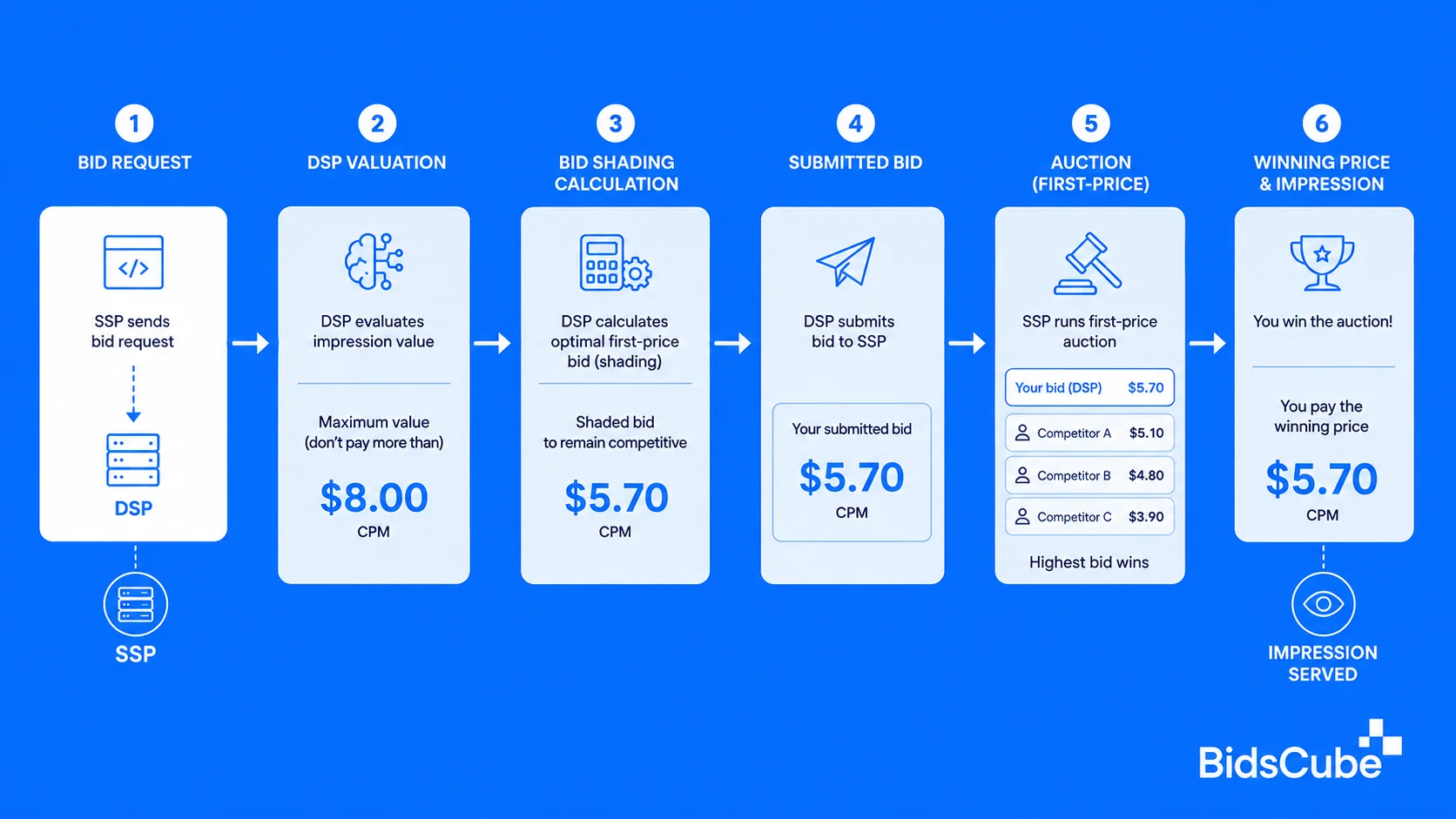
A shading model does not know the next competing bid. It works from available signals and past results.
- The SSP sends a bid request. It can include format, domain or app, device, geography, floor price, and other permitted fields.
- The DSP checks campaign rules. It decides whether the impression matches audience, budget, frequency, and placement settings.
- The DSP sets a ceiling. The campaign may allow up to $8 CPM.
- The model estimates a competitive range. Similar auctions may suggest that $5.40 often wins.
- The DSP submits a lower bid. It may send $5.60 instead of $8.
- The auction clears. If $5.60 is the highest eligible bid, the buyer wins and pays $5.60.
- The result informs later bids. Wins, losses, floors, and price feedback change later calculations.
Google’s Authorized Buyers documentation describes a minimum_bid_to_win field for first-price auctions. The field can show the lowest amount that would have won an eligible previous auction, giving bidders useful feedback for later pricing decisions.
Read What Is Bidstream Data in Programmatic Advertising? for more on auction fields.
Review First-Price Buying
Use the BidsCube DSP to manage bid prices, budgets, targeting rules, and transaction reporting.
Types of Bid Shading Approaches
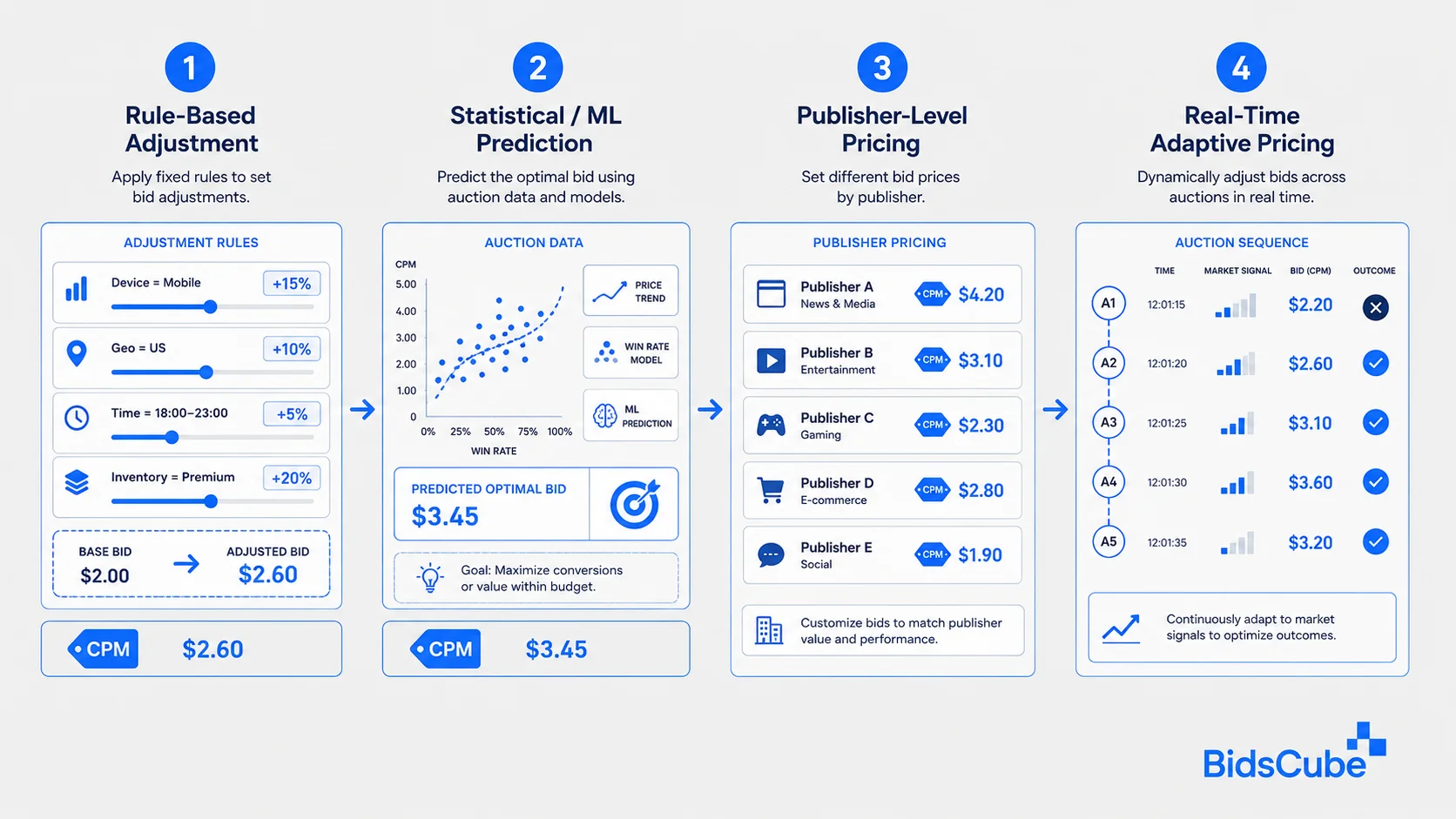
DSPs do not all use the same method.
- Rule-based shading. The system applies a fixed reduction based on floor price, publisher, placement, or campaign rules.
- Statistical or ML-based shading. A model estimates the likely clearing range from signals such as domain, ad size, device, geography, time, floor, and earlier auction results.
- Publisher-level shading. Bid logic changes for a specific publisher or SSP. One seller may need higher bids because competition is stronger.
- Real-time adaptive shading. Recent wins and losses change the next calculation. Too many losses can push bids up. Repeated wins by a wide margin can push them down.
This second use of programmatic bid shading shows why one fixed percentage rarely fits mixed inventory.
Benefits for Advertisers
The main benefit is paying less when a lower bid would have won anyway.
Other gains include:
- Lower average winning cost
- More impressions from the same budget
- Less manual bid adjustment
- Clearer comparison across SSPs and publishers
- Better links between media cost and campaign results
The second use of bid shading belongs in campaign reporting, not just auction theory. A lower CPM is useful only if reach, conversions, and spend pace remain healthy.
See Programmatic Metrics That Define Campaign Success for a wider measurement set.
Limits and Trade-Offs
New inventory can be difficult because the DSP may have little auction history for a domain, app, placement, or deal.
Aggressive cuts can hurt delivery. When bids fall below the market price too often, win rate drops and the campaign may miss spend targets.
Different DSPs also use different logic. A buyer may see the submitted bid and result without seeing every factor behind the model.
Floor prices add another variable. Publishers can change them by placement, geography, device, or demand source.
That is why the second first-price auction bid shading test should compare win rate, spend pace, CPM, conversions, and publisher mix after any material rule change.
How BidsCube Can Help
BidsCube provides a DSP for programmatic media buying. Its DSP page lists bid price controls, budget distribution, transaction history, daily caps, PMP deals, frequency caps, and real-time reporting.
BidsCube also discusses custom bidding logic and shading as tools for first-price buying. Its programmatic material recommends setting bid rules around audiences, inventory, floors, and campaign requirements rather than applying the same price everywhere.
A bid shading first-price auction setup should be tested on real traffic. One publisher may respond well to a lower bid. Another may need a higher price because floors or bidder density differ.
The practical question is whether the method saves media spend without cutting too much delivery. Compare bid price, transactions, spend, and campaign results before applying the same rule across more inventory.
Independent client reviews are available on the BidsCube Clutch profile.
Final Thoughts
Shading exists because first-price auctions make overbidding costly. The buyer pays what it submits, so the DSP has a reason to estimate how much of the ceiling is actually needed.
Enough auction history matters. So does measurement. Lower media cost is useful only when the campaign still reaches the right inventory and meets its business target.
Our tech staff and AdOps are formed by the best AdTech and MarTech industry specialists with 10+ years of proven track record!

FAQs
What Is Bid Shading in Programmatic Advertising?
It is a method that lowers a submitted bid below the advertiser’s maximum while trying to keep it high enough to win a first-price auction.
Why Did Bid Shading Become Necessary After the Shift to First-Price Auctions?
First-price winners pay their submitted bids. Buyers needed a way to avoid paying the full ceiling when a lower amount could still win.
How Does a DSP Calculate the Right Amount to Shade a Bid?
A DSP can study floor prices, publisher history, device, geography, ad size, time, and previous wins and losses. It then estimates a bid range for a similar auction.
Does Bid Shading Reduce My Campaign’s Win Rate?
It can. A cut that goes too far gives competitors more chances to win.
Is Bid Shading the Same as Bid Optimization?
No. Shading focuses on the submitted auction price. Broader bid management can also account for pacing, conversions, audience priority, and budget allocation.
Can Bid Shading Be Turned Off for Specific Campaigns?
That depends on the DSP. Buyers should check whether the platform supports manual rules, campaign-level settings, or custom bidding logic.


