



Bidstream data in programmatic advertising is the set of signals passed through a bid request during a real-time auction. It allows advertisers to assess the value of an impression and allows publishers to objectively describe their inventory in a way that can facilitate better monetization.
Table of Contents
Bidstream data links the impression that can be bought, the information surrounding that impression, and then the auction logic that enables buyers to respond in milliseconds. OpenRTB remains the main standard behind this process, and IAB Tech Lab still lists OpenRTB 2.6.x as the active release line in its Supply Chain & Foundations standards.
- For advertisers, programmatic bidstream data improves targeting, bidding, fraud checks, and creative selection.
- For publishers, it makes inventory easier to package, price, and sell through the SSP, DSP, and white-label ad exchange layers that power modern auctions.
That is the practical answer to what is bidstream data and why it matters.
The Definition of Bidstream Data
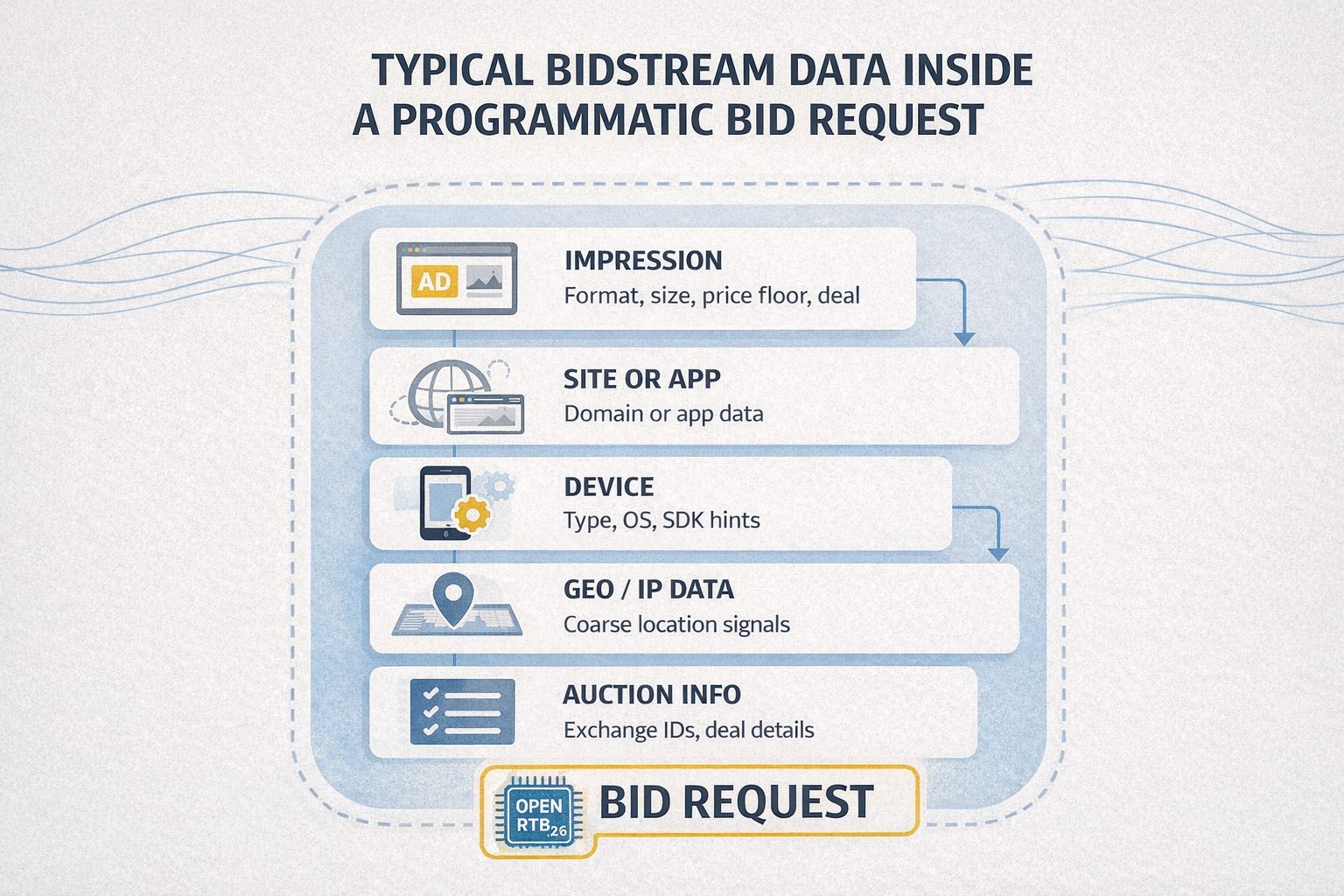
Bidstream data is the information carried inside a bid request as an impression moves from a publisher to an SSP, then to an ad exchange or exchange-like auction environment, and finally to DSPs that decide whether to bid. In technical terms, the bid request is the auction payload. It usually contains an impression object, either a site or app object, device details, some user or session signals where allowed, and transaction metadata that helps the buyer evaluate the opportunity.
The exact content of bid request data depends on the platform, privacy settings, consent status, and channel. Some requests include device and geo signals, while non-personalized requests can remove or reduce user identifiers and other addressability data. Google’s Authorized Buyers documentation, for example, notes that non-personalized bid requests remove buyer user IDs and device advertising IDs, while geolocation is derived from IP data and shared at a coarse level.
| Field | Description | Who Uses It |
| Impression (imp) | Describes the ad opportunity, format, size, floor price, and deal data | SSPs, DSPs, exchanges |
| Site or App | Identifies whether the inventory is from a website or an app, plus domain or app details | DSPs, advertisers, verification partners |
| Device | Includes device type, OS, browser or SDK details, connection hints, and privacy-limited identifiers | DSPs, measurement vendors |
| Geo / IP-derived location | Gives coarse location signals for targeting, fraud screening, and reporting | DSPs, advertisers, fraud tools |
| User / session signals | Can include pseudonymous IDs, frequency, or session data when policy allows | DSPs, advertisers |
| Supply and auction metadata | Covers exchange IDs, deal IDs, billing info, and other transaction data | SSPs, DSPs, finance and ops teams |
This is why bidstream data in programmatic advertising is not just “user data.” It is a transaction layer that describes the impression, the context, and the route that the opportunity takes through the auction.
How Is Bidstream Data Collected?
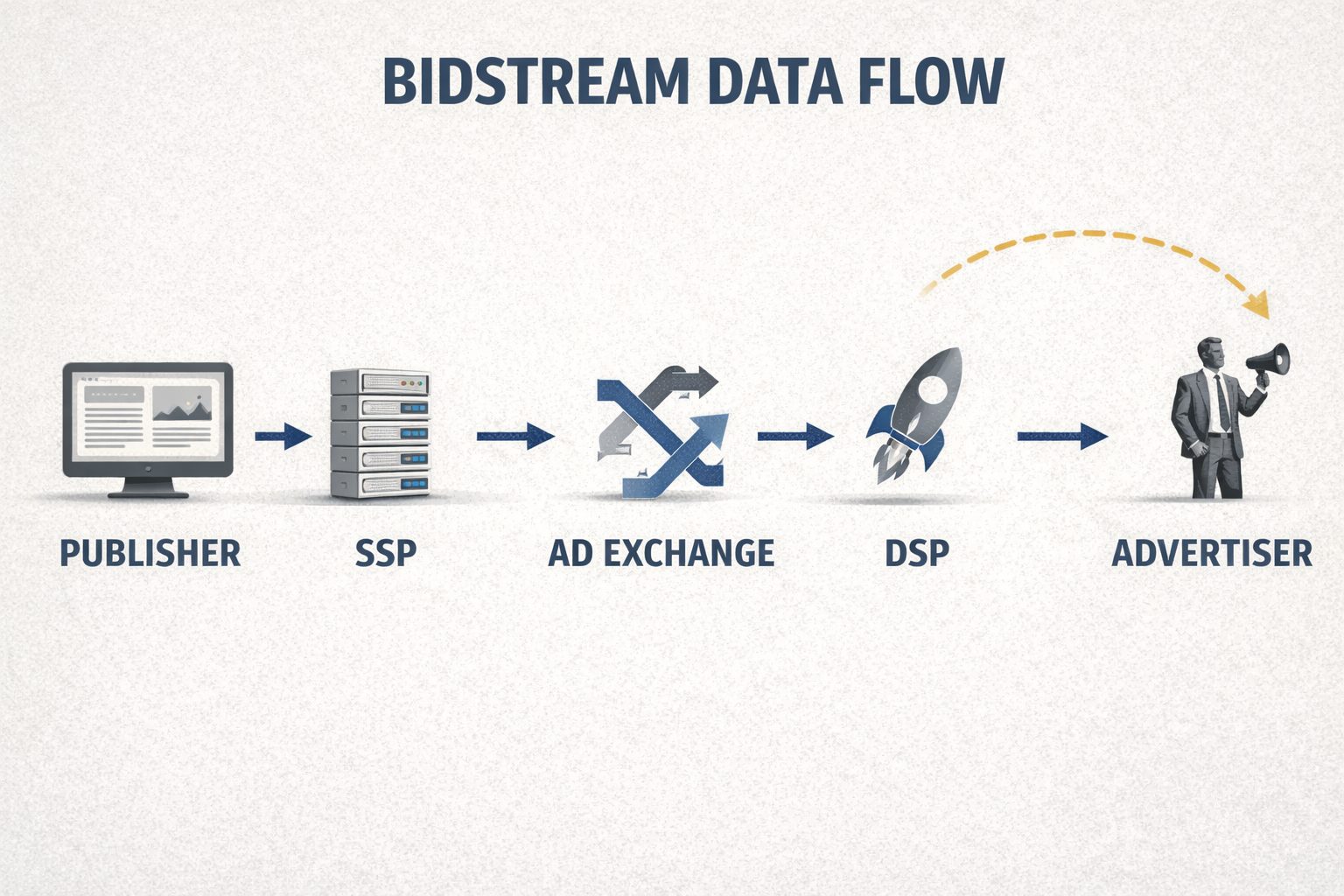
This begins when a user opens some page or app screen with an ad space. A publisher or app sends information about that slot and its context to an SSP. The SSP wraps that information up in a bid request and sends it off into a realtime bidding stream, where the DSPs assess the opportunity and return a bid, all on the fly, if it conforms with what they want based on their targeting and pricing algorithms. The auction runs in milliseconds, and the winning ad is served back through the chain.
A simplified RTB flow looks like this:
- User opens a page or app with an ad placement.
- Publisher creates the ad call and passes inventory details to the SSP.
- The SSP sends an ad exchange bid request using OpenRTB or a related implementation.
- DSPs read the request, score the impression, and decide whether to bid.
- The auction selects a winner.
- The winning creative is returned and shown to the user.
This will make the SSP and DSP data flow easy to scan.
Real-World Example: How Bidstream Data Works in Practice
Imagine a user browsing a fashion retailer on a mobile phone. When the page loads, the publisher passes the available impression, page context, device type, and location-level signals allowed by policy into the auction. A clothing advertiser using a DSP sees that the impression matches its audience and bids aggressively because the context and device signals suggest strong purchase intent. If that bid wins, the ad is rendered almost immediately.
That example shows the value of bid request data. The advertiser does not need a full personal profile to make a decision. It needs enough real-time context to judge relevance, price the impression, and respond fast.
Benefits of Bidstream Data
For Users
Bidstream-based auctions can support more relevant ads without always relying on long-lived third-party cookie tracking. In many environments, privacy rules already reduce or remove identifiers from the request, which limits the amount of user-level data shared in the auction. That makes cookieless targeting and contextual decision-making more important.
For Publishers
Publishers use programmatic bidstream data to describe inventory more clearly, attract suitable demand, and support yield optimization. Better structured requests can improve how buyers value impressions, especially when the request includes strong context, clean app or domain data, and transparent supply information. That is one reason supply-chain standards like ads.txt and sellers.json matter so much.
For Advertisers
Advertisers use bidstream signals to score impressions, set bids, choose creatives, and screen for fraud or low-quality supply. The more reliable the request, the better the buyer can judge whether an impression matches campaign goals. This is one of the clearest practical answers to what is bidstream data from the buy-side point of view.
Bidstream Data in a Cookieless World
Bidstream data still matters in a cookieless market, but the way it is used is changing. The Topics API is part of the Privacy Sandbox relevance and measurement APIs, which are now generally available in Chrome and aims to facilitate interest-based advertising in manner that doesn’t expose a user’s complete web browsing history. This means that bidstream signals today operate in conjunction with browser-based privacy tools, first-party data, and contextual targeting rather than relying on third-party cookies in isolation.
The changeover is practical for publishers and advertisers. First-party data is so vital because it directly comes from your audience. Another reason why bidstream does not become outdated is because it talks about the live impression and auction context.
In contrast, third-party cookies are becoming increasingly unreliable as the industry shifts towards privacy-safe solutions. LiveRamp announces this change: its focus with the ATS and RampID is both on attention to authenticated audiences and interoperable identity inside the cookieless browser.
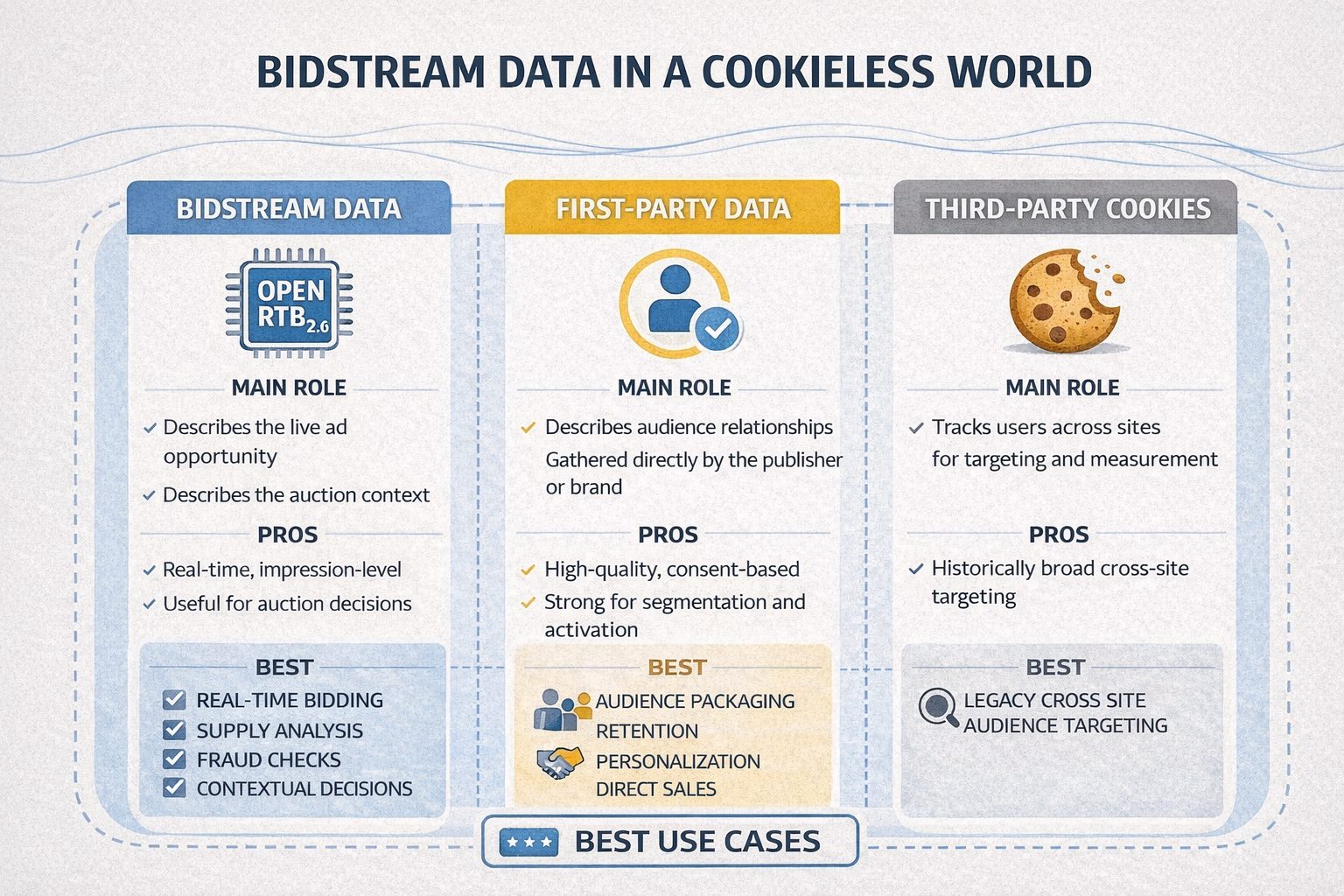
| Parameter | Bidstream Data | First-Party Data | Third-Party Cookies |
| Main Role | Describes the live ad opportunity and auction context | Describes audience relationships gathered directly by the publisher or brand | Tracks users across sites for targeting and measurement |
| Pros | Real-time, impression-level, useful for auction decisions | High quality, consent-based, strong for segmentation and activation | Historically broad for cross-site targeting |
| Cons | Limited by privacy rules, not built for deep profile history | Scale depends on login or direct relationship depth | Weakening due to browser and privacy changes |
| Best Use Cases | Real-time bidding, supply analysis, fraud checks, contextual decisions | Audience packaging, retention, personalization, direct sales | Legacy cross-site audience targeting |
This is why bidstream data in programmatic ads is still relevant even as cookies lose ground. It is not a replacement for first-party data, but it is a key layer in modern cookieless targeting.
What Is the Future of Bidstream Data?
The future of bidstream data will be shaped by two forces: better auction standards, and better supply-chain transparency. IAB Tech Lab still lists OpenRTB 2.6.x as the active protocol family, while OpenRTB 3.0 split the model into a transaction wrapper and AdCOM, the reusable advertising object model. At the same time, supply-chain standards such as ads.txt, sellers.json, and the SupplyChain object continue to improve how buyers verify who is selling inventory and how that inventory reaches the market.
That matters because cleaner supply paths make bid data request more trustworthy. IAB Tech Lab explains that ads.txt lets publishers publicly declare authorized sellers, while sellers.json and the OpenRTB SupplyChain object help buyers identify direct sellers and intermediaries in the path. In other words, the future of the programmatic bidstream is not only richer signaling. It is also better validation.
If you want a better view of how infrastructure choices affect bidstream handling, you can review BidsCube’s white-label ad exchange, DSP, and SSP stack, then compare real client feedback on Clutch and G2.
Conclusion
Programmatic ads contain bidstream data, or the real-time auction data that the publisher uses to describe inventory and the advertiser uses to determine whether to place a bid. It is the nexus of real-time bidding, as it contains the impression details, context, and transaction signals that enable the auction.
In a privacy-sensitive market, bidstream data delivers best when augmented with first-party data, contextual targeting, and transparent supply standards. That is the long and also short explanation of what the bidstream data is, and why is it still a central feature of programmatic infrastructure.
Our tech staff and AdOps are formed by the best AdTech and MarTech industry specialists with 10+ years of proven track record!

FAQ
What is bidstream data in programmatic advertising?
Bidstream data in programmatic advertising is the set of signals passed in a bid request during a real-time auction. These typically contains information, such as impression details, context about the site or application, device signals, and transaction metadata that guide a buyer bid decision.
What data is included in a bid request?
Typical bid request data includes the impression object, site or app details, device information, geo signals, and auction metadata such as deal or billing information. What exact fields are depends on things like platform rules, consent status, and whether the request was personalized or non-personalized.
How does bidstream data work without third-party cookies?
Third-party cookies would not work with bidstream at all because the bidstream describes the live impression and auction context, not just long-term cross-site identity. It may also be used in conjunction with first-party data, contextual targeting, and browser tools like the Topics API in a privacy-focused environment.
What is the difference between bidstream data and first-party data?
Bidstream data is real-time information at the moment of an auction about the ad opportunity currently on offer, and first-party data is information obtained directly by the publisher or brand in a direct relationship with their audience. They each address divergent concerns, and therefore are all really helpful, none less than the other.


