



Alt: Planner connects CTV campaigns across devices and channels.
Table of Contents
CTV is not just a small side channel for brands to experiment with video.
- U.S. digital video ad spend grew 18% Y-Y in 2024 to $64B, and IAB expected that number to be $72B in 2025 and was on point.
- In October, eMarketer also forecast U.S. CTV ad spending at $33.35 billion in 2025 and $46.89 billion by 2028.
That change is a reflection of how viewers watch video now. As an example, viewers have transitioned away from full dependence on linear TV and started employing Smart TVs, Roku, Apple TV, Chromecast, gaming consoles and apps to view streamed media. Enter connected TV advertising, where all the ads run on streaming content in devices that are plugged into TVs, but the targeting, measurement and optimization of advertisers can be digital-like.
With the ability to tailor content for older social media channels, this serves as a handy compromise for brands. CTV preserves the scale of TV while augmenting it with the precision marketers have come to expect from programmatic media buying. Advertisers can use the BidsCube DSP to programmatically access CTV inventory, apply audience and contextual targeting and track performance in real-time.
Competition is growing too. For many brands, CTV has become less about reach and more about retargeting, product launches and lower-funnel campaigns over the last decade+ Here are five CTV creative best practices that can enhance CTV ad performance, while ensuring the campaign does not look like an extended version of a TV spot.
What Makes CTV Advertising Effective?
CTV is video ads shown on big screens (Smart TVs and devices such as Roku, Apple TV, Chromecasts, etc.) over streaming providers. Because CTV allows for programmatic buying, we can no longer achieve targeting, measurement and personalisation all at once with linear TV.
The strongest CTV ad tips focus on five basics:
- QR codes for activation;
- omnichannel planning;
- a clear narrative;
- a specific CTA;
- and audio that works in an unmuted environment.
These CTV best practices help brands connect TV-style attention with digital-style action.
| Parameter | Linear TV | OTT | CTV |
| Delivery Device | Cable or antenna | Any connected device, including mobile, desktop, and TV | Smart TV, Roku, Apple TV, Chromecast |
| Targeting | Broad demographic targeting | Behavioral and contextual targeting | Household-level, behavioral, and contextual targeting |
| Measurement | Ratings and GRP | Digital metrics | Digital metrics plus TV attribution |
| Ad Format | Standard 15- or 30-second spots | Pre-roll, mid-roll, overlay, and video | Non-skippable, interactive, and QR-enabled video |
| Pricing | Mostly fixed CPM | Auction or fixed deals | Mostly auction-based RTB and private deals |
Use QR Codes to Activate the Audience
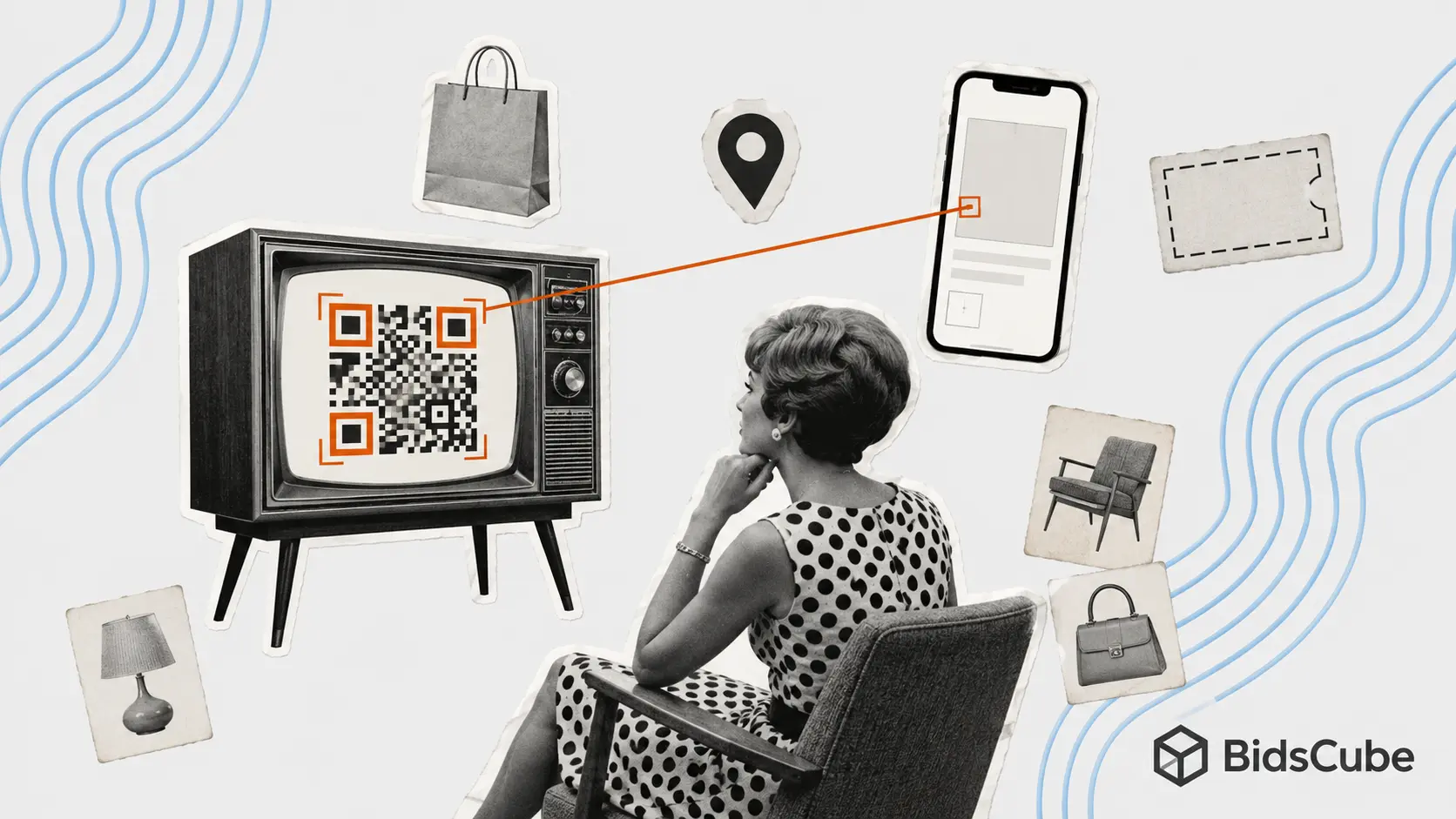
Of course, the benefits of TV advertising are obvious. But there is one clear gap: viewers who see an ad and want the product cannot click the TV screen in the same way they would click a mobile or web ad. They need a simple next step. A QR code solves part of this problem.

Add a QR code near the end of your CTV ad and keep it on the screen long enough for a viewer to scan it. Most viewers have a smartphone nearby while watching TV. A scan can send them to a landing page, product page, app store, coupon, booking form, or local store finder.
For example, a retail brand can show a 20-second CTV ad for a seasonal product line, then add a QR code with “Scan to shop the collection.” An auto brand can use a QR code to send viewers to a local dealer page or test-drive form. For example, a food delivery brand can link the QR code with an offering that is valid for selected cities and has some time bound offer. Looking over CTV creative case studies from retail, automotive, and B2B campaigns can illustrate how QR codes, storytelling, and CTA timing cater to delivery aspects of the buying journey. Developing a code is inexpensive.
Developing a code is inexpensive. Free and paid QR tools can create trackable codes, add a logo, and show scan data. The key point is not which generator wins a ranking. The key point is whether the QR action matches the viewer’s intent and whether the landing page loads fast on mobile.
This is one of the simplest CTV ad tips : do not ask viewers to remember a URL unless the URL is short and obvious. Give them a scan path instead.
Include CTV in Your Omnichannel Strategy
Any advertising channel becomes more effective when it is part of a cross-channel strategy aimed at one specific audience. CTV also gives advertisers a practical way to use data from other channels to improve targeting and creative decisions.
- Use your CRM list to direct existing customers to new product launches.
- Exclude existing buyers when the campaign goal is customer acquisition.
- Apply user data to target similar consumers and find new prospects.
- Use retargeting windows to follow up after CTV exposure on display, mobile, or social.
- Use data from search, web, app, and BidsCube SSP inventory sources to inform CTV audience planning.
Collecting, analyzing, and applying information correctly helps you organize audience data and improve campaign decisions. CTV advertising in an omnichannel strategy keeps the user journey more consistent because insights do not sit in disconnected channel reports.
A DSP also helps manage frequency across CTV and display. For instance, instead of the same TV spot as repeated CTV exposure, a viewer can see the top CTV messaging once or twice and follow up with a display ad reminding them of the product. This is one of the most pragmatic Connected TV best practices because it safeguards the budget and minimizes frequency fatigue.
So is the remarketing strategy because you do not lose out on a potential customer who has already expressed interest in the brand or product. Another of the core Connected TV best practices is to cap exposure across CTV and display, so viewers do not receive repeated versions of the same campaign.
Craft a Strong Narrative for Your CTV Campaign

A well-built script directly affects the final effectiveness of your CTV advertising. It is important not just to talk about your offer, although this is the main purpose of advertising. You need to show what problem your audience has, why it matters, and how your product helps.
The script should include situations and details that feel close to the audience. Remember that your ad has only a few seconds to hook the viewer before attention drifts to a phone, laptop, or another person in the room.
The way you tell it can be the difference between a successful CTV advertising campaign, and one that flops. Whether you have 15, 20 or even 30 seconds, follow a clear narrative. Sometimes, if there are several short videos that could be tied with one storyline, mini-series formats can also work. There is also reasoning behind the story: one ad presents the problem, another introduces the product, and a final ad provides an offer.
These CTV creative examples work because they respect the way people watch streaming content. Viewers do not need a full brand manifesto. They need a clear setup, one message, and a reason to act.
The potential buyer must understand your message quickly. Keep it simple, concrete, and memorable. A strong CTA can support the narrative, but it should not feel disconnected from the story. Visual effects, voice-over, sound effects, and dialogue should help the story, not compete with it.
Make it Actionable
Some advertisers reuse linear TV ads for CTV. That can work as a starting point, but CTV gives more room for interaction, testing, and measurable response. A few small creative changes can make the same video perform better.
Start with a clear call to action. The CTA should match the campaign goal and the audience’s likely behavior. Examples include:
- “Scan to shop” for retail and ecommerce.
- “Book a test drive” for automotive.
- “Find a store near you” for local retail.
- “Visit bidscube.com/dsp” for B2B campaigns.
- “Scan for the offer” for short-term promotions.
Scannable codes via phones often seem like a natural way for under-50 viewers, whose scanning behavior is part of just about everything they do with their hand held devices. A QR code can have viewers take action before the curtain falls rather than ask them to call back to the brand after.
Location matters too. When you have retail products, connect your online and offline actions. An example is to use a CTV ad that promotes a product found in stores on the same block, and link the viewer to a local inventory URL.
Programmatic DSP also help to measure CTA performance. Campaign reports can link QR scans, landing-page visits, view-through actions and audience follow-up. This coverage extends a CTV spot beyond just a brand placement, into an attribution-driven performance channel.
Use Sound to Your Benefit

If advertisers use banners on mobile devices or PCs, banners are silent. Many mobile and web video ads can also load muted by default. The viewer has to turn the sound on, and many will not.
CTV is different. Viewers usually watch streaming video with sound on because they are watching long-form content on a TV screen. This makes audio a bigger part of the creative. Use music, voice, dialogue, and sound effects to support the message, not just to fill silence.
For a 15-second spot, keep the audio message tight. The brand name, value point, and CTA should arrive fast. For a 30-second spot, you have more room for a short scene, dialogue, or sound cue that builds memory.
Audio helps shape how viewers remember your company. Your goal is to create a clear association between the brand and the feeling you want to leave. Calm music can support trust. A sharper sound cue can support action. Dialogue can work when it sounds natural and does not bury the CTA.
Layered captions can still help, even when sound is on. Captions support viewers in noisy rooms and make key phrases easier to remember. This is one CTV creative best practice that works across many categories.
Five CTV Tips: What To Do And Why
| Tip | Key Action | Expected Result |
| QR Codes | Add a QR code near the end of the ad | Direct path from TV view to product page, app, or offer |
| Omnichannel | Connect CTV with CRM, display, and retargeting | More consistent user journey across channels |
| Narrative | Build a story arc in 15 to 30 seconds | Higher brand recall and clearer message delivery |
| Actionable CTA | Use one specific CTA that matches the campaign goal | Better engagement and cleaner conversion tracking |
| Sound | Build audio for an unmuted viewing environment | Stronger brand association and clearer message recall |
The most useful CTV creative case studies compare several creative versions against the same audience, budget, and campaign goal.
These CTV creative best practices work best when the campaign has one main goal. A prospecting campaign may focus on reach and recall. A retail campaign may focus on scans, store visits, or product-page traffic. A B2B campaign may focus on site visits and lead actions.
How BidsCube Enables Programmatic CTV Advertising
BidsCube helps advertisers buy, manage, and measure CTV inventory through programmatic tools. The BidsCube DSP supports programmatic CTV advertising by giving teams a way to control targeting, bidding, frequency, and reporting from one platform.
Core CTV buying options can include:
- Household-level targeting for TV-connected environments.
- Behavioral targeting based on available audience signals.
- Contextual targeting based on content category and placement logic.
- Device and geo settings for more precise delivery.
- Frequency capping across CTV and other programmatic channels.
- Real-time reporting to track spend, impressions, and performance signals.
In addition, CTV can help run omnichannel campaigns. Your team can leverage CTV for reach, Display to follow up, and Action via Mobile or Web placements. This helps advertisers bridge the gap between upper-funnel awareness on larger screens and lower-funnel activity.
BidsCube also supports broader marketplace workflows through its white-label Ad Exchange. That can matter for companies that manage both supply and demand relationships across video, display, native, and CTV inventory.
If you plan to test CTV ad buying or need more control over connected TV programmatic campaigns, review the BidsCube DSP and contact the team.
What’s Next?
Brands benefit from precisely targeted, more measurable, and high attention video environments with CTV advertising. The ideal format is one created for the channel rather than recreated from linear TV with no tweaks.
Use the five CTV best practices above as a working checklist: QR code → omnichannel logic → narrative → CTA → sound that resonates with viewers on a TV-powered environment. If you need a full-featured platform for CTV buying and campaign control, review BidsCube DSP. For vendor checks, you can also review BidsCube на Clutch.
Our tech staff and AdOps are formed by the best AdTech and MarTech industry specialists with 10+ years of proven track record!

FAQs
What Is CTV Advertising?
CTV advertising is video ads shown on streaming platforms on Smart TVs and connected devices. CTV is different from linear TV in that advertisers can apply targeting, digital measurement and programmatic buying.
How Is CTV Advertising Different From OTT?
CTV stands for Smart TVs such as Roku, Apple TV, Chromecast, and similar devices to name a few. OTT, on the other hand, describes the content delivery method, meaning that video content streams through the internet rather than through cable or satellite channels.
How Do QR Codes Work In CTV Ads?
QR code ads are straightforward: the QR code appears along or following a CTV ad. Users scan the code using the smartphone, and redirect to product page, app store, lead form, coupon or store locator.
How To Measure CTV Advertising Effectiveness?
To measure CTV advertising performance, marketers use view-through attribution, QR scan tracking, household IP matching, site visits, and conversion events. Several DSP platforms are available with real-time dashboards to track the campaigns such as BidsCube.


