



Verticals of the programmatic advertising landscape Identification of sequencing in the acquisition of advertisements: Why programmatic advertising?
Table of Contents
The programmatic advertising market is still transforming, due to the fact that digital media buying is now based on pace, information, computerization, and flexible estimating.
- Global ad spend hit close to $1.1 trillion in 2024, driven primarily by digital. According to DataReportal which aggregated the Statista Market Insights data, in 2024 social media alone attracted nearly a quarter of a trillion U.S. dollars in ad spend.
- The market outlook for 2025 also highlights a more significant change in ad spend. Global ad revenue was already said by WPP Media to total $1.08 trillion in 2025, with the digital advertising market making up 73.2% of that, according to Reuters. The US continued to be the biggest ad market, with a forecast of ad revenue of US$ 404.7 billion.
In this article, we take a look at recent programmatic advertising statistics, differences between the regions, channel distribution, and trends that influence the market. It also answers a frequently asked planning question: What percentage of digital advertising is programmatic?
Short Answer: Programmatic has become almost all display buying in mature markets, CTV & retail media continues to grow, and mobile,DOOH & digital audio all still gaining traction in our case studies.
Programmatic Advertising Market: Key Numbers and Regional Breakdown
As advertisers shift more buying through automated platforms, programmatic ad spending continues to grow worldwide. According to eMarketer, global spending on programmatic display ads was expected to increase by 14.6% in 2025, which illustrates that programmatic is still one of the main engines for growth when it comes to display advertising.
The IAB and PwC Internet Advertising Revenue Report revealed that in the U.S., programmatic advertising revenue in 2024 was $134.8 billion, an 18% increase compared to 2023. The latter reinforces the continuing strength of the US programmatic advertising market by helping buyers move more digital display, video and CTV buying into automated channels.
North America
Programmatic activity is greatest in North America. According to Mordor Intelligence, in 2025, North America occupied 37.5% of the programmatic advertising market. The high positioning is the result of strong high digital ad maturity, platform adoption, and deep buyer demand, as well as significant investment from US-based advertisers.
The US programmatic advertising market also benefits from large-scale retail media, CTV, mobile video, and social buying. Buyers in this region often treat programmatic not as a single channel, but as buying infrastructure across several formats.
Asia-Pacific
The Asia-Pacific is the largest and fastest-growing regional market. In this regard, Mordor Intelligence in their global market outlook has suggested that Asia-Pacific will be the fastest-growing region, with 12.3% CAGR until 2031. Over the same period, its stand-alone Asia Pacific forecast estimates the region’s programmatic market will reach A$206.22 billion ($210.22 billion) by 2025, with further growth continuing beyond 2031.
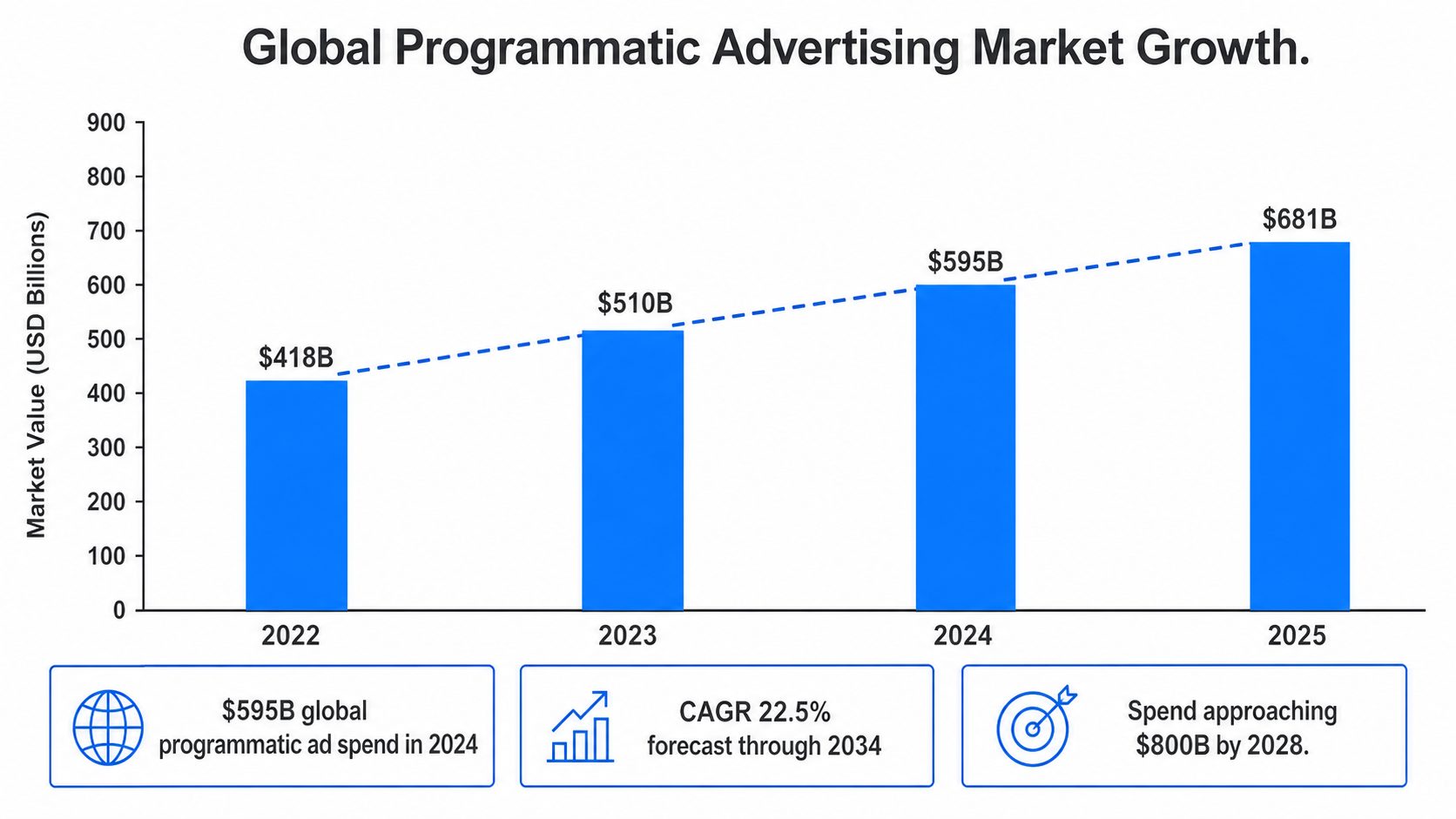
The wider programmatic advertising growth in the regions can be attributed to contributions from China, India, Japan, South Korea and Southeast Asia alike.
Australia & Oceania
The most exploding region market is Asia-Pacific, taking the largest fiber segment. As per Mordor Intelligence in their conducted global market outlook, it is been stated that till 2031, Asia-Pacific will be the fastest-growing region with CAGR 12.3%.
Australia still is comparatively more mature market. The Australian internet advertising market was valued at $18.4 billion in 2025 and grew 11.5% year-on-year according to IAB Australia, with video accounting for a large part of the increase. While Australia’s programmatic market is smaller than the North America and Asia-Pacific, it represents an amalgamation of automation that spans video, mobile, social and DOOH.
Distribution of Programmatic Advertising
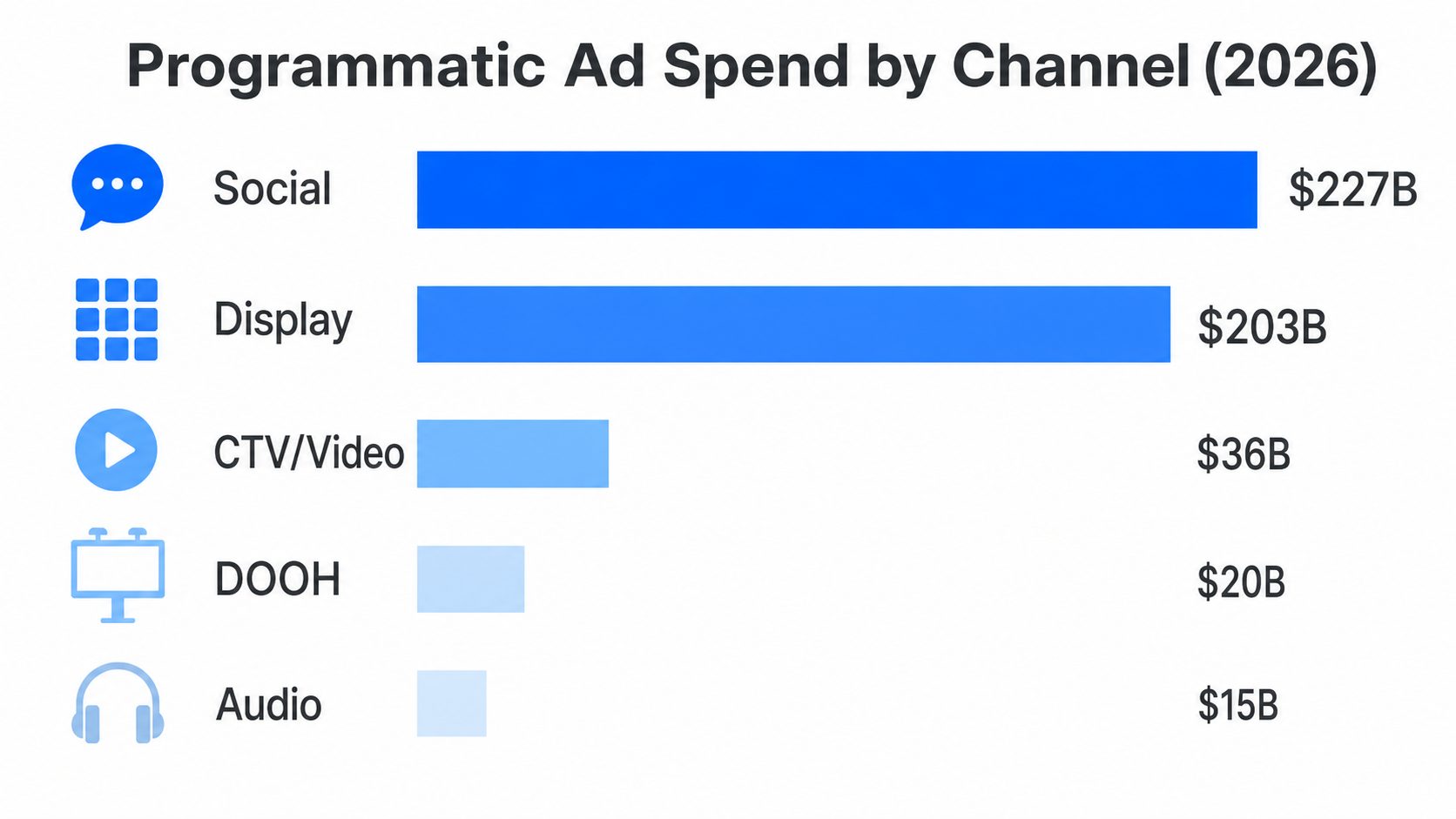
Programmatic now supports several major media channels. It no longer covers only display banners. Advertisers use automated buying for social, video, audio, DOOH, native, mobile, and CTV.
| Channel | Market Size | Key Player | Growth Driver |
| Social media advertising | Close to $250 billion in global ad spend in 2024 | Meta, TikTok, YouTube, LinkedIn | Mobile-first content, creators, and performance campaigns |
| Digital video and CTV | U.S. digital video spend reached $64 billion and was projected to reach $72 billion in 2025 | YouTube, Netflix Ads, Roku, Amazon | Streaming growth, CTV inventory, and audience targeting |
| Programmatic display | U.S. programmatic revenue reached $134.8 billion in 2024 | Google, The Trade Desk, Amazon, DSPs | Automated buying, audience data, and bid optimization |
| Digital audio | Growing through podcasts, streaming music, and programmatic audio platforms | Spotify, Amazon, SiriusXM, podcast networks | Mobile listening, host-read ads, and dynamic audio insertion |
| Digital out-of-home | Expanding through programmatic DOOH and real-time screen buying | JCDecaux, Clear Channel, Vistar, Broadsign | Location signals, footfall data, and flexible buying |
This channel mix shows why the digital advertising market now depends on platform control and reporting quality. If a team needs to connect supply and demand across channels, a White Label AdExchange can support marketplace-level control, partner routing, and direct trading.
Secondary Factors Influencing the Programmatic Advertising Market
The global programmatic market is influenced by a multitude of factors, with mobile use, connected devices, 5G, streaming and retail media commanders. The way advertisers plan campaigns, purchase inventory and measure the outcome is transformed by these factors.
Mobile advertising
People spent an average of 3 hours 46 minutes on their mobile device every day and today it seems like unimaginable without your phone being connected to the internet. Then businesses leverage this international trend to promote their products and services online.
The mobile marketing market is anticipated to grow five times between 2020 and 2030 as we look forecast 2030. The fact that this is growing each day at such a large scale just goes to show how integrated with mobile, the current digital infrastructure is. Mobile devices represent one of the most indispensable tools for personal use, likewise invaluable channels for businesses to connect and establish transactional relationships with their intended audience in a dynamic digital landscape.
5G commercial services
5G mobile subscriptions are forecasted to grow exponentially, and reach almost 5 billion worldwide by 2026. In particular, North and Southeast Asia are expected to be frontrunners in the transition to 5G, as the new technology becomes commonplace in other parts of the world.
A concrete example is how faster internet speeds correlate with less struggle to download new and creative ad formats. Its fast-paced growth signifies the game-changing capacity of 5G that is propelling a new age of worldwide connectivity and progression.
Screen Time Usage
Screens have become ubiquitous in our lives, phones, tablets, smartwatches, TVs, and nearly all of them interconnected and connected to the internet. So it is no surprise then that over more time using the internet through these screens has continued to grow. CTV has started to expand its entire screen usage in some areas, while the linear TV has continued to decline with its viewers slowly moving to video on demand.
Recent data show that the average person now spends 6 hours and 58 minutes a day in front of connected screens. Extrapolated to the size of the global internet user base this increase equates to an average of five billion additional screen hours per day. On average, we spend an additional 49 minutes per day on our screens, a monstrous 13% increase since 2013.
What is more, recent statistics indicate that people are actively engaged with screen-based devices that are online for more than 40% of the time we are awake. Since mobile device screen time surged 30% from 2 hours and 56 minutes in 2019 to 4 hours and (12 minutes) in 2021, we can almost guarantee that global screen time averages will only ever continue to climb.
Video-on-Demand Popularity
In recent years, video-on-demand services have had a remarkable surge in popularity, primarily propelled by the widespread use of OTT platforms and the rise of CTV devices, such as Netflix and Amazon Prime, that people can now watch on TV set-top boxes, game consoles, and other gadgets.
| Factor | Impact on Programmatic | Trend Direction |
| Mobile advertising | Pushes more budgets into in-app, mobile web, and short-form video inventory. | Growing |
| 5G adoption | Supports richer ad formats, faster video delivery, and lower latency. | Growing |
| Screen time | Gives advertisers more addressable moments across mobile, CTV, desktop, and tablets. | Stable to growing |
| Video-on-demand | Moves TV-style budgets into CTV and programmatic video. | Growing |
| Retail media | Connects commerce data with programmatic buying and closed-loop reporting. | Growing |
Look for a Supply-Side Platform to help balance your inventory, price it, and even manage who consumes it for you! A Demand-Side Platform enables bidding, targeting, pacing and rules to be defined (used by advertisers).
What are We Waiting for in the Future?
A deep dive into the programmatic advertising market quickly reveals there are certain factors and processes already at work that will soon boost the entire industry. In this context, we would be pleased to highlight some of the most fascinating and promising events that, for us, will have great impact.
AI In Programmatic
AI in programmatic is moving from broad hype to specific use cases. With the new buyers using AI for bid optimization, budget pacing, fraud detection, creative testing, audience scoring, and anomaly alerts. This is because the ultimate objective is simple: waste less before affecting the campaign performance too negatively.
AI also helps teams read signals faster than manual reporting can. For example, algorithms can flag rising CPMs, poor placement quality, weak conversion probability, or suspicious traffic patterns. This supports better programmatic ad spending decisions without turning every campaign into a black box.
Personalized Content
While earlier, practitioners had relied on unlimited tracking, today, personalized advertisements depend on consented data, contextual signals and well-defined creative rules. Brands utilize first-party data, product feeds, location, device type, and even on-site behavior to refine messages. The better approach is not “personalization everywhere.” It is relevant content where the signal is strong enough to justify the change.
White-Label Solutions
White-label and proprietary programmatic arguments that reference older IAB Europe in-housing research are not out of place. Media costs down 42% vs advertisers, operational control up 50% vs the agencies, and audience insights access up 60%. However, they should not be regarded as a new 2025 benchmark but simply as historical in-housing context.
Given that a lot of companies would love greater control over fees, data, access rules, and partner relationships, white-label platforms continue to play a significant role in the future fintech landscape even in October 2023. If your team explores vendors, third-party review sites, such as Clutch and G2 can support the research process.
Voice-Activated Advertising
Voice advertising continues to be a niche use case; it is not a top-five programmatic channel. They also support audio discovery and a branded prompt for smart speakers, voice assistants and even in-car systems as well. The opportunity exists but because measurement and attribution are still a work in progress, testers of voice formats should think carefully.
Omnichannel Approach Impulse
Now, however, programmatic growth is coming from connected planning across mobile, desktop, CTV, audio and DOOH and retail media. Then, how does the omnichannel buying benefits the advertisers when it comes to channel frequency, creative and budget across multiple touchpoints?
This is where programmatic advertising growth becomes operational. Teams need connected reporting, not just more inventory.
Conclusion
The global programmatic market internationally is growing larger, as advertisers demand more agility in purchasing, better metrics and faster hit back. North America is the leader by share, the fastest growing region in Asia-Pacific, and most developed digital market Australia in Oceania.
The main growth channels now include social, video, CTV, mobile, DOOH, and retail media. Programmatic will keep gaining ground as long as buyers can control data quality, partner access, and campaign transparency. For BidsCube, this creates a clear role for white-label DSP, SSP, and ad exchange infrastructure.
Our tech staff and AdOps are formed by the best AdTech and MarTech industry specialists with 10+ years of proven track record!

FAQs
What Is the Size of the Programmatic Advertising Market?
The dramatic expansion of the programmatic advertising market is evident, U.S. programmatic advertising revenue hit $134.8 billion in 2024. By 2025, it was predicted that total spend for programmatic display ads worldwide would be up 14.6%.
Which Regions Lead in Programmatic Advertising Spending?
In 2025, North America is Footwear expected to amass 37.5% market share in programmatic advertising. Mobile consumption, digital commerce, and growing platform adoption are making Asia-Pacific the fastest-growing region.
What Are the Main Programmatic Advertising Trends?
As for the trends? Topics: AI in programmatic CTV Growth Retail media Programmatic DOOH Mobile video Omnichannel buying These trends compel advertisers in search of cleaner data, optimised bidding rules, and clearer partnerships.
How Is AI Changing the Programmatic Advertising Market?
Programmatic does is changing thanks to AI bettering bid optimization, creative consideration/pacing, fraud detection, and audience scoring. You extract value from decision-making velocity, not from automating human campaign strategy.


