



Customer data and programmatic campaign records can help teams compare audiences, placements, costs, and outcomes. A big data AdTech process combines large event volumes with clear definitions, access controls, and a decision that the team can act on.
Table of Contents
- What is Big Data and How It is Related to Advertising
- Big Data vs Traditional Data Analysis in Advertising
- How Big Data Becomes Decision-Changing For Marketers?
- Turn campaign data into action
- Big Data = Big Opportunities
- How BidsCube Uses Big Data in Programmatic Campaigns
- To Sum Up
- FAQ
- What Is Big Data in Programmatic Advertising?
- How Is Big Data Used in Advertising?
- What Is the Difference Between Customer Data and Big Data in Marketing?
Programmatic data analysis should connect approved campaign signals with business results. Data in programmatic advertisement supports bidding, pacing, segmentation, and reporting, while big data in advertising also includes operational and financial records.
Customer data and programmatic records should only be connected for a defined and permitted purpose. A big data AdTech program needs consistent event names, access controls, retention rules, and documented reporting definitions.
Data is an incredibly valuable resource for the 21st century, comparable to petroleum. With the rapidly increasing volumes of information and data that are constantly emerging and diverse, it is no longer possible to process them as before. But with big data, we can uncover subtle patterns that humans can’t see and use them to make decisions based on precise algorithms, predictive models, and more.
But what kind of role does big data play in the modern advertising industry? Is it essential to current and all future advertising technologies? Let’s get to the bottom of it.
What is Big Data and How It is Related to Advertising
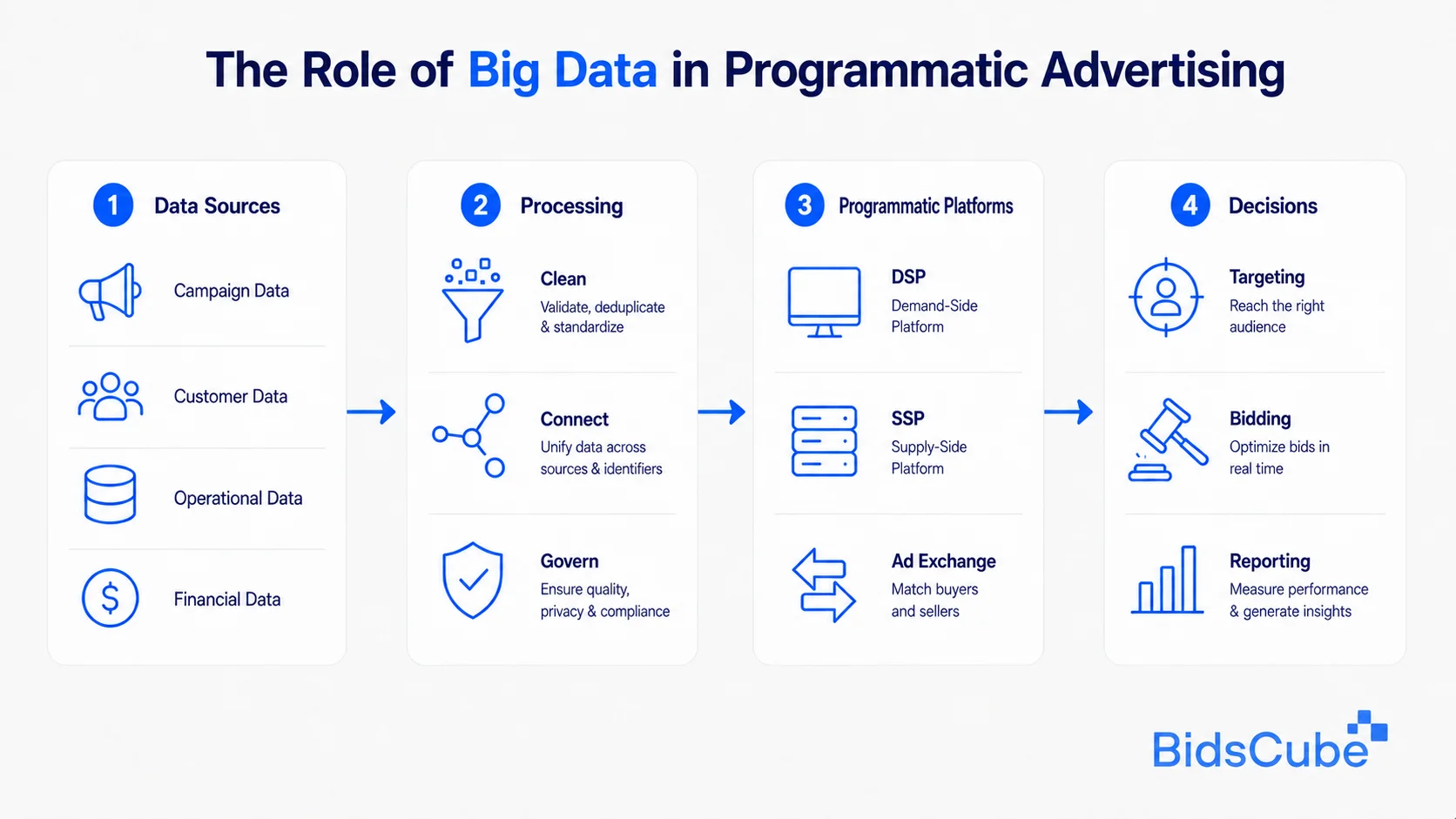
Big Data is a general term that describes technologies and different methods for analyzing and processing continuous flows of useful information that are literally enormous and could not be processed without the help of machines.
For comparison, this text consists of approx 130 lines or 1100 words. If we put some big data into a single spreadsheet file, it could contain billions of lines of data in different formats. For example, it could be data that includes all programmatic advertising deals within the BidsCube AdExchange and details about them for just one month.
In today’s world, everyone is constantly generating data. It happens by using apps, searching for information through search engines, online shopping, and even simply traveling around cities and countries with your smartphone in your pocket. All this creates a huge amount of valuable and helpful information. Furthermore, it can then be quickly collected, visualized, and carefully analyzed.
To make it easier to understand the essence of Big Data, let’s take a look at a simple example. Imagine a market where all products are arranged in a chaotic order: bread near the vegetables, fruit in the beverage department, vegetable oil next to the bathtub and toiletries, and so on. With Big Data, it became possible to distribute all the goods strictly in their places. But that’s not all.
You can easily find the product you want, see expiration dates, learn about the benefits of that brand or variety of products, and compare it with other similar products.
Big Data is also a tool for the effective application of received information. It is presented in a clear and convenient form and makes it easy to solve everyday tasks and make decisions. For example, for advertising campaigns, you need to learn how to find your potential client and offer a particular product at the right time. You can’t do this without a specific database.A data management platform can help organize audience data before it moves into campaign systems; see data management platforms (DMPs) for a practical explanation.
DemandSage reports that the global big data analytics market is projected to reach $447.68 billion in 2026, up from $394.70 billion in 2025. It also cites a 12.8% compound annual growth rate through 2034. For marketers, that growth reflects demand for systems that can process high-volume customer, campaign, transaction, and device data.
There are three main types of using Big Data that matter in marketing:
- Customer data. Consisting of various metrics from different sources, such as transactional and behavioral metrics, as well as attitudinal data. Sources can include online websites, sales points on the Internet, marketing companies, social networks, loyalty programs, customer surveys, and a variety of communities in the online world.
- Operational data. Mainly objective indicators measure and reflect the quality of ongoing marketing processes that are directly related to the allocation of resources, different operations, budget control, and asset management.
- Financial data. This includes different tools such as profits, sales, revenues, and other essential objective data capable of measuring and displaying the financial condition of the company or organization.
Big Data vs Traditional Data Analysis in Advertising
Traditional analysis often uses smaller extracts and scheduled reports. Big data systems process larger, faster, and more varied records, but the extra volume only helps when events are accurate and teams know which decision the analysis should support.
| Aspect | Traditional Approach | Big Data Approach |
|---|---|---|
| Data volume | Smaller samples or limited exports | Large campaign, customer, contextual, and transaction records |
| Speed | Daily, weekly, or monthly review | Near-real-time processing where the platform supports it |
| Sources | A few campaign or business reports | DSP, SSP, exchange, site, app, CRM, and financial records |
| Use | Historical reporting and manual comparison | Audience scoring, bid support, anomaly checks, forecasting, and measurement |
| Main risk | Slow or incomplete view | Poor data quality, unclear permissions, and false patterns at larger scale |
How Big Data Becomes Decision-Changing For Marketers?
In today’s digital advertising landscape, Big Data has the potential to make a significant impact. There are several reasons for this.
Turn campaign data into action
Use the BidsCube DSP to connect targeting, budget, and reporting decisions to the campaign data your team reviews.
Firstly, the key to successful digital marketing is the collection, processing, integration, and analysis of data from various sources (both internal and external). However, the primary challenge is the chaos that comes with about 80% of all data being unstructured. For example, on social networks, there are numerous photos, videos, and text messages that provide insights into user behavior. Yet, traditional methods cannot analyze or structure them.
With Big Data, a marketing company can collect, store, process, and analyze all information, including structured and unstructured data, allowing advertisers to access relevant and operative data from seemingly chaotic data sets. This approach enables marketers to make informed decisions and develop effective strategies.A documented first-party data strategy gives teams a clearer basis for using consented customer signals in campaign decisions.
Secondly, real-time information analysis is crucial in today’s fast-paced digital world. Conventional relational databases were the go-to solution for analyzing and managing large amounts of data, but their speed was limited. Even simple tasks took days or weeks to complete and provided outdated results. However, modern analytics platforms powered by Big Data can perform complex processes in moments, providing access to real-time analysis.For forecast-led use cases, see predictive analytics in digital marketing.
Marketers can rely on relevant and reliable data to make quick and accurate decisions.
Thirdly, Big Data allows for more personalized and targeted ads. Advertisers can use personal data provided by users, such as likes, geolocation, and store purchases, to create ads that users are interested in.
Finally, Big Data offers opportunities to merge with various components of programmatic ecosystems. For instance:The bidstream data guide explains which auction-level signals teams can review when evaluating supply and campaign activity.
- DSPs (demand-side platforms) can predict target audiences or improve existing ad targeting using Big Data capabilities and features.
- AdExchanges can optimize auctions by utilizing machine learning and artificial intelligence in conjunction with data.
- SPPs (supply-side platforms) can improve result analysis using algorithms designed for Big Data, driving revenue growth for webmasters.
Big Data = Big Opportunities
As you can see, big data offers significant opportunities. In addition to the benefits discussed, there are a few other essential additional points, including:
- Hyper-personalization
- Predictive capabilities
- Dynamic creatives
- reliable attribution models
- Reduced ad spend
- Improved cross- and upselling.
However, there are still some challenges associated with effectively using Big Data, particularly in marketing. This is because most applied analytics systems are not aligned with the data, decisions, and processes used by modern marketing organizations.
The three main challenges are:
- Knowing what data to collect.
- Choosing the right tools for analysis.
- Understanding how to transition from data to insights and impacts.
It is essential not only to analyze and process helpful Big Data but also to use the results correctly.
How BidsCube Uses Big Data in Programmatic Campaigns
BidsCube products give businesses ways to review buying activity, marketplace transactions, partner connections, and campaign results. The exact data available depends on the selected product, account configuration, and approved integrations.
- The BidsCube DSP supports campaign operations such as targeting, budget management, and reporting.
- The BidsCube Ad Exchange supports marketplace activity and transaction visibility for companies operating branded advertising infrastructure.
How is big data used in advertising? Teams connect reliable campaign, customer, supply, and financial records to improve a defined buying or selling decision.
To Sum Up
Now that you know what Big Data is, what it is for, and where it is used, you can use it as an effective tool to gather information about users and run a profitable advertising campaign. If you are interested in using big data in your promotional or monetized process, please contact us, and we will provide you with the best solution!
Our tech staff and AdOps are formed by the best AdTech and MarTech industry specialists with 10+ years of proven track record!

FAQ
What Is Big Data in Programmatic Advertising?
Big data in programmatic advertising includes large sets of campaign, auction, placement, audience, and transaction information. Platforms use approved data to support buying decisions, publisher monetization, reporting, and performance analysis.
How Is Big Data Used in Advertising?
Teams analyze customer, contextual, operational, and financial records to improve audience selection, bidding, placement review, and campaign measurement. Useful analysis starts with accurate events and a clear business question.
What Is the Difference Between Customer Data and Big Data in Marketing?
Customer data describes information tied to consented customer relationships, such as purchases or account activity. Big data is the wider collection of customer, campaign, contextual, operational, and financial information used for analysis.


