



Ad tech prepped for a world without third-party cookies for nearly five years. All the deadlines were for conference panels, white papers, product launches, something. The deadline kept sliding. Everyone called it the cookieless future, usually with a slightly worried face.
Table of Contents
Then Google blinked. Privacy Sandbox tools were mostly turned off too, and Chrome was still keeping its third-party cookies in 2025. So is the cookieless future cancelled? Not at all. Neither Safari nor Firefox have removed that cookie protection, privacy laws are still in force, and readers expect a voice. So Here Is What Actually Happened And Why It Now Matters For Cookieless Programmatic Advertising.
How Did Cookies Influence Programmatic Ads?
What is a cookie? A cookie is a piece of text data that an internet site will store in your browser. It may be a session ID that keeps you logged in, your language preference or an ID so that next time a site can identify you. Previous guides claimed it would hold passwords or other sensitive information directly, which is rarely the case.
For years, programmatic ads relied on cookies. They allow the same browser to be detected through multiple sites by ad platforms. This enabled three very routine tasks: retargeting, frequency caps, and conversion tracking. Take the cookie away, and all three get harder, though none of them disappears.
Types of Cookies
Three terms come up all the time. Only two of them are real cookie types:
- First-party cookies. Set by the site you’re on. And they make sure that you remain logged in when necessary, remember what you have in the cart and drive on-site analytics such as Google Analytics.
- Second-party data. A business term, not a cookie. That is, first-party data that one company shares with another in a bilateral agreement, such as an airline that has partnered with a hotel chain.
- Third-party cookies. Created from another domain embedded on the page, such as an ad server or a social button. They follow one browser across many sites.
That last type is the one ad targeting relied on for years. It’s also the one browsers started to block, which is where the trouble began. Once one big browser shut the door, every ad platform had to plan for a slice of readers it could no longer follow from site to site.
A Brief History of the Third-Party Cookie Phase-Out
Third-party cookies were doing a lot of obviously unsexy silent work for more than 10 years. They showed you the shoes you looked at yesterday. They stopped the same banner from chasing you twenty times. They told advertisers which ad led to a sale. Useful stuff. Also a little creepy, depending on who you asked.
Eventually, people became uncomfortable with being stalked on the internet. There were data leaks and political pressure, so lawmakers intervened with GDPR in Europe: Collect only what you need, use it for a specified purpose, protect it, be open about it, and have a legal basis to process it. California’s CCPA and a stack of other state laws followed.
Browsers moved next. Since 2020, Safari has blocked third-party cookies by default. With Total Cookie Protection, Firefox put the cookies from each site in its own locked box. Let’s put the ad blocking principle into practice: In 2020, Google pledged to eliminate them from Chrome as well. Then came the date: 2022, then 2023, then 2024, then 2025.
Google’s first cookie replacement, FLoC, segmented people into interest “cohorts.” Privacy groups exploded in outrage against it, and Google abandoned it in early 2022. Its successor is the Topics API, which was added to a larger privacy-focused toolbox called the Privacy Sandbox. That toolkit was supposed to carry the industry past cookies. They had other ideas.
Third-Party Cookies in 2026: What Actually Happened
The phase-out never came. Here’s the short version:
- Chrome kept them. In April 2025, it dropped those plans to phase out Chrome, instead putting the choice in users hands via existing settings.
- The Sandbox closed. In an October 2025 update, Google retired most Privacy Sandbox tools, including Topics and Protected Audience. Only CHIPS, FedCM, and Private State Tokens remain.
- Other browsers still block. Safari, Firefox and Brave now limit third-party cookies by default.
- The law didn’t move. Consent rules in all browsers for GDPR, ePrivacy and CCPA.
Why the U-turn? Pressure, mostly. Advertisers and publishers warned of lost revenue, early tests showed publishers earning noticeably less with Sandbox tools, and regulators like the UK’s Competition and Markets Authority watched every step. Few companies adopted the new APIs. Low adoption sealed it.
| Browser | Third-party cookies by default | Comment |
| Chrome | Allowed | Users can block them in settings |
| Safari | Blocked | Blocked by default since 2020 |
| Firefox | Restricted | Each site gets its own cookie jar |
| Brave | Blocked | Blocks cross-site trackers too |
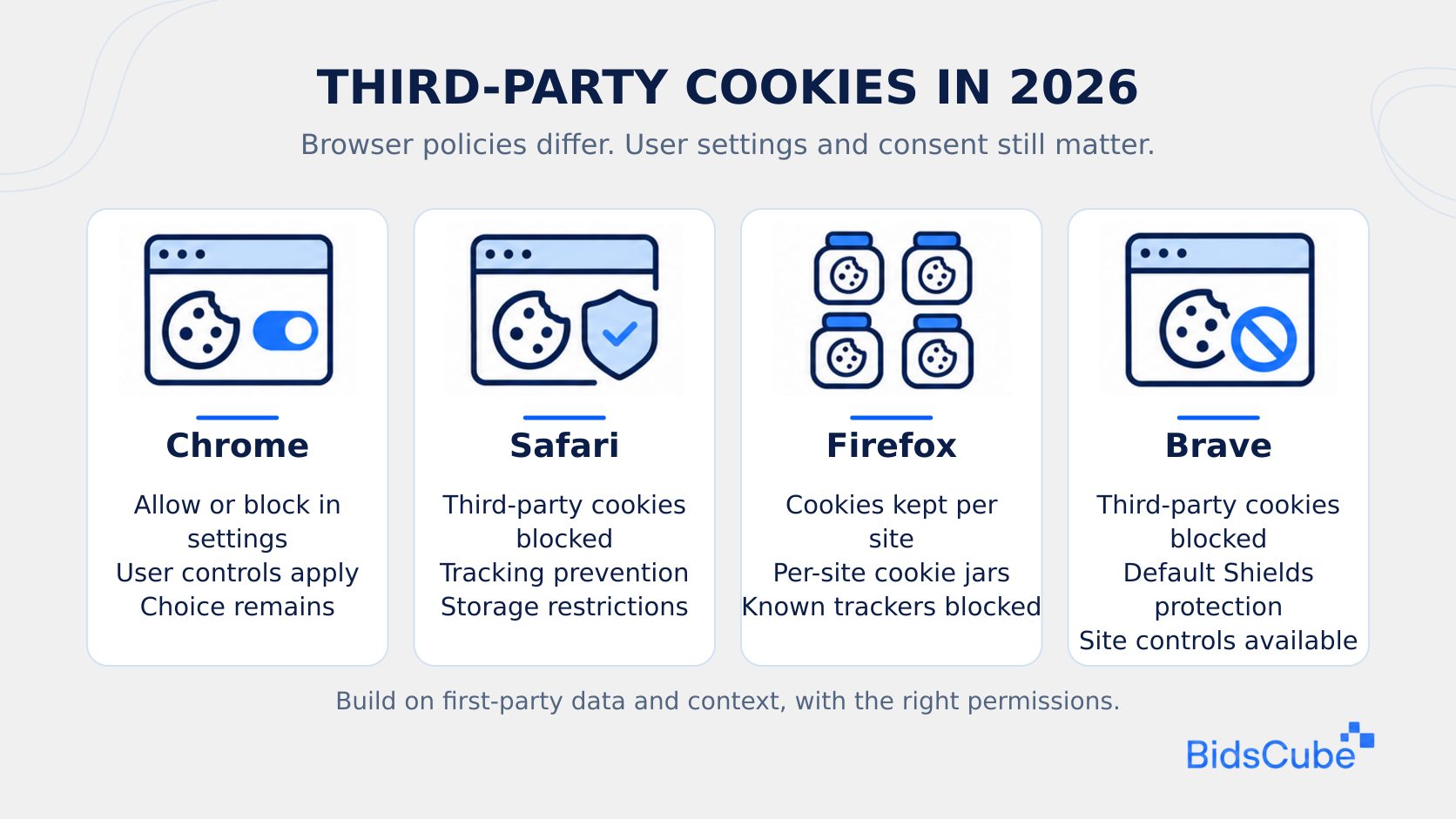
According to StatCounter, Safari and Firefox combined accounted for about 21% of worldwide browser traffic in September 2026. The third-party cookies 2026 picture is, therefore, a house divided. Cookies work for part of your audience and not for the rest. That’s why programmatic cookieless tactics still matter, whatever Chrome does next.
Need to reach readers in Safari and Firefox too? The BidsCube DSP runs campaigns that work with and without cookies. Let’s plan yours.
What’s Next?
A few years back, articles like this one ended with “trends to watch.” Many of those trends have now become just everyday practice. This is what cookieless programmatic looks like in 2026:
- Contextual targeting. Ads are tied to the page and not the person It requires no personal information, is functional on any browser known today and current tools can read each page whole, inclusive of video and sound.
- Universal IDs. Privacy-safe IDs, usually built from hashed emails, recognize users who logged in and agreed. Matching often runs through cookie syncing or similar methods, so match rates vary.
- Curated marketplaces. Curators package quality inventory with audience or context data into ready-made deals buyers can switch on fast.
- Clean rooms. A data clean room allows a brand and publisher to match audience without sharing raw records.
- First-party data partnerships. Consented data is passed directly under contract between retailers, publishers and brands.
As first-party data is now among the few assets that most publishers own. Logins, newsletters and subscriptions create audiences that no browser will be able to extract away. The first is the clear first-party data strategy that demonstrates what types of information to collect, with consent, and how to convert it into revenue.
One old idea aged badly, fingerprinting. It tries to identify browsers from device details. It is a pretty shaky bet, regulators treat it like just any other tracking and it’s actively fought by browsers. For Advertisers, The Safer Route is a Cookieless DSP That Buys in Context, First-Party Groups and Privacy Safe IDs. A cookieless programmatic platform that transmits the cleanest signals about cookies (that may or may not exist) for publishers. The winners are not waiting for Chrome to show it was simply kidding.
FAQ
Did Google remove third-party cookies from Chrome?
No. In April 2025, Google said it would retain third-party cookies in Chrome. Users can still manually block them in the settings, and Incognito mode blocks them by default. The big Chrome switch-off that everyone planned for simply never happened.
What happened to Google’s Privacy Sandbox?
Google shuttered most of them, including Topics, Protected Audience, and Attribution Reporting, in October 2025 because too few companies implemented the tools. Only CHIPS, FedCM, and Private State Tokens are left. As a full cookie replacement, the Privacy Sandbox is over.
Is programmatic advertising still cookieless-ready without Chrome’s deprecation?
Safari, Firefox and Brave already have it turned on for cookies coming to the browser and privacy legislation also requires consent again if it oversteps. Programmatic cookieless tactics provide access to audiences cookies can’t target through contextual targeting and first-party data. That leaves more than one in five websites unvisited.
Which browsers still block third-party cookies?
Safari and Brave block them automatically. Firefox does this by putting them into a separate jar for each site, so that one site cannot glean information from others. They’re permitted in Chrome and Edge by default, though user can disable them. Mobile apps have some different rules, so take a look at those too.
Conclusion
We never woke up from our slumber one fateful morning, finding the cookieless future had arrived. No, it happened in dribs and drabs: one browser, one statute, and then a consent banner. It was in April 2025 that the timing of Chrome’s turnaround, not its trajectory, changed. Train in an era when some will have cookies and many do not: Make cookieless programmatic campaigns every time the cookie sets.
Want campaigns that work across all browsers? The BidsCube DSP buys on contextual signals, first-party data and ID solutions in a privacy-safe manner. Write to us, let’s discuss your setup.


