



TL;DR
- In-stream ads play inside a video the viewer chose to watch: pre-roll, mid-roll, or post-roll.
- Out-stream ads play outside a video player, in articles, feeds, or native blocks. Most start muted.
- The real difference is intent. Did the person choose to watch video or not?
- IAB Tech Lab’s 2022 update pushed about 90% of former in-stream inventory into out-stream.
- OpenRTB now labels each placement type, so buyers can tell the two apart.
- In-stream is measured by completion rate. Out-stream is measured by viewability and time in view.
- In-stream builds the message. Out-stream extends its reach at a lower cost.
Table of Contents
- What are in-stream video ads?
- What are out-stream video ads?
- How IAB Tech Lab formally defines the difference
- In-stream vs out-stream: comparison table
- How each format is measured
- When to use in-stream vs out-stream
- Publisher perspective: fill rate and inventory
- How BidsCube Can Help
- Summary
-
FAQ
- 1. What is the difference between in-stream and out-stream video ads?
- 2. Does in-stream video always have sound on by default?
- 3. Which format has a higher completion rate?
- 4. Which format is better for publishers without video content?
- 5. Is out-stream video the same as native video advertising?
- 6. Should advertisers choose in-stream or out-stream, or both?
People mix up in-stream and out-stream all the time. The names sound alike. The viewing experience isn’t. The difference isn’t only where the ad sits on the page. It’s about choice. Did the person press play on a video? Or did a video ad start while they were reading something else?
That one question changes how buyers value each format. It changes prices, metrics, and goals too. The industry takes it seriously. According to AdExchanger, about 90% of inventory that was previously sold as in-stream ended up being classified as out-stream. Now let us explain you in-stream vs out stream video ads step by step
Let’s break down in-stream vs out-stream video ads step by step.
What are in-stream video ads?
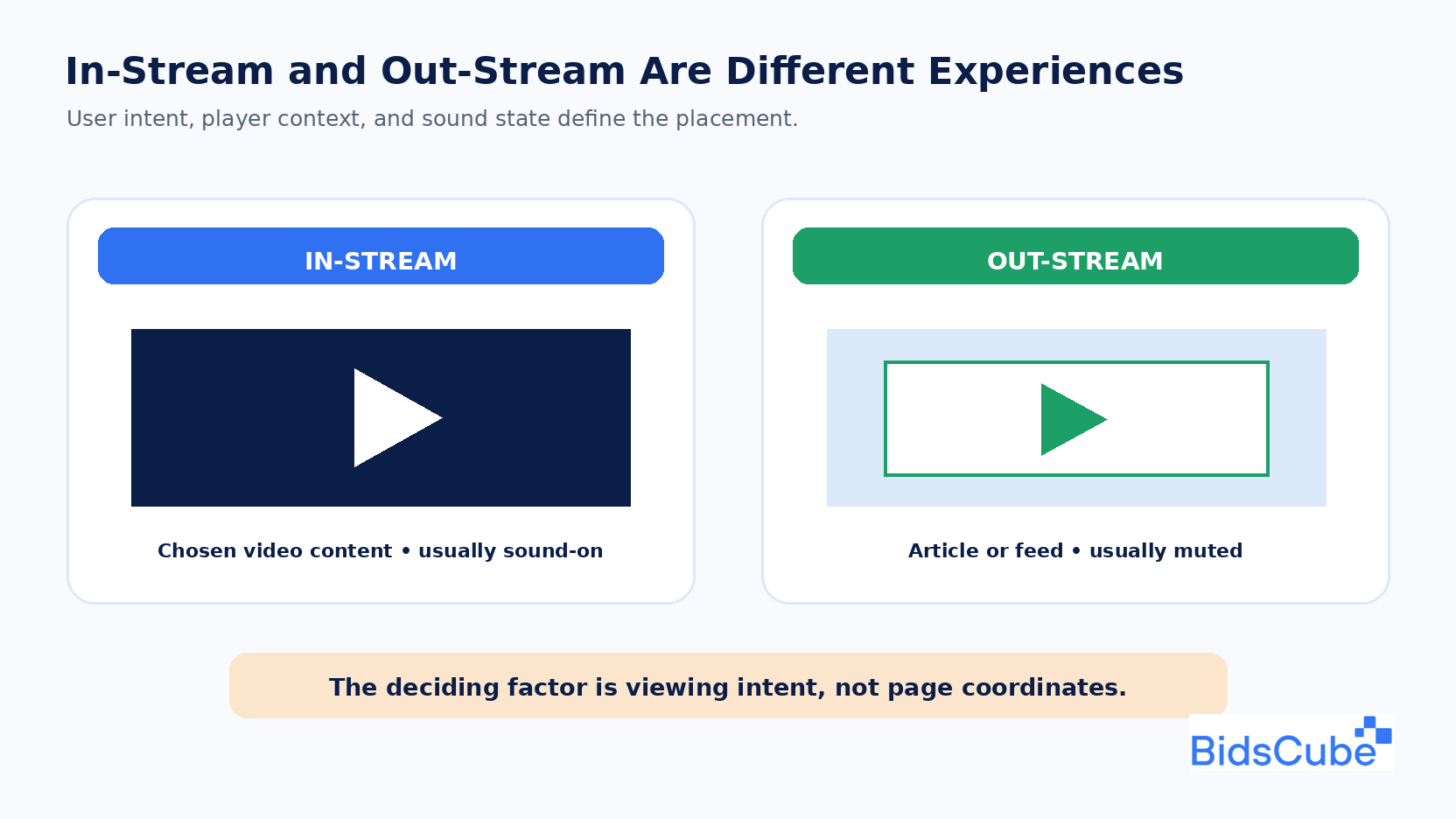
In-stream video ads play inside a video player, around content the viewer chose to watch. You can read a short definition in our in-stream video glossary.
They come in three spots:
- Pre-roll. Before the video starts.
- Mid-roll. During a break in the video.
- Post-roll. After the video ends.
You’ll find in-stream video advertising on CTV and streaming apps, in online video (OLV), and in premium publisher video.
What are out-stream video ads?
So, what is outstream video advertising? It’s video that plays outside a video player. It shows up inside articles, social feeds, or native blocks on a page. Our glossary covers out-stream video ads and out-stream advertising in more detail.
Outstream video ads usually start on their own when they scroll into view. That’s the viewability trigger. Most play with the sound off. If the person scrolls past, the ad pauses.
How IAB Tech Lab formally defines the difference
Since 2022, in-stream is more than a location. It’s a technical standard.
IAB Tech Lab’s 2022 update said in-stream video should play with sound on by default, inside a player that monetizes the publisher’s own video content. Much of the market didn’t meet that bar, which is why so much inventory moved to out-stream.
In 2023, IAB Tech Lab softened the rule. Sound-on is still a strong sign of intent, but it’s no longer the only test. The key question now is whether the user truly meant to watch video. A player that turns into a floating, sticky box as you scroll can no longer count as in-stream for later ad calls.
OpenRTB carries this label in the bid request. Older versions used a “placement” field, where value 1 meant in-stream and values 2 to 5 meant different out-stream types (in-banner, in-article, in-feed, and interstitial or floating). OpenRTB 2.6 added a newer “plcmt” field built on the updated definitions. Either way, buyers can see which format they’re bidding on.
Google has also aligned its video rules with these IAB definitions. In practice, inventory that doesn’t meet the criteria can’t be sold as in-stream anymore.
In-stream vs out-stream: comparison table
Here’s instream vs outstream video ads side by side:
| Parameter | In-stream | Out-stream |
|---|---|---|
| Where it plays | Inside a video player, around chosen content | Outside a player, in articles, feeds, or native blocks |
| User intent | Viewer chose to watch video | Viewer came for other content |
| Sound | Often sound-on | Usually muted |
| Typical environments | CTV, streaming, OLV, publisher video | News sites, blogs, feeds |
| Main metric | Video completion rate (VCR) | Viewability and time in view |
| Price | Higher CPM | Lower CPM |
| Fill rate | Limited by video supply | Usually higher |
How each format is measured
The two formats need different scorecards.
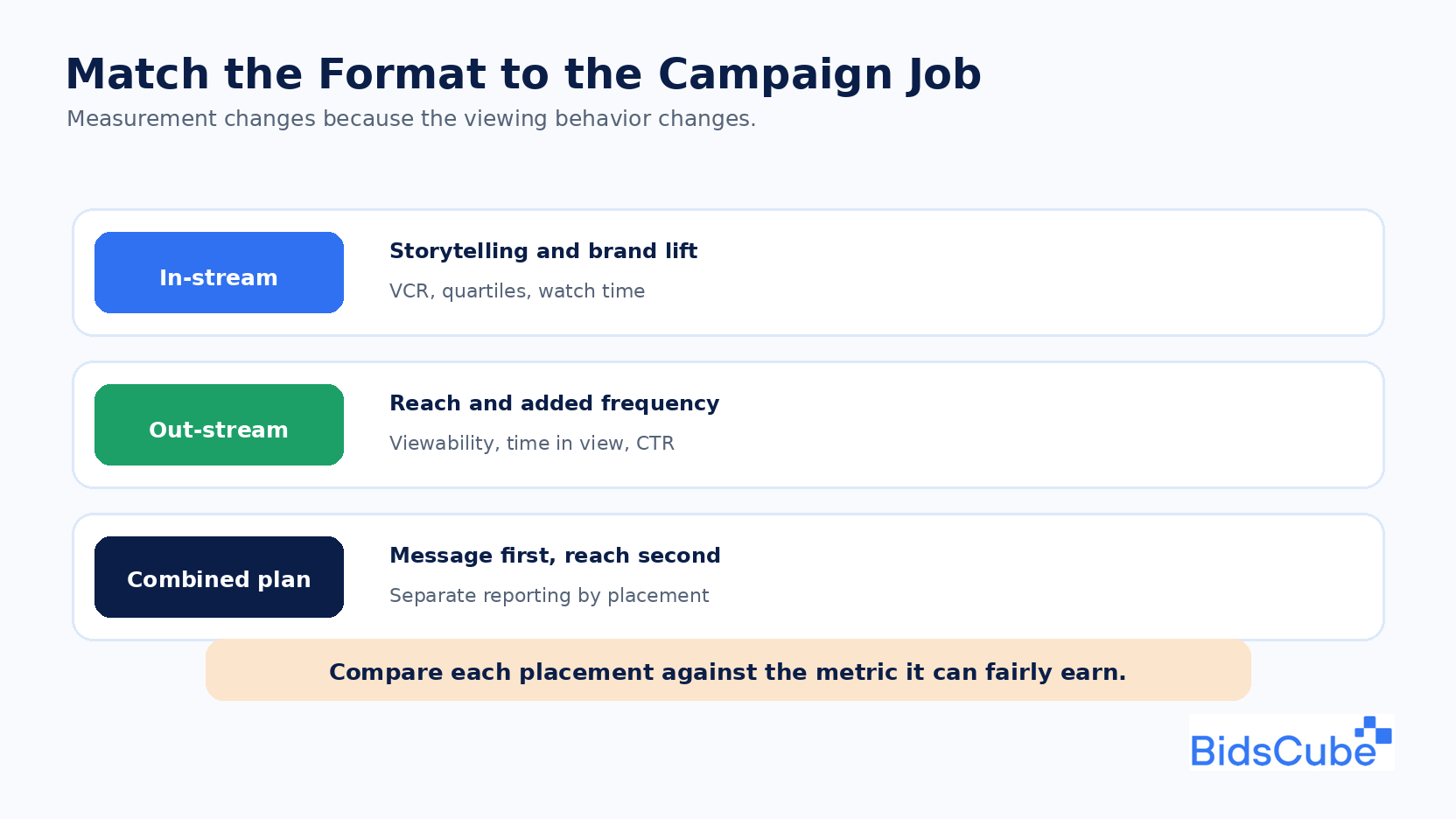
- In-stream. Watch the video completion rate (VCR). Track quartiles: 25%, 50%, 75%, and 100%. Look at average watch time too. People chose to watch, so completion tells you a lot.
- Out-stream. Watch the viewability rate, time in view, play starts, and CTR. Completion rate means less here. Playback depends on scrolling, so a “skip” is often just a reader moving on.
Comparing the two by completion rate alone isn’t fair. It’s like judging a billboard and a TV spot by the same rule.
When to use in-stream vs out-stream
Pick by goal.
- Use instream video ads when you want brand lift, recall, or storytelling. Someone is watching closely, so contact quality = high.
- Use outstream video advertising when you want more reach or frequency at a lower cost. It follows that it serves as a complement to an in-stream campaign.
Strong media plans often use both. In-stream builds the message. Out-stream spreads it wider. That’s why the outstream vs instream video ads question rarely has a single winner. For more planning ideas, read our strategic approaches to programmatic advertising.
What about pre-roll vs outstream video ads specifically? Pre-roll is the classic spot in instream video advertising. It gets strong attention but costs more. Out-stream is cheaper and broader. With budgets tight, you should think about using out-stream where reach is required, but start to layer in some pre-roll for your heartland audience.
Want to run both formats from one place? Try the BidsCube DSP to buy in-stream and out-stream video in one campaign.
Publisher perspective: fill rate and inventory
Many publishers don’t make their own videos. Out-stream lets them earn from video ads on plain text pages. A news article or a blog post can hold a video unit without any video content behind it. The trade-off is simple. Out-stream usually has a higher fill rate, because there’s plenty of space for it. But CPMs are lower than in-stream. In-stream gives you more, but to sell that, you need actual video.
A quick reality check. If an out-stream unit is pushy, they can frustrate readers. Mute them, tighten the space between ad and content, and limit the number that appear on one page.
How BidsCube Can Help
The BidsCube White Label Video Ad Server supports both in-stream and out-stream formats from one dashboard.
- Format control. Run pre-roll, mid-roll, post-roll, and out-stream units side by side.
- Pacing. Spread delivery evenly across the day or the campaign.
- Tracking. Measure VCR, quartiles, viewability, and CTR in real time.
- Demand connection. Sell inventory through the BidsCube SSP and reach buyers on the BidsCube DSP.
BidsCube has 10+ years in programmatic and 230+ clients. Read their reviews on Clutch.
Summary
In-stream and out-stream aren’t rivals. They do different jobs. In-stream is destination based, meaning you have to go out of your way in some respects to watch it so it’s more suited to impact. Best for scale: You reach the people who came to read (not just watch), its essentially an out-stream. Evaluate each on metric terms, and mix them to fit your purpose. That’s the practical answer to in-stream vs out-stream video ads.
Talk to BidsCube about running and monetizing both video formats.
Our tech staff and AdOps are formed by the best AdTech and MarTech industry specialists with 10+ years of proven track record!

FAQ
1. What is the difference between in-stream and out-stream video ads?
In-stream plays in a video that viewer voluntarily clicked. Out-stream plays outside a player, inside other content. That’s instream vs outstream video ads in one line.
2. Does in-stream video always have sound on by default?
Not always. IAB Tech Lab’s 2022 update made sound-on a requirement. In 2023, it softened that rule. The principal test now is user intent to watch video, and sound-on is a very good signal of that.
3. Which format has a higher completion rate?
Typically, in-stream video advertising have a higher completion rate since people opted to watch. Instream video advertising will play through to completion more ofter than out-stream since it relies on scrolling.
4. Which format is better for publishers without video content?
Out-stream. Since outstream video ads can run on text pages, that additional revenue benefit by no means relies upon publishers creating their own content material.
5. Is out-stream video the same as native video advertising?
Not quite. Out-stream will be in such a package, but it also runs on articles and feeds. Native is like tried to match the aesthetics of the page. So, first of all, just knowing what is outstream video advertising will help you realize the overlap.
6. Should advertisers choose in-stream or out-stream, or both?
Often both. In-stream video ads build impact. Outstream video advertising adds reach. The outstream vs instream video ads choice depends on your goal and budget. For pre-roll vs outstream video ads, pre-roll wins on attention, and out-stream wins on cost. Mix instream video ads and out-stream to get both.
This Article's Ad Tech terms


