



EMARKETER predicts that global ad spend will be approximately $1.17 trillion in 2026. And through programmatic advertising software, more and more of that money moves. No wonder so many agencies, networks, and publishers now want a platform of their own instead of renting someone else’s.
Table of Contents
Wanting one is easy. Getting one is where people get stuck. In ad tech platform development, you really have three roads. Build it with your own team. Hire an external team to develop it. Or you could go with an off the shelf white-label platform and slap your logo on it. After all, each road comes with its own price tag, timeline, and control.
So this guide brings all three, lays them out in a single table, and then how they map to respective common business types. Spoiler, there’s no single right answer. But there’s usually an obvious one for you, and it often depends less on budget than on how soon you need to sell your first impression.
What is a Programmatic Platform?
Its software that takes the responsibility of purchasing or selling ad inventory automatically. Real-time bidding It bids on your behalf, parses audience data, enforces targeting principles and delivers report cards. A DSP does this for buyers. An SSP does it for sellers. The market between them is run by an ad exchange, which takes a bid from one side and a slot on the other.
It’s not a weekend project to build one. Your adtech architecture must respond to bids in milliseconds, store massive volumes of data, communicate with dozens of partners and run around the clock every single day. Interested to see what do these platforms in practice? Here are some programmatic advertising examples from real campaigns.
The Rise of AdTech Platforms
Marketers were quick to move advertising online, and automated purchasing came swift behind. For a majority of agencies, ad networks and publishers today an adtech platform is their real business. It aggregates, buys or sells ads at scale vetting which ad is best for a given visit, expanding to previously unreachable audiences, all without investing heavily in a sales funnel.
That’s the appeal. The catch is that someone has to create it, maintain it and update it. How you decide to do that costs you for years, not months. Back in 2023, taking a shortcut will just trigger a longer rebuild later. Taking it slow and building things out gradually means missing the market completely.
Understanding the Development Approaches
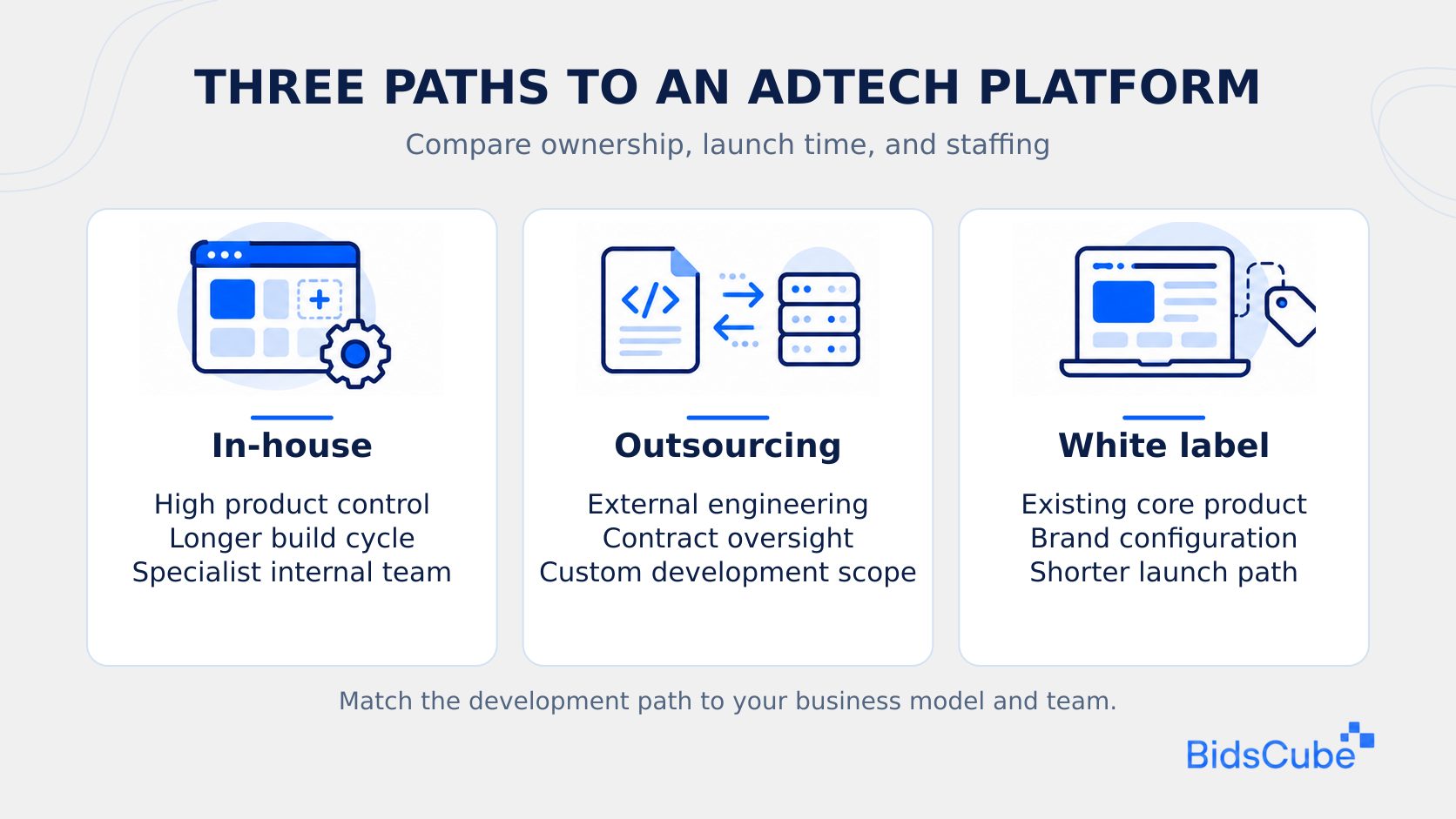
In adtech development, there are three lines:
- In-house. The platform is designed, built and run by your own staff.
- Outsourcing. An outside adtech development company builds it to your brief.
- White-label. You take an institutionalized platform or company (add your brand), and you launch.
They’re simple, in theory. Whether the decision is hiring, cash flow, legal work, how quickly you can accept a new client-it really touches life. A great smart adtech development begins with candor about which of those three money no object (poor Jeff Bezos) and which you can afford the stretch. What actually happens once you start working on each path
In-House Development. Full Control, Higher Costs
In-house means that your own people design, build, test and run the platform. Perhaps you utilise engineers that are already at your disposal. Or there are specialists in programmatic tech that you hire. Whichever way you go, nobody else touches the code at all and every decision is yours.
The reason that this makes sense is if you care about more control over performance than speed. In-house works if you want every line of code owned, the product tailored your way, and a team on-call all hours. That caters to firms that have servers, engineers and ad tech knowledge at home, along with owners prepared to wait.
The downsides are real. It’s expensive. Even before the platform makes a penny you are paying for hiring, salaries, tools and servers. It’s slow, a full build often takes more than a year. And the right people are hard to find. Ad tech engineers are scarce, and it can take months to find experienced folks; every month spent looking is a month added to your release date. So in-house is best for well-resourced business (think: rich owners and an existing team already fluent in programmatic).
Outsourcing. Lower Cost, Less Control
Outsourcing means you need to hire an external team who will build the platform for you. Some companies hand over only one piece, like the bidding engine. Others hand over everything, from design to testing and launch. Plenty of adtech development services work this way, and some offer custom adtech development built to your exact spec.
It helps when you need a platform but don’t have time to build a team. It is often more cost-effective, as you aren’t paying full-time salaries for years. You also have people who have already built such systems before, which avoids the beginner mistakes. Your own staff stays on sales and growth instead of code reviews.
The trade-off is control. You dont know every combat the external facet does. But in addition time zones and language barriers create friction. Once you go live, you’re reliant on the vendor to fix bugs and push updates, and the quality of their shoddy work needs constant monitoring. Everyone also knows that projects run late [than anybody will ever admit to] because each change is subject to another companies’ queue. You only outsource to those companies where internal teams are lean but excellent at vendor management and writing the brief.
White-Label Platforms. Fast, Affordable, Limited Customization
A white-label platform is a finished product built by another company. You add your brand, set it up for your clients, and launch. No build at all. Of all the routes to adtech solution development, it’s by far the fastest, and usually the cheapest to start.
Some, like BidsCube for instance, can have a white-label site launched in your brand name in as little as 2 days. Decades of engineering have gone into what is effectively the core product already; you pay only for setup and support. It’s lower risk too, since the platform has already handled real traffic for real clients.
There are limits. You can brand it and change many settings, but deep changes to how it works may be off the table. Other companies may run on the same base. You rely on the provider for updates and security fixes. And you do not get the physical code that undergirds it, important if you ever want to sell the business. However, for most companies that are looking to launch quickly with a smaller team, the white-label is indeed the more pragmatic option. Not glamorous. Just practical.
Cost-Benefit Analysis
It is usually just money and time. But here’s how the three paths stack up once you peel back the sales pitch:
- In-house development. The largest initial investment since you pay for the hiring, the tools and servers. It often takes more than a year to launch, so revenue does not start until late; and you can be hit by delays or market shifts before going live.
- Outsourced development. In-house is cheaper but can be heavy on the pockets, regularly going as much as $500000. Timelines depend on your vendor, and you’re stuck with them for future updates.
- White-label platforms. Far less to start, with the price set by the provider and your custom needs. Launch takes days or weeks, then you pay a subscription or license fee.
Look at the total over three years. The first invoice tells you very little. A low upfront cost and high monthly fees can be more expensive than a high upfront cost and low running costs. Check your own volumes before you pen anything.
Comparing the Approaches
The table puts all three paths side by side on the four things that decide most projects:
| Criterion | In-House | Outsourcing | White-Label |
| Cost | High upfront and ongoing | Medium, often up to $500,000 | Low start, then license fees |
| Time to market | Over a year | 6 to 12 months | Days or weeks |
| Control | Full control and code ownership | Partial, shared with the vendor | Settings and branding, no code ownership |
| Risk | High, from delays and hiring | Medium, from vendor quality | Low, product is already proven |
Read it row by row, and mark the rows that matter most to your business. If time to market is your top row, the choice makes itself. If control is, the math changes. And if risk keeps you up at night, a proven product with real traffic behind it removes most of the unknowns that sink first-time builds.
Want to launch in days instead of a year? A BidsCube white-label SSP or AdExchange can run under your brand on its own infrastructure. Let’s show you a demo.
Why BidsCube’s White-Label Platform?
BidsCube builds white-label platforms for advertisers, publishers, and RTB partners. The platform can go live under your brand in about two days. The team behind it has 10+ years in ad tech and more than 230 clients. Here’s what that means in practice.
What You Get with BidsCube
The platform has been tested in real use, so you’re not paying to fix someone’s first draft. It runs under your brand on dedicated servers that aren’t shared with other clients. You get full access to settings, with different permissions for different users. It supports many integration types, so it plugs into the partners you already work with.
You also get the BidsCube Community, a network of publishers and advertisers you can offer to your partners as your own. Pricing sits among the most affordable in the white-label market. And a support team is on hand 24/7, which matters more than it sounds at 3 a.m. on a holiday weekend.
Benefits for Your Business
Your clients never have to know what is running under the hood. BidsCube does a large part of the legal, compliance and tech legwork that is likely to fall on your desk otherwise. You can modify reports, interface elements and integration types as per your changing needs. You skip the cost of a full engineering team, and your people spend their time on sales and partners. Because these servers are also isolated, privacy-minded clients can chill, too.
Making the Decision
The correct route is dependent on what you care for most about. In-house: if complete control and ownership of the tech is a priority, you have budget and time, build it yourself. Outsource if you want the best of both worlds and you’re capable at vendor management. When speed, price, and a small team are the main concern then a white-label platform like BidsCube is the logical choice.
Our tech staff and AdOps are formed by the best AdTech and MarTech industry specialists with 10+ years of proven track record!

How to Choose an AdTech Platform Based on Your Industry Requirements
More than anything else, your needs are shaped by your industry. Here is a short way to map business type to approach:
- Publishers → launched fast without much maintenance → white-label. Additionally, the reality is that most publishers want to sell ads – not run engineers. Learn which publishers drive the most incremental revenue from a white-label SSP.
- Agencies→Flexible Integrations → Whitelabel or Outsource. There is possibility where agencies may manage multiple clients on DSPs. White-label works if it supports custom connections. Outsourcing fits rare feature needs.
- Ad networks → own brand and demand → white-label. Networks want to grow fast under their own name. All using a white-label stack to build your own ad network.
- External tech team for large publishers = full control = Only inside. At the same time with big media groups having engineers and money, there is nothing stopping you owning every layer of your adtech stack.
Whatever your industry, write down your must-haves first. How fast must you launch? What’s the budget? How much control do you need? Hold those answers up against the table above. Plenty of companies spend months comparing and end up where they could have started. Pick what’s ready to run and spend your energy on clients. That’s the real job anyway, ad tech platform development is just the road to it.
Still weighing build against buy? BidsCube white-label platforms launch under your brand in about two days. Let’s talk through your plan.


