



Some of the best writing online comes from tiny teams. A three-person site about trail running, home brewing, or city council votes often knows its subject better than any media giant. Readers can tell. Advertisers, sadly, don’t always pay for that difference.
Table of Contents
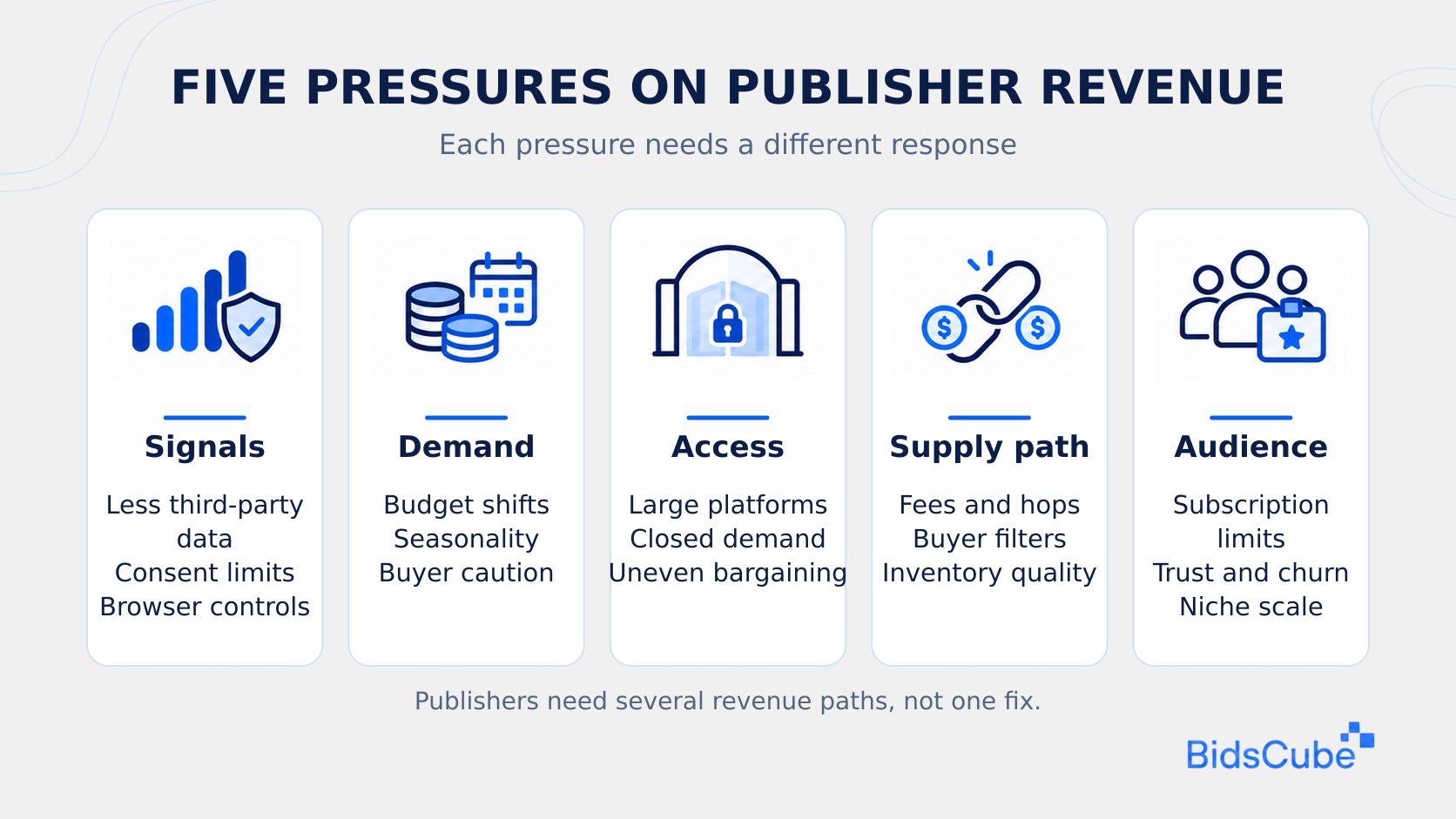
When we first wrote this piece in 2023, five problems stood out. It’s 2026 now. None of them left. A couple grew teeth. These are still the core independent publishers ad monetization challenges, and each one looks a little different than it did three years ago. Here’s what changed, with fresh numbers, and what a small publisher can actually do about each one.
Decreasing access to consumer data
Targeted ads pay more than blind ones. Targeting needs data, and that data keeps getting harder for publishers to collect. Two forces squeeze it from both sides, the law and the browser, and neither one is going to loosen up anytime soon.
The law first. Since 2023, more states in the US adopted their own versions of GDPR– or CCPA-like legislation requiring explicit consent for much data use, with GDPR in Europe and CCPA in California providing the primary for these regulations. Each new law adds another banner, another toggle, and one more reason for a reader to click “reject all” and move on.
Then the browser. 2025: Google gives in, keeps third-party cookies in Chrome Safari, which has a 13% global footprint among browsers, and Firefox also by default block them; between them, they account for almost one-fifth (21%) of global browser traffic, according to StatCounter September 2026 data. In other words, a fifth of every audience is already invisible to old-style tracking, no matter what Chrome does next up.
That, I believe, is the best answer: a straight line to your readers. Whether it is newsletters, free accounts, memberships or paid plans: they all create 1st party data that you own. People trade an email address when they get something useful in return, a weekly digest, a benefit for members, early access. That opting in data has a higher value for buyers than all of the cookies that were used to scrape.
Shift to Contextual Targeting
When buyers know less about the person, they look harder at the page. Contextual targeting matches the ad to the content itself. A running shoe ad lands next to a marathon training plan. No cookies, no IDs, no consent pop-up. It’s old logic, the same one magazines used for a hundred years, now done by software in milliseconds.
For many independent sites, this shift is quiet good news. When a website is dedicated to one topic with deeply focused content, it speaks loud and clear to contextual buyers. It is much easier to target a discussion site dedicated to old cameras than for example, the front page of news that accommodates everything from elections to which celebrity had sex with whom.
Third-party data, meaning data bought from outside providers, keeps losing weight too. Your own audience data matters more. Publishers who collect it with consent and sort it into clear groups, say, “readers who opened three cycling reviews this month,” can sell those groups straight to buyers. That’s a real edge, and big sites can’t copy your niche.
Ad Spending Slowdown
Here’s the twist since 2023. Ad budgets didn’t shrink. They grew. According to EMARKETER global ad spend will surpass the trillion milestone in 2025 and sit right around $1.17 trillion by 2026. And for the first time in a while, it expects that Meta will be No.
So why does it still feel like an ad spending slowdown for small sites? Because the new money is not disbursed uniformly. The majority is funneled to search, social, retail media and streaming behemoths. Independent publishers realm–the open web gets a narrower slice. Advertisers coming under pressure first push budgets into the biggest, safest channels. Small sites get what’s left after that.
Traffic is shrinking too. Chartbeat data cited by the Reuters Institute shows Google search traffic to publishers fell by about a third worldwide in the year to November 2025, as Press Gazette reported. AI answers in search keep more readers on Google. That translates to fewer visits, which means fewer impressions to sell, even if prices hold.
The realistic solution is to generate more revenue from the visits you already have. On average, higher revenue per visit is the result of smarter floor prices, more demand partners, improved page quality, and fewer wasted slots. Details: None of those guys need one more reader. Start with the floor prices, since that change takes an hour and often shows results within a week.
Growing Market Monopolization
When the pie grows unevenly, the biggest players eat most of the new slices. That’s the core of market monopolization publishers deal with today, and it hits in three places at once:
- Distribution. A few platforms decide how most people find content. One algorithm update can cut a small site’s traffic in half overnight.
- Revenue share. Big platforms set the terms, and independent publishers often get the smallest slice of what their content earns.
- Data. The giants see what billions of users do every day. A small site sees a sliver, which makes pricing inventory harder.
There’s some movement, at least. In April 2025, a US federal court ruled that Google illegally held monopolies in publisher ad servers and ad exchanges. In September 2026, the judge ordered fixes, including Prebid access and more bid data for publishers, though not a forced sale of AdX. Helpful, but slow.
These remain some of the hardest publisher monetization challenges, because no single site can change them. What you can do is spread the risk. Build traffic from more than one source. Sell through more than one demand partner. Grow the channels you own, like email, that no algorithm can take away overnight.
The Rise of SPO
A few years ago, most publishers sold through many exchanges at once. The same inventory could pop up through five resellers at five prices. That helped supply-side platforms post strong fill rates. Buyers, though, paid a fee at every hop and got tired of it.
They pushed back with supply path optimization. Buyers use software to find the shortest, cheapest route to each publisher and cut the rest. The Trade Desk’s OpenPath, which connects buyers straight to publishers, was an early example. SSPs like Magnite and PubMatic built their own SPO programs, and most big agencies followed with house rules of their own.
In 2023, SPO felt new. By 2026 it’s just how buying works. Most large DSPs and agencies have clean direct paths until around Oct 2023 for an expectation. They check ads. txt and sellers. JSON files, and they both provide routes that are padded with resellers. If your setup has five hops where one would do, some buyers simply won’t see you.
The latest evolution is seen in curated marketplaces. A curator, which will usually be either an SSP or a data company, selects premium inventory, and enrich it with appropriate audience or context data making turn-key offers. For a good independent site, that can open doors. A deal site for niche inventory is able to put it in front of buyers that would never discover its existence during the open auction.
Our 2023 question still stands. Will this be enough demand from smaller publishers to keep a healthy fill rate? So long as they rest upon the rightful way. Direct links, honest sellers.json entries, and a name for clean inventory quality matter more than ever.
Is your inventory on the paths buyers trust? The BidsCube SSP helps publishers set up direct, transparent supply paths. Let’s review your setup together.
How BidsCube Helps Independent Publishers Overcome These Challenges
You dont have to rely on own ad tech with competing with bigger publishers. White-label SSP means you have some premium buyers without the overhead of servers, engineers or years spent on building. BidsCube SSP allows you to connect your inventory with thousands of DSPs and advertisers through real-time auctions, header bidding. This backs the direct, transparent paths that SPO-minded buyers seek out. You remain in control of floor prices, ad formats, branding rules and have access to every single result in real-time reports. A team with 10+ years in ad tech and 230+ clients sits behind it.
Not sure it fits your site? So now, who are the publishers white-label SSPs work best with? Most setups run live quickly allowing a few ad units to be executed while you change the entire site over. Ready to talk? Contact us.
FAQ
What is the biggest monetization challenge for independent publishers today?
Still user data loss is number one. Privacy laws and browser limits are making targeting more difficult, which is pulling prices down. Falling search traffic and the pull of big platforms come close behind. Combined, they represent the three primary challenges to independent publisher ad monetization in 2026. That is why independent publishers ad monetization challenges often start with data access, then affect pricing and reach.
How can independent publishers reduce dependency on third-party cookies?
Generate first-party data using opt-ins for newsletters, account registrations and subscriptions Rely on contextual targeting that does not require any user data at all. Collaborate with partners that offer privacy-safe IDs and data clean rooms. All these measures will help keep monetization of digital material rolling across any browser, whether it be Chrome or otherwise.
What is supply path optimization (SPO) and why does it matter for small publishers?
SPO is how buyers pick the shortest, most transparent route to buy ads. They trim off additional resellers and the accompanying costs. Small publishers: Buyers may drop paths that seem indirect even with great inventory. Direct, clean paths have your site in front of demand
To Wrap it Up
Independent publishers still face five big hurdles. Less access to user data. A move to contextual targeting. Uneven ad budgets and thinner search traffic. More power in fewer hands. And pickier buyers, thanks to SPO. These publisher monetization challenges are nothing new, but most have been greater than they were in 2023.
But small publishers do have some very real advantages. Focused content suits contextual buyers. >Pillar #2: First-Party Data is Driven By the Loyalty of Your Readers On the other hand, when you have a small stack, it has been easier to build short and clean supply paths. Three habits make Good digital content monetization in 2026; know your readers, keep your inventory clean and work with partners who deliver real demand. For small sites, digital content monetization still depends on reader trust, traffic quality, and direct access to buyer demand.
Want more revenue without building your own ad tech? The BidsCube SSP brings premium demand to independent sites. Let’s talk about yours.
This Article's Ad Tech terms


