



While gaming is now a major channel in the media landscape, ad spend still lags behind time and attention. It is expected that by 2026, 59.2% the U.S. Finally, the worldwide player base has climbed to over 3.4 billion individuals.
Table of Contents
- TL;DR
- What Is In-Game Advertising?
- The Gaming Industry and the In-Game Advertising Market
- In Game Advertising Statistics for 2026
- Types of In-Game Advertising: Static vs. Dynamic Ads
- Static vs Dynamic In-Game Advertising
- Programmatic In Game Advertising: How RTB Brings In-Game Ads to Scale
- How Intrinsic In-Game Viewability Works
- In Game Advertising Companies and Platforms to Know
- In-Game vs In-App Advertising
- In Game Advertising Cost: What Brands Actually Pay
- In-Game Advertising Cost by Format and Buying Model
- Real In Game Advertising Examples Across Game Genres
-
How Brands Can Effectively Use In-Game Advertising
- Step 1: Define the Campaign Goal
- Step 2: Understand the Gaming Audience
- Step 3: Choose the Right Game Genre
- Step 4: Match the Format to the Player Experience
- Step 5: Choose the Buying Method
- Step 6: Set Context and Brand-Suitability Rules
- Step 7: Build Creative for the Environment
- Step 8: Control Frequency
- Step 9: Measure More Than Clicks
- The Benefits of In-Game Advertising for Advertisers
- Benefits for Game Developers and Publishers
- Challenges and Limitations of In-Game Advertising
- How BidsCube Supports In-Game Buying and Monetization
- Final Thoughts
-
FAQs
- What Is Programmatic In-Game Advertising?
- What Types of In-Game Ads Can Brands Buy?
- How Much Does In-Game Advertising Cost?
- How Do Brands Measure In-Game Ads?
- Are In-Game Ads the Same as In-App Ads?
- How Can Game Developers Monetize Through Programmatic Ads?
- Which Vendors Support In-Game Advertising?
By 2029, game advertising revenue could surpass $10 billion in the U.S. Still, gaming will only take a 2.3% share of all U.S. digital ad spending in 2026. The gap also highlights the opportunity available, and the hesitation from marketers on measurement, formats, and accessing inventory.
In this guide, we cover: What in-game advertising is, how real-time bidding makes it scalable, which formats brands can use, how much campaigns might cost, and which platforms connect buyers and game inventory
And the advertising market is also separate from that of the gaming industry. Ad revenue from within games is not the same thing as game sales, subscriptions, esports, and in-app purchases.
TL;DR
- Branded messages are embedded in gameplay with in-game advertising.
- So we have static placements (stay fixed during a game) and dynamic placements (can change later).
- Through an SSP or ad exchange, a DSP checks for eligible game inventory via programmatic buying.
- The key formats include intrinsic ads, rewards ads, interstitials, adjacent ad placements, branded items and sponsorships.
- According to EMARKETER, more than 10 billion dollars will come from U.S. game ad revenue by 2029 but the channel doesn’t get as much spend that its audience size might assume either.
- Campaign costs depend on format, market, targeting, game quality, viewability and buying method.
- Depending on the campaign goal, advertisers should measure things such as attention, viewability, completion and brand lift for videos or installs/conversions for apps.
- While ad revenue is great, game publishers have to balance this need with retention, the quality of sessions and ultimately the experience of the player.
What Is In-Game Advertising?
In-game advertising inserts paid content from marketers in a video game or in a game interface. It allows for a placement which can feature during gameplay, between levels, next to the play area and, in the context of the rest of the game, beyond.
Popular instances of this are virtual billboards in racing games, sponsored signage in sports arenas, rewarded video ads, branded in-game character items, product placements, and full-screen interstitials between levels.
A roadside billboard can feel natural in a driving game. A branded drink machine may fit an urban game environment.
The term covers several commercial models:
- A brand can negotiate a permanent product placement directly with a developer.
- A publisher can sell rewarded video through a mobile ad network.
- An SSP can make dynamic game inventory available to DSP buyers.
- An advertiser can book a private marketplace deal for selected titles.
- A studio can sell a custom event, skin, or sponsored level as a fixed partnership.
The IAB Gaming Measurement Framework divides gaming ads into four broad groups: intrinsic in-game ads, rewarded ads, interstitial ads, and adjacent ads. It also covers custom formats and sponsorships that do not fit standard media units.
The Gaming Industry and the In-Game Advertising Market
The gaming industry includes much more than advertising. This includes game spending, subscriptions, hardware, in-game purchases, esports, cloud gaming, licensing, and/or other monetization opportunities.
- One report may count only ad placements inside gameplay.
- Another can consist of rewarded video, app-store promotion, esports sponsorships, and gaming creator campaigns.
While the in-game advertising market is still smaller than the wider gaming economy, its audience spans generations. S
In Game Advertising Statistics for 2026
The most useful in game advertising statistics show audience size, ad acceptance, market investment, and campaign potential. The figures below focus on advertising rather than game sales.
- 3.4 billion people play digital games worldwide. Gaming reaches far beyond teenage audiences and includes substantial adult and older-player groups.
- 59.2% of the U.S. population will play digital games in 2026. Penetration reaches 76% among people aged 18 to 24, 73.5% among those aged 25 to 34, and 62.9% among those aged 35 to 44.
- U.S. game ad revenue will exceed $10 billion by 2029. Gaming will still represent only 2.3% of overall U.S. digital ad spending in 2026.
- 62% of players describe rewarded ads as the most engaging gaming ad type. Rewarded formats give users something useful in return for their attention.
- 46% of gamers report making purchases based on ads seen in games. The result increased from 40% in the previous year, according to the cited Bain research.
- 64% of gamers also say ads can disrupt the gaming experience. The result shows why placement design and frequency matter as much as audience size.
- Only 20.3% of U.S. gamers generally dislike ads in games. Skippable units, rewarded formats, relevant messages, and ads that fit the game receive better responses.
In game advertising effectiveness depends on how well the format fits the game, how long the ad stays visible, whether the player can interact with it, and what the advertiser measures.
Types of In-Game Advertising: Static vs. Dynamic Ads
Static In-Game Advertising
Static ads become part of the game during development. Since a developer can’t take back a fully released title without having to release an update, they usually cannot replace the content creator for all the extra work afterward.
For example, a brand logo on a stadium wall, a product used by a character or a permanent billboard along a racing track. The advertiser may need to commit before the final audience size or game performance becomes clear.
Dynamic In-Game Advertising
You can use dynamic placements, which allow for real-time reporting and programmatic buying. They are commonplace in connected PC, console, cloud, and mobile environments.
A virtual billboard may show one campaign today and another next week. Dynamic placements support real-time reporting and programmatic buying. They are common in connected PC, console, cloud, and mobile environments.
Intrinsic In-Game Ads
Intrinsic ads appear inside the actual game world. They can simply put billboards, posters, screens, signs, vehicles, arenas, or another object logically placed into the scene. Player should be able to continue playing. That ad seeps into the context.
Rewarded Advertising
Rewarded ads, which provide the player with an obvious benefit for watching/engaging with an ad. These may be extra lives, currency, hints, cosmetics, or access to content. This makes the format a clear value exchange in that the player decides whether to play.
Interstitial Ads
These ads appear between the natural stages of the game and fill the entire screen. These can take the form of level changes, menus, restarts, loading screens or common placements.
Poor timing can hurt retention. Publishers really don’t want to crowd them with full-screen games once a day while they are streaming live play or every action right after one’s own play session.
Adjacent Ads
Nearby ads were in proximity of the game, instead of within it. Such as an overlay over a banner, companion units, or an ad alongside a browser-based game window.
While these placements are easier to implement, they will probably not perform as well as the ads plugged into the game.
Branded Items and Custom Experiences
Brands may sponsor character skins, virtual objects, events, challenges, stores, or whole levels. Deals that often need to be negotiated with the game developer. They are powerful for brand recall, but they are also costlier and longer than standard media units.
Static vs Dynamic In-Game Advertising
| Criterion | Static In-Game Ads | Dynamic In-Game Ads |
| Creative updates | Fixed during development or changed through a game update | Creative can change through an ad server or programmatic connection |
| Buying model | Direct agreement, sponsorship, licensing, or fixed fee | CPM auction, PMP, programmatic guaranteed, or direct campaign |
| Targeting | Usually based on the game, genre, platform, and total audience | Can include location, device, language, context, time, and approved audience signals |
| Reporting | Often based on estimated exposure or publisher reports | Can include impressions, viewability, completion, clicks, and campaign events |
| Lead time | Weeks or months | Hours or days after integration and approval |
| Creative flexibility | Low after release | High during campaign delivery |
| Best use | Long-term placement, product integration, or sponsorship | Timely campaigns, audience targeting, testing, and scaled media buying |
| Main risk | The placement stays fixed even if the message becomes outdated | Weak integrations, poor placement quality, or excessive frequency |
Programmatic In Game Advertising: How RTB Brings In-Game Ads to Scale
Programmatic in game advertising uses software to buy and sell eligible game impressions through automated auctions or programmatic deals.
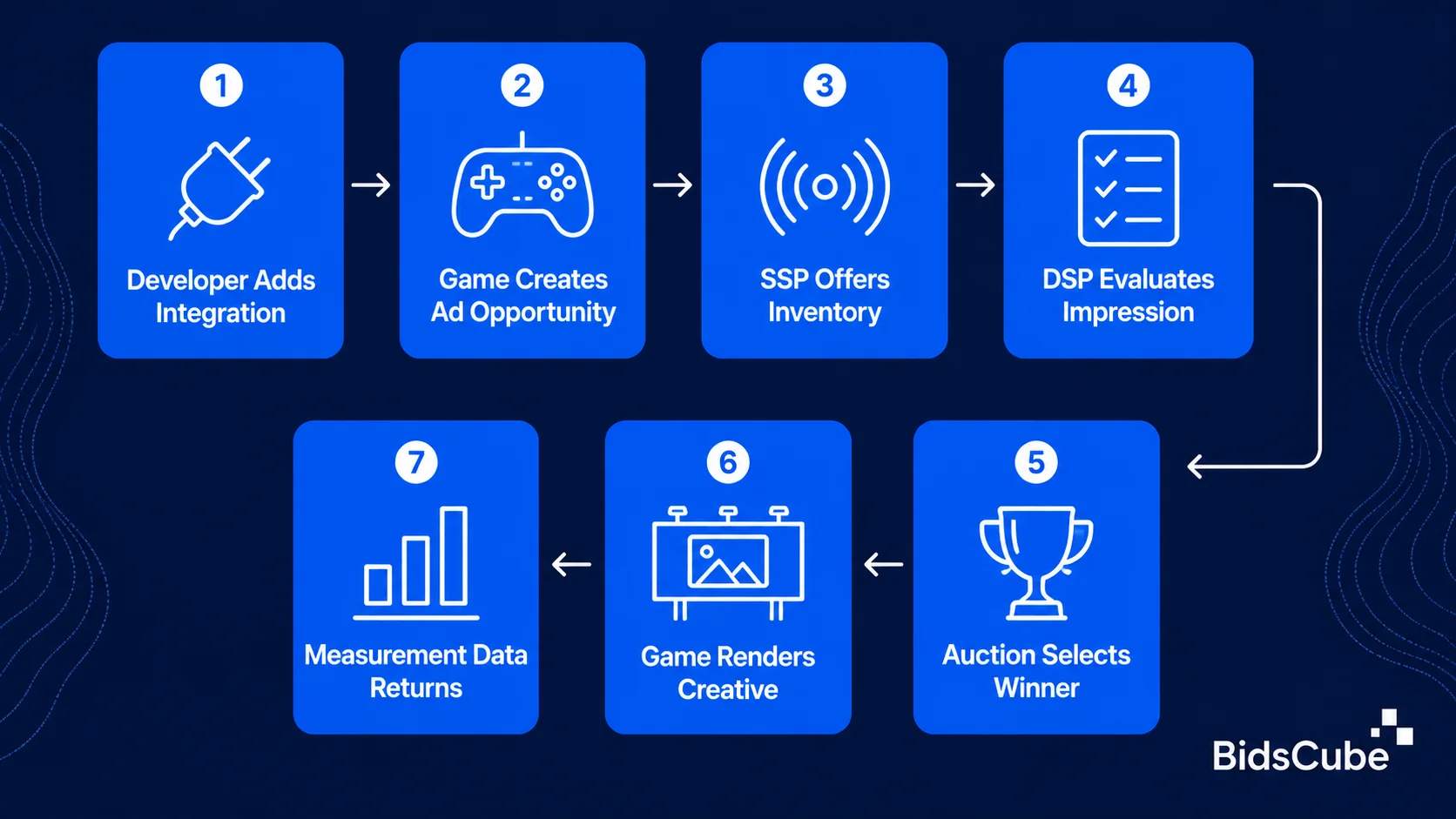
Step 1: The Developer Adds an Advertising Integration
The game developer integrates an SDK, ad server or SSP integration. The integration detects available ad spots like billboards, screens, overlays, interstitials or rewarded placements.
Step 2: The Game Creates an Ad Opportunity
At an eligible moment for ad display, the game makes an ad request. The request can specify allowed device, game, genre, placement, geography, language, & creative requirements.
Step 3: The SSP Offers the Inventory
Once the impression is made available, the SSP picks up the request for the impression and serves it to approved demand sources. SSPs may apply a floor price, block specific categories, or pass premium inventory through a private marketplace.
Step 4: A DSP Evaluates the Impression
The DSP compares the request with active campaign rules. It may review game category, location, device, audience, budget, frequency, supply path, brand suitability, and expected value. Eligible campaigns submit bids.
Step 5: The Auction Selects a Winner
This is where valid bids are compared to each other at the SSP or ad exchange layer. Under auction rules, the highest qualifying bid wins. The entire process happens well before the player can see the placement.
Step 6: The Game Renders the Creative
The advertising that wins is the advertising that got placed, that shows up in the predetermined place. An intrinsic advertisement could be a texture displayed on a billboard or some other surface in the game world. The system rendering might change sizes, angles, light perspective to correlate the image with scene.
Step 7: Measurement Data Returns
This one logs delivery and signals that were agreed upon performance of the agreement. They can be impressions, viewable impressions, time in view, completion, clicks, interaction, attention, installs, or any conversion event. The new framework aims to provide advertisers, publishers and vendors with a uniform language for these metrics.
For more context on where gaming sits among other automated channels, see BidsCube’s guide to programmatic advertising types and formats.
Buy Gaming Inventory Through a DSP
Use the BidsCube DSP to manage bidding, targeting, budgets, supply connections, and campaign reports across supported programmatic inventory.
How Intrinsic In-Game Viewability Works
Web viewability rules do not fully capture what happens inside a 3D environment. A game camera can move, rotate, zoom, or pass an ad at speed.
The IAB intrinsic in-game guidelines address factors such as screen coverage, visible pixels, viewing time, angle, inactivity, and fraud. The updated approach separates a loaded ad from an ad that the player could reasonably see.
Advertisers should ask vendors how they handle:
- The percentage of visible pixels
- The ad’s share of the screen
- Viewing angle and distance
- Time in view
- Player inactivity
- Occlusion by game objects
- Invalid traffic and automated play
- Duplicate impressions
- Accidental clicks
A large impression count means little when the player never faces the placement. Viewable CPM, time in view, attention, and brand lift can provide a more useful picture.
In Game Advertising Companies and Platforms to Know
The phrase in game advertising companies covers several types of vendors. They perform different roles, so advertisers should not compare all of them as direct substitutes.
Intrinsic In-Game SSPs and Technology Providers
These vendors work with developers to embed ad placements in gaming environments. For instance, Anzu has derived its product based on the programmatic intrinsic placement on mobile, PC, console, and gaming metaverses. It claims direct integrations to over 40 programmatic partners including top DSPs.
Demand-Side Platforms
A DSP provides inventory from connected supply partners for advertisers. Buyers who wish to submit bids, budgets, targeting, frequency, allowlists, blocklists, and rules for reporting
BidsCube operates on the demand side through its white-label DSP. The platform supports real buying, campaign configurations, audience controls, and reporting across formats and devices supported.
Mobile Ad Networks and Mediation Platforms
For rewarded video, interstitials, banners, offerwalls, and playable ads, mobile game publishers typically rely on an ad network and mediation tool.
An in game advertising network may provide its own demand, while a mediation platform normally connects several networks and compares their bids or priorities.
Supply-Side Platforms
An SSP helps game and app publishers connect inventory with external buyers. It can manage floor prices, demand partners, ad formats, reporting, and traffic rules.
BidsCube SSP supports real-time bidding, analytics, white-label configuration, and several integration methods for publishers.
Ad Exchanges and Private Marketplaces
DSPs and SSPs are linked through an ad exchange. It’s capabl of running open auctions or selected deals betweens buyers and publishers. Private marketplace serves great when an advertiser can define a acceptable list of games, negotiated awareness or if ad placement needs more stricter controls.
Measurement and Verification Vendors
Separate tools are also applied for viewability, invalid traffic, brand suitability, attention and brand lift with gaming campaigns.
What is the right partner mix will depend on the format. The measurement for intrinsic advertising, rewarded video, and a custom game sponsorship need not be the same.
So, when assessing an in game advertising platform, inquire about its inventory, integration mechanism, game list, measurement metrics, fraud protections, creative guidelines, and data availability.
The best in game advertising setup is not the vendor with the longest game list. It is an appropriate setup to meet the campaign objective, delivers the correct metrics, and safeguards the player experience.
In-Game vs In-App Advertising
The overlaps between in-game and in-app advertising are as essential as they are not the same.
In-app advertising refers to ads in any type of mobile application, such as news, weather, shopping, finance, social, and gaming applications. In-game advertising specifically refers to advertising that is related to video games.
A rewarded video in a mobile game is in-app and in-game. Inside an in-game PC racing game is in-game, but not mobile in-app advertising with a virtual billboard.
That distinction is relevant for strategy and tagging. The article should use #In-Game or #Programmatic instead of classifying all gaming inventory as #In-App.
For a breakdown of mobile banners, interstitials, video, native units, and playables, read the BidsCube in-app advertising guide.
Mobile in game advertising includes both intrinsic placements and standard app monetization formats It should format to the game loop not a generic app template.
For in game advertising Android campaigns, advertisers need to pay attention to factors such as device performance, operating-system versions, app-store regulations, screen sizes, network quality, and regional eCPM differences.
The mobile programmatic advertising guide explains how DSPs, SSPs, SDKs, identifiers, and mobile formats connect.
In Game Advertising Cost: What Brands Actually Pay
There is no fixed in game advertising cost. Formats, geography, game quality, device, audience, deal type, campaign length and a few other things such as creative work and measurement requirements all embody pricing.
Static product placements usually use a fixed fee. Dynamic inventory often trades on CPM. Rewarded campaigns may use CPM, cost per completed view, cost per install, or another performance model.
The ranges below work as planning references, not guaranteed buyer prices. Mobile eCPM figures describe publisher revenue per 1,000 impressions and can differ from the advertiser’s gross media cost after platform and service fees.
In-Game Advertising Cost by Format and Buying Model
| Format or Platform | Payment Model | Approximate CPM or Pricing Level | Example Use |
| Static product placement | Fixed fee, licensing fee, or sponsorship | No standard CPM; negotiated project cost | A branded vehicle or product built into a game |
| Dynamic intrinsic display | CPM, PMP CPM, or programmatic guaranteed | No universal public range; compare viewable CPM and time in view | Billboards, arena signs, posters, or digital screens |
| Mobile banner | CPM or eCPM | Around $0.50 to $2 publisher eCPM | Persistent banner on a menu or non-critical screen |
| Interstitial | CPM, eCPM, or CPA | Around $3 to $15 publisher eCPM | Full-screen ad between levels |
| Rewarded video | CPM, CPCV, CPA, or eCPM | Around $10 to $50+ publisher eCPM in higher-value markets | Video exchanged for currency, lives, or an item |
| Playable ad | CPM, CPI, CPA, or eCPM | Around $10 to $30+ publisher eCPM | Interactive demo for another game or app |
| Custom sponsorship | Fixed fee or mixed media package | Project-based, often above standard media rates | Branded event, skin, level, tournament, or story integration |
Tenjin lists typical publisher eCPM ranges of $0.50 to $2 for banners, $3 to $15 for interstitials, $10 to $50 or more for rewarded video, and $10 to $30 or more for playable ads. Actual rates vary sharply by country, operating system, genre, and audience value.
What Changes the Final Price?
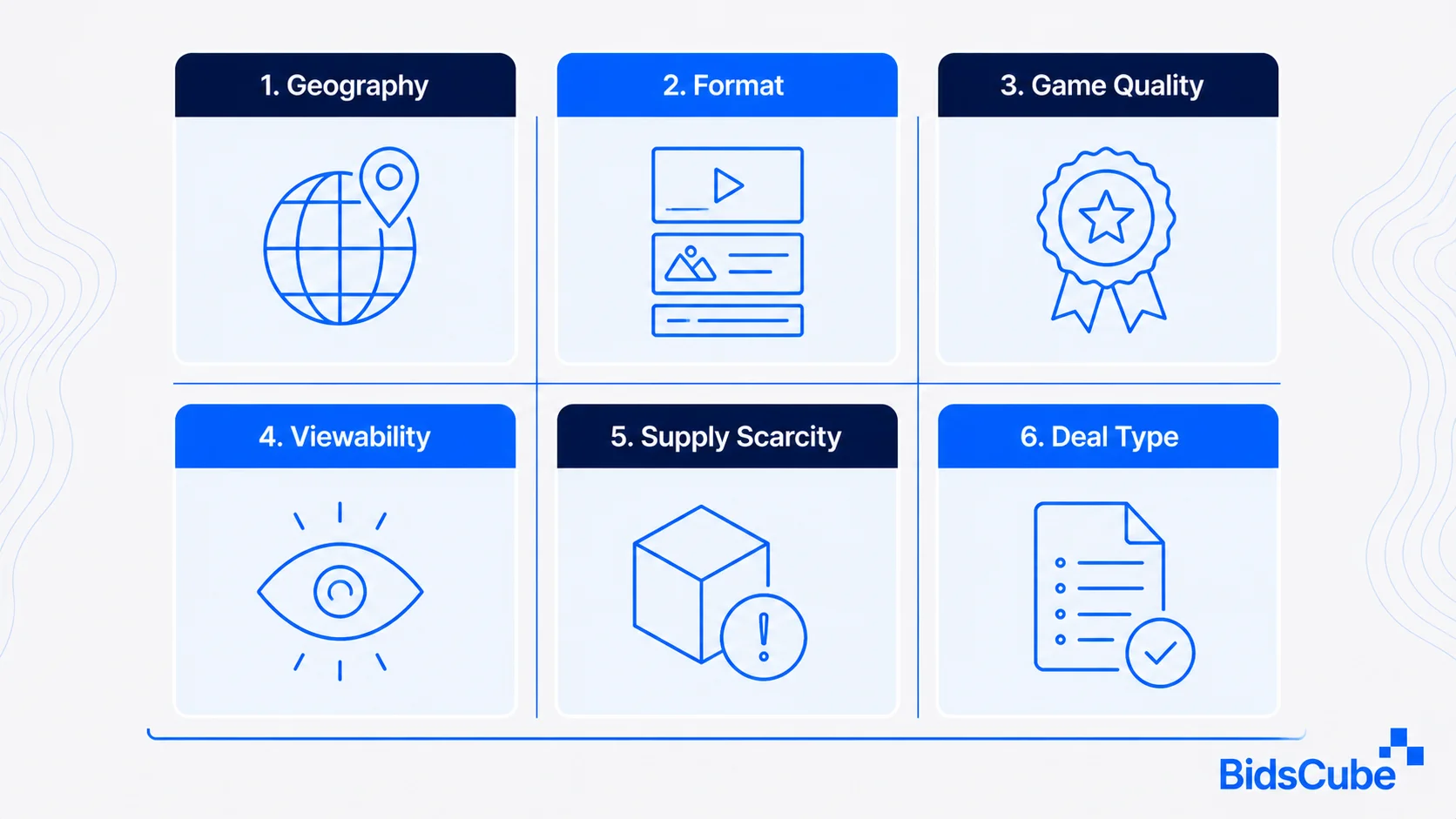
Several factors move the rate:
- Geography: North American and Western European impressions often cost more than traffic in lower-CPM markets.
- Format: Rewarded video and playable ads often command more than banners.
- Game quality: Premium titles with strong retention and trusted publishers may charge more.
- Viewability: A placement visible for several seconds can carry more value than a small background sign.
- Audience data: Approved contextual or audience targeting may increase the bid.
- Supply scarcity: A limited premium placement can create stronger competition.
- Measurement: Attention studies, brand-lift surveys, and independent verification add cost.
- Creative production: A static image costs less to produce than a custom branded object or game event.
- Deal type: Open auctions, private marketplaces, guaranteed deals, and direct sponsorships follow different pricing rules.
Brands should compare viewable CPM, attention cost, completion, and business outcomes. The lowest bid does not automatically produce the lowest acquisition cost.
Real In Game Advertising Examples Across Game Genres
Strong in game advertising examples show how the format fits the environment rather than covering the screen with a generic message.
Sports Games
Sports titles provide natural surfaces for billboards, scoreboards, pitch-side signs, stadium screens, branded uniforms, and equipment.
A sportswear company can sponsor virtual banners in a football stadium. A beverage brand can appear on arena signs or team benches.
The context already contains commercial branding, so the placement can feel realistic.
Racing Games
Racing games provide trackside signs, starting areas, garages, vehicles, city screens, and roadside billboards.
Automotive brands fit naturally, but entertainment, retail, technology, and consumer brands can also use these spaces.
Dynamic delivery allows the publisher to change campaigns without rebuilding the track.
Open-World Games
Open-world environments contain shops, posters, buildings, vending machines, transit ads, and street furniture.
A branded object can add realism when it suits the fictional setting. It can feel forced when it uses modern branding inside a historical or fantasy world.
Casual and Puzzle Games
Casual games often use rewarded video, interstitials, banners, and playables. These formats work around short sessions and clear level breaks.
Publishers should protect the core game loop. Too many interstitials can push players away before ad revenue covers the retention loss.
Battle Royale and Social Games
These games can support sponsored events, branded islands, virtual clothing, emotes, character items, and limited-time challenges.
Marvel and Fortnite collaborations show how entertainment brands can become part of a game’s content rather than run only as standard ads.
Simulation Games
City builders, sports managers, farming games, and life simulators can include branded objects or sponsored tasks.
The placement should match the game’s normal actions. A retail brand may fit inside a city simulation, while an unrelated product could feel artificial.
Programmatic Intrinsic Campaigns
Anzu lists campaign examples that place real brand creative inside live games, including display and video units adapted to game environments. Its advertiser product supports mobile, PC, and console campaigns through programmatic partners.
For more campaigns across formats and industries, see these real programmatic advertising examples.
How Brands Can Effectively Use In-Game Advertising
There are all sorts of brands that want to benefit from advertising in video games, and the philosophy about how to incorporate a brand into the gameplay in the right way. In-game advertising, when implemented correctly, boosts player engagement while providing another avenue of exposure for brands. So, here is the seven simple ways to do it efficiently:
Step 1: Define the Campaign Goal
Identify what the campaign needs to do: Create awareness, change the brand perception, make them downloaded Install app, something related to the product, something related to visit the nearby store, or simply something related to sales result.
Not every goal can be evaluated with the same KPI in a campaign. Brand recall fits awareness. Cost per install matches that of app acquisition. Sales lift fits retail activity.
Step 2: Understand the Gaming Audience
Do not make the mistake of classifying gamers as one type of consumer. Age, platform, genre, session length, spending habits, and reasons for playing all make players different.
Study:
- Game genres
- Age groups
- Platforms and devices
- Session times
- Player regions
- In-game purchase behavior
- Competitive or casual play
- Ad tolerance
- Reward preferences
Gaming reaches adults across all age groups. The creative should reflect the chosen audience rather than an outdated stereotype.
Step 3: Choose the Right Game Genre
A sports brand may fit a racing, football, basketball, or fitness title. A business software company may find better context in a strategy or simulation game than in a fantasy adventure. The game does not need to copy the advertiser’s category. It needs a credible connection between the player, context, and message.
Step 4: Match the Format to the Player Experience
Use intrinsic ads for non-interruptive awareness. Use rewarded video when a clear value exchange fits the game economy. Use interstitials only at natural breaks. Use custom integrations when the campaign needs deeper participation.
Step 5: Choose the Buying Method
Use open programmatic buying for scale and testing. Use a private marketplace for selected games and stricter controls. Use a direct deal for custom content, an exclusive sponsorship, or a placement that needs developer work.
Step 6: Set Context and Brand-Suitability Rules
A game category may be acceptable for one brand and unsuitable for another. Advertisers should review age ratings, content, community behavior, violence, language, monetization design, and geographic availability.
Read BidsCube’s guide to brand safety in programmatic advertising for allowlists, blocklists, PMPs, verification, and supply controls.
Step 7: Build Creative for the Environment
Do not place a web banner inside a 3D game without checking scale, color, angle, and movement. Keep the message short. Use strong contrast. Test whether the player can read it during normal gameplay. For video, consider whether the unit has sound and whether the player can skip it.
Step 8: Control Frequency
Gaming sessions can create many repeat opportunities. The same player should not see one creative every few seconds. Set limits by session, day, campaign, and placement where the platform supports them.
Step 9: Measure More Than Clicks
Some intrinsic ads are not clickable. A billboard in a console game can still drive attention, recall, search activity, or offline action.
The Benefits of In-Game Advertising for Advertisers
Access to a Large Audience
Gaming reaches more than 3.4 billion people worldwide. It also covers age groups that many media plans underrepresent.
Strong Contextual Placement
A brand message can appear in an environment connected to the game’s genre, setting, activity, or audience. Context can provide relevance without depending only on personal data.
Non-Interruptive Brand Exposure
You place intrinsic and this doesn’t require the player to exit out of the game or pause action. This can help with awareness while maintaining the flow of play.
Cross-Platform Reach
Gamer partner ecosystems provide programmatic access to inventory in mobile, PC, console, cloud and browser environments. For example, Anzu details cross-platform support and over 40 programmatic connections.
Campaign Changes During Delivery
Dynamic placements where advertisers can update the creative, bid, budget and targeting mid-campaign. When the release date comes closer a film studio can modify a message. A seasonal campaigns can be rotated by a retailer.
Measurable Attention
And this is what it means: There are now standards for impressions, viewability, time in view, interaction, completion and other campaign signals in gaming measurement. Next, the framework gives both buyers and sellers a common jumping off point.
Benefits for Game Developers and Publishers
Additional Revenue
Advertising provides developers an additional avenue for revenue in excess of game sales, subscriptions, and in-game purchases. The end result can assist freemium games extract money from folks who do not shell out out.
More Monetization Options
Publishers may then mix rewarded video, banners, interstitials, intrinsic ads, and direct sponsorships together. Some formats are more appropriate for certain genres and groups of players.
Support for Ongoing Development
Advertising income can fund content, maintenance, live operations, support, and user acquisition. It should not come at the cost of player retention.
Demand Competition
An SSP or mediation setup can let several demand sources compete for eligible inventory. Greater competition can support stronger fill and pricing when the partners provide distinct demand.
Control Over Placement
Developers define where ads appear and which formats the game accepts. They can block categories, restrict frequency, and reserve premium inventory for direct deals.
Successful in-game advertising examples demonstrate that brands can enhance their visibility while developers benefit from additional revenue streams. When done right, these partnerships create a win-win scenario for everyone involved.
Challenges and Limitations of In-Game Advertising
While in-game advertising offers exciting opportunities, it’s not without its challenges. Brands and developers must carefully address potential pitfalls to create effective, engaging campaigns.
Intrusive Placements
Poor timing can break concentration and create negative reviews. EMARKETER reports that 64% of gamers say ads can disrupt gameplay. Publishers should place interstitials at natural breaks and let rewarded formats remain optional.
Measurement Differences
A mobile rewarded video and a virtual billboard do not produce the same signals. Teams need format-specific KPIs and shared definitions before launch.
Brand Safety and Suitability
The game, scene, player community, and surrounding content can affect brand perception. Advertisers should use approved game lists, content rules, private deals, and regular placement reviews.
Fragmented Supply
Gaming inventory spans many platforms, engines, SDKs, ad networks, and publishers. A campaign may need several partners to reach meaningful scale.
Privacy and Younger Audiences
Some games reach children and teenagers. Advertisers and publishers must follow COPPA, GDPR, CCPA, platform rules, consent requirements, and local advertising restrictions where they apply. Anzu states that its product supports compliance with GDPR, CCPA, and COPPA, but each campaign still needs its own legal and operational review.
Creative Production
Custom objects, skins, levels, and events require more work than standard display creative. Brands should compare the production cost with the expected reach, exclusivity, and reuse value.
Retention Risk
A higher short-term in game advertising revenue figure does not help when aggressive advertising drives players away. Publishers should track session length, churn, reviews, daily active users, and lifetime value alongside ad revenue.
How BidsCube Supports In-Game Buying and Monetization
BidsCube provides separate tools for the demand and supply sides of programmatic advertising.
For Advertisers
The BidsCube DSP helps buyers manage campaign settings, real-time bidding, budgets, targeting, supply connections, and reporting.
For gaming campaigns, a DSP can provide the buying layer once suitable in-game inventory arrives through connected SSPs or exchanges. The exact availability depends on active integrations, formats, regions, and partners.
Advertisers can use the platform to:
- Set campaign budgets and bid rules
- Choose devices and locations
- Use approved audience or contextual segments
- Apply frequency limits
- Review campaign reports
- Connect selected programmatic supply
- Compare gaming with mobile, video, display, and other media
For Game Publishers
The BidsCube SSP helps publishers manage inventory, demand partners, real-time auctions, revenue reports, and white-label settings.
BidsCube also provides an SDK integration guide for mobile app and game publishers that want direct control over programmatic inventory.
Publishers can use the SSP layer to:
- Connect game or app inventory
- Apply price floors
- Manage accepted formats
- Add demand partners
- Review fill, CPM, and revenue
- Control user access
- Operate the platform under their own brand
An in game advertising platform does not create premium game inventory by itself. Publishers still need suitable placements, correct SDK work, quality controls, and a healthy player experience.
Final Thoughts
Gaming gives advertisers access to more than 3.4 billion players worldwide, while U.S. game ad revenue may exceed $10 billion by 2029. The channel still receives a small share of total digital spending, which leaves room for brands that can solve the measurement and execution problems.
Good in-game advertising respects the player. It places the message at the right moment, uses a suitable format, limits frequency, and measures more than clicks.
Programmatic buying adds scale, live campaign control, and access to multiple supply partners. Direct deals still make sense for custom sponsorships and deep game integrations.
Advertisers can use BidsCube DSP as the demand-side buying layer. Game publishers can use BidsCube SSP to connect inventory with programmatic demand and track monetization.
Our tech staff and AdOps are formed by the best AdTech and MarTech industry specialists with 10+ years of proven track record!

FAQs
What Is Programmatic In-Game Advertising?
Programmatic in-game advertising uses automated auctions or programmatic deals to buy and sell ads associated with video games. A DSP evaluates eligible impressions, while an SSP or ad exchange connects the game publisher with demand.
What Types of In-Game Ads Can Brands Buy?
Brands can buy intrinsic ads, rewarded video, interstitials, adjacent banners, playable ads, virtual items, product placements, and custom sponsorships. The available formats depend on the game, platform, developer, and technology partner.
How Much Does In-Game Advertising Cost?
Campaign prices depend on format, market, audience, viewability, game quality, creative work, and buying method. Mobile publisher benchmarks often range from below $2 eCPM for banners to $10 to $50 or more for rewarded video, while custom sponsorships use negotiated project fees.
How Do Brands Measure In-Game Ads?
Brands can measure impressions, viewability, time in view, video completion, interaction, clicks, attention, brand lift, installs, sales, and offline outcomes. The correct metric depends on the format and campaign objective.
Are In-Game Ads the Same as In-App Ads?
In-game ads appear in video games. In-app ads appear in any mobile application. A rewarded video inside a mobile game belongs to both categories, while a virtual billboard inside a PC game is in-game but not mobile in-app advertising.
How Can Game Developers Monetize Through Programmatic Ads?
Developers can integrate an SDK, ad server, or SSP to make selected inventory available to buyers. The publisher controls placements, accepted formats, frequency, floor prices, demand partners, and reporting.
Which Vendors Support In-Game Advertising?
The market includes intrinsic gaming specialists, mobile ad networks, mediation platforms, DSPs, SSPs, exchanges, and measurement vendors. Advertisers should compare inventory access, game lists, standards, fraud controls, reporting, and data rights rather than judge vendors by category labels alone.


