



If your revenue slide started right after a core update, start with the basics: protect demand, and rebuild stable traffic. BidsCube SSP can help you tighten delivery and diversify demand while you work on search recovery.
Table of Contents
- Why Google Core Updates Impact Ad Revenue
-
How to Diagnose a Revenue Drop After a Core Update
- Step 1: Confirm the Timing in Google Search Console
- Step 2: Confirm the Traffic Story in Analytics
- Step 3: Read Your SSP and Ad Server Reports Like a Forensic Report
- Step 4: Check for Secondary Issues That Look Like SEO, but Are Really Delivery Bugs
- Step 5: Confirm if Only Google Traffic Fell, or if the Whole Site Fell
- Reddit Case: Publishers Discuss Revenue Drops After Core Updates
- Recovery Strategies for Publishers
- SSP and Demand Diversification After a Core Update
- Conclusion
- FAQ
Focus on stopping losses, stabilizing your ad auctions, and fixing pages that have lost demand. Taking small, consistent steps is more effective than reacting with panic.
This guide covers why rankings and ad income are connected, how to spot the cause of a decline, what other publishers have experienced, and what steps to take if your ad revenue drops after a Google Core Update.
Why Google Core Updates Impact Ad Revenue
Organic traffic is the main input for most publisher revenue models. When Google changes rankings, the mix of users changes first. Revenue changes next.
Here is the typical chain reaction for a Google core update ad revenue drop:
- Positions fall for pages that used to drive long tail clicks.
- Sessions decline, and pageviews per session often decline, too, because fewer users arrive on deep pages.
- Fewer pageviews mean fewer ad requests. This pushes down auction pressure.
- Lower traffic can reduce viewability and time on page, which can reduce demand and CPM.
- Fill rate can drop if your floor prices are set for higher quality traffic, or if buyers cap spend when inventory volume shrinks.
It is easy to blame one partner, but ranking shifts often hit the entire funnel. When traffic falls, the supply curve changes. When supply changes, buyers rebalance budgets across sites and formats. A Google core update ad revenue drop usually starts with ranking losses, but the revenue hit gets worse when fill rate, viewability, and session depth also fall. That is why recovery needs both SEO fixes and monetisation controls at the same time.
It helps to remember that the digital ad market keeps moving. Gartner reported that digital took 57.1% of paid media budgets in 2024.
How to Diagnose a Revenue Drop After a Core Update
Do not start with guesswork. Do a quick, organised check to tell apart traffic issues from ad demand issues. Sometimes both happen at the same time, but it’s important to know which is the main problem.
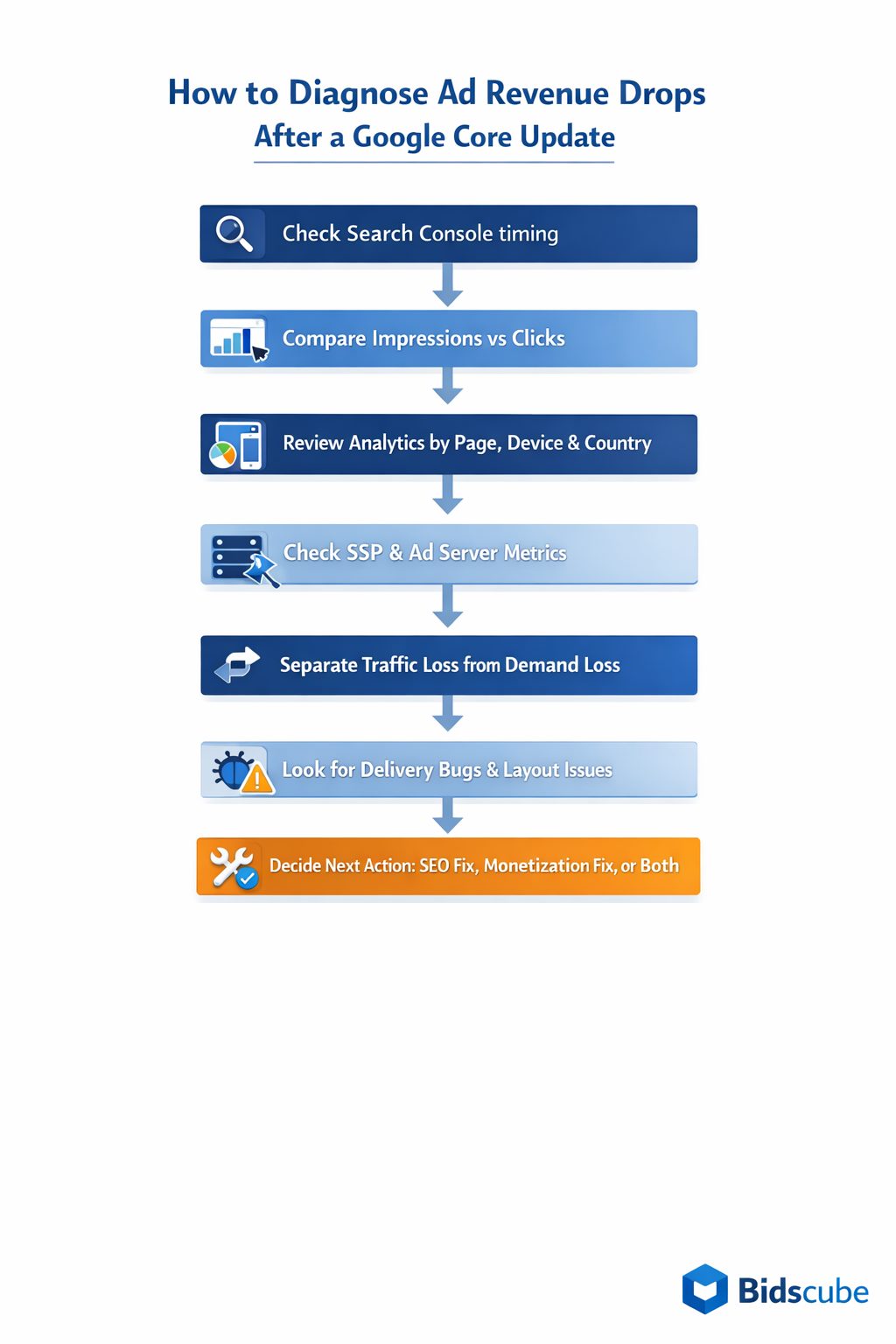
Step 1: Confirm the Timing in Google Search Console
Open Search Console, and compare clicks and impressions in two windows:
- 28 days before the update window
- 28 days after the update window
Then split by:
- Query groups that used to drive volume
- Page groups, especially evergreen pages
- Search appearance, including Top stories, if you are a news publisher
If impressions dropped first, you likely lost visibility. If your impressions stayed the same but clicks went down, it likely means your titles, snippets, or the search results layout changed, which hurt your click-through rate.
Step 2: Confirm the Traffic Story in Analytics
In Analytics, pull a view with organic sessions and revenue per session. Then check:
- Landing pages that lost the most sessions
- Device split, because mobile drops often hit RPM harder
- Country split, because buyer demand varies by geo
- Engagement changes, like time on page and pages per session
If sessions drop but engagement improves, you might have lost low intent traffic. That can sometimes soften the RPM hit. If sessions drop and engagement drops, buyers often lower bids, and fill rate can fall.
Step 3: Read Your SSP and Ad Server Reports Like a Forensic Report
Open your SSP, network, or ad server reports and compare these metrics:
- Ad requests
- Matched requests or fill rate
- Viewability and time in view
- CPM, net eCPM, and revenue
- Block rate, timeout rate, and auction errors
This is where you split the diagnosis. If you’re wondering why ad revenue dropped after Google update, first compare impressions, clicks, ad requests, fill rate, and RPM. Do this before blaming a specific partner or template.
Step 4: Check for Secondary Issues That Look Like SEO, but Are Really Delivery Bugs
Core updates often coincide with changes you made recently, even small ones. Check:
- Lazy load changes that stop ads from rendering
- Layout shifts that reduce viewability
- Consent and privacy changes that cut addressability
- Script errors and timeouts
If you are not sure where to begin, run one Lighthouse report on your top templates, and compare it to last month.
Step 5: Confirm if Only Google Traffic Fell, or if the Whole Site Fell
Look at direct, email, Discover, social, and referral. If everything fell, you may have a broader issue like site speed, indexing problems, or a broken template.
If only Google organic fell, the update likely changed how your pages compete.
Reddit Case: Publishers Discuss Revenue Drops After Core Updates
In a thread on r/SEO about a news site traffic drop after a core update, the poster shared a sharp decline in clicks and impressions, and asked how to regain traffic fast.
A few themes came up that match what publishers see in practice:
- Several commenters pushed for root cause analysis, not a generic plan. They asked what pages and queries lost rankings, and whether the site triggered risky tactics.
- One commenter suggested starting with crawlability and basic technical issues, like robots.txt mistakes, sitemap problems, and Core Web Vitals on mobile.
- Another commenter said many news sites lost meaningful traffic, and some lost even more revenue. Their advice was blunt: remove or rewrite low quality pages, and reduce ad clutter on affected pages.
- The original poster later mentioned that fixing sitemaps caused a visible uptick, which supports the idea that indexing and crawl signals can amplify update impact.
Take two lessons from that discussion:
- First, do not assume you got penalized. Core updates can reshuffle winners and losers without a manual action.
- Second, treat technical hygiene as a multiplier.
If the content is borderline and the site also has crawl, speed, or template problems, the update impact often feels harsher.
The Reddit thread makes one point clear: traffic drops after a core update rarely come from one issue alone. Weak content, indexing problems, and poor page experience often stack up and hit publishers at the same time. The smart move is not panic, but diagnosis. Find what changed, fix what you can prove, and work from the pages that matter most.
Recovery Strategies for Publishers
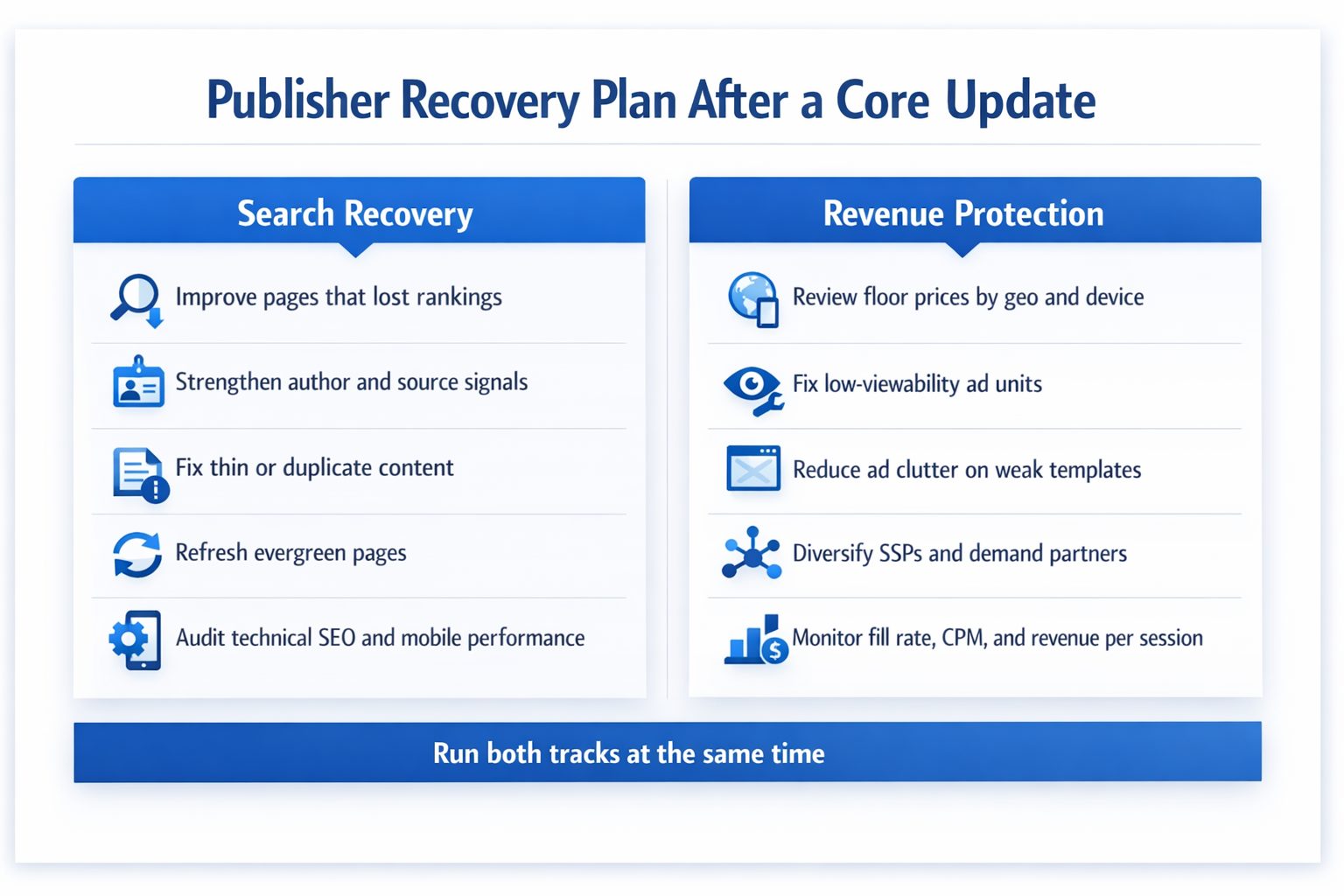
If you want to recover ad revenue after core update, you need two tracks running at the same time: search recovery and monetization protection. Do not wait for traffic to come back on its own. Treat it like an incident.
Content Rehabilitation with E E A T Signals
For most publishers, the fastest wins come from improving content quality on the pages that lost the most.
Start with:
- Pages that used to rank and still have search demand
- Pages with thin or duplicated sections
- Pages with unclear authorship or outdated claims
Then improve:
- Author pages with clear bio, credentials, and editorial ownership
- Transparent sources, dates, and updates
- Better structure: clear headings, internal links, and a focused answer early
If your site is heavy on quick takes, consider fewer pages with higher depth. A core update often punishes same story, many variants patterns.
Technical SEO Audit After the Update
Do a template based review. Look for:
- Indexing issues: robots directives, canonicals, and sitemap errors
- Crawl waste: broken internal links and redirect chains
- Mobile experience: layout shifts, font sizes, and intrusive interstitials
- Performance: slow LCP and high CLS, especially on story templates
Even a small change can matter. If a navigation component became hard to crawl, you can lose internal link equity, and rankings can slide across a section.
Updating Outdated Content with a Schedule
Build a refresh plan:
- Update top evergreen pages first
- Add missing context and new examples
- Remove or merge pages that only exist to target near duplicate queries
- Add last updated dates when you actually update content
This is not about writing more. It is about making your best pages look like your best work. Recovery works best when publishers run content fixes and revenue protection at the same time. Stronger pages, cleaner templates, and a clear update schedule can help restore search trust faster. At the same time, better traffic monetization recovery choices protect income while traffic is unstable. The goal is not to publish more, but to make the pages that matter clearly worth ranking.
To recover ad revenue after core update, publishers need to improve weak pages, fix technical issues, and tighten SSP settings so lower traffic does not create a second revenue hit.
SSP and Demand Diversification After a Core Update
When traffic falls, buyers get pickier. This is where programmatic advertising strategy matters, but you need to keep it practical.
Protect Yield While Volume Is Down
Start with these actions:
- Review floors by geo and device, and avoid one global floor
- Identify units with low viewability, and fix placement before you blame demand
- Reduce ad density on templates that lost rankings, and test the impact
Too many ads can hurt user experience and, in turn, engagement. Lower engagement can hurt both rankings and bids.
Diversify Demand Sources
Do not rely on one SSP, one exchange, or one network. A single buyer change can cause a demand cliff.
Use a mix:
- Direct deals for your strongest sections
- Multiple programmatic demand partners for auction pressure
- Regional demand where you have geo traffic
This is the practical meaning of SSP optimization after update: not a full rebuild, but enough redundancy so one partner cannot sink fill rate. If you operate your own stack, BidsCube white label ad exchange can help you add more routes to demand while you keep control over pricing and reporting.
You can also validate partner quality through third party reviews like BidsCube on G2 and BidsCube on Clutch.
Watch for Budget Shifts Outside Your Site
Advertisers shift budgets across channels quickly.
- Dentsu estimated that algorithmically enabled ad spend reached 59.5% of total ad spend in 2024.
- Deloitte reported that 54% of SVOD subscribers surveyed had at least one ad supported tier.
When your traffic drops, managing your ad yield becomes even more important. Protect your revenue by tightening ad placements, reviewing floor prices, and avoiding reliance on a single demand source. Diversifying helps your setup adjust if one partner slows down.
Conclusion
If you are asking why ad revenue dropped after google update, do not treat it as one metric problem. Start with a clean diagnosis, separate traffic loss from demand loss, and fix what you can control this week. The Google update impact on publisher revenue becomes easier to manage when you track search signals and auction metrics in one reporting view instead of treating them as separate teams or problems.
Then build a recovery plan that improves page quality, fixes technical multipliers, and reduces risk in your demand stack. When you do that, the Google update impact on publisher revenue becomes a managed variable, not a surprise.
FAQ
What should I do first when ad revenue drops after Google Core Update?
Check in the Search Console where and which pages and queries lost impressions as well as clicks, then confirm vis-a-vis Analytics that traffic did indeed drop. Then dive into your SSP reports inspecting requests, fill rate, viewability and CPM to help you determine if the damage is traffic or demand related.
How long does it take to recover ad revenue after a Google Core Update?
How long recovery takes depends on how far your rankings fell and how quickly you can improve your pages and fix technical problems. A subset of publishers see early progress within weeks of implementing significant changes, but full recovery generally takes 1 to 3 update cycles, particularly if your site has widespread content quality problems.


