



TL;DR
- Viewability tells you an ad could be seen. It doesn’t tell you anyone looked.
- Attention metrics measure whether people actually noticed an ad, and for how long.
- They don’t use personal data. They rely on signals from the page, the ad, and the screen.
- Teads and Dentsu found attention predicts campaign results three times better than viewability.
- Active attention suits launches. Passive attention can still build brand awareness.
- Use attention to guide bids, frequency, creative refresh, and media planning.
- There’s no single industry standard yet, so compare vendors with care.
Table of Contents
- What are attention metrics?
- Attention metrics vs viewability: what's the difference
- Active vs passive attention
- How attention is measured
- How to use attention metrics to optimize campaigns
- Limitations of attention metrics
- How BidsCube Can Help
- Summary
-
FAQ
- 1. What are attention metrics in advertising?
- 2. How are attention metrics different from viewability?
- 3. What is the difference between active and passive attention?
- 4. How is attention actually measured?
- 5. Can attention metrics replace viewability completely?
- 6. Which channels benefit most from attention metrics today?
For years, viewability was the gold standard. If at least half an ad sat on screen for one second, it counted. Box ticked.
But being “on screen” is not the same thing as being “visible.” They put a banner in view while the reader looks at a pic, or looks at a headline, or looks down at their phone. Technically viewable.
Teads and Dentsu claimed that attention is three times as good a predictor of campaign performance than viewability, after analysing over 1,500 campaigns in Q4. Relevantly-placed ads also scored 13% more attentive seconds per 1,000 impressions.
So, what are attention metrics in digital advertising, and how do you apply them? Let’s go through it.
What are attention metrics?
Here’s a plain attention metrics advertising definition. Attention metrics are data points that show whether a person really paid attention to an ad, and for how long. They go past whether the ad simply had a chance to be seen. They combine many signals into one view. That’s why people call them multi-dimensional.
One more point. Attention metrics in advertising don’t rely on personal data. They read signals from the page, the ad, and the device. That’s very different from behavioral targeting, which tracks the user. So attention works just as well when cookies are blocked.
Attention metrics vs viewability: what’s the difference
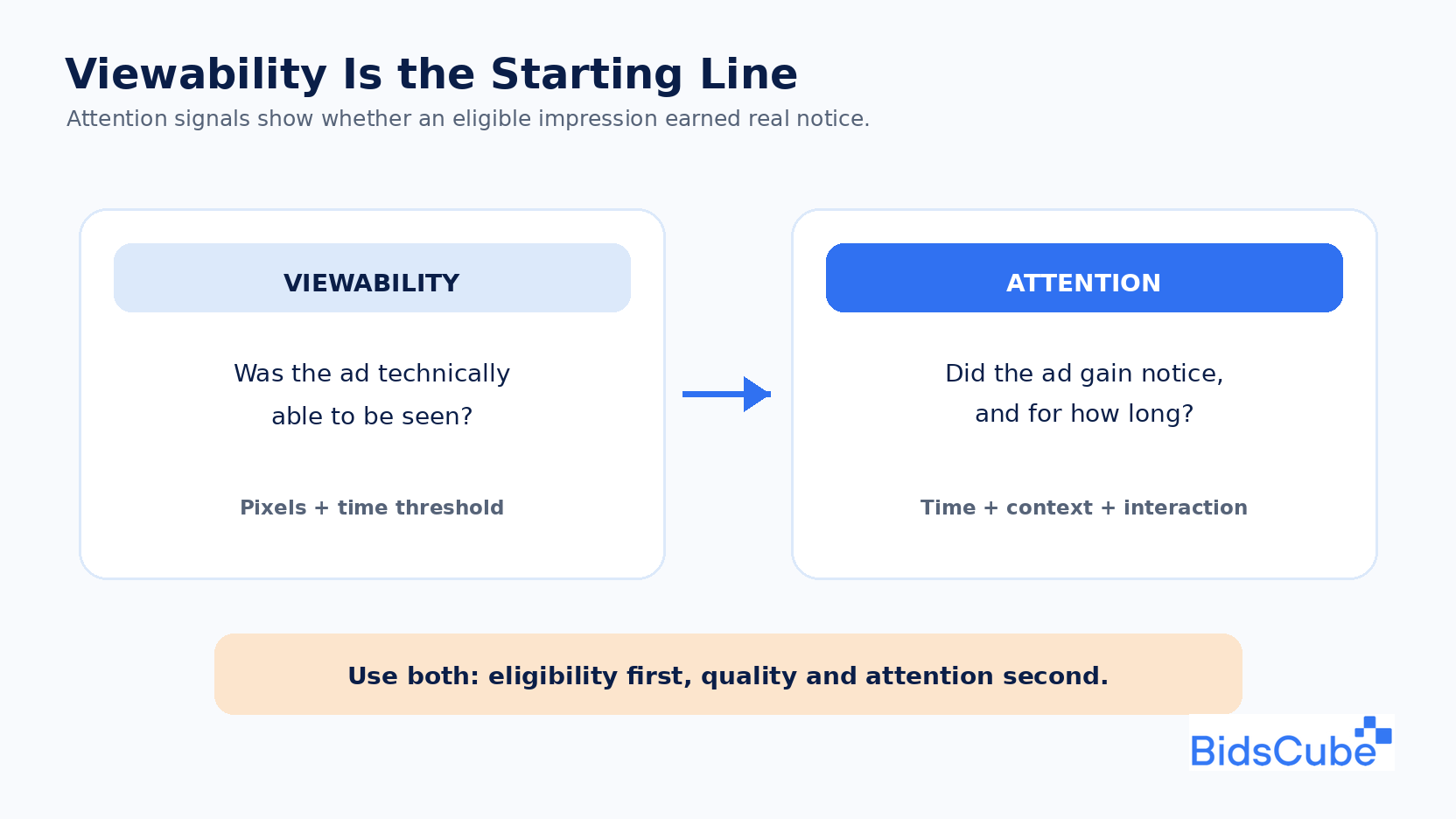
The attention metrics vs viewability debate comes down to one thing. Viewability measures opportunity. Attention measures what happened.
| Parameter | Viewability | Attention metrics |
|---|---|---|
| What it measures | The technical chance to see an ad | Whether and how deeply people actually noticed it |
| Signal source | Pixels inside the visible part of the screen | Time in view, interaction, page context, eye-tracking |
| How well it predicts results | Moderate | Higher. Three times more accurate, per Teads and Dentsu |
| Depends on cookies | No | No. It reads the setting, not the user |
Viewability still matters. You can’t pay attention to an ad that never loads. Think of it as the floor. Attention is what you build on top. If you buy on a vCPM basis, you already pay for viewable impressions. Attention adds the next layer.
Active vs passive attention
The active attention vs passive attention split is simple.
- Active attention. The person is focused on the content. For example, they’re watching a video and the ad plays inside it. Their eyes are on the screen.
- Passive attention. The ad plays in the background. Their attention is diverted elsewhere. Like a TV ad while the person is scrolling through their phone or a banner next to an article, they are reading.
Active attention works best for a product launch. You need people to take in new details. Even though passive attention assists in brand awareness. An absence of light creates a disciplinary relationship as flashbacks to the liberated lands serve as psychological counsel.
How attention is measured
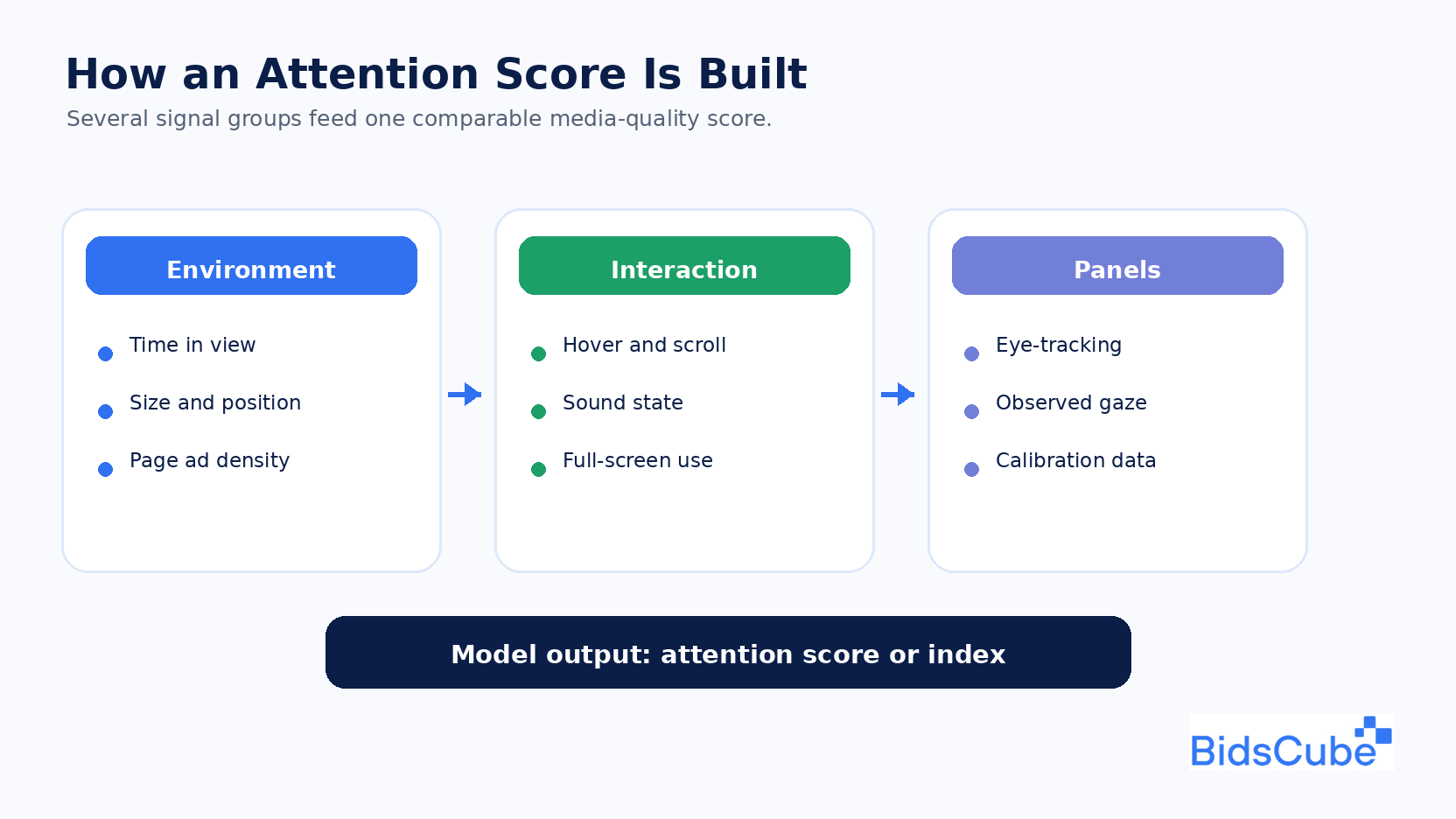
Wondering how attention metrics work in advertising? Most vendors use four groups of signals.
- Environment signals. These might be time, size of ads, location on the page (above the fold versus below), number of other ads on that page, relevance to content etc.
- Interaction signals. Hover, Scroll Depth Sound On/Off and Full-screen which
- Eye-tracking. The advanced layer. Panels of real people let cameras record where their eyes actually go.
- The model. A machine learning model combines all these signals into one number. It’s usually called an attention score or attention index.
That’s the core of attention measurement advertising. Signals in, one score out. A small aside. Eye-tracking sounds high-tech, but the idea is old. Print publishers ran similar studies on newspaper layouts decades ago. The tools changed. The question didn’t.
Want to buy impressions that people actually notice? Explore the BidsCube DSP and put quality signals to work in your bidding.
How to use attention metrics to optimize campaigns
Here’s how to use attention metrics for advertising in daily work.
- Bid more on high-attention inventory. Optimised bids on the bases of strong attention score on domains and formats. Lower them where scores are weak.
- Cap frequency where attention fades. Attention often drops with each repeat view. That’s called attention decay. When you see it, lower the cap.
- Refresh the creative. When attention slips, swap the ad. Don’t just add budget to a tired banner.
- Plan media by attention, not just CPM. A cheap CPM with low attention can cost more per real view than a pricier slot people actually look at. Split budget across channels by expected attention.
These steps tie attention to outcomes like ad recall and brand lift. For a wider view of what to track, see our guide to top programmatic metrics that define campaign success.
Limitations of attention metrics
Attention metrics advertising tools are useful. They’re not perfect yet.
- No single standard. Each vendor builds its own score. A 70 from one tool doesn’t equal a 70 from another. Compare with care.
- Uneven channel coverage. Models are most mature for display, mobile web, and online video. CTV, DOOH, and social have fewer clear standards so far. Our article on CTV measurement tools, standards, and challenges explains the gaps.
- Small eye-tracking panels. Eye-tracking gives the sharpest data. However, panels can be minuscule and not perfectly representative of your entire audience.
To be frank, the attention scores are best used as an approximation, not a definitive statement.
How BidsCube Can Help
The BidsCube DSP uses attention-style quality signals when it sets bids and frequency.
- Viewable time. Inventory where ads stay in view longer gets priority.
- Interaction signals. Engagement data helps spot placements people actually notice.
- Domain quality. Low-quality and cluttered sites can be filtered out.
- Smarter frequency. Caps help limit spend where attention drops off.
Publishers can raise the value of their inventory through the BidsCube SSP. Better viewability is a good first step. Our guide on how to improve ad viewability shows how.
BidsCube has 10+ years in programmatic and 230+ clients. Read their reviews on Clutch.
Summary
Viewability tells you an ad had a chance. Attention tells you if it worked. Optimize with viewability as the floor and attention as the signal for bids, caps, and creative. Scores vary by vendor, and channel as you know. Start with one campaign, compare attention to results, and grow from there with attention measurement advertising.
Talk to BidsCube about bidding on inventory that earns real attention.
Our tech staff and AdOps are formed by the best AdTech and MarTech industry specialists with 10+ years of proven track record!

FAQ
1. What are attention metrics in advertising?
They show whether people actually noticed an ad and for how long. That’s the short answer to what are attention metrics in digital advertising. It’s also the core attention metrics advertising definition.
2. How are attention metrics different from viewability?
Viewability measures the chance to see an ad. Attention measures real focus. In attention metrics vs viewability, attention predicts results about three times better, per Teads and Dentsu.
3. What is the difference between active and passive attention?
Active attention means the person is focused on the content. Passive attention means the ad plays while their focus is elsewhere. Active attention vs passive attention also maps to goals: launches versus awareness.
4. How is attention actually measured?
Vendors combine environment signals, interaction signals, and eye-tracking data in a machine learning model. That’s how attention metrics work in advertising in one line.
5. Can attention metrics replace viewability completely?
No. An ad has to be viewable before anyone can pay attention to it. Attention-based measurement builds on viewability. It doesn’t replace it.
6. Which channels benefit most from attention metrics today?
Display, mobile web, and online video have the most mature tools. CTV and DOOH are catching up. If you’re new to how to use attention metrics for advertising, start with those formats. They’re also where attention metrics advertising data is easiest to compare.
This Article's Ad Tech terms


