



TL;DR
- A floor price is the lowest bid you accept for an impression. Anything below it gets rejected.
- High floors push CPM up. They also leave more impressions unsold.
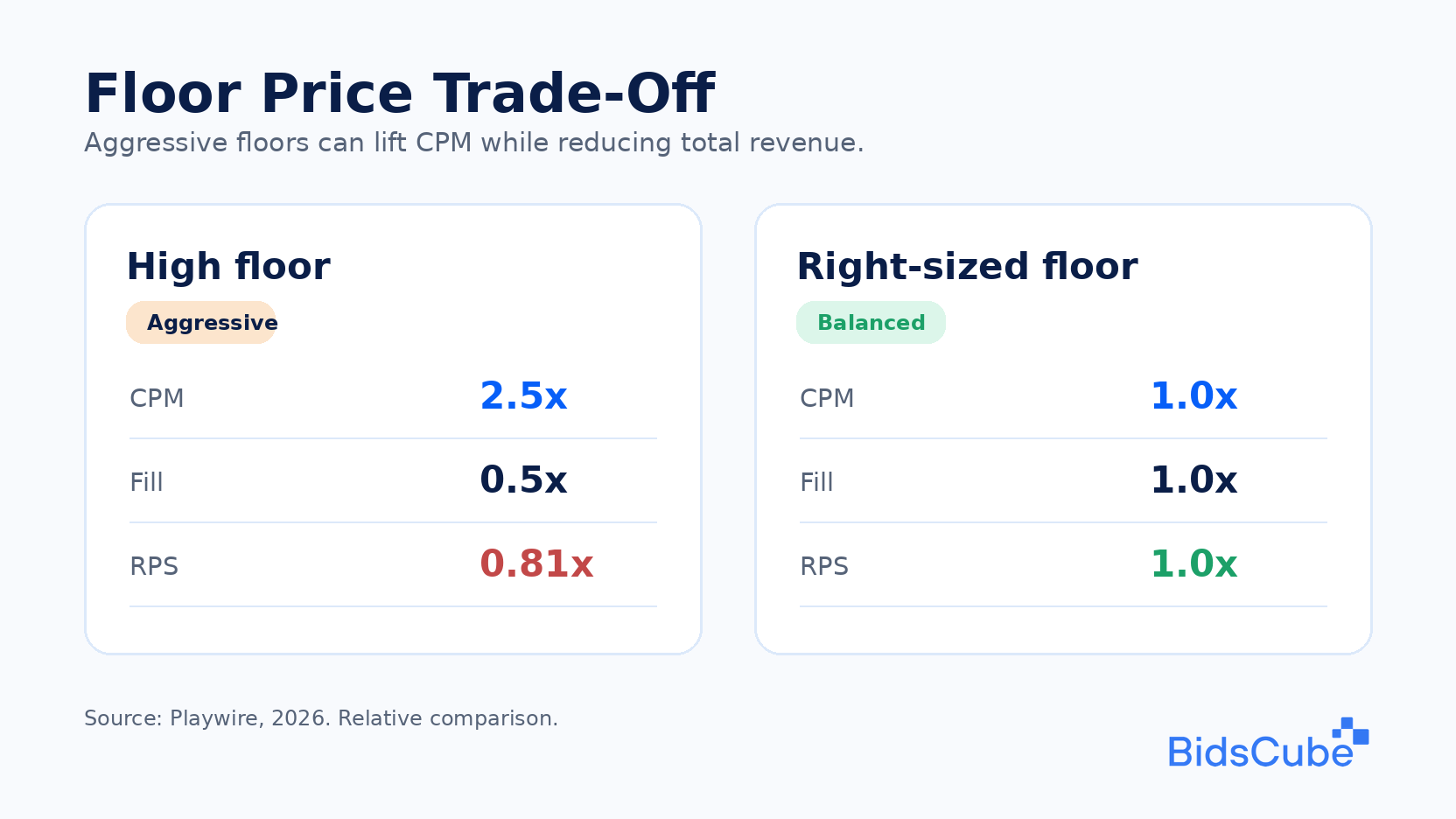
- Playwire’s 2026 data shows publishers with aggressive floors fill about half as much inventory and earn 19% less per session.
- Publishers at 90%+ fill earn 5.3 times more per session than those below 40%.
- Dynamic floors set a new price for every auction. Static floors don’t move.
- Judge floors by revenue per session (RPS), not by CPM alone.
- Floors are one lever of yield optimization. Ad density, viewability, and demand depth matter too.
Table of Contents
- What is a floor price in advertising?
- What is a reserve price in advertising?
- Price floor vs fill rate: the trade-off
- How floor prices affect ad fill rate
- Dynamic floor pricing: how it works
- Static floor pricing vs adaptive floor pricing: comparison table
- How to set floor prices in header bidding: step-by-step
- Floor price best practices for publishers
- Common floor price mistakes that hurt fill rate
- Yield optimization: Floor price as one part of the bigger picture
- How BidsCube Can Help
- Final Thoughts
-
FAQ
- 1. What is a floor price in advertising?
- 2. What is the difference between a floor price and a reserve price?
- 3. How does floor price affect ad fill rate?
- 4. What is dynamic floor pricing and how does it work?
- 5. How do I set the right floor price in header bidding?
- 6. Does a higher floor price always mean more revenue?
Most publishers watch CPM first. It’s the number on every dashboard, and a higher one feels like a win.
Here’s the catch. The floor you set to protect that CPM can cost you more than it earns. A tall floor wins the price fight for each impression. It often loses the war for total revenue.
The reason is simple. The floor decides the lowest bid the auction will take. So it also decides how many impressions get filled at all. That makes floor price optimization one of the strongest revenue levers you have. It’s also one of the most often broken.
The numbers back this up. Playwire’s 2026 State of Publisher Ad Revenue Report looked at more than 100 billion impressions. Within the same demand tier, publishers with aggressive floors filled about half as much inventory as those with right-sized floors. Their CPMs were nearly twice as high. Yet they made 19% less revenue per session.
Half the fill. Double the price. Less money.
What is a floor price in advertising?
So, what does a floor price mean in advertising? It’s the lowest bid a publisher will accept for one impression. Bids under that line get rejected automatically. You’ll also hear it called a price floor or a floor price.
There are two types:
- Hard floor. A strict line. Any bid below it loses, with no exceptions.
- Soft floor. A flexible line. Bids a bit lower can still win under set conditions, for example when no bid clears the floor.
The floor price in programmatic advertising is usually set inside the SSP or the header bidding wrapper. You may also see it shown as a floor CPM, the price per thousand impressions.
What is a reserve price in advertising?
Next question: what is a reserve price in advertising? It’s also a minimum price for an impression. In daily use, people treat it as a synonym for floor price.
Some SSPs draw a line between the two, though. In those platforms, the floor price is a fixed value the publisher sets by hand. The reserve price is a dynamic minimum the auction sets on its own, based on live demand. In reserve price programmatic advertising talks, ask your partner which meaning they use.
Price floor vs fill rate: the trade-off
First, a quick answer to what is ad fill rate. It’s the share of ad requests that get filled with a paid ad. If 1,000 requests come in and 800 get an ad, your fill rate is 80%.
Formula: Fill rate = (filled impressions ÷ ad requests) × 100
Now the price floor vs fill rate trade-off. Say your floor sits above what a buyer is willing to pay. The bid gets rejected. The impression goes unsold. Your ad fill rate falls.
Playwire’s data shows how much fill matters. Here is revenue per session in each fill bracket, compared to publishers below 40% fill:
| Fill rate bracket | Avg. RPS vs the <40% fill bracket |
| Below 40% | 1.0x (baseline) |
| 40 to 60% | 2.5x |
| 60 to 75% | 3.4x |
| 75 to 90% | 3.5x |
| 90% and above | 5.3x |
The takeaway is clear. Moving from below 40% fill to 90%+ brings 5.3 times more revenue per session. Each step up stacks on the last one. In fill rate advertising, the gains compound.
How floor prices affect ad fill rate
Let’s walk through one impression to see how floor prices affect fill rate.
Your SSP sets the floor at $2.00. A DSP values the impression at $1.60. It doesn’t bid. The impression stays unsold, and you earn $0.
Now drop the floor to $1.20. The same DSP bids $1.60. The impression sells. You earn money on a slot that paid nothing a moment ago.
Multiply that by millions of impressions. The gap grows fast.
One more point. Within a single demand tier (same geography), CPM and fill move in opposite directions. A higher floor reliably predicts lower fill. That pattern is how floor prices affect fill rate at scale, not just in one auction.
Not sure where your floors sit? Talk to the BidsCube team about a free review of your publisher setup. We’ll show you where fill leaks out.
Dynamic floor pricing: how it works
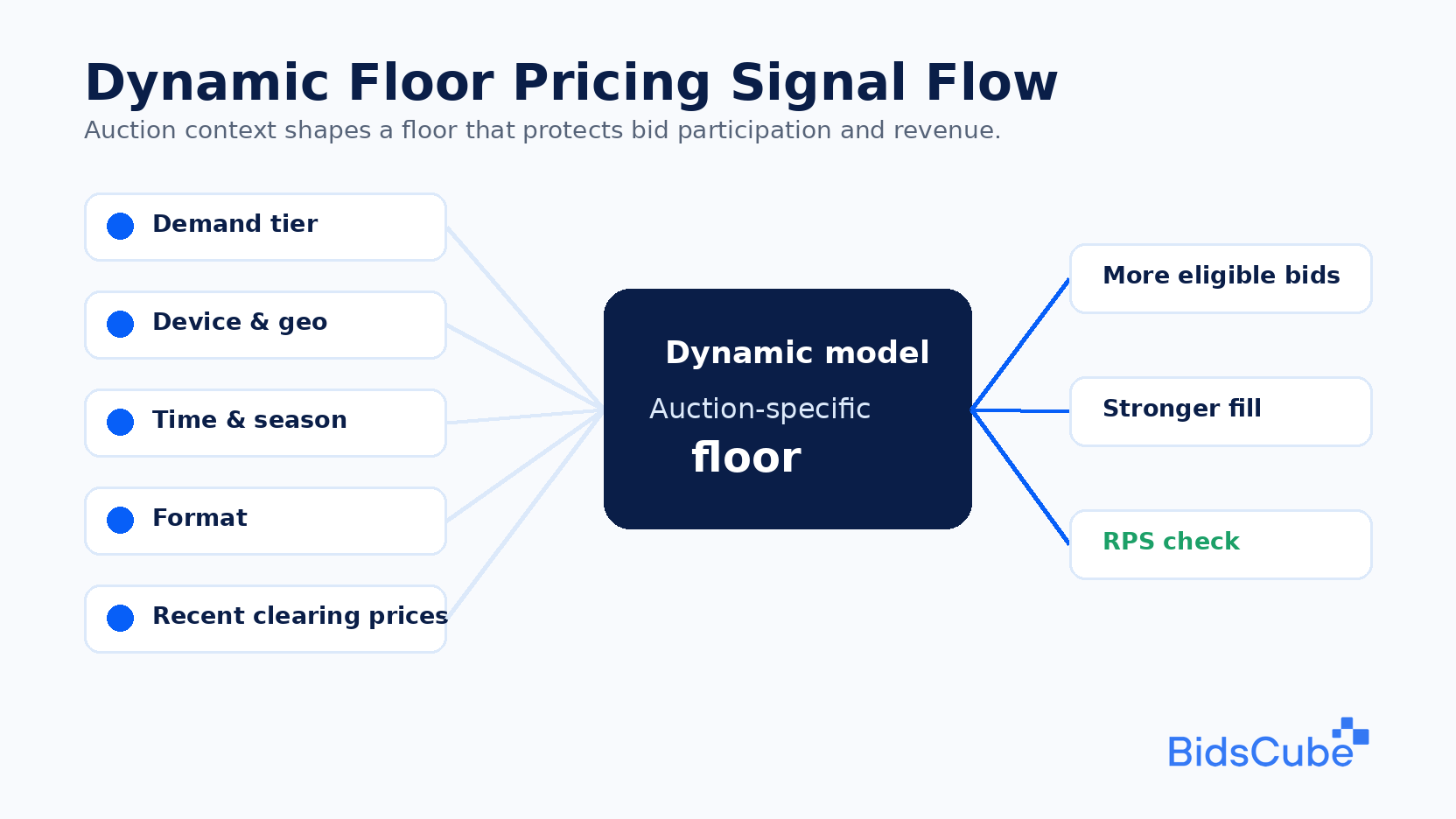
Auction-level pricing is a model that works out the best floor for each single auction. It uses live demand signals instead of one fixed number.
A dynamic model often looks at:
- the user’s geography and device type;
- past clearing prices for similar inventory;
- the time of day and day of week;;
- ad format and size
- how much demand is connected (the number of active DSPs).
Morning traffic from a German desktop user and late-night mobile traffic from Brazil don’t deserve the same floor. A dynamic model knows that. A static one doesn’t.
Static floor pricing vs adaptive floor pricing: comparison table
| Parameter | Static floor pricing | Dynamic floor pricing |
| How the floor is set | One fixed value, set by hand | Recalculated for each auction |
| Reaction to demand | None until someone edits it | Adjusts in real time |
| Segmentation | Often one value for all traffic | Varies by geo, device, format, and time |
| Effect on fill | Higher risk of unsold impressions | Fewer missed bids |
| Upkeep | Manual reviews needed | Runs on its own, with checks |
| Best fit | Small sites with steady demand | Mid to large publishers with mixed traffic |
How to set floor prices in header bidding: step-by-step
Here is how to set floor prices in header bidding without hurting fill:
- Collect past clearing prices. Pull data for each inventory segment: domain, format, geo, and device.
- Set a base floor per demand tier. Don’t use one floor for all traffic. A US desktop user and a mobile user in a smaller market are different buys.
- Turn on unified pricing rules. Apply them in your header bidding wrapper so different SSPs don’t fight over clashing floors.
- Test on part of your traffic. Run an A/B test. Compare fill rate and RPS, not just CPM.
- Review floors on a schedule. Don’t leave them on autopilot for months.
If you still run a waterfall, floors work differently there. Our guide on header bidding vs waterfall explains the gap.
Floor price best practices for publishers
These floor price best practices for publishers come up again and again: Aim for revenue per session. CPM alone can mislead you. RPS shows what a visit is really worth. Segment your floors. Split them by demand tier, format, and geo. One number for all traffic leaves money on the table.
Keep viewability at 70% or higher. Buyers show more interest from that level. Playwire found the best results between 80% and 90%. Past 80%, extra viewability adds little. Don’t split requests into too many slots. Too many ad units per page lowers fill, whatever your floor is.
Pair dynamic floors with deep demand. A dynamic model needs bidders to work with. A deep header bidding stack gives it more bids to read. Watch unreserved inventory closely. Open auction traffic is where floor changes show up first. Following these floor price best practices for publishers stops the most common leaks.
Common floor price mistakes that hurt fill rate
Want to know how to improve ad fill rate? Start by fixing these mistakes.
An “ambitious” static floor. Some publishers set the floor at the CPM they want, not the CPM the market pays. Buyers simply walk away. One floor for all geos and devices. Demand in the US and demand in Southeast Asia are not the same. A single value overprices one and underprices the other.
No review after demand shifts. Q4 demand is not Q1 demand. Losing a big demand partner changes things too. Old floors don’t notice. Chasing 100% fill at any cost. Fill matters, but so does price. Dropping floors to zero can lower total revenue. Track RPS, not one metric in isolation. Fixing these is the fastest answer to how to improve ad fill rate without new partners.
Yield optimization: Floor price as one part of the bigger picture
Floors are only one lever in yield optimization. Other levers sit right next to them:
- Ad density. How many impressions you serve per session.
- Viewability. Whether people can actually see the ad.
- Demand depth. How many header bidding partners compete for each impression.
Good yield optimization advertising looks at all of these together. Raise the floor while cutting demand partners, and the two moves can cancel out.
And ad yield optimization is never a one-time setup. Demand shifts every week. Your floors and your stack need to shift with it. The best yield optimization strategies for publishers treat it as an ongoing habit, with regular checks and small tests.
For a broader list, see our publisher’s checklist for boosting revenue with programmatic. To check how your eCPM moves after floor changes, read how to calculate eCPM and improve your ad revenue.
How BidsCube Can Help
BidsCube SSP gives publishers the tools to balance fill and CPM without editing floors by hand every week.
- Auction-level pricing. Floors adjust to live demand for each auction.
- Unified pricing rules. One set of rules across demand sources, so floors don’t clash.
- Inventory controls. Set floors by geo, device, format, and domain.
- Real-time reporting. Track fill, CPM, and revenue side by side.
BidsCube has more than 10 years in programmatic and works with 230+ clients. Publishers rate the team on Clutch. If you want ad yield optimization that runs on data instead of guesswork, our publisher solutions are a good place to start.
Ready to stop losing fill to high floors? Book a BidsCube SSP demo and see how dynamic floors work on your traffic.
Final Thoughts
A high floor feels safe. It often isn’t. According to the 2026 data from Playwire, right sized floors earn more per session than aggressive ones even at lower CPMs.
- The fix starts with measuring RPS, segmenting floors, and moving from static to dynamic pricing.
- Treat floor price optimization as part of a wider set of yield optimization strategies for publishers, and review it often.
- The floor price in programmatic advertising is not a set-and-forget number.
- Good yield optimization advertising keeps it moving with demand.
Talk to BidsCube about tuning your floors for fill and revenue.
Our tech staff and AdOps are formed by the best AdTech and MarTech industry specialists with 10+ years of proven track record!

FAQ
1. What is a floor price in advertising?
If you’re asking what is a floor price in advertising, it’s the lowest bid a publisher accepts for one impression. Lower bids get rejected.
2. What is the difference between a floor price and a reserve price?
If you’ve wondered what is a reserve price in advertising, it’s a minimum price for an impression. Many people use the terms as synonyms. In some SSPs, the floor is a fixed value the publisher sets. The reserve price is a dynamic minimum the auction sets. In reserve price programmatic advertising, check which meaning your partner uses.
3. How does floor price affect ad fill rate?
A floor above what buyers will pay means bids get rejected. Impressions go unsold, and your fill percentage drops. Within one demand tier, higher floors reliably mean lower fill. If you wonder what is ad fill rate, it’s filled impressions divided by ad requests.
4. What is dynamic floor pricing and how does it work?
With this pricing strategy, each auction will have a brand new base price. Geo, device, time of day, ad format (native/mobile/desktop) and historic clearing prices in 2-second increments plus an indication of how many DSPs are currently online
5. How do I set the right floor price in header bidding?
Here is how to set floor prices in header bidding in short. Start with past clearing prices by segment. Set floors per demand tier, apply unified pricing rules, A/B test, and review often. Track RPS, not just CPM.
6. Does a higher floor price always mean more revenue?
No. In fill rate advertising, a higher floor often means fewer filled impressions. Playwire found publishers with aggressive floors earned 19% less per session, even with nearly double the CPM.
This Article's Ad Tech terms


