



- Winners are charged the amount they bid in first-price auctions.
- In a second-price auction, winners pay the next-highest eligible bid.
- The move to first-price made bid shading more important for buyers.
- Header bidding exposed problems with stacked second-price auctions.
- Price floors can change the amount paid in either auction model.
- OpenRTB carries auction type and price floor data between sellers and buyers.
Table of Contents
- What Is a First-Price Auction?
- What Is a Second-Price Auction?
- How the Clearing Price Is Calculated: Step-by-Step Example
- First-Price vs Second-Price Auction: Comparison Table
- Why the Industry Moved from Second-Price to First-Price
- Hard Floor and Soft Floor: How Price Floors Affect the Outcome
- Bid Shading: How Advertisers Adapt to First-Price Bidding
- How BidsCube Can Help
- Final Thoughts
-
FAQs
- What Is the Difference Between a First-Price and a Second-Price Auction?
- Why Did Programmatic Advertising Shift from Second-Price to First-Price Auctions?
- How Is the Clearing Price Determined in a Second-Price Auction?
- What Is Bid Shading and Why Does It Matter in First-Price Auctions?
- Are Second-Price Auctions Still Used in Programmatic Advertising?
- What Is the Difference Between a Hard Floor and a Soft Floor?
A programmatic auction determines which buyer wins an impression, and what they pay for it. Two different decisions can lead to completely different results even on the same bids placed by the same advertisers.
As per Digital Applied, 96% of programmatic bids now clear via first-price auctions versus 88% in 2022. Previously, Ad Exchange traffic was migrated to a first-price auction in September 2019.
For teams evaluating first price vs second price auction structures, the clearing rule makes bidding behavior, publisher revenue, and the requirement to shade bids differ. The first price and second price auction difference starts with one question: does the winner pay its own bid or a price based on the next bidder?
For background on the auction process, see Real-Time Bidding (RTB).
What Is a First-Price Auction?
A first price auction is, in the opinion of the highest capable bidder. The winner pays the amount it submitted.
Bidder A bids $6.00 CPM, Bidder B bids $4.80 and Bidder C bids $3.90
The pricing rule is direct. It also creates a cost problem for buyers. Buyer A might have won with $4.81, but the auction charges the full $6.00.
DSPs can respond with bid shading. Instead of sending the advertiser’s maximum valuation, the DSP estimates a lower price that still has a reasonable chance of winning.
This is why an first price auction vs second price auction review needs to look past the winner. The amount paid matters just as much.
What Is a Second-Price Auction?
A second-price auction similarly conveys to the most-competitive paid bidder that,
A Vickrey auction is a second price nature auction, the winner pays the price of the 2nd highest bid. Many advertising systems would, in the older days, add a small amount such as one cent.
Even if you have the same bids all along, Buyer A wins at $6.00 CPM. If Buyer B bid $4.80, then the likely clearing price will be either $4.80 or $4.81 depending on auction rules employed.
Under ideal Vickrey auction assumptions, truthful bidding makes sense because the winner does not automatically pay its full valuation.
BidsCube provides a separate definition of the model in its Second-Price Auction glossary entry.
How the Clearing Price Is Calculated: Step-by-Step Example
Take three bids for one display impression:
- Buyer A: $5.40 CPM
- Buyer B: $4.20 CPM
- Buyer C: $3.60 CPM
First-price result
Buyer A wins and pays $5.40 CPM.
Second-price result
Buyer A still wins. Under a second-price rule with a one-cent increment, Buyer A pays $4.21 CPM.
The same bidders create a $1.19 CPM difference in cost.
This is why first price vs second price auction programmatic buying calls for different pricing behavior. First-price buyers must estimate both what an impression is worth and what amount may actually win it.
Programmatic Auction Definitions (2026) by IAB Tech Lab, September 2023: Ideal auction price is not limited to simple publisher/advertiser level differences and can also include fees or discounts, as well as participant level adjustments.
First-Price vs Second-Price Auction: Comparison Table
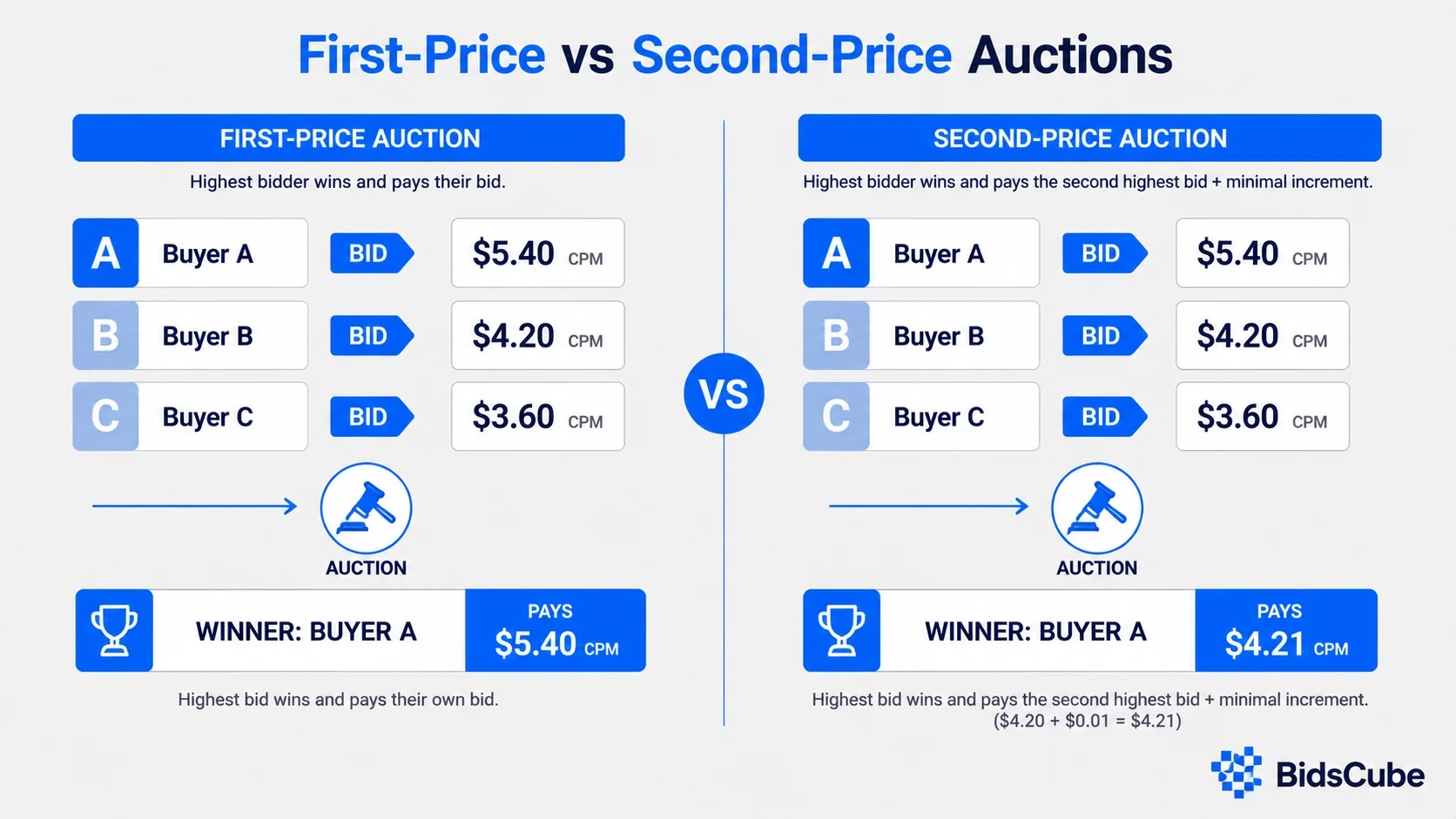
An first price auction vs second price auction comparison is easier to scan when the clearing rule sits beside the bidding behavior it creates.
| Parameter | First-Price Auction | Second-Price Auction |
| Clearing price | Winner’s own eligible bid | Based on the second-highest eligible bid |
| Buyer approach | Often uses bid shading | Truthful bidding works under ideal Vickrey assumptions |
| Buyer risk | Paying more than needed | Lower direct overpayment pressure |
| Header bidding fit | Works cleanly across parallel auctions | Stacked auctions can reduce the bid passed upstream |
| Price floors | Can reject shaded bids below the floor | Can raise the effective clearing price |
| Open programmatic use | Dominant model | Rare on open exchanges |
The second first price and second price auction difference is operational. It changes how DSPs price impressions and how SSPs pass auction results into later auction stages.
Why the Industry Moved from Second-Price to First-Price
Header bidding exposed a weakness in stacked second-price auctions.
Imagine one SSP receives bids of $8 and $5. Under second-price logic, it may pass about $5.01 into the publisher’s final auction. Another SSP receives bids of $7 and $6.50 and passes about $6.51.
The second SSP can then win the final auction even though the strongest original bid was $8.
First-price bidding passes the actual winning bid into the next stage. Parallel auction results become easier to compare.
Buyers also pushed for clearer pricing rules. Floors and platform-specific adjustments sometimes made it difficult to understand why an impression cleared at a certain amount.
Google has received buzz for its aggression in moving to first-price as a way to simplify the auction and make less opaque pricing.
Publisher-side mechanics: read Header Bidding and Prebid Explained and Header Bidding vs Waterfall.
Hard Floor and Soft Floor: How Price Floors Affect the Outcome
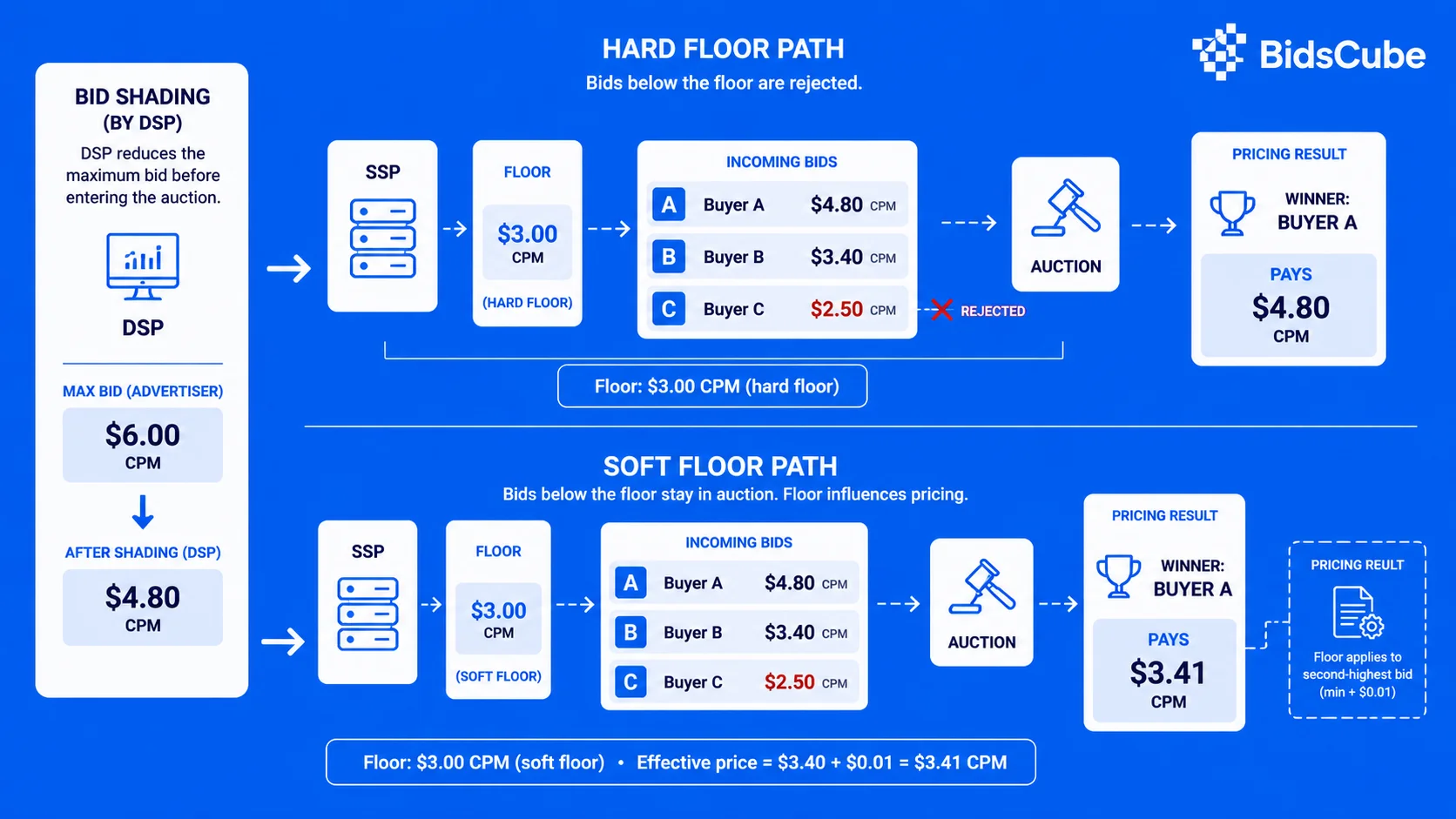
A price floor sets a minimum threshold for an impression.
A hard floor rejects bids below the stated minimum. If the hard floor is $3.00 CPM, a $2.90 bid cannot win even when it is the highest offer.
A soft floor is less strict. A seller may let lower bids remain eligible while using the threshold to affect pricing or auction treatment. The exact implementation varies by platform.
Google Ad Manager, for example, applies floor prices to several forms of non-guaranteed demand and can filter bids that do not meet the applicable publisher price.
Floors can alter both models. A second-price auction may clear above the second-highest bid when a floor applies. A first-price auction can reject a shaded bid that falls below the required minimum.
OpenRTB carries floor information between trading systems. See the BidsCube OpenRTB glossary for the protocol basics.
Check the Full Auction Path
A winning CPM tells only part of the story. Review floors, SSP rules, header bidding paths, and fees before comparing publisher revenue.
Bid Shading: How Advertisers Adapt to First-Price Bidding
Bid shading reduces the amount submitted in a first-price auction while trying to keep the bid high enough to win.
A DSP may study earlier auctions, publisher, device, geography, placement, time, floor price, and win-loss history. If a campaign values an impression at $7 CPM but similar auctions often clear near $5, the DSP may submit a bid somewhere between those figures.
Too little shading means the buyer may keep overpaying. Too much shading can cut win rate and campaign delivery.
This second first price vs second price auction programmatic comparison matters because a second-price auction handled much of the price adjustment inside the auction itself. First-price buying moves more of that pricing decision to the DSP.
BidsCube covers automated bidding methods in its article on AI in Programmatic Advertising.
How BidsCube Can Help
BidsCube provides DSP and SSP products for programmatic trading.
The BidsCube SSP lists header bidding among its supported connection methods and provides real-time inventory reporting. BidsCube materials also describe OpenRTB connections for sell-side trading.
The BidsCube DSP handles advertiser-side RTB buying. OpenRTB connections let DSP and SSP systems exchange bid requests, prices, floors, and auction information through a common format.
For a closer look at the two platform roles, read SSP vs DSP.
When comparing the two auction models, check the entire path: floor settings, bidder behavior, SSP fees, header bidding setup, win rate, and the net amount reaching the publisher.
Independent vendor feedback is available through the BidsCube Clutch profile.
Final Thoughts
First-price and second-price auctions can select the same winner and charge very different amounts. That is the practical distinction.
Open programmatic trading now runs mainly on first-price rules. Buyers need better price estimates and bid shading, while publishers need to watch floors and multi-stage auctions closely.
For a clean comparison, follow the money from the original DSP bid to the amount the publisher receives.
Our tech staff and AdOps are formed by the best AdTech and MarTech industry specialists with 10+ years of proven track record!

FAQs
What Is the Difference Between a First-Price and a Second-Price Auction?
In a high-bid wins and pays its own bid first price auction, the winning qualified bidder is simply the qualified bidder with the highest ultimate bid. For a second-price auction the winner pays a price that is equal to the next-highest bid eligible to win.
Why Did Programmatic Advertising Shift from Second-Price to First-Price Auctions?
It was essentially impossible to compare stacked second-price auctions due to header bidding, and the ability of SSPs to send lower clearing prices into another auction. First-price bids proceed to the next round of an actual winning bid.
How Is the Clearing Price Determined in a Second-Price Auction?
In the standard second-price auction, the clearing price is the highest bid that was not also winning. A few promotion systems even historically inflated all submissions by a little number or applied floor rules.
What Is Bid Shading and Why Does It Matter in First-Price Auctions?
Bid shading is a mechanism where the bid submitted by the bidder is lower than the maximum value that buyers are willing to pay, thus keeping enough strength in place for bidding to be won. This mitigates overpayment when the winner has to pay its bid.
Are Second-Price Auctions Still Used in Programmatic Advertising?
They can still show up on individual systems, or in some deal structures, but open programmatic trading is a first-price auction.
What Is the Difference Between a Hard Floor and a Soft Floor?
A hard floor rejects bids below its threshold. A soft floor can allow lower bids to remain eligible while affecting pricing or auction treatment according to the seller’s rules.
This Article's Ad Tech terms


