


- Google has a single purchasing platform about Google Search, YouTube, Shopping, apps, and the Google Display Network, called Google ads.
- Programmatic advertising, a more broad (in a sense) media-buying configuration through DSPs, SSPs, and ad exchanges that makes it possible to connect advertisers with inventory across the open web.
- There are different types of auction setups, and while both models use auctions to obtain calls, they differ in their access to inventory, data possibilities, reporting depth and formats, and operational needs.
- While Google Ads is generally a good fit for smaller budgets, search-led campaigns, and teams that prefer a self-serve platform that is similar to Google Ads.
- Programmatic tends to be ideal for efforts focusing on cross-publisher reach, multi-format campaigns, private marketplace deals, and teams needing additional influence as to supply paths.
- Both can work in tandem. Utilising Search to capture active demand, and recognizing that because of these limitations, Programmatic creates demand and reaches audience across all properties not exclusive to Google.
- It all depends on the job, not which platform has the biggest (or been around the longest).
Table of Contents
- What Is Google Ads?
- What Is Programmatic Advertising?
- Key Differences: Programmatic Advertising vs Google Ads
- When Google Ads Fits Better
- When Programmatic Advertising Fits Better
- Can You Combine Google Ads and Programmatic Advertising?
- How BidsCube Can Help
- Final Thoughts
-
FAQs
- What Is the Difference Between Programmatic Advertising and Google Ads?
- Is Google Ads a Form of Programmatic Advertising?
- When Should I Use Google Ads Instead of Programmatic Advertising?
- Can I Run Programmatic Advertising and Google Ads at the Same Time?
- Which Platform Offers Better Transparency: Google Ads or Programmatic?
- Does Programmatic Advertising Reach More Inventory Than Google Ads?
Marketers often place Google Ads vs programmatic advertising on opposite sides of one decision. That comparison misses an important point. Google Ads is a walled garden with its own buying interface, auction logic, data signals, and connected inventory. Programmatic is a buying technique that was utilized by numerous independent publishers, platforms, data providers, and exchanges.
It all sounds very confusing and rightly so since both use auction buy. In Google Ads, the ads eligible to show are determined by an auction run by Google itself, inside a buying environment owned by Google. In programmatic RTB, a DSP connects to multiple supply sources (SSPs with integrated ad exchanges) and analyzes impressions on a per-impression basis across a multitude of supply sources. This happens when someone searches for something or visits a site to display ads that can be shown in Google, which Google confirms its auctions run.
The market has room for both approaches. According to the IAB 2025 Internet Advertising Revenue Report, programmatic revenue grew to $162.4 billion in 2025, an increase of 20.5%. Search ads (the scale mainstay of Google Ads) expanded 11% to $114.2 billion.
What Is Google Ads?
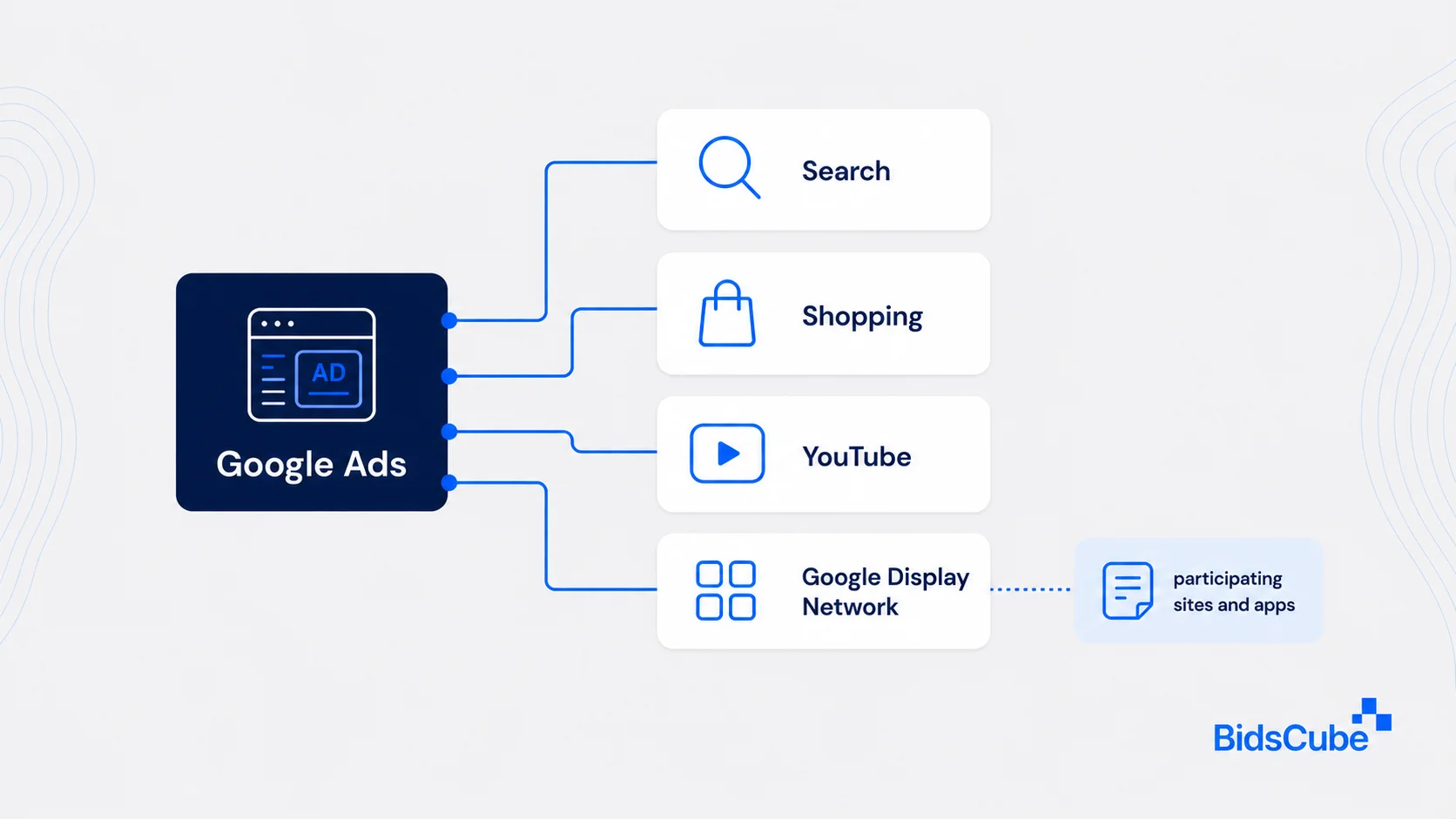
Google Ads is the platform that Google provides to buy placements on Search, Shopping, YouTube, apps and the Google Display Network (GDN). Advertisers build a campaign, choose an objective, target where and to what degree to every detail which they target, upload creative, and wait for Google to decide that an ad can enter an auction.
Now that the auction is run and the ranking systems are applied, the signals are being used that are accessible through Google products, and the results are reported via its interface. Search campaigns respond to queries and search intent, while display and video campaigns leverage audience, context, placement, and automated signals.
Small teams can launch without building publisher connections or running an AdTech stack by leveraging the self-serve platform. In return, the buyer works within Google’s rules, formats, reporting, and available supply.
The GDN extends campaigns beyond Google-owned pages to participating websites and apps. However, access still comes through the Google Ads system. Google states that Display campaigns take part in auctions, with an internal Google Ads process deciding which ads enter and how they rank.
Understand the Google exchange layer. Read Understanding Google AdExchange to see how Google Ad Manager, Ad Exchange inventory, Open Auction transactions, and Authorized Buyers connect on the publisher side.
What Is Programmatic Advertising?
Programmatic advertising is the automated buying and selling of digital ad inventory through software. Advertisers usually buy through a DSP. Publishers make inventory available through an SSP, ad exchange, or connected monetization platform.
IAB describes RTB as a real-time auction for an individual impression and OpenRTB as an open protocol for automated media trading.
A bid request can describe the page or app, device, format, placement, content category, floor price, and privacy signals. The DSP checks the request against campaign rules and may bid. The seller then selects a valid winner.
The model supports display, video, native, CTV, audio, mobile, and DOOH. Buyers can use open auctions, private marketplaces, preferred deals, curated publisher lists, contextual rules and first-party segments. Systems that are independent from each other, which connect, each following a shared protocol, rather than a single company owning every step.
For a wider buying-model comparison, see Direct vs. Programmatic Advertising.
Key Differences: Programmatic Advertising vs Google Ads
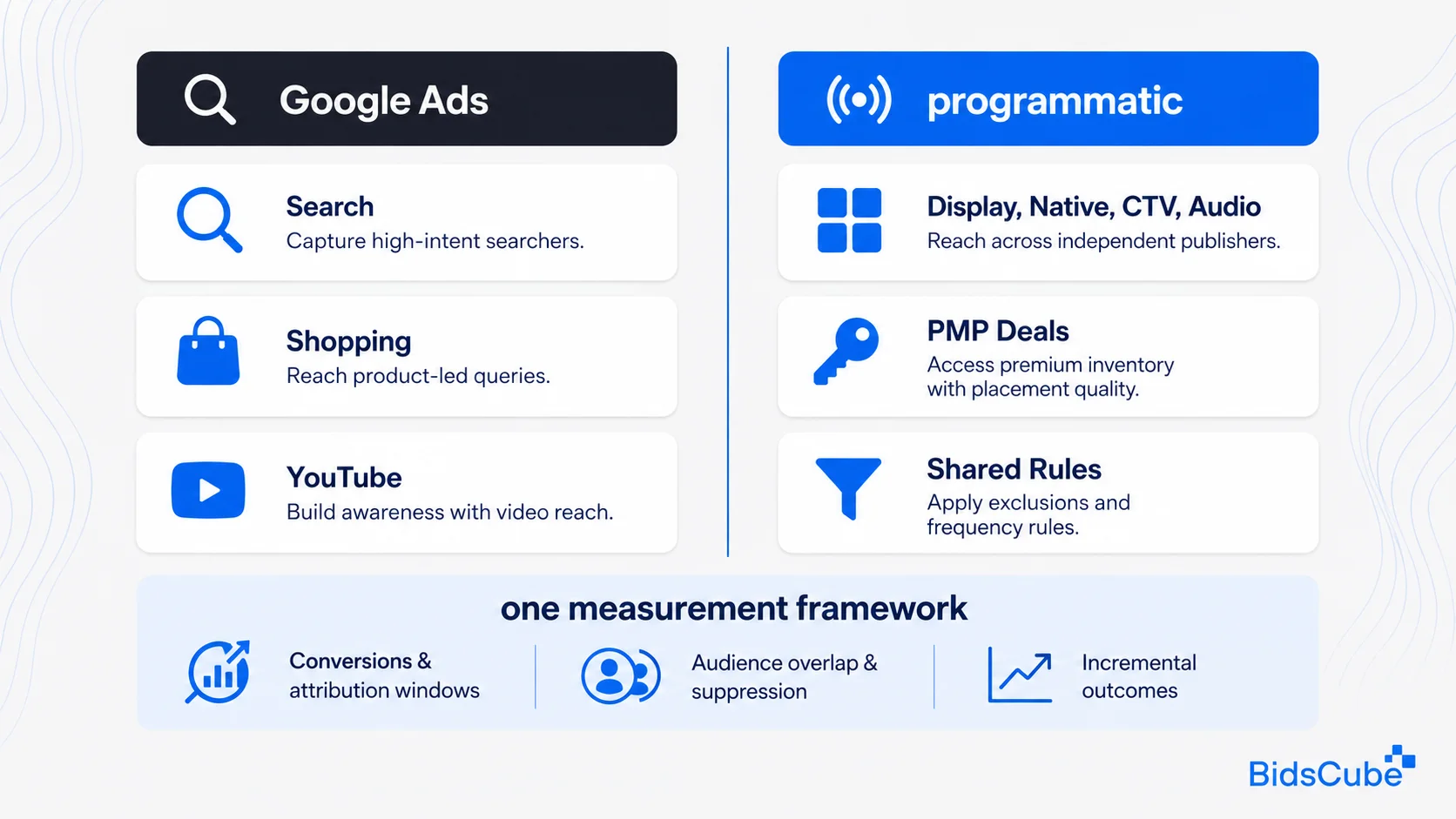
The exact options depend on campaign type, vendor, deal, integration, and reporting setup.
| Parameter | Google Ads | Programmatic Advertising |
| Inventory access | Google Search, Shopping, YouTube, apps, and GDN supply available through Google Ads | Open web inventory connected through multiple SSPs, exchanges, publishers, and private deals |
| Buying model | Auction inside Google’s buying system | RTB and deal-based buying between independent supply and demand platforms |
| Targeting data | Google query, video, account, audience, and modeled signals | First-party data, contextual data, DSP signals, DMP segments, and approved external data |
| Transparency | Campaign and placement reporting within Google tools, with detail varying by campaign type | Potential domain, app, placement, auction, viewability, and bidstream detail, depending on the DSP and seller |
| Formats | Search, Shopping, display, app, and YouTube formats | Display, video, native, CTV, audio, DOOH, and other connected formats |
| Deal access | Google campaign products and Google Ad Manager marketplace connections in relevant buying products | Open auction, PMP, preferred, and guaranteed deals across connected publishers |
| Team needs | Accessible to generalist performance teams | Often needs media buyers, Ad Ops, data support, or a managed service |
| Primary strength | Capturing demand inside Google’s media environment | Building controlled reach across independent media and multiple channels |
The query programmatic advertising vs Google display network compares a buying method with one part of Google’s inventory system. GDN can serve display ads across participating sites and apps, while a DSP may connect to many exchanges and SSPs beyond one network.
The phrase programmatic vs display advertising also compares different categories. Programmatic describes how media is bought. Display describes an ad format. A display banner can be bought through Google Ads, an independent DSP, a direct publisher deal, or another channel.
Google Ad Manager adds another layer to the picture. Publishers can make inventory available to Authorized Buyers and Open Auction demand, while private auctions invite selected buyers. These publisher tools do not turn a standard Google Ads account into an independent open-web DSP.
For publisher-side planning, read How to Maximize Revenue With Google Ad Exchange. Also, Review Media Buying Platforms Compared before choosing a platform, managed service, or white-label setup.
When Google Ads Fits Better
Google Ads often makes sense when the campaign depends on clear intent, fast setup, and a modest operating burden.
- The team needs to capture search demand. Search ads can appear when people actively look for a product, service, location, or answer. This makes the channel useful for high-intent queries and time-sensitive demand.
- The budget is limited. A smaller advertiser can set daily limits, start with a narrow keyword set, and adjust spending without maintaining several platform contracts.
- The team needs a familiar self-serve workflow. Generalist marketers often know the interface, account structure, conversion tracking, and campaign types.
- The campaign relies on Google remarketing signals. Brands can reconnect with people who visited a site, used an app, watched content, or took another tracked action, subject to current consent and platform rules.
- The creative mix centers on Search, Shopping, or YouTube. Google Ads gives direct access to these environments from one account.
In practical discussions about Google Ads vs programmatic advertising, Google Ads usually wins on ease of entry. It reduces setup work, but the buyer accepts a more closed operating model.
When Programmatic Advertising Fits Better
Programmatic buying becomes more useful when the campaign needs supply diversity, deal control, and reporting across the wider internet.
- The brand needs reach outside Google inventory. A DSP can connect with news sites, specialist publishers, mobile apps, streaming services, audio inventory, and other open web environments.
- The strategy uses several data sources. Teams can combine first-party segments, contextual signals, campaign events, publisher data, and approved provider data within one buying plan.
- The buyer needs placement and quality controls. Depending on the platform, teams can review domains, apps, sellers, viewability, bid activity, supply paths, and block lists.
- The campaign needs private marketplace inventory. PMP agreements can provide access to selected publishers, agreed floors, premium placements, or tighter content controls.
- The plan covers several formats. A single DSP may manage native, standard display, online video, CTV, audio, and mobile inventory.
- The company wants more control over the technology layer. Agencies and AdTech businesses may need branded interfaces, partner management, custom fees, or direct platform ownership.
The choice between programmatic advertising vs Google display network becomes clearer at this stage. GDN can cover broad display reach through Google’s system, while programmatic can connect display with CTV, audio, native, and publisher deals under a wider supply strategy.
See Open-Web Buying Tools
Review the BidsCube DSP for RTB buying, multiple ad formats, campaign controls, real-time reporting, and bidstream data access.
Can You Combine Google Ads and Programmatic Advertising?
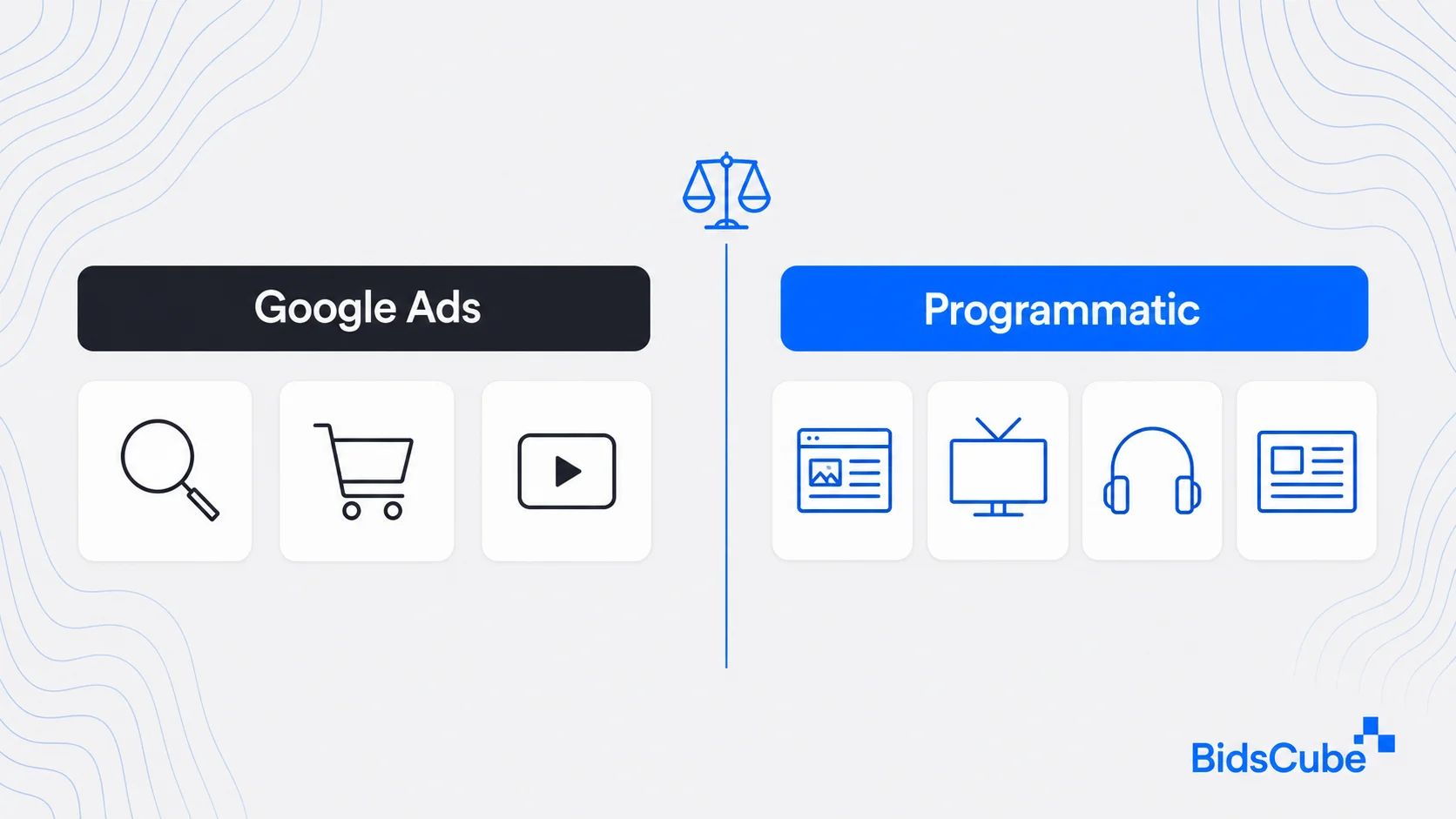
Yes. Many strategies work better when the two channels have different jobs. Running both does not require duplicated audiences, creative, budgets, or measurement rules.
A practical split may look like this:
- Use Google Search to capture people who already express intent.
- Use Shopping for product-led queries where a current feed supports the campaign.
- Use YouTube for reach inside Google’s video environment.
- Use programmatic display, native, CTV, and audio to reach relevant audiences across independent publishers.
- Use PMP deals when placement quality or publisher access matters.
- Apply shared exclusions and frequency rules where the available tools allow them.
- Compare incremental outcomes, not only platform-reported conversions.
The combined plan needs one measurement framework. Define conversions, attribution windows, geographic rules, and naming standards before launch. Without shared definitions, both platforms can claim credit for the same sale.
Teams should also control audience overlap. Exclusion lists, suppression rules, conversion imports, and path analysis can reduce repeated spending on people who already converted. The second use of Google Ads vs programmatic advertising should focus on channel roles, not a winner-takes-all contest. One channel can collect demand while the other builds reach.
Expert View
The technical value of a DSP depends on how much data and supply detail it exposes. The quote explains why access to auction, placement, and bidstream data matters.
The real technical difference appears in data access and supply control. An independent DSP can expose auction, placement, and bidstream details that teams need for custom reporting, quality checks, and optimization.
Dmitriy Iliashenko, Chief Operations Officer at BidsCube
This level of access helps teams build custom reports, check inventory quality, and adjust campaign rules using direct platform data.
How BidsCube Can Help
BidsCube offers programmatic infrastructure for advertisers, agencies, ad networks, and platform operators that need access beyond a single walled garden.
The BidsCube DSP supports real-time bidding across websites and apps. Its current product page lists banner, video, native, audio, CTV, desktop, and mobile support, plus targeting controls, budget tools, real-time data, issue inspection, and bidstream access.
The White Label AdExchange supports supply and demand connections through oRTB and VAST workflows. BidsCube also lists real-time reports, bidstream access, a global block list, multiple media formats, and direct partner trading options.
Advertisers can use this setup for open-web prospecting, private deals, cross-format buying, and supply-path testing. BidsCube also lists inventory quality controls, targeting, automation rules, API reporting, and real-time analytics. The exact setup depends on campaign goals and integrations.
Teams comparing programmatic vs display advertising can use the DSP for more than banners. They can assign display, native, video, CTV, and audio separate roles while keeping buying controls within one programmatic environment.
Build the Right Buying Mix
Visit BidsCube for Advertisers or review the company on Clutch before discussing an open-web buying setup.
Final Thoughts
Google Ads gives marketers direct access to search demand and major Google media properties through a familiar account. Programmatic buying adds wider supply access, more deal options, several media formats, and deeper control when the chosen platforms expose the needed data.
The right strategy may use one or both. Set a clear role for every channel, define shared measurement rules, and judge each platform by business outcomes rather than interface-level metrics.
Use BidsCube when the plan calls for an independent DSP, a white-label exchange layer, or broader open-web buying. Contact us to have a deeper understanding of project planning and execution.
Our tech staff and AdOps are formed by the best AdTech and MarTech industry specialists with 10+ years of proven track record!

FAQs
What Is the Difference Between Programmatic Advertising and Google Ads?
Google Ads is one advertising service that offered with the Google media products and connected partner inventory. Programmatic advertising is the broader buying technique with DSPs, SSPs, exchanges, and direct deals across multiple publishers.
Is Google Ads a Form of Programmatic Advertising?
Since Google Ads relies on automated auctions, targeting systems, and algorithmic bidding, it has a number of common programmatic mechanics. Marketers are typically trained to consider “programmatic advertising” to refer to purchases made both via independent DSPs, but how about through exchanges across the open web?
When Should I Use Google Ads Instead of Programmatic Advertising?
When search intent, Shopping campaigns, YouTube access, fast setup or a limited DIY budget plays a part in the decision, Google Ads. Google Ads also caters well to teams who may not have a dedicated programmatic operations function.
Can I Run Programmatic Advertising and Google Ads at the Same Time?
When each channel has a clear role, you can run Google Ads and programmatic campaigns at the same time. Shared conversion rules, audience exclusions, and attribution settings help restrict misleading duplication and wasted frequency.
Which Platform Offers Better Transparency: Google Ads or Programmatic?
The detail of an independent programmatic platform can give granular domain, app, placement, auction and bidstream reporting but ultimately that depends on the vendor(s) and supply partner. Reporting is available from Google Ads itself but varies by campaign type and inventory source.
Does Programmatic Advertising Reach More Inventory Than Google Ads?
Programmatic buying can access broader and more diverse independent publishers, exchanges, CTV services, audio inventory, apps, and private marketplace deals. Google Ads gives reach to a wide array of users; however, buyers are actually getting your inventory via Google supported products (like the bidding and optimization tools), other supported inventory products, and its connected network


