



Publishers now see a new kind of visit in analytics. Some sessions arrive from AI answer tools, and they do not behave like classic organic search. If you want to prepare website for AI-driven traffic, start by separating measurement, technical readiness, and monetization rules. Small fixes can change outcomes fast, because AI referred sessions often have high intent and short patience.
Table of Contents
That creates a new challenge for publishers. A visit can look weak in surface metrics, but still carry strong value. A user may land on one page, skim fast, ignore your usual content path, and still sign up, click a partner link, or return later through another channel. This article explains what AI-driven traffic is, how it differs from organic search, what technical changes matter most, and how to make your monetization setup ready for more of these visits. You can also connect the operational side of that shift to a stronger programmatic setup with BidsCube.
What Is AI-Driven Traffic and Why Publishers Should Pay Attention
AI driven traffic is traffic that starts from an AI answer layer, not from a standard search results page. Common sources include ChatGPT Browse, Perplexity, and Google AI Overviews. A user reads a summary first, then clicks to request proof, details, or a direct next step.
AI referrals are growing, but they still sit next to a much larger shift: fewer classic clicks in some query types. Similarweb data reported by TechCrunch shows no click news searches rising from 56% to almost 69% by May 2025, after Google AI Overviews launched couple years ago.
At the same time, referrals from AI tools are climbing from a low base. Similarweb data showed year over year AI referral growth from September 2024 to September 2025 for several large publishers, while still staying under 1% of total traffic for many outlets. That is a small slice, but it is growing.
Outside publishing, Adobe analysis reported AI search referrals up by 1,300% during the 2025 holiday season, with a 1,950% jump on Cyber Monday. That tells you two things. AI referrals can spike quickly, and industries with high intent queries can see the effect first.
This is why an AI traffic publisher strategy matters. You do not need to bet the business on AI traffic today. You do need the basics in place, so you do not waste the visits you already get.
How AI-Driven Traffic Differs from Organic Search
Behavioral patterns: session depth, bounce, pages per visit
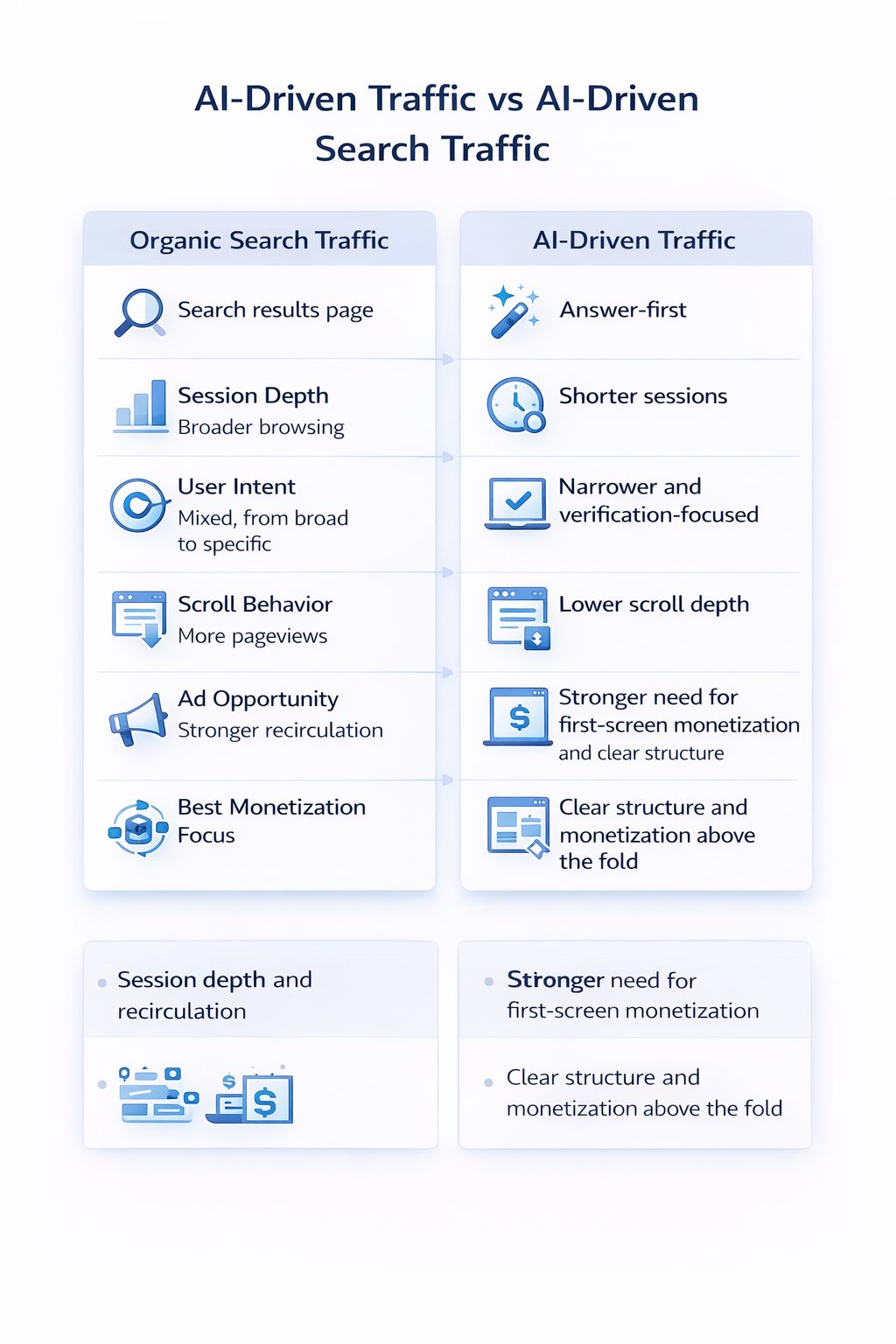
AI referrals often bring shorter sessions for publishers. The user already got the summary. The click happens for confirmation, a quote, a statistic, a tool, or a deeper explanation. That can increase bounce rate, even when the session is valuable.
The effect is not universal. Adobe also found AI search referred users on retail sites stayed 8% longer and viewed 12% more pages, with a lower bounce rate. The key point is that behavior depends on query type and page design. A product page can benefit from high intent. A publisher page can lose scroll depth if the page does not front load value.
Intent signals: informational vs transactional
AI clicks often land mid journey. Users ask a specific question, narrow options, then click when they want a source or a clear answer. This changes how you should design the first screen. It also changes how you measure success. Revenue per session often matters more than pages per session.
Impact on ad impressions and fill rate
When sessions get shorter, ad impressions per visit can drop. Viewability can also drop if users do not scroll. This can reduce auction pressure and fill. That is the common pattern behind AI-driven traffic monetization challenges for publishers.
If you want to know how to handle increased AI-driven traffic, approach it as a new channel with its own KPIs: viewability, revenue per session and return rate.
Quick Reference
Here is a summary of organic search traffic vs AI-driven traffic. You can use this as a cheat sheet when you are reviewing behavior, monetization, and reporting.
| Factor | Organic Search Traffic | AI-Driven Traffic | What Publishers Should Do |
| Entry Point | Search results page | AI answer layer with citations or links | Track AI as a separate acquisition channel |
| Session Depth | Often broader browsing | Often shorter, task-focused visits | Front-load value on the first screen |
| User Intent | Mixed, from broad to specific | Usually narrower and verification-focused | Match pages to clear intent |
| Ad Opportunity | More pageviews can mean more ad impressions | Fewer impressions per session are common | Focus on viewability and revenue per session |
| Attribution Pattern | Easier to classify as organic | Can appear as referral or direct | Build source segments and compare assisted conversions |
| Monetization Priority | Recirculation and session depth | Fast answer delivery and stable first impressions | Tune layouts, floors, and demand paths for short sessions |
These differences are significant because AI referrals typically require a different page configuration and a different monetization logic. Even if you treat them as regular organic traffic, it’s because you can miss revenue and user intent.
Reddit Case: Website Owners on Preparing for AI Traffic
A TechSEO thread asked how site owners can increase AI driven traffic and get recommended by tools like ChatGPT and Perplexity.
A few practical themes stood out:
- Several commenters argued that classic SEO basics still matter, because AI tools pull from crawlable content and well structured pages.
- One commenter emphasized “machine readable facts” and gave examples like price, seller, return policy, and shipping details, plus Organization schema and author signals.
- Some commenters recommended testing and learning, because tactics change fast, and results vary by niche.
- llms.txt came up. One person pushed it as a tactic, while another said they had not seen evidence that LLMs use it.
The useful takeaway is simple. Focus on clear structure, trusted signals, and content that answers real questions. Treat new ideas like llms.txt as optional until you see proof in your own logs.
Technical Preparation for AI Traffic Growth
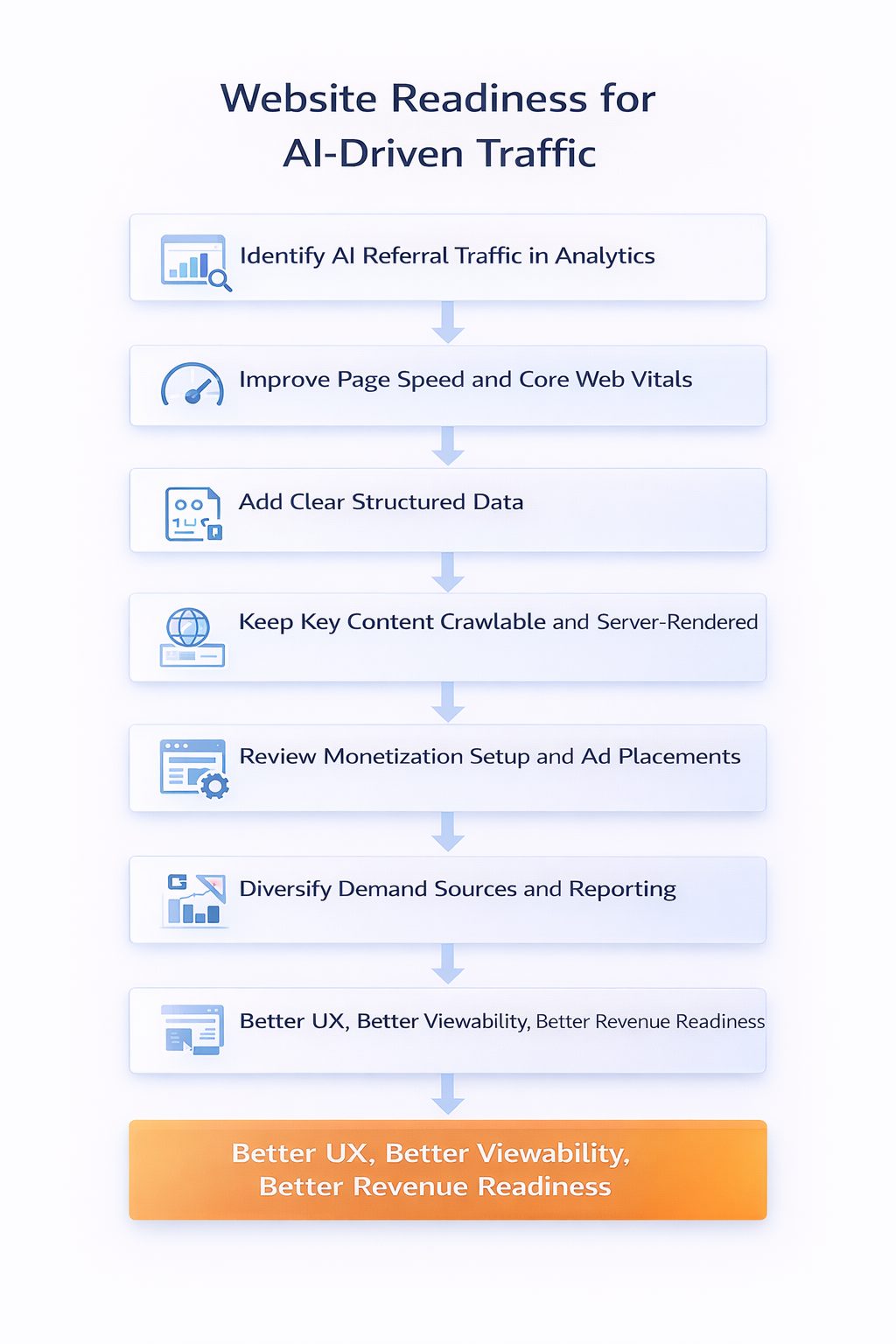
This section focuses on website optimization for AI traffic. The goal is not to “trick” AI systems. The goal is to make your best pages fast, crawlable, and easy to cite.
Page speed and Core Web Vitals
AI referred users often have low patience. If your page loads slowly, the session ends before ads render and before the user reads. Start with:
- Fix slow LCP on your top templates
- Reduce layout shift so ads render in stable slots
- Reduce third party script weight, especially on mobile
- Preload critical fonts, and avoid heavy client side rendering for key content
Run Core Web Vitals checks on pages that show up as AI entry points. If AI sends fewer visits but higher intent, every lost session hurts more.
Structured data for AI crawlers
Structured data does not guarantee citations, but it helps machines read your page. The TechSEO thread specifically called out schema structure and clear facts.
Start with what matches your content:
- Article and NewsArticle for editorial pages
- FAQPage when you have real questions and answers
- HowTo when you have steps and outcomes
- Organization plus sameAs links for brand identity
- BreadcrumbList for clear page hierarchy
Keep key facts in server rendered HTML. Do not hide essential information behind interactive widgets.
LLM.txt and robots.txt considerations
Robots.txt still controls crawlers you can identify. Use it to allow what you want indexed, and block what you do not want crawled.
llms.txt is newer and not standardized. Some site owners mention it as a way to guide LLM usage, but others report no evidence that LLMs follow it. If you use it, treat it as documentation for now. Do not rely on it as a control layer. Focus on things that clearly work today: crawlable content, consistent structure, and strong brand signals.
Monetization Readiness for AI-Driven Visitors
AI traffic can convert well, but it can also produce fewer viewable impressions per session. Your setup should support both outcomes. This section covers publisher readiness for AI search traffic from a monetization and ops angle.
Ad stack readiness: header bidding, SSP connections
AI traffic is still traffic. It needs competition in the auction. If you rely on a single demand path, you create a single point of failure.
A basic readiness checklist:
- Stable header bidding setup with clean timeouts
- Multiple demand sources, not one dependency
- Floors by geo and device, not one global floor
- Viewability measurement, and placement audits
- Separate reporting for AI sources, where possible
As AI-driven traffic grows, technical readiness is only half the job. Publishers also need a monetization setup that can handle shorter sessions, shifting source quality, and changes in bidder behavior without creating avoidable revenue swings. That is where supply paths, buyer diversity, and reporting discipline start to matter more.
- If you want more control over your supply and demand routing, start with BidsCube SSP.
- If you want to diversify buyers and reduce dependence on one partner, explore BidsCube DSP.
- If you operate an exchange layer, a white label option can help you test demand mixes faster.
This is the practical side of the programmatic ecosystem. You need redundancy, clean reporting, and stable delivery. When AI-driven traffic starts behaving differently from standard organic traffic, those basics stop being nice to have and start becoming part of revenue protection.
Format strategy for new traffic behavior
AI referred sessions can be short. Do not assume users will scroll past three screens.
Practical format rules:
- Put one high viewability unit early, but keep the first screen readable
- Use sticky formats carefully, because they can increase exits
- Favor clean in content placements on explainer pages
- Test video only when it does not block the answer
If you want the simplest way to monetize AI-driven visitors, start with improving viewability and reducing layout shift. Those two changes often lift CPM without adding more ads.
This is also where a simple traffic monetization strategy comes in handy: segment AI traffic, measure revenue per session and then tune floors, placements and timeouts according to actual behavior.
Quality signals and partner selection
AI traffic can shift your geo mix and device mix. That can change demand. Track bidder concentration and CPM spread per source. If one buyer wins most auctions, your revenue can swing when budgets shift.
If you want third party feedback on a partner stack, check BidsCube reviews on G2 and Clutch.
Conclusion
AI referrals will not replace classic search traffic overnight. They will keep growing, and they will keep changing how users arrive and what they do next. If you monetize AI-driven visitors well, you focus on fast pages, clear structure, strong brand signals, and an ad stack that does not depend on one demand path.
If you want to prepare website for AI-driven traffic, treat AI as a channel, not as a mystery. Measure it, segment it, and tune for it. That is how you move from random AI clicks to repeatable results in AI-driven traffic monetization.
FAQ
How should publishers prepare their website for AI-driven traffic?
Publishers should prepare by segmenting AI referrals in analytics, improving page speed on top entry templates, and adding clear content structure that answers the question early. Publishers should also review ad placements for viewability and ensure multiple demand sources support stable auctions.
Does AI-driven traffic affect ad revenue differently than organic traffic?
AI driven traffic can affect ad revenue differently because sessions can be shorter and scroll depth can drop, which reduces viewable impressions. AI driven sessions can also show higher intent, which can lift revenue per session when page design and ad formats match the user goal.


