



AI search traffic is showing up in analytics, and it often looks odd. Sessions can be short, pages per visit can be low, and the user can still convert. That is why publishers need a new playbook to monetize traffic from AI search engines without assuming it behaves like standard organic traffic.
Table of Contents
If you want to protect yield while you test, start with stable demand and clean reporting. BidsCube SSP can help you manage supply, floors, and demand routing while you learn how AI referred users behave.
What Is AI Search Traffic and Why It Matters for Publishers
AI search traffic is any visit that starts from an AI answer layer, not a classic ten blue links page. The common sources today include ChatGPT Browse, Perplexity, and Google AI Overviews. These tools answer the question inside the interface, then show citations or links for users who want details.
For publishers, this matters because the click happens later in the journey. The user has already read a summary, and the user arrives with a narrower goal. This shift affects AI search engine traffic monetization because attention is not distributed the same way.
Ad buyers also keep moving budget toward digital channels. Gartner reported that digital took 57.1% of paid media budgets in 2025. That is good news for demand, but publishers still need high quality sessions and viewable impressions to capture it.
AI tools are also becoming normal for information seeking.
- Gartner also noted that 29% of surveyed organizations had deployed and were using GenAI in late 2025.
- Deloitte found that 58% of Europeans were familiar with GenAI tools, and over a third had used them in 2024.
More usage means more chances for publishers to earn publisher revenue from AI search, but only if pages and ads fit the new behavior.
How AI Search Engines Change Traffic Behavior
AI referred sessions tend to be shorter and more task focused. The user asks a question, reads a summary, and clicks only when the user wants proof, a quote, a table, or a step by step guide. That can raise intent while shrinking session length.
This affects referral versus direct versus organic patterns. Some visits show up as referral from an AI domain. Others arrive as direct because of app handoffs, privacy settings, or link wrappers. You should treat AI as a new acquisition channel and build a separate segment for it.
| Traffic Source | Typical User Behavior | Monetization Focus |
| Classic Organic Search | Broader browsing, more page comparisons | Display depth, internal recirculation, affiliate paths |
| AI Search Traffic | Shorter, task-focused, high-intent visits | First-screen viewability, clear CTA, contextual targeting |
| Direct / Returning Users | Higher familiarity, stronger repeat intent | Membership, email capture, direct response offers |
Bounce rate and viewability often move in opposite directions. Bounce rate can rise because the user reads one page and leaves. Viewability can fall if the user scrolls less. At the same time, conversion rate can rise because the user is closer to a decision.
This is the core tension behind AI traffic ad revenue. You might get fewer ad impressions per session, but higher value actions per session. Your job is to align ads, content structure, and conversion paths with that reality.
AI traffic also changes attribution. Many AI sessions are assist clicks. The user reads an AI answer, then returns later through branded search, direct, or email. If you only look at last click, you will undervalue the channel.
Do two checks right away:
- Compare assisted conversions for AI segments versus organic.
- Compare new user rate and returning user rate by source.
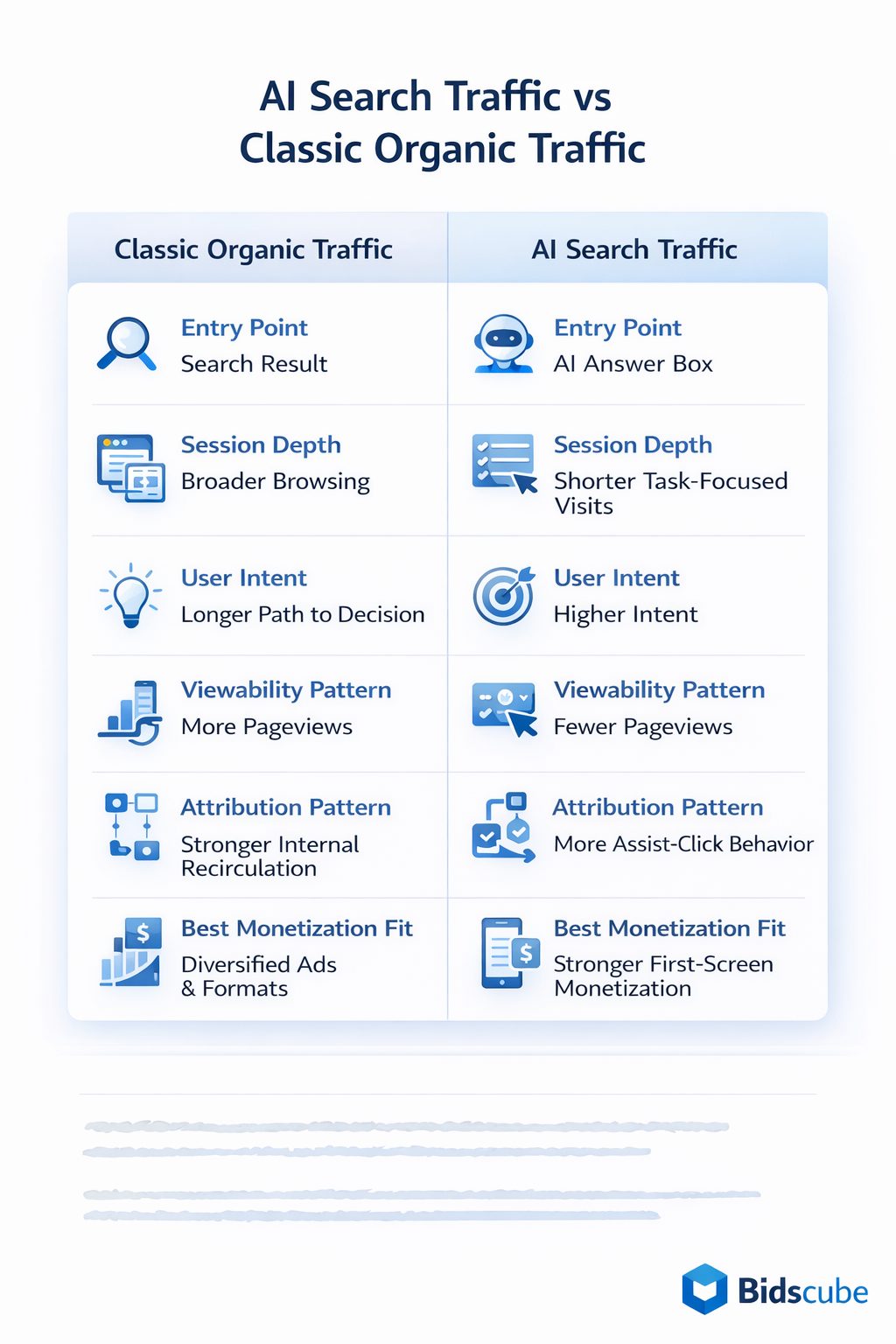
If you see many first time users and a higher returning rate a week later, AI is acting like discovery. In that case, your monetization plan should include a longer funnel, not only display.
Reddit Case: Publishers on AI Search Traffic Revenue
A thread in r/AISearchLab asked a blunt question: how do you monetize ranking on AI when users do not click as often.
The original poster argued that AI search is still small, but some brands report meaningful referral volume. The post also suggested that the best approach is to become a source AI tools cite naturally, then place conversion opportunities inside the content that gets cited.
Several practical ideas from the discussion are useful for publishers, even if you treat the specific numbers as unverified anecdotes:
- Treat AI visibility as top of funnel, then measure delayed conversions, not only last click.
- Build comparison pages and best of lists that answer high intent questions.
- Use clear structure and simple HTML so AI tools can extract the answer and cite the page.
- Track AI referrals in analytics and add a survey option that names AI tools as a source.
- Focus on platforms AI tools cite often, such as forums and review sites.
The thread also warned against trying to trick models. It pushed for clear, factual pages with strong structure. That advice fits publishers, too, because clarity improves both AI citations and on page UX.
How to Monetize a Website with AI Search Traffic
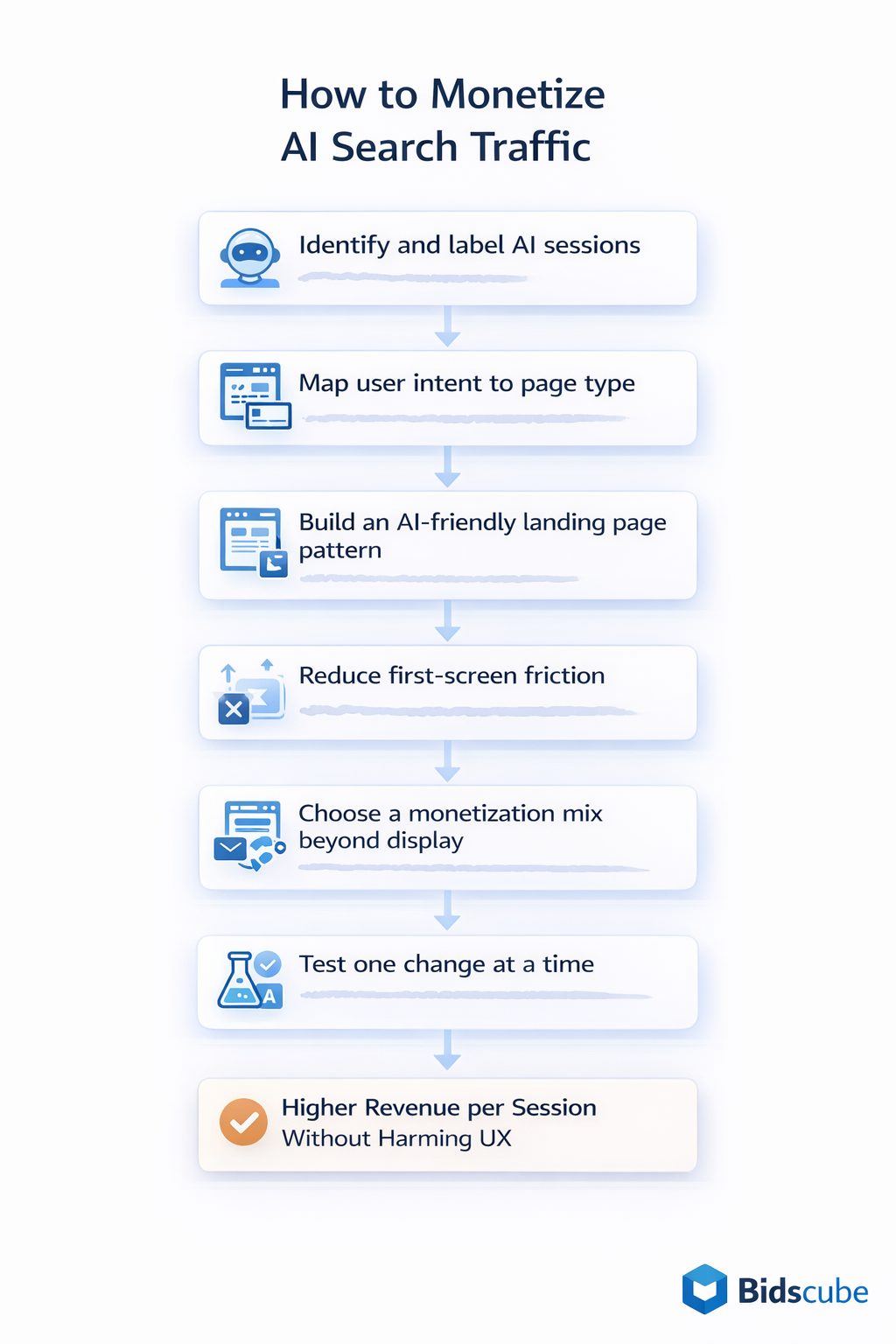
Start by treating AI as a distinct channel with its own funnel. You need measurement, page templates that fit the intent, and an ad setup that does not assume long sessions.
Step 1: Identify and label AI sessions
Create segments for known referrers such as Perplexity, ChatGPT, and Copilot. Then add a second segment that captures likely AI direct traffic, such as sudden direct spikes on deep pages with no matching campaign tags.
Add clean internal tagging, such as custom dimensions, and keep a list of referrer patterns. This makes AI search engine traffic monetization measurable.
Step 2: Map intent to page types
AI clicks cluster around a few page types:
- Explainers with definitions and context
- Comparisons and buyer guides
- How to steps and troubleshooting
- Data driven posts with numbers and sources
Match your strongest monetization to those pages first. If you publish programmatic advertising heavy pages, start with the pages that already earn well per session.
Step 3: Build an AI landing page pattern
Create a simple pattern you can reuse:
- A short answer box in the first screen
- A show sources section that lists references and links
- A next step block that recommends two related pages
- One clear CTA that fits the page goal
This structure supports users who arrive for verification. It also gives ads a stable layout, which helps viewability.
Step 4: Reduce friction on the first screen
AI users often want confirmation fast. Put the answer early, then expand. Use a table of contents for long pages. Keep the first ad placements viewable, but do not overload the top of the page. If you scare the user away, you lose both revenue and future citations.
Step 5: Choose a monetization mix beyond display ads
Display still matters, but AI traffic can respond well to non display paths:
- Email capture for follow up content
- Membership or ad light mode
- Affiliate links on high intent comparisons
- Lead forms for B2B pages, with clear value
If you sell ad inventory through your own stack, you can add more options through a white label exchange like BidsCube WL AdExchange to diversify demand and reporting.
Step 6: Run short experiments, not big redesigns
Pick one template and test one change at a time. For example, change the first screen layout, then measure scroll depth and viewability. Next, change ad density, then measure revenue per session and user feedback.
If you need supply side controls while testing, a managed buyer setup can help. See BidsCube DSP for demand options that fit different audience segments.
Monetization Strategies That Work for AI Search Traffic
Match Ad Formats to AI Referred User Intent
AI referred users often land on a specific answer page, not your homepage. Use formats that fit that narrow intent.
For how to and troubleshooting pages, keep units compact and consistent. Sticky video can work when it does not block content. If video is part of your strategy, a dedicated stack like BidsCube SSP can help keep video delivery stable and viewable.
For comparisons and lists, native units and in content placements often feel less disruptive. These pages can also support affiliate modules because the user already evaluates options.
A quick rule: if the page exists to answer one question, do not force three page breaks. Keep the experience calm, and let the user finish the task.
Prioritize Contextual Over Behavioral Targeting
AI referrals can arrive without full cookie signals, especially on mobile apps. That can weaken behavioral targeting. Context becomes the safer lever.
Use contextual targeting monetization by improving taxonomy, page level topics, and clean metadata. Make sure ad requests carry the correct category and keywords. Buyers can pay more when context is clear and brand safe.
Also revisit your page level keyword focus. AI clicks often cluster around specific entities, tools, or problems. That makes contextual packages easier to sell, even when user level signals are thin.
Optimize for CPM Efficiency and Viewability
AI sessions can be short. This makes the first viewable impressions matter more.
Do these basics:
- Place one high viewability unit above the fold, but keep it light.
- Reduce layout shift so ads render in stable slots.
- Use lazy load carefully, and do not delay ads until the user scrolls too far.
- Keep page speed healthy, because slow pages drop viewability and engagement.
- Watch ad density on mobile, because the session is often single page.
One more tip: separate AI segments in your reporting, then adjust floors and timeouts based on the data. If AI visitors bounce fast, an aggressive timeout can waste the first impressions. If a source sends fewer sessions but higher value users, a slightly higher floor can help without hurting fill. Watch bidder concentration. If one buyer wins most auctions, you are exposed to sudden budget cuts. Add a second path, then compare win rate and net revenue over two weeks. Keep changes small, and log them. Also check consent signals, because missing consent can reduce demand on EU traffic.
This is where publisher revenue from AI search can grow without chasing more traffic. You make each session worth more.
You should also check your demand reporting outside your own dashboard. Reviews can help with partner selection. See BidsCube on G2 and Clutch. Always double check and verify to find a reliable partner out there.
Analyze AI Traffic Source Before Optimization
Not all AI sources behave the same.
Perplexity often sends users who want citations and quick verification. ChatGPT Browse can send users who want a deeper read, but referral tagging can vary by client. Google AI Overviews can send fewer clicks, but the clicks can be high intent.
Build a simple table in your analytics view that compares, by source:
- Sessions
- Revenue per session
- Viewability rate
- Scroll depth
- Conversion rate
Then adjust pages and ad rules per source. This is the fastest way to monetize AI-driven referral traffic without harming UX.
Conclusion
AI search is not a threat by default. It is a new type of distribution with different behavior and different attribution. If you want to know how to monetize AI search traffic, start with measurement, then align page templates and ad formats with high intent sessions.
Publishers who treat AI as a channel can protect AI traffic ad revenue, test new placements, and build a conversion path that does not depend on long sessions. Over time, this becomes website monetization for AI search visitors that can compound, even if classic organic clicks flatten.
FAQ
Can traffic from AI search engines generate strong ad revenue
Yes, but it depends on intent and page structure. AI visitors often view fewer pages, so ad density rarely fixes the problem. Better first screen viewability and better context signals tend to matter more.
What is the best way to monetize AI search engine traffic
The best approach combines clear measurement with a small set of optimized templates. Start with high intent pages, improve contextual signals, protect viewability, and diversify demand so one buyer change does not break revenue.


