



U.S. digital advertising revenue reached $294.6 billion in 2025, while programmatic buying accounted for about 92% of U.S. digital display spending. Those figures describe two different markets, but they point in the same direction: automated media trading now handles most display transactions.
Table of Contents
- What Are White-Label Programmatic Auction Platforms?
- Key Advantages of White-Label Platforms for Programmatic Advertising Auctions
- Why Programmatic Advertising Auctions Benefit from White-Label Solutions
- Industry Examples: White-Label Platforms in Action
- White-Label Platforms for Publishers: Maximizing Inventory Value in Auctions
- What Is Changing in White-Label Programmatic Auctions
- Best White-Label Programmatic Ad Serving Platform: What to Look For
- Bidscube’s White-Label Platform
- Conclusion
Building the auction software behind those transactions is another matter. A company needs bidding logic, reporting, billing, supply and demand connections, fraud controls, user roles, and constant maintenance. A white-label model provides that technical base under the buyer’s brand.
A white label programmatic advertising platform can suit agencies, ad networks, publishers, and brands that want more control without funding a full software build. This article explains how the model works, where it saves time, and what to check before choosing a provider.
What Are White-Label Programmatic Auction Platforms?
A white-label auction platform is prebuilt AdTech software that another company can brand and offer as its own. The provider maintains the core system. The buyer controls the name, interface, user access, commercial terms, and many campaign or inventory settings.
Depending on the product, the software may act as a DSP, SSP, ad exchange, ad server, or a mix of those parts. The auction can support real-time bidding, direct deals, private marketplaces, reporting, billing, and user management.
A programmatic white label platform cuts out the first years of backend work. It does not remove every technical task. The buyer still needs onboarding, integrations, trading rules, sales, and account management.
White-Label vs Custom-Built Programmatic Platform
| Criterion | White-Label Platform | Custom-Built Platform |
| Launch time | Often measured in days or weeks after setup | Often measured in months or longer |
| Upfront cost | Subscription, setup, usage, and support fees | Engineering, infrastructure, security, testing, and staffing costs |
| Branding | Custom domain, interface, roles, and reports within the provider’s options | Full control over every product and design choice |
| Maintenance | Core updates and server work handled by the provider | Internal team owns fixes, uptime, releases, and technical debt |
| Connections | Existing DSP, SSP, exchange, and scanner connections may be available | Each connection must be built, tested, and maintained |
| Product risk | Lower build risk, but more dependence on the provider | Higher build risk, but full ownership of the codebase |
The table does not make one option universally better. A white-label setup often makes sense when:
- The company needs a branded client portal
- A full internal build would delay revenue
- Existing supply or demand connections matter
A large AdTech company with a mature engineering team may still prefer its own stack. See how DSP, SSP and ad exchange fit together before choosing the type of platform you need
Key Advantages of White-Label Platforms for Programmatic Advertising Auctions
There are a couple of angles on white-label platforms and their role in programmatic auctions. In this part, we look at the aspects delivered by white-label programmatic auctions, which allow businesses to enter the market quickly, save costs, access ad customization, and work with advanced tech.
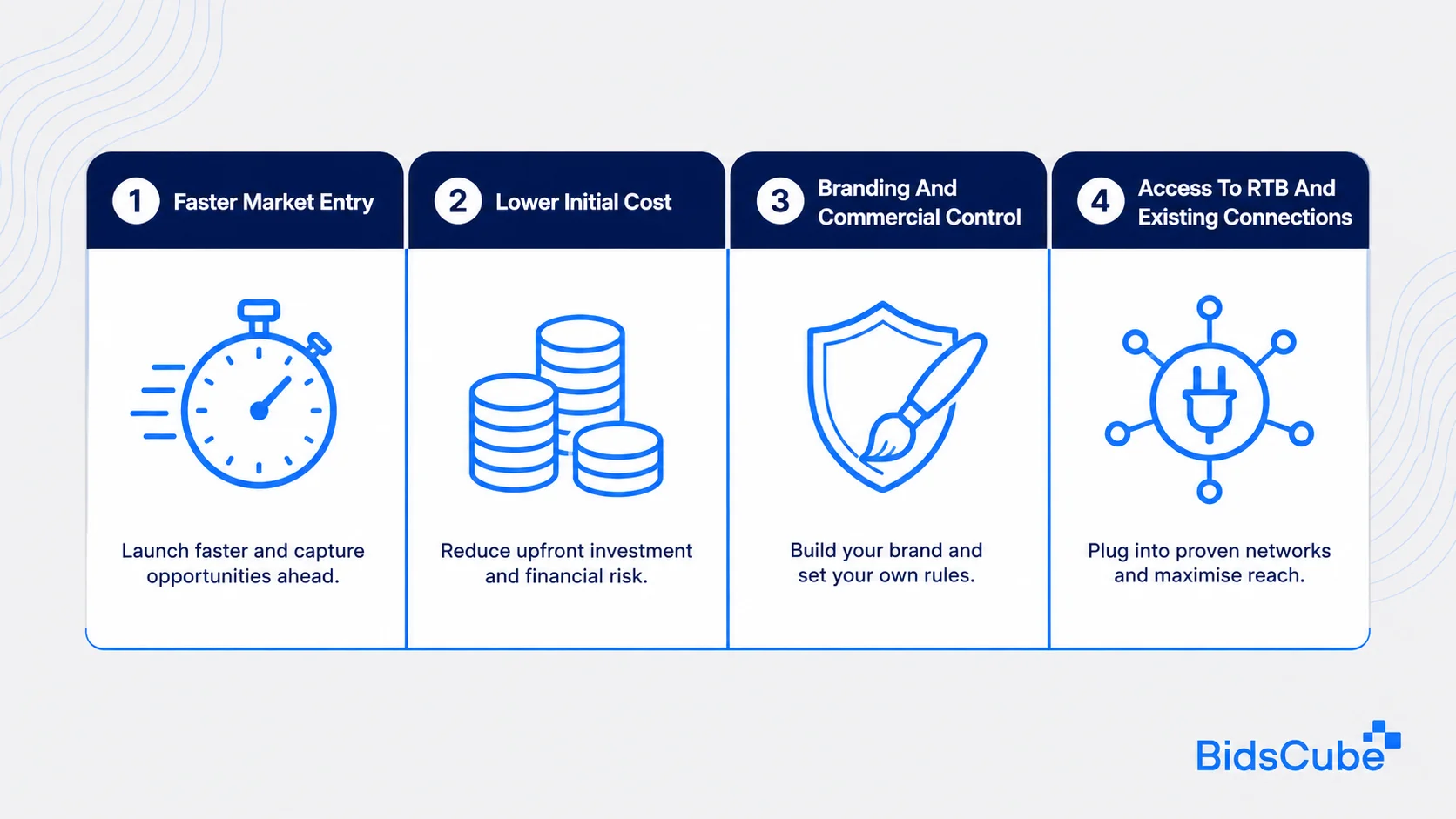
1. Faster Market Entry
A custom auction system needs product planning, backend development, cloud setup, data storage, reporting, access controls, and testing. Each exchange or partner connection adds more work.
White-label software starts with those parts already in place. The buyer can focus on branding, commercial rules, onboarding, and the first trading partners. Launch timing still depends on integrations and account setup, but it is usually shorter than a full build.
2. Lower Initial Cost
Custom AdTech software creates costs before the first auction runs. Companies pay for engineers, DevOps staff, infrastructure, monitoring, security reviews, and ongoing releases.
A white-label provider spreads those core costs across several clients. The buyer pays an agreed setup and service model rather than funding the whole stack alone. Fees still need close review. Low entry cost means little if markups, data charges, or support fees stay hidden.
3. Branding and Commercial Control
White-label software can carry the buyer’s name, colors, domain, user roles, and reporting labels. Agencies can give clients direct access without sending them to a third-party brand.
Commercial control matters as much as visual branding. The owner may set margins, user permissions, campaign limits, publisher terms, and account structures. The exact controls differ by provider, so the contract and demo should match the sales promise.
4. Access to RTB and Existing Connections
Real-time bidding requires fast bid requests, response handling, auction rules, event logging, and reporting. A mature platform already has this auction layer.
Existing demand and supply connections can also shorten setup. Buyers should still check which connections are active, which require separate approval, and which carry extra fees. The number on a sales page means less than the number of partners that fit the buyer’s traffic, regions, and formats.
Why Programmatic Advertising Auctions Benefit from White-Label Solutions
Programmatic auctions need more than a bidding button. The software must process campaign rules, budgets, user data, creative checks, pricing, and partner responses within a short time.
White-label products can support that work in several ways:
- Audience and contextual rules can guide bidding
- Display, native, video, audio, mobile, and CTV inventory can sit in one account
- Price floors, bid limits, and daily budgets can control spending
- Reports can show bid rate, win rate, fill rate, errors, and revenue
- Private deals can separate selected inventory from the open exchange
- User roles can divide work across sales, AdOps, finance, and clients
The buyer should confirm which functions come with the base plan. Some vendors charge separately for raw bidstream access, custom reports, extra servers, scanner connections, or API work.
Industry Examples: White-Label Platforms in Action
Digital agencies can use a branded DSP to sell media buying under their own name. The agency keeps client access, campaign structure, and margin rules in one account.
Ad networks can connect demand and supply through a branded exchange. This model gives the network a central place for partner setup, traffic rules, billing, and reports.
Publishers and publisher groups can use a branded SSP to set floors, connect demand, and compare inventory results. Retail or media companies can also use a private buying platform for internal teams and selected partners.
General examples help explain the model, but named work provides better proof. Readers can review real BidsCube case studies to see how companies applied the technology in live trading setups.
White-Label Platforms for Publishers: Maximizing Inventory Value in Auctions
Publishers need control over inventory quality, pricing, ad load, and page or app behavior. A white-label SSP can put those settings under the publisher’s brand or under an ad network serving several publishers.
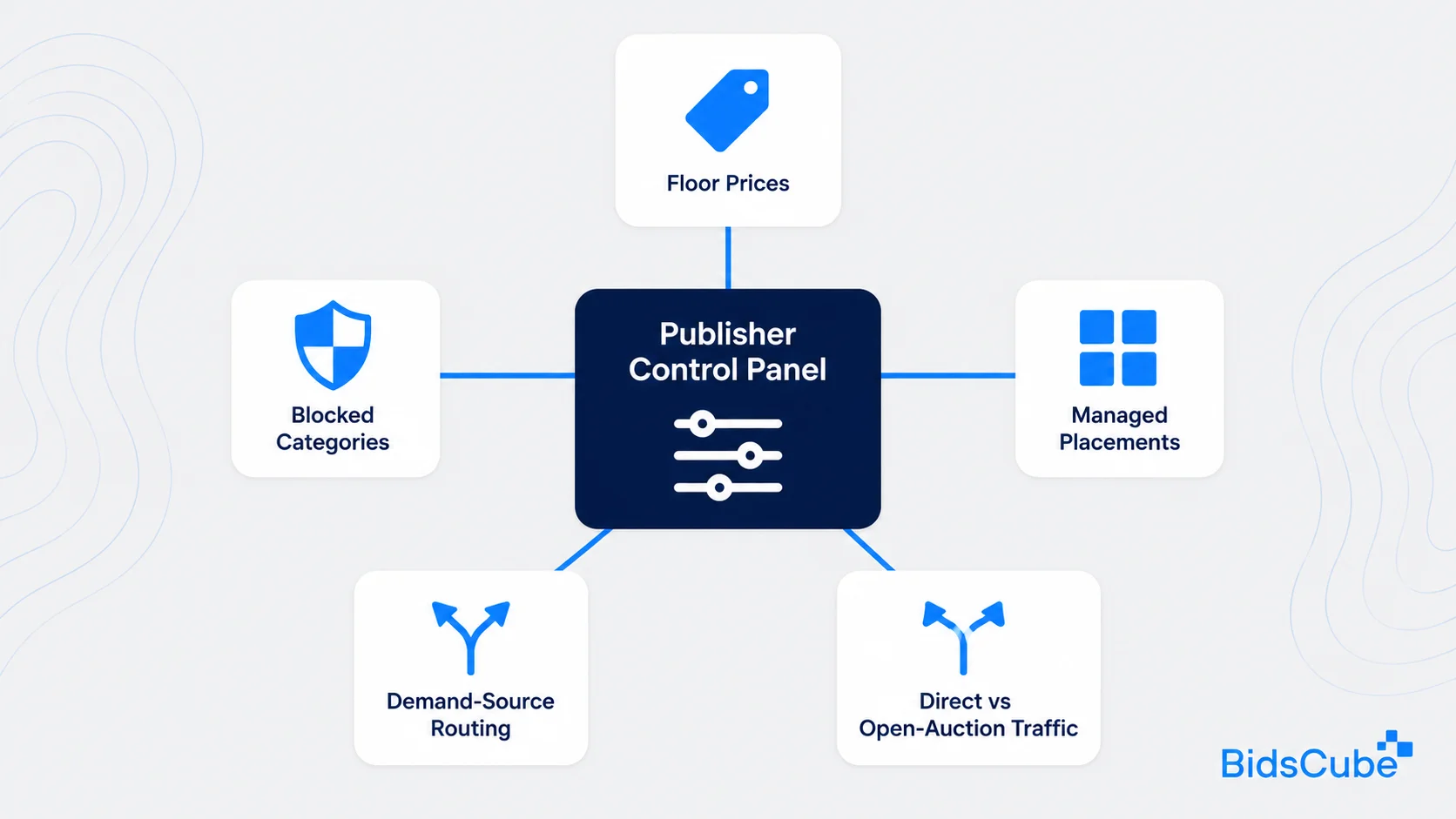
Control Over Ad Placement and Auctions
Publishers can set floor prices, block categories, manage placements, and decide which demand sources receive each request. They can also separate direct campaigns from open-auction traffic.
Auction structure matters. Header bidding can invite several demand sources at once, while a waterfall calls partners in a set order. The BidsCube guide to header bidding vs waterfall explains the trade-offs.
Revenue and Fill Rate
Higher bid pressure can raise the price of some impressions, but more demand does not guarantee more revenue. Floors, latency, ad quality, viewability, geography, and format all affect the result.
Publishers should review several figures together:
- Net revenue and eCPM
- Fill rate and bid rate
- Discrepancies and partner fees
- Page speed and auction latency
- Blocked or rejected ads
A strong gross CPM can hide weak fill or high fees.
Data, Privacy, and Brand Safety
White-label software can give the operator direct access to campaign, partner, and inventory reports. Access does not remove privacy duties. The operator still needs clear consent rules, data retention terms, user permissions, and contracts.
Brand safety tools can block unwanted categories, domains, apps, or creatives. Fraud scanners and sellers.json or ads.txt checks can add another layer, but teams still need human review and escalation rules.
What Is Changing in White-Label Programmatic Auctions
AI-based bidding and traffic scoring will keep growing, but the useful question is not whether a platform uses AI. Buyers need to know what the model changes, which data it reads, and how staff can override it.
Privacy rules will keep shaping data access. Platforms need consent controls, regional settings, logging, and clear data ownership terms. Buyers should avoid claims that one technical feature makes an operation compliant by default.
CTV, audio, mobile apps, and video also bring different creative, reporting, and latency needs. A provider that supports several formats should show how each one works in the product, not only list the format on a landing page.
Best White-Label Programmatic Ad Serving Platform: What to Look For
The best white-label programmatic ad serving platform is the one that fits the buyer’s trading model, not the one with the longest feature list. Start with partner access. Ask which SSPs, exchanges, demand sources, scanners, and payment routes are live today.
Next, check deployment. Get a written setup plan covering branding, domain work, seats, data transfer, partner approvals, and launch testing. Review fee transparency as well. The contract should state setup charges, usage fees, markups, data costs, support limits, and custom work.
Then test brand control. A white label programmatic advertising platform should let the owner manage logos, domains, user roles, reports, and client access without repeated vendor requests.
Format support is the last major check. Display, video, native, audio, mobile, and CTV use different standards and reports. The best white-label programmatic ad serving platform should show working examples for the formats the buyer plans to sell.
Bidscube’s White-Label Platform
BidsCube offers white-label DSP, SSP, ad exchange, and video ad server products. Its current materials list more than 55 campaign settings, access to more than 250 trading partners, real-time reports, bidstream options, issue inspection, and 24/7 support.
Some branded setups can launch in two days. Treat that figure as a target tied to the chosen product and integration scope. Custom API work, partner approvals, data migration, and legal review can extend the schedule.
Main Product Features
- Branded interface, domain, and user access
- Campaign, inventory, and margin controls
- RTB, VAST, and OpenRTB connection options
- Display, video, native, audio, mobile, and CTV support
- Real-time reporting and system monitoring
- User sync, API statistics, and bidstream access options
- Issue inspection and request validation tools
- Dedicated account and technical support
Business Benefits
A BidsCube white-label setup can reduce the engineering work needed to open a programmatic business. The operator can spend more time on sales, partner quality, campaign work, and client service.
The model also keeps the operator’s brand in front of clients. Reports, roles, and commercial rules can sit inside the branded account. The exact level of control depends on the selected product and contract.
No white-label provider removes business risk. Buyers still need a clear margin model, demand and supply review, payment controls, privacy processes, and staff who understand auction data.
Our tech staff and AdOps are formed by the best AdTech and MarTech industry specialists with 10+ years of proven track record!

Conclusion
White-label auction software gives companies a practical middle path between using a public buying account and building an AdTech stack from zero. It can cut launch time, reduce initial engineering cost, and keep the operator’s brand and commercial rules in view.
The decision still needs careful review. Compare live connections, fee terms, format support, data access, uptime terms, support, and exit conditions. A good provider should answer those questions in writing.
For agencies, ad networks, and publishers, the main advantage is focus. The team can work on partners, traffic, media, and clients while the provider maintains the core auction software.
Book a product call only after you have a requirements list. That turns a sales demo into a useful technical and commercial check.


