



- Programmatic audio involves media buying automation to place ads in digital audio content.
- In layman’s terms, audio ads can run in podcasts, streaming music, digital radio, smart speakers and connected cars.
- The buying path includes RTB and responsible DSPs, SSPs, and ad servers.
- DAAST helped standardize digital audio delivery, but IAB Tech Lab now says VAST 4.1 or newer should replace it.
- Audio ad formats include pre-roll audio, mid-roll audio, post-roll audio, companion banners, and interactive voice ads.
- Audio succeeds when brands think about attention, context and recall, not just clicks or impression-based ads.
Table of Contents
- Programmatic Audio Advertising Definition
- How Audio Programmatic Buying Works: Step by Step
- Types of Programmatic Audio Ad Formats
- Programmatic Audio Advertising Platforms
- Targeting Options in Audio Programmatic Advertising
- Benefits of Automated Audio Ad Buying
- Challenges of Audio Programmatic Advertising
- How BidsCube Can Help
- Final Thoughts
-
FAQs
- What Is Programmatic Audio Advertising?
- What Is the Programmatic Audio Advertising Definition?
- How Does Audio Programmatic Advertising Work?
- What Are the Main Programmatic Audio Advertising Platforms?
- What Ad Formats Does Programmatic Audio Ads Include?
- Is Automated Audio Advertising Cookieless-Friendly?
Audio, in fact, is no longer radio with a digital coat of paint. This includes listening through podcasts, streaming apps, smart speakers, mobile devices, connected cars and desktop players. That pivot opens the door for more automated systems that allow advertisers to buy audio inventory.
For teams that need stronger control over buying, selling, and reporting, including the programmatic audio advertising realm, BidsCube offers programmatic infrastructure for demand, supply, and marketplace workflows.
That screen-free moment is the main reason advertisers keep looking at digital audio advertising.
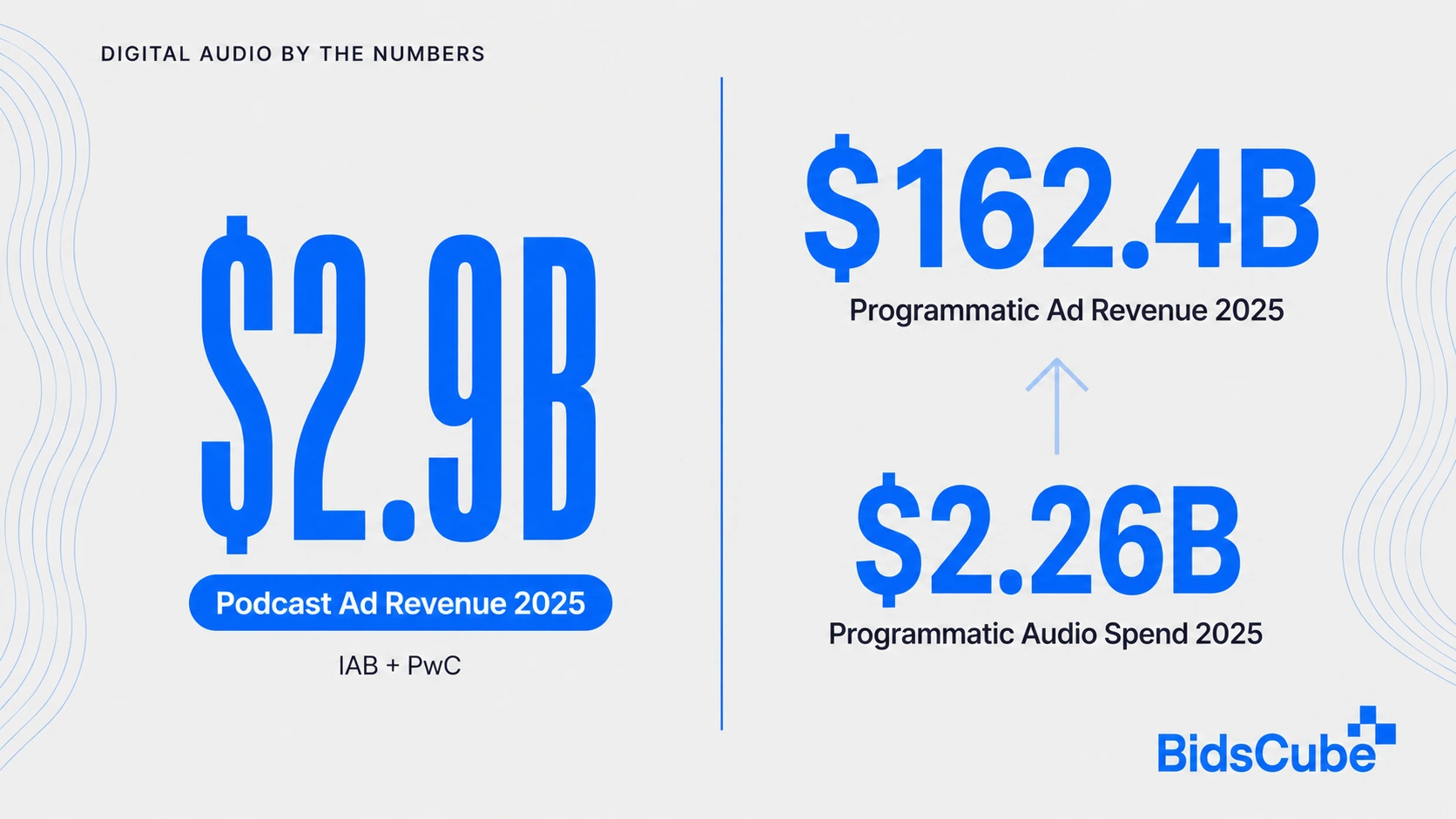
- According to IAB and PwC, US digital ad revenue was $294.6 billion in 2025, an increase of 13.9% over the previous year.
- Podcast revenue alone reached $2.9 billion in just podcast revenue, an increase of 17.6%. Programmatic advertising grew 20.5% to $162.4 billion in 2025, illustrating the rapid spread of that automated buying across media types.
According to our experts, audio is not a replacement for display, video, or search. It is a different attention lane. The listener may not click, but the ad has raised an awareness and lift search intent while assisting any future conversion.
This article details what automated audio advertising is, how it works, the ad formats available and identifies some of the first platforms brands seek to test on.
Programmatic Audio Advertising Definition
The audio market has many old terms. Radio spots, host reads, streaming ads, podcast sponsorships, programmatic audio often live in one dirty bucket. The useful starting point is a clear programmatic audio advertising definition.
Programmatic audio ads are the automated buying and selling of digital audio ad inventory. Brands use software to bid for audio impressions based on audience, context, device, location, time, and campaign rules. The process often uses RTB, in which demand-side platforms evaluate available audio impressions and place bids in milliseconds.
This differs from traditional radio advertising in three main ways.
- Radio usually buys broader audience blocks by station, geography, and schedule.
- Programmatic audio can buy listener-level or context-level impressions across streaming audio ads, podcast advertising, and app-based audio.
It also differs from display programmatic. 3) Display relies on visual slots, viewability, clicks, and page context. Audio relies more on listen-through, completion rate, frequency, context, recall, and companion actions.
Amazon Ads defines programmatic advertising as automated media buying through marketing technology and notes that the process can serve relevant impressions in less than a second. Amazon also explains that DSPs help advertisers decide which impressions to buy and at what price.
That is the simple answer to what audio advertising in the programmatic world actually is: automated buying of audio impressions, with targeting, bidding, and delivery handled through ad tech.
How Audio Programmatic Buying Works: Step by Step
The audio ad path has more moving parts than a classic radio buy. The good news: the basic flow is still easy to follow.
The listener opens a podcast, playlist, radio stream, or audio app. The publisher or platform detects an available ad slot. The audio SSP sends a bid request with allowed signals. DSPs evaluate the request, compare it with campaign rules, and bid. The auction runs. The winning audio ad gets inserted into the stream. The listener hears the ad.
The process usually looks like this:
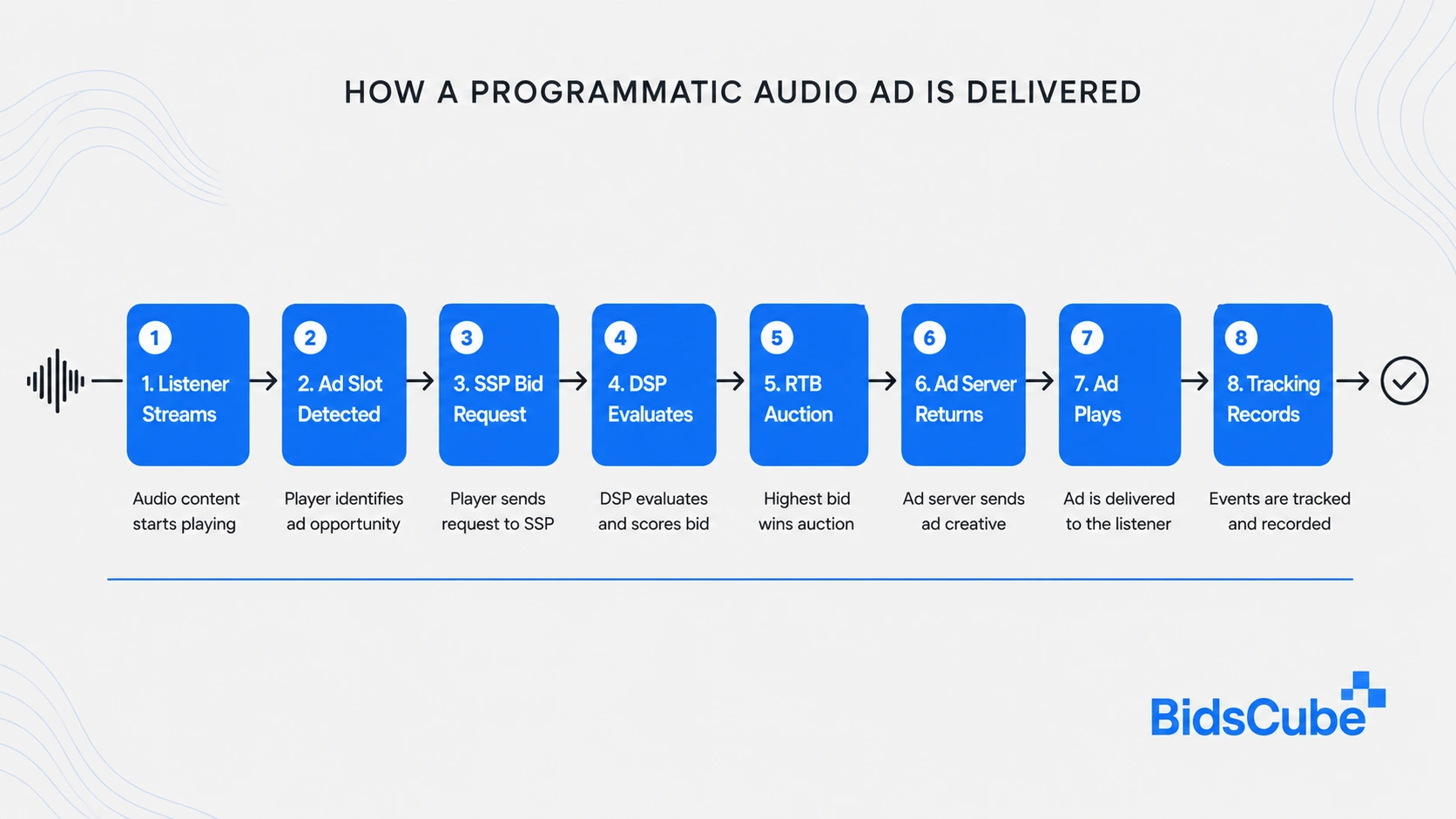
- Listener streams audio content.
- Audio player or server creates an ad request.
- Audio SSP sends a bid request.
- DSPs check audience, context, budget, frequency, and price.
- RTB auction picks the winning bid.
- Audio ad server returns the creative.
- The ad plays before, during, or after the content.
- Tracking records delivery, completion, and other events.
DAAST matters because it gave digital audio a shared delivery structure. IAB Tech Lab describes DAAST as its first technical standard for fragmented audio advertising and says it covered audio delivery, execution, and reporting across devices and platforms. IAB Tech Lab also states that DAAST has now been deprecated and replaced by VAST 4.1 or newer.
An audio ad pod is another key concept. It is a group of audio ads that plays in one break, similar to a radio commercial break. A podcast episode may include a mid-roll ad pod with two or three short ads in sequence.
According to our experts, ad pods need careful frequency control. A listener may accept one relevant ad. Three mismatched ads in a row can damage attention fast.
This is where audio advertising in programmatic needs discipline. The auction can run fast, but the listening experience still has to feel clean.
Types of Programmatic Audio Ad Formats
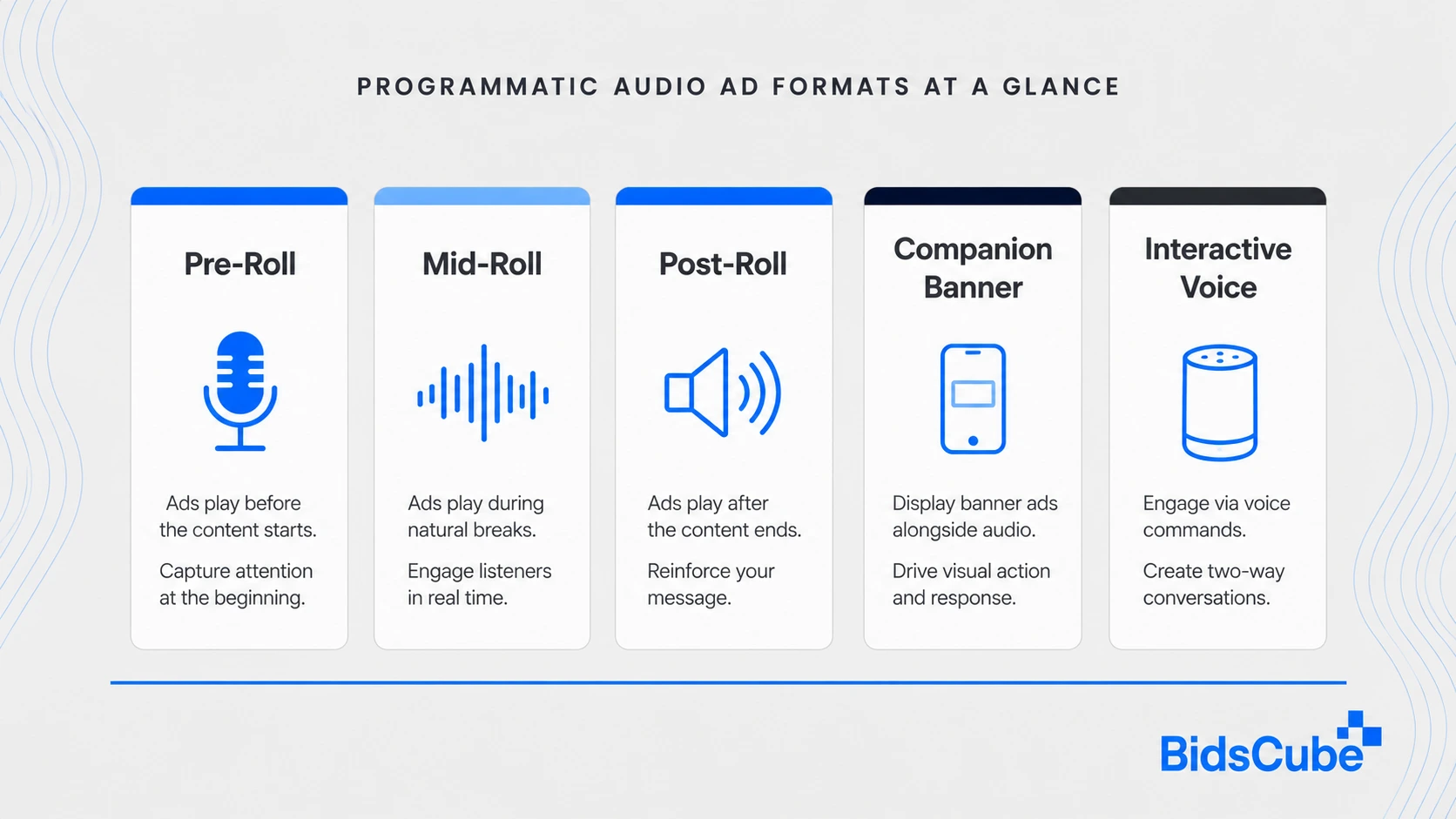
Audio formats shape how the listener experiences the ad. A pre-roll spot can introduce a brand before content starts. A mid-roll spot can catch deeper attention. A companion banner can give the listener a clickable path when the device has a screen.
| Format | How It Works | Common Use Case |
| Pre-roll audio ads | Plays before the audio content starts, often 15 to 30 seconds. | Brand awareness, launches, app installs, and event reminders. |
| Mid-roll audio ads | Plays during the audio content, usually after the listener has already committed. | Podcast advertising, product education, and high-recall campaigns. |
| Post-roll audio ads | Plays after the content ends. | Lower-cost reach, reminders, and sequential messaging. |
| Companion display ads | Shows a visual banner with the audio ad on screen-based devices. | Clickable offers, coupon codes, landing page visits, and app downloads. |
| Interactive audio ads | Lets listeners answer or take an action by voice, often on smart speakers. | Smart speaker ads, surveys, product trials, and direct response tests. |
These audio ad formats work best when creative fits the listening moment. A commuter may respond to a short local offer. A podcast listener may accept a longer host-like message if the topic fits. Audio creative cannot act like a banner read aloud. It needs a clear voice, a short idea, and one action.
To get even a broader perspective, please read our comprehensive guide on top six most common programmatic advertising types and formats.
Programmatic Audio Advertising Platforms
There are streaming platforms, audio networks, ad servers, SSPs, DSPs, publisher tools, and so on. Your options for the best platform vary based on your needs: Your reach and inventory type, targeting, measurement, etc.
| Platform or Source | Type and Short Description |
| Spotify Audience Network | Podcast and streaming audio inventory with audience and content signals. |
| Pandora / SiriusXM | Streaming audio and radio-style inventory, with AdsWizz as a major ad tech layer. |
| iHeart Media | Broadcast, podcast, streaming, and network audio inventory. |
| Amazon Music / Amazon DSP | Streaming and Amazon-linked media buying through Amazon’s programmatic tools. |
| Triton Digital | Audio ad tech, audio SSP, and digital audio monetization tools. |
| AdsWizz | Audio ad server and SSP technology used across digital audio inventory. |
| Google Audio Ads in DV360 | Audio buying through Google’s enterprise media buying tools. |
SiriusXM Media reported US programmatic digital audio spend was expected to total $2.26 billion by 2025 (an 18% increase YoY). Elsewhere, the report added programmatic digital audio would represent 30% of total digital audio spend by 2025.
According to our experts, brands should test platforms by audience fit, not by logo size. The right inventory source for a finance podcast campaign may differ from the right source for a quick-service restaurant streaming campaign.
Targeting Options in Audio Programmatic Advertising
Audio targeting starts with a simple question: What can the buyer know at the moment of listening? The answer depends on platform data, publisher data, consent, device type, and campaign setup.
Common targeting options include:
- Contextual targeting: Target by the genre of a podcast, what an episode is about, music mood, category or type of content theme.
- Demographic targeting: It targets based on information such as age, gender, income household and similar audiences if available.
- Behavioral targeting: Uses listener interests, app activity and consented audience signals.
- Device targeting: Break delivery based on mobile, desktop, connected car, smart speaker, tablet or TV app.
- Geographic targeting: Targeting listeners, going at the locational level, with country, region, city and DMA or local area.
- Time-of-day targeting: Run campaigns during commutes, work hours, evenings, weekends or any other listening peaks.
- Frequency targeting: Limits the number of times one listener can hear a specific ad while it is running.
Cookieless targeting also matters in audio. Audio environments often use logged-in accounts, app sessions, content data, and device signals instead of browser cookies. That makes audio useful for privacy-aware campaigns, as long as the data source and consent setup are clear.
Benefits of Automated Audio Ad Buying
Programmatic audio provides brands with a chance to find media moments outside of where display can play. Everyone is multitasking when they listen so it makes audio relevant for memory, repetition and contextual association.
The first benefit is the screen-free environment. A listener may not be scrolling, so the ad has a better chance to own the moment.
The second benefit is high attention potential. Mid-roll audio, given the right placement, will present itself to someone who has already made the content choice and pushes play.
The third benefit is cookieless targeting. Audio ones can harness context, first-party signals, platform audiences, and device data without strictly having to solely rely on third party cookies.
The fourth benefit is premium context. Many audio campaigns run in podcasts, streaming environments, and known content libraries where brand safety rules can apply.
The fifth benefit is creative intimacy. A voice in headphones feels closer than a display impression on a crowded page. That can help with brand recall.
The sixth benefit is full-funnel support. Audio can build awareness, support retargeting, push promo codes, and pair with companion display for clickable action.
Overall, it is clear that audio advertising works best when buyers respect the format instead of forcing display logic into sound.
Challenges of Audio Programmatic Advertising
Audio has limits, and teams should plan for them before spending. The format can work well, but it asks for different measurement habits.
Inventory is the first challenge. Audio inventory remains smaller than display and video inventory. Some premium podcasts also sell much of their inventory through direct deals.
Measurement is the second challenge. Brand recall, lift, and attribution can take more work because most audio impressions do not create a direct click.
No-click behavior is the third challenge. Listeners may hear the ad while driving or cooking. That can delay action until later.
Fragmentation is the fourth challenge. Platforms, standards, reporting fields, and buying routes differ across audio sellers.
Ad-free subscriptions are the fifth challenge. SiriusXM Media notes that ad-free subscriptions can limit the reachable listener pool for programmatic campaigns.
The fix is not to avoid audio. The fix is to set the right KPIs. Use reach, completion, frequency, brand lift, search lift, promo code use, and site traffic changes instead of expecting audio to act like search.
How BidsCube Can Help
Programmatic audio sits inside a wider trading system. Advertisers need buying controls. Publishers need monetization paths. Marketplaces need routing, reporting, and partner rules.
- BidsCube White-Label AdExchange can support companies that want their own marketplace layer for demand and supply connections.
- BidsCube DSP can support buyer-side activation, campaign setup, filtering, and reporting.
- BidsCube SSP can support publisher-side monetization and demand access across digital inventory types.
For due diligence, teams can also review BidsCube on Clutch before vendor shortlisting.
Roman Vasyukov, CEO and Founder, BidsCube.
According to our experts, programmatic audio advertising platforms should never be judged only by reach. The more relevant question is whether the platform can enforce clean buying rules, clear reporting, and inventory appropriate to the campaign.
Final Thoughts
The growth of programmatic audio can also be attributed to the fact that people listen in many different digital environments today and advertisers want buying systems that accommodate this change in listening behavior. The form delivers some important gifts: screen-less focus, relevance, privacy first targeting and high-quality audio inventory.
It also brings real limits, especially around attribution, scale, and fragmented reporting. Brands that treat audio as its own channel, not as “display without a screen,” will build better campaigns.
At its core, automated audio ad buying is straightforward: in a nutshell, automated buys push audio ads to listeners on the fly; however, far more important than either aspect of that equation is matching message to moment.
Need a programmatic setup for audio inventory, demand, or marketplace logic? Contact us to discuss how BidsCube can support your next step.
Our tech staff and AdOps are formed by the best AdTech and MarTech industry specialists with 10+ years of proven track record!

FAQs
What Is Programmatic Audio Advertising?
When you talk about an automated marketplace for buying and selling digital audio ads across podcasts, streaming music, digital radio, and connected audio devices.
What Is the Programmatic Audio Advertising Definition?
The definition is straightforward: Automated audio media buying using ad tech systems that utilize targeting, RTB, DSPs, SSPs and Ad Servers to place Audio Ads.
How Does Audio Programmatic Advertising Work?
A listener starts content, an audio SSP sends out a bid request granularity in sync with the start of the advert stream (currently quite instantaneous), DSPs evaluate the impression to decide their (attribute ready) bid, an auction runs and winning ad plays through into MSM generated broadcaster end in the audiostream.
What Are the Main Programmatic Audio Advertising Platforms?
The main platforms and inventory sources include Spotify Audience Network, Pandora, SiriusXM, iHeart Media, Amazon Music, Amazon DSP, Triton Digital, AdsWizz, and Google Audio Ads.
What Ad Formats Does Programmatic Audio Ads Include?
Programmatic audio ads include pre-roll, mid-roll, and post-roll audio, as well as companion display ads and interactive voice ads for smart speaker environments.
Is Automated Audio Advertising Cookieless-Friendly?
Automated audio advertising can be cookieless-friendly because many audio environments use context, logged-in audiences, device data, and platform first-party signals instead of browser cookies.


