



An Ad Exchange is a virtual marketplace where publishers put their digital ad inventory up for sale, and advertisers bid to purchase individual impressions. Exchanges often link with supply-side platforms, demand-side platforms, ad servers and other media solutions.
Table of Contents
The simple answer to what is an Ad Exchange starts with an auction. When somebody visits a web page, an app or video, the exchange can pass information in regards to the accessible impression to buyers. Bids are entered by eligible advertisers, and the winning advertisement can be shown within milliseconds.
This guide answers:
- what are Ad Exchanges;
- how do Ad Exchanges work;
- how they differ from Ad Networks.
It also covers real Ad Exchange examples, platform costs, publisher controls, buyer methods, and the main points to check before joining an exchange.
Programmatic advertising generated $162.4 billion in the United States during 2025, according to IAB and PwC. That figure represented 20.5% annual growth and more than half of all US digital ad revenue reported for the year.
Understanding Ad Exchanges
Ad Exchanges are the lifeblood of the digital ad ecosystem. They automate and smoothen the process of purchasing or offering ad areas between advertisers and publishers.
What Are Ad Exchanges?
To answer what are Ad Exchanges, think of a stock exchange for ad impressions. Publishers provide available ad space. Advertisers compete to place ads in that space. The transaction happens through software rather than email negotiations or manual insertion orders.
A digital Ad Exchange does not usually work alone. Advertisers connect via a DSP as the publishers are connected through an SSP. The exchange forwards bid requests from one side to the other, applies rules for the auction, and sends back the top creative to the publisher.
The basic answer to what is an Ad Exchange includes three functions:
- Receive available inventory from publishers.
- Send bid requests to qualified buyers.
- Select and return a winning ad.
Many exchanges support display, native, mobile, video, connected TV, and audio inventory. They may also run open auctions, private auctions, preferred deals, and other forms of programmatic trading.
IAB Tech Lab describes OpenRTB as ‘the primary technical foundation for real-time bidding.’ It allows for sellers to send out bid requests through a structured protocol and buyers to respond with bids back in a standard format.
Ad Exchange vs Ad Network: What Is the Difference?
The Ad Network vs Ad Exchange comparison comes down to how they package up and sell their inventory.
In general, an Ad Network gathers the inventory from publishers and categorizes it according to subject, audience, format or quality. Match the data with advertisers. Buyers often purchase a prepared inventory bundle rather than compete for every impression.
An Ad Exchange acts as an auction marketplace. It lets several buyers value an impression and bid for it as the ad request occurs. Buyers may have more control over audiences, sites, bid prices, frequency, and placement rules.
The Ad Exchange vs Ad Network distinction has become less rigid over time. Some Ad Networks now use RTB, while many exchanges offer curated deals that resemble network packages. The business model and level of buyer control still differ.
| Criterion | Ad Network | Ad Exchange |
| Main role | Groups inventory and sells it to advertisers | Runs a marketplace between sellers and buyers |
| Buying method | Packages, direct orders, or set-rate campaigns | Open auctions, private auctions, and programmatic deals |
| Pricing | Often negotiated or set by the network | Commonly set through bids and publisher floors |
| Inventory visibility | May show categories rather than every source | Can provide placement, domain, app, or seller details |
| Buyer control | Depends on the network’s tools | Often includes bid, audience, frequency, and inventory controls |
| Publisher control | The network may manage demand and packaging | Publishers can set floors, blocks, deal rules, and buyer access |
| Best fit | Buyers seeking managed inventory packages | Buyers and sellers seeking auction access and granular controls |
The table provides a quick Ad Network vs Ad Exchange summary. Actual terms vary by provider, so buyers should check fee disclosure, supply paths, reporting, and inventory access before signing a contract. Review how DSP, SSP and Ad Exchange fit together.
Real Ad Exchange Examples: Google, Xandr, and Private Exchanges
Useful examples of Ad Exchanges include large platform-owned marketplaces, independent exchanges, and white-label systems.
- Google Ad Exchange: AdX functions now sit within Google Ad Manager. Publishers can make inventory available to Authorized Buyers and the Open Auction. Google Ad Manager also supports preferred deals and private auctions.
- OpenXExchange: OpenX runs a global marketplace across websites, apps, connected TV, and other formats. Its exchange gives DSPs real-time access to publisher inventory.
- Microsoft Monetize: Microsoft Advertising added Xandr, formerly AppNexus, to its advertising business in 2022. Microsoft Monetize now provides publisher inventory management, programmatic demand, reporting, and deal tools.
- Magnite: Magnite operates a sell side advertising platform utilized by media owners and buyers for their digital properties, predominantly video and connected TV.
- PubMatic: PubMatic improves the programmatic connection between publishers, buyers, data partners and commerce media integrated on one platform for their mobile, connected TV and web inventory.
- BidsCube: The BidsCube White Label Ad Exchange enables businesses to quickly launch their branded marketplace without needing to build the entire technical foundation on their own.
These Ad Exchange examples show that the category includes several business models. Some Ad Exchange companies own large marketplaces, while others give agencies, Ad Networks, and media firms the software to run their own exchange.
A private Ad Exchange limits access to selected buyers. Publishers can invite chosen advertisers or DSP seats, set minimum prices, and give those buyers access to specific inventory. Google describes private auctions as controlled sales of non-guaranteed inventory to invited buyers.
How Ad Exchanges Work
The question how do Ad Exchanges work is easiest to answer by following one ad impression.
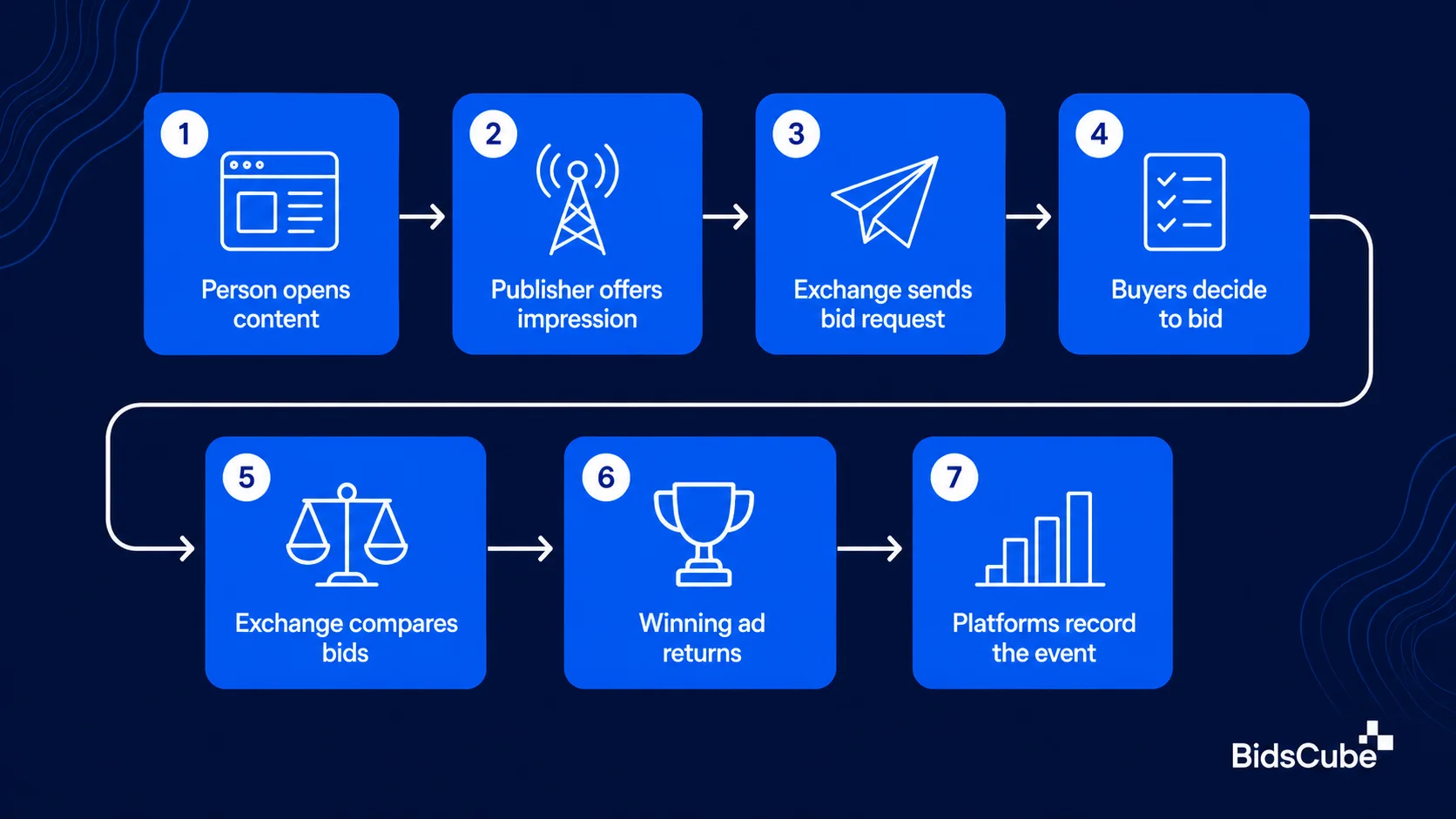
- A person opens digital content. A webpage, app, game, or video player creates an ad request.
- The publisher offers the impression. The publisher’s ad server or SSP sends details to an exchange. The request may include the format, page category, device type, location, consent status, and permitted audience signals.
- The exchange sends a bid request. Connected DSPs and other approved buyers receive the available impression.
- Buyers decide whether to bid. Each buyer checks campaign settings, audience rules, site lists, frequency limits, and available budget.
- The exchange compares eligible bids. It applies auction rules, pricing floors, buyer restrictions, and creative checks.
- The winning ad returns to the publisher. The publisher’s system loads the selected creative.
- The platforms record the event. The parties may record the impression, price, viewability data, click, and later conversion events.
OpenRTB covers the technical communication between sellers and bidders. It standardizes the bid request, bid response, auction notice, and related information used during real-time transactions.
Not every exchange transaction uses an open RTB auction. Publishers may sell inventory through preferred deals, programmatic guaranteed agreements, or invitation-only marketplaces. These methods trade some auction competition for more control over buyers, prices, and placement terms.
Key Players in Ad Exchanges
Several parties take part in exchange transactions:
- Publishers own websites, apps, video services, or other media inventory
- Advertisers pay to place messages in front of selected audiences
- SSPs help publishers manage inventory, pricing, demand sources, and sales rules
- DSPs help advertisers manage campaigns, bidding, budgets, and targeting
- Ad Exchanges connect supply with demand and run transaction rules
- Ad servers select, send, count, and report ad delivery
- Verification providers check viewability, fraud, content, and brand suitability
- Data providers supply permitted audience or contextual signals
Some companies perform several roles. A provider may combine an exchange, SSP, ad server, and deal marketplace. Buyers should check which company controls each stage and which fees apply.
See how Ad Exchange vs SSP changes the role of each platform.
Benefits of Using Ad Exchanges
Ad Exchanges offer numerous advantages essential to modern digital advertising strategies.
Wider Access to Inventory and Demand
Exchanges connect many sellers and buyers through shared technical connections. An advertiser can reach inventory from several publishers without building a separate connection to each one.
Publishers can expose available inventory to more bidders. More eligible bids may raise auction pressure, though higher bidder counts do not guarantee higher publisher revenue. Inventory quality, demand strength, latency, floors, and buyer relevance also affect the result.
Exchanges support several channels through one buying process. A campaign may access web display, mobile apps, native placements, video, audio, or connected TV, depending on the connected sellers.
Access to Real-Time Bidding
RTB lets buyers value each impression separately. A travel advertiser may bid more for a user researching flights than for a visitor reading unrelated content.
The DSP can evaluate the impression against campaign rules before bidding. This gives the advertiser more control than purchasing a broad inventory package at one price.
RTB also helps publishers test price floors and buyer demand. They can review which formats, locations, devices, and audiences receive stronger bids.
This does not mean every RTB impression performs well. Poor audience settings, weak creative, high fees, duplicate supply paths, and low-quality placements can waste money. Buyers still need clear campaign goals and frequent checks.
More Control Over Targeting
Ad Exchanges can support several targeting methods:
- Context and page category
- Country, region, or city
- Device, operating system, or browser
- App, website, channel, or placement
- Time of day and day of week
- First-party audience segments
- Retargeting lists
- Deal IDs and selected publisher packages
Available options depend on consent, privacy law, browser settings, publisher rules, and the connected DSP.
Advertisers should use the minimum data needed for the campaign. More targeting conditions can shrink reach, raise prices, and make reporting harder. Broad campaigns can waste spend, while overly narrow campaigns may struggle to win enough impressions.
Faster Media Transactions
An exchange can process many auctions without manual negotiation for each impression. Teams still need people to set campaigns, approve media plans, review data, manage sellers, and handle policy issues.
Automation removes repetitive transaction work. It does not remove business judgment.
Publishers might sell inventory via preferred deals, programmatic guaranteed contracts, or invitation-only marketplaces. These approaches exchange a degree of auction competition for greater control over buyers, prices and placement parameters.
Choosing the Right Ad Exchange
Choosing an Ad Exchange platform requires more than comparing the number of connected sites or buyers. Teams should examine inventory access, fees, reporting, technical connections, support, and quality controls.
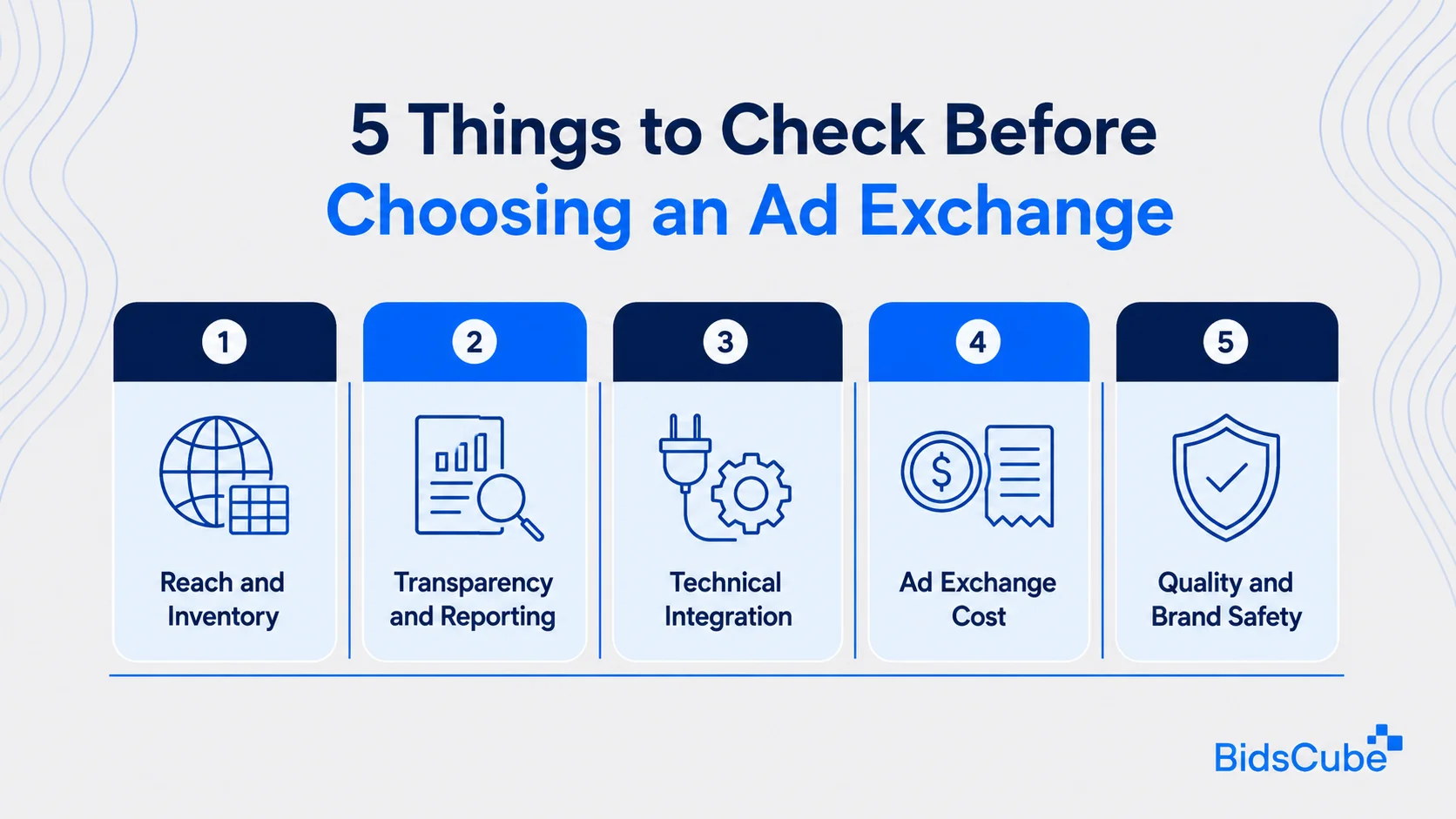
Reach and Inventory
Check which channels, formats, regions, and publishers the exchange covers. A large inventory count means little when most impressions do not match the campaign.
Ask the provider:
- Which formats and devices are supported?
- How much supply comes directly from publishers?
- Can buyers see domains, apps, and seller information?
- Does the exchange support private marketplace deals?
- Which DSPs, SSPs, and ad servers connect to it?
- Are inventory and geographic reports available?
Advertisers should also check whether the exchange sends the same inventory through several reseller paths. Duplicate paths can increase bidding costs and make supply analysis harder.
Transparency and Reporting
Reports should show enough detail to trace spend, revenue, fees, and media sources.
Useful reporting fields include:
- Domain or app
- Publisher or seller ID
- Ad size and format
- Country and device
- Bid price and clearing price
- Impressions and viewability
- Clicks and conversions
- Fees and revenue share
- Deal ID and auction type
IAB Tech Lab created ads. txt, sellers. json, and the SupplyChain object enables buyers to find authorized Sellers and Intermediaries. Buyers can thus understand more about who sells an impression. And how it traverses the supply chain, thanks to these standards.
Technical Integration
The exchange ought to cooperate with the organisation’s current systems. Some of the more common ways to connect include OpenRTB, Prebid, server-to-server bidding (where both demand and supply partners communicate independently via their own servers), ad tags (these are scripts integrated with a web page that will call the advertisement through headers − but may vary from publisher to publisher), as well as SDKs and APIs.
Before integration, technical teams should check:
- Supported OpenRTB versions
- Bid request fields and extensions
- Creative approval rules
- User consent signals
- Timeout requirements
- Discrepancy handling
- Reporting APIs
- Billing and currency terms
Poor integration can cause lost requests, slow pages, missing reports, creative errors, and billing disputes. A test period helps both parties find these issues before sending large traffic volumes.
Ad Exchange Cost
Ad Exchange cost may include transaction fees, platform fees, revenue shares, minimum commitments, technical setup fees, and paid support.
Some exchanges deduct a percentage from media spend. Others charge publishers, buyers, or both. White-label providers may charge a setup fee and a recurring platform fee.
An Ad Exchange for small business should have clear minimums and billing terms. A low advertised fee can still become expensive when the platform requires large monthly spending, paid technical work, or several outside services.
Ask for a written explanation of:
- Buyer and seller fees
- Revenue share
- Minimum monthly commitments
- Setup and connection fees
- Support charges
- Payment schedule
- Currency conversion
- Invalid traffic deductions
Quality and Brand Safety
Open marketplaces can include many inventory sources and creative buyers. Both sides need controls.
Publishers should check whether they can block:
- Specific brands and advertisers
- Sensitive ad categories
- Unsafe creative types
- Low-quality landing pages
- Unapproved ad technologies
Advertisers should check whether they can exclude:
- Unwanted domains and apps
- Resold or indirect inventory
- Made-for-advertising sites
- Sensitive content
- High-risk regions
- Poor-viewability placements
Google Ad Manager, for example, gives publishers controls for blocking buyers, advertisers, brands, and inventory categories in the Open Auction.
Compare auction access with header bidding vs waterfall.
Ad Exchange Strategies for Publishers
Effective Ad Exchange strategies can boost publishers’ revenue and quality. Below are strategies that can help publishers optimize their use of Ad Exchanges.
Increase Auction Competition
Publishers can connect more than one qualified demand source, but adding every available bidder is rarely the best choice.
Each partner adds requests, reporting work, payment risk, and possible latency. Publishers should compare net revenue rather than gross bids. A bidder with strong gross CPMs may produce less income after fees, discrepancies, and unpaid traffic.
Header bidding can let several partners compete before the ad server makes its final selection. Server-side bidding can reduce browser work, though it may offer less access to browser-based identifiers.
Manage Inventory by Value
Publishers should not treat every impression the same. They can group inventory by placement, format, device, content, geography, audience, and historical demand.
Premium placements may work well through direct deals or private auctions. Unsold inventory may enter an open auction. Testing different routes can show which method produces the best net return.
Floor prices need regular review. A floor that is too low may reduce the value of strong inventory. A floor that is too high may lower the fill rate and leave impressions unsold.
Protect Inventory Quality
Publishers should maintain accurate ads.txt and sellers.json records. They should remove sellers they no longer use and investigate unknown reseller entries.
Creative review also matters. Poor ads can damage the publisher’s reputation, slow pages, or expose visitors to misleading offers.
Publishers should track:
- Invalid traffic rates
- Creative rejection rates
- Page speed
- Viewability
- Fill rate
- Net revenue
- Payment timing
- Buyer concentration
These figures help a publisher spot demand sources that bring technical or commercial risk.
Ad Exchange Strategies for Advertisers
Advertisers can optimize ad spending and targeting by using effective Ad Exchange strategies. Here’s how to get the most out of your campaigns using Ad Exchanges.
Set Bid and Budget Rules
Advertisers should start with clear campaign goals. A campaign built for reach needs different bid rules from one built for sales or lead generation.
A DSP can adjust bids according to placement, audience, device, time, and past results. Teams should set spending limits and check whether automatic bidding follows the campaign goal.
Frequency caps also matter. Showing the same ad too often can waste money and irritate viewers.
Use Targeting With Care
Audience data can help buyers select relevant impressions, but it does not fix weak creative or a poor offer.
Start with a few clear audience groups. Compare them against a broader control group. This makes it easier to see whether the targeting rule adds enough benefit to justify the higher price.
Retargeting can reach people who visited a site, viewed a product, or started an action. Buyers should exclude recent purchasers and use a reasonable time window.
Check Supply Paths
One impression may reach a DSP through several exchanges and resellers. Buyers can compare these paths by price, latency, seller relationship, quality, and reporting.
Ads.txt, sellers.json, and the OpenRTB SupplyChain object can help confirm whether a seller has permission to offer the inventory. They also show which intermediaries appear in the transaction.
A shorter path is not always better, but unexplained intermediaries deserve review.
Review Campaign Results
Advertisers should track more than clicks.
Useful figures include:
- Cost per thousand impressions
- Viewability
- Click-through rate
- Conversion rate
- Cost per acquisition
- Return on ad spend
- Frequency
- Invalid traffic
- Win rate
- Bid rate
- Completion rate for video
Results should also be split by publisher, placement, audience, device, format, and supply path.
An exchange can provide access to impressions, but it cannot guarantee business results. Creative quality, landing pages, product pricing, measurement, and customer demand also affect campaign performance.
Launch and manage a branded marketplace with BidsCube White Label Ad Exchange.
Our tech staff and AdOps are formed by the best AdTech and MarTech industry specialists with 10+ years of proven track record!

Conclusion
Ad Exchanges connect advertisers and publishers with automated auctions & programmatic deals. Advertisers can control the bids, inventory, audiences and campaign rules while these solutions provide publishers access to demand.
The Ad Exchange vs Ad Network choice depends on the buying model. Ad Networks often package inventory, while exchanges let buyers compete for individual impressions. Many providers now combine both approaches.
Real examples of Ad Exchanges include Google Ad Exchange, OpenXExchange, Microsoft Monetize, Magnite, PubMatic, and white-label exchange products. Each provider differs in inventory, formats, fees, reporting, access rules, and technical requirements.
Before joining an exchange, check seller transparency, supply paths, transaction fees, supported formats, privacy controls, reporting fields, and payment terms. Run a limited test before committing a large budget or sending all available publisher traffic.


