



The public web has moved through three broad stages. A read-only Web 1.0 where people were served static pages. Web 2.0 introduced accounts, social networks, easy mobile access, and content created by the user. Web 3.0 was a more nebulous combination of decentralized services, data read by machines, ownership of digital goods, and new privacy tools.
Table of Contents
Advertising changed at each stage. Basic banners became targeted campaigns bought through automated auctions. This article explains the history of digital ads, the present state of Web 3.0 advertising, and what advertising in Web 3.0 means for advertisers and publishers in 2026.
Web 1.0 vs Web 2.0 vs Web 3.0
| Characteristic | Web 1.0 | Web 2.0 | Web 3.0 |
| Main period | 1990s to early 2000s | Mid-2000s to present | Developing alongside Web 2.0 |
| User role | Reads published pages | Reads, posts, shares, and comments | May control data, assets, or identity |
| Main content | Static text and images | Social, video, mobile, and user-created content | Connected data, virtual assets, and decentralized services |
| Common ad formats | Text links and banners | Display, video, social, native, and mobile ads | Virtual-world placements, token-based access, and privacy-focused formats |
| Media buying | Direct deals | Ad networks, DSPs, SSPs, and RTB | Existing programmatic systems plus experimental decentralized tools |
| Data use | Very limited | Cookies, accounts, device IDs, and behavior data | First-party data, contextual signals, consent, and alternative identifiers |
| Main privacy issue | Few tracking tools existed | Large-scale cross-site tracking | User control, consent, identity, and restricted identifiers |
Web 1.0 [Read only]
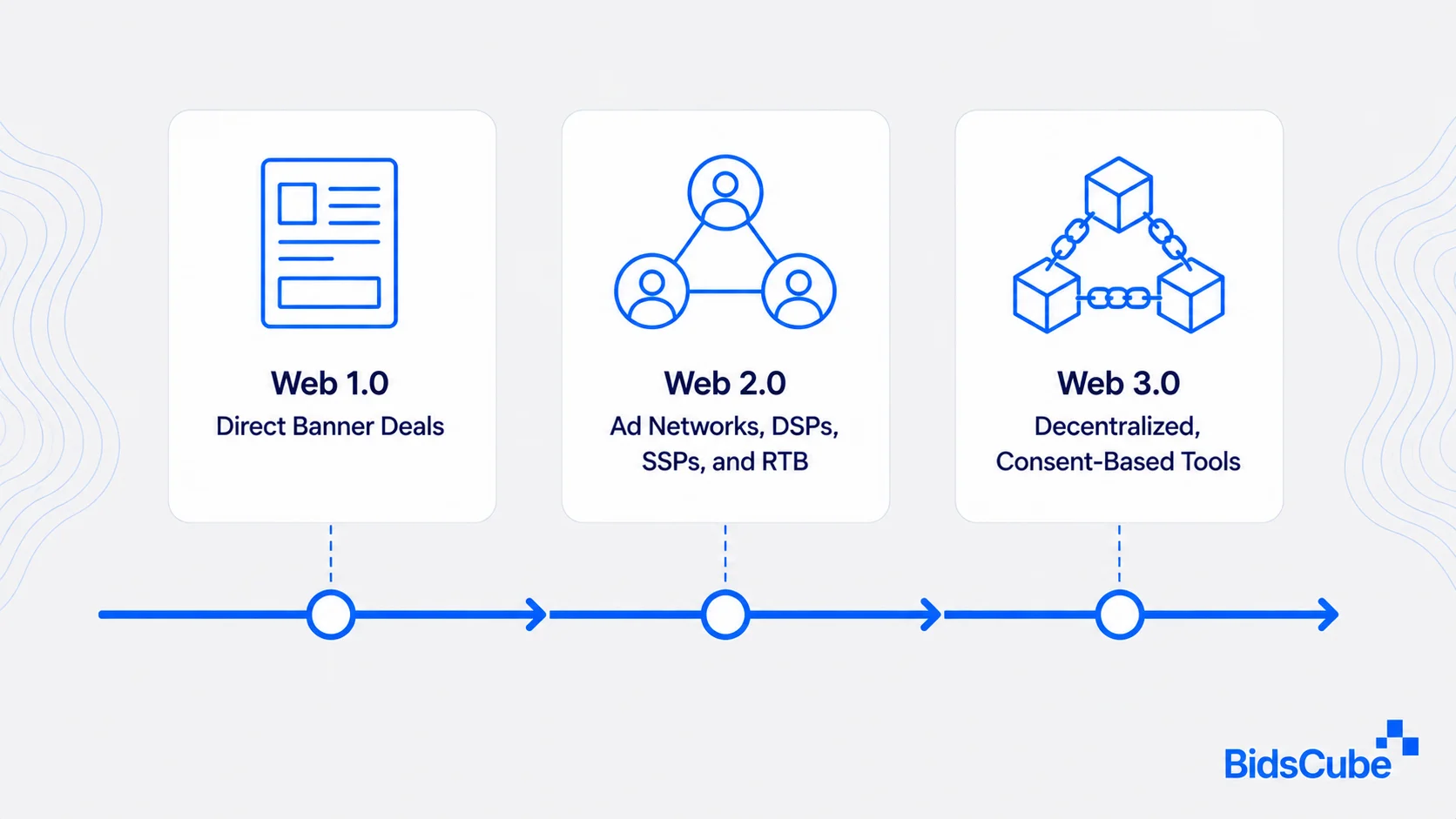
Web 1.0 refers to the original public-facing web, where sites primarily functioned as modern-day brochures. A small number of people and companies published content. Most visitors could only read it.
Pages contained basic text, simple images, links, and later, GIF files. Accounts, comments, feeds, and interactive tools were rare. Websites also had little information about individual visitors.
Early digital advertising followed the same model. Brands bought banner space directly from website owners. Targeting usually depended on the subject of the site rather than a visitor’s interests or browsing history.
Measurement was basic. Advertisers could count impressions and clicks, but they had few ways to connect an ad with a later purchase.
Web 2.0 [Participative Web]
The web 2.0 transformed the web into a two-way system. Blogs, forums, video platforms, social networks, podcast and online marketplaces allow users to publish and even respond to the content.
Mobile devices brought these services into daily life. User accounts also gave platforms a clearer view of interests, searches, purchases, locations, and content habits.
Digital advertising grew around this data. Ad networks bundled publisher inventory & DSPs, SSPs, exchanges automated media trading In the settlement, real-time bidding enabled advertisers to bid for impressions on an each page load basis throughout the latter half of the next.
Machine learning later gave campaign teams more control over bidding, audience selection, fraud checks, and budget allocation. The BidsCube guide to AI in programmatic advertising explains how these systems work.
Web 2.0 also created privacy problems. Big platforms gathered data across sites, apps, devices, and services.
Web 3.0 [Read-Write-Execute]
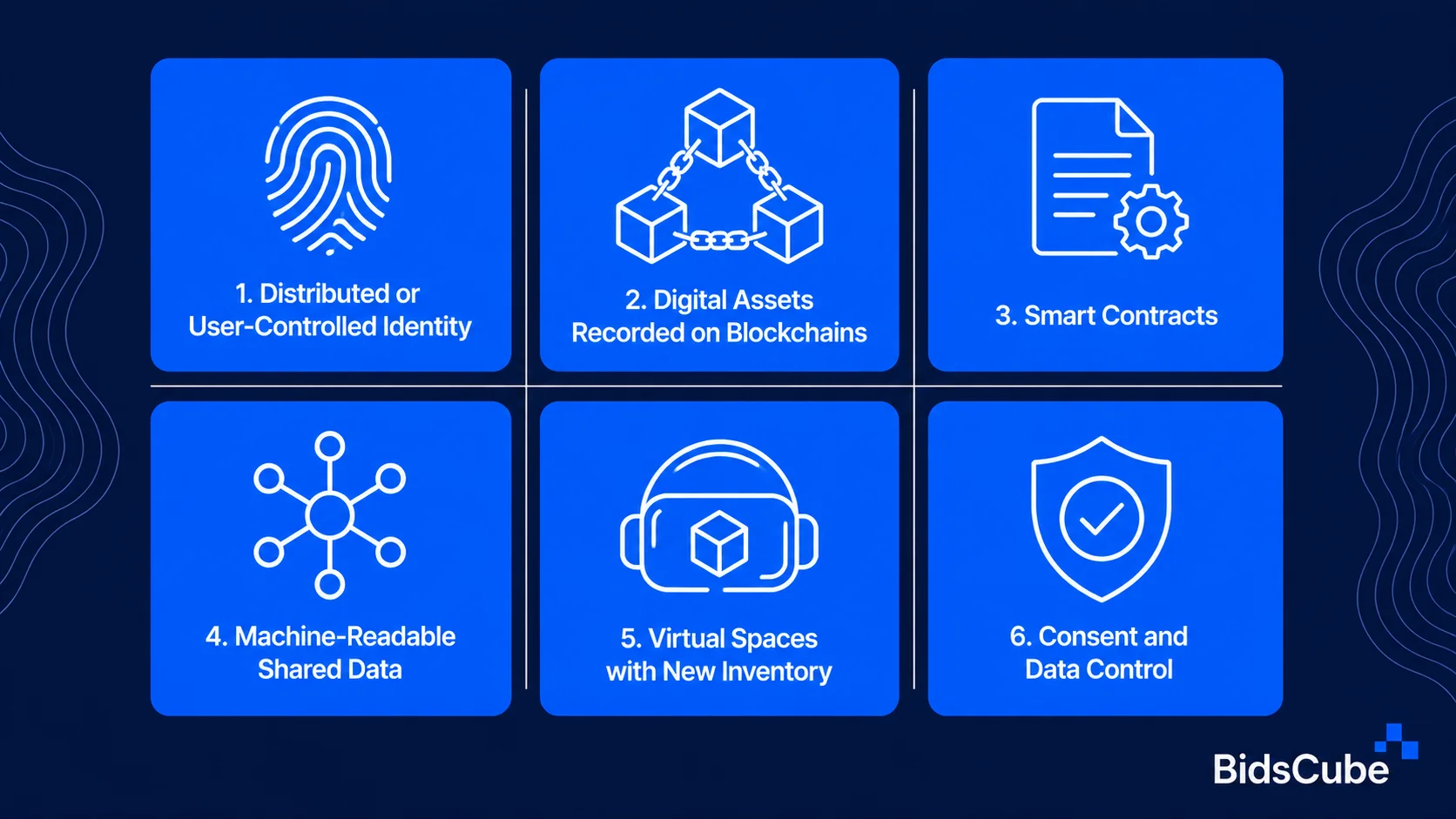
There’s no single agreed-upon launch date for Web 3.0 and there’s not one defined technical infrastructure it will have. It usually includes technologies based on decentralization, connected data, digital ownership or smart contracts and a larger user-controlled space.
A decentralized advertising model could let participants trade media or verify transactions without placing every part of the process under one company. Some projects have also tested blockchain advertising for payment records, digital ownership, reward systems, and fraud checks.
The practical revolution is less dramatic for advertising in Web 3.0. Your typical campaign still involves DSPs, SSPs, ad exchanges, ad servers, and even OpenRTB. OpenRTB is still considered the baseline protocol for real-time programmatic auctions, according to the IAB Tech Lab.
Even privacy dialogue has been influenced by Web 3.0. Advertising, meanwhile, today eats more first-party data to contextual signals, consent records and cookieless tech. None of these approaches get rid of all identifiers, but at least they reduce the dependence on untrammeled cross-site tracking.
The main traits linked with Web 3.0 include:
- Distributed or user-controlled identity
- Digital assets recorded on blockchains
- Smart contracts for automated transactions
- Machine-readable data shared across services
- Virtual spaces with new advertising inventory
- More control over consent and data access
Where Web 3.0 Adoption Stands in 2026
We were told that Web 3.0 would be just around the corner, with users migrating to blockchain platforms and virtual worlds en masse and a fully cookieless ad market coming onstream almost overnight. True, substantive change has typically been a far slower and much less linear process.
In April 2025, Google changed its mind about having third-party cookie controls in Chrome. The firm does not show the independent cookie-choice prompt it had talked about before. The announcement of Chrome 115 is slated for October 2023, by which time users should still manage third-party cookies through Chrome settings.
In October 2025, Google also announced plans to retire several Privacy Sandbox advertising APIs because adoption remained low. This adds Topics, Protected Audience, Attribution Reporting, Shared Storage, and others to the list. Google continued to support CHIPS, FedCM, and Private State Tokens.
This is a choice, not an entire industry refactoring for cookieless targeting and that too till mid of 2026. Advertisers aggregate cookies, 1st party datasets, contextual data, consent triggers and browser privacy controls.
There are campaigns that use blockchain and those that run in the virtual-world, neither of which have yet supplanted standard programmatic trading. Web 3.0 advertising has a complimentary role beside (not in place of) Web 2.0 systems.
Web 3.0 and the Future of Programmatic Advertising
Web 3.0 can add new inventory rather than replace the auction process behind digital media. Virtual events, games, augmented reality, and online worlds can contain sponsored objects, video screens, branded spaces, and digital products.
Metaverse advertising is one example. A brand can place an ad inside a virtual venue or sponsor an interactive event. A DSP can still buy some of this inventory through standard programmatic pipes when the publisher and supply platform support them.
Identity will require more care. Advertisers cannot assume that a wallet address, device signal, or virtual profile gives unlimited permission to track a person. Every campaign still needs clear consent, data rules, and regional controls.
- A privacy-first advertising approach can help teams set these rules before a campaign starts.
- Contextual advertising as a cookieless alternative can also place ads according to page, video, game, or virtual-world content instead of a detailed personal profile.
Programmatic platforms will remain useful because they already connect advertisers, publishers, data sources, and inventory. The main work will involve adding new formats and signals without weakening reporting, brand safety, or privacy controls.
Summary
The web did not move from one version to another overnight. Static Web 1.0 pages still exist. Web 2.0 platforms remain the main home of online content and advertising. Web 3.0 adds selected tools and formats on top of that base.
Advertisers and publishers do not need to wait for a complete Web 3.0 shift. They can act now by:
- Building first-party data programs
- Testing contextual campaigns
- Recording and respecting consent
- Checking new identity methods
- Testing virtual and gaming inventory in small campaigns
- Comparing new formats with standard programmatic results
The strongest Web 3.0 advertising plan will connect new formats with existing buying systems. It will also treat privacy and measurement as operating requirements, not sales claims.
Companies preparing campaigns for new web environments can review the BidsCube DSP for programmatic buying, audience controls, multiple ad formats, and campaign reporting.


