



Manual margin control in programmatic advertising creates a simple problem: the market changes faster than Ad Ops teams can react. If margins stay too high, fill rate drops. If margins stay too low, publishers and exchange owners leave money on the table. This dynamic margin definition explains how automated margin logic helps an ad exchange adjust pricing in real time.
Table of Contents
- What is Dynamic Margin in Advertising?
- How Dynamic Margin Works: Step by Step
- Dynamic Margin Optimization: How It Improves Ad Exchange Performance
- Benefits of Dynamic Margin for Publishers and Advertisers
- Dynamic Margin vs. Static Margin vs. Dynamic Floor Pricing
- Making Dynamic Margin Work for You
- Conclusion
-
FAQs
- What Is Dynamic Margin in Programmatic Advertising?
- What Is the Definition of Dynamic Margin in Ad Exchange?
- How Does Dynamic Margin Optimization Work?
- What Is the Difference Between Dynamic Margin and Dynamic Floor Pricing?
- How Does Dynamic Margin Help Publishers Increase Ad Exchange Revenue?
- What Is a Dynamic Ad Allocation Tool?
A dynamic margin in programmatic setup uses market signals, historical results, and machine learning to change margins per impression or traffic segment. The need is clear. ANA’s Programmatic Benchmark Study found that only 43.9% of every $1,000 entering a DSP reached consumers as effective ad spend. Not all of that loss comes from margin settings, but it shows how much programmatic revenue can disappear through fees, weak paths, and poor trading decisions.
This article is here to help platform owners reduce manual pricing work and react faster to auction conditions. It fits ad exchanges, SSP-like setups, and white-label programmatic businesses that need better margin control without watching every auction by hand.
What is Dynamic Margin in Advertising?
The dynamic margin definition is simple: Dynamic margin is an automated pricing feature that adjusts the margin between buy-side demand and sell-side revenue based on live and historical market data. In BidsCube’s case, the Dynamic Margin Tool sits inside the ad exchange platform and helps choose a better margin for each trading situation.
If you ask what is dynamic margin in advertising, compare it with the static margin. Static margin uses a single fixed rule, such as 10% across all partners, traffic sources, or time periods. Dynamic margins change the rule when demand, floor prices, DSP behavior, win rate, or fill rate change.

Dynamic Margin works through three core inputs:
- Live market analysis: the system scans current demand and supply signals.
- Historical data: the tool checks past win rates, partner behavior, and pricing outcomes.
- Machine learning: the model predicts which margin level fits current market conditions.
This makes Dynamic Margin a dynamic ad allocation tool because it helps route pricing decisions based on auction context. It does not replace strategy. It helps the platform apply strategy faster and with fewer manual errors.
How Dynamic Margin Works: Step by Step
A dynamic margin in ad exchange setup works best when the system can read current auction conditions and learn from past results. The goal is not to set the highest possible margin. The goal is to find the margin that protects revenue, supports fill rate, and keeps demand partners active.
The process usually works like this:
- The system receives a real-time bid request with current traffic, demand, and supply parameters.
- The machine learning programmatic model checks historical win rates, floor prices, DSP behavior, traffic source, and past performance.
- The system calculates the margin for the current impression or segment.
- The margin is applied automatically without manual changes from the Ad Ops team.
- The result enters a feedback loop, so the next prediction can use updated data.
| Step | System Action | Data Used | Output |
| 1 | Receives bid request | Traffic source, device, GEO, format, demand signals | Current auction context |
| 2 | Reviews market history | Win rate, bid rate, floor price, DSP response patterns | Performance forecast |
| 3 | Calculates margin | Live and historical trading data | Suggested margin level |
| 4 | Applies margin automatically | Platform pricing rules | Real-time pricing decision |
| 5 | Records result | Fill, revenue, win rate, no-bid reasons | Feedback for future auctions |
This process supports bid request optimization and real-time bidding optimization because every decision uses current auction data. It also helps teams avoid old pricing rules that no longer match the market.
Dynamic Margin Optimization: How It Improves Ad Exchange Performance
Dynamic margin optimization improves ad exchange performance by making the margin respond to real trading conditions. During a major match or breaking news event, traffic value may rise fast. A fixed margin can miss that spike.
In a dynamic margin ad exchange, the system can raise or lower margin based on signals that appear during the auction. This supports dynamic pricing in ad exchange because pricing reacts to demand instead of waiting for manual review.
Three common scenarios show the value clearly.
Scenario 1: Peak demand
During sports finals, breaking news, or major shopping days, demand rises. Dynamic Margin can increase margin because buyers show stronger intent and higher willingness to bid.
Scenario 2: Off-peak or low demand
At night, in weaker GEOs, or in low-demand segments, a high margin can reduce fill. Dynamic Margin can lower margin to keep auctions active and support fill rate optimization.
Scenario 3: New DSP onboarding
New demand partners often need a learning period. Dynamic Margin can start with safer margin settings and adjust once the platform sees bid behavior, win rate, and payment quality.
| Scenario | Market Condition | Dynamic Margin Response | Business Outcome |
| Peak demand | Many buyers compete for the same traffic | Raises margin where demand can support it | Higher RPM and better publisher revenue |
| Low demand | Fewer bids or lower bid prices | Lowers margin to protect fill | More sold impressions and fewer lost auctions |
| New DSP onboarding | Limited performance history | Tests margin against early bid patterns | Faster partner calibration |
| Weak traffic segment | Low win rate or poor bid response | Reduces margin or routes traffic differently | Better auction participation |
| Premium segment | Strong viewability and high bid density | Applies stronger margin rules | Higher yield from quality inventory |
This is where real-time margin optimization supports ad exchange margin optimization. The exchange does not use one blunt rule. It works with the market as it changes.
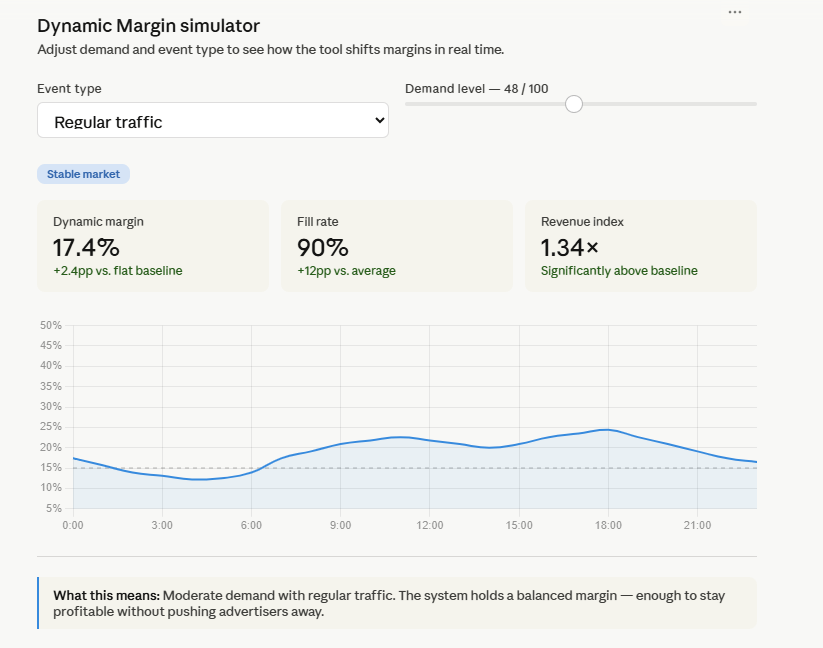
Try the Dynamic Margin Simulator
Want to see how margin changes can affect revenue and fill rate?
Use the Dynamic Margin Simulator to compare a static margin setup with an automated margin scenario. Adjust demand level, bid density, floor price, traffic volume, and current margin to see how different conditions can change RPM, fill rate, and estimated exchange revenue.
Benefits of Dynamic Margin for Publishers and Advertisers
Dynamic Margin supports ad exchange revenue optimization because it helps both sides trade at a more realistic price. Publishers want stronger RPM. Advertisers want fairer access to impressions that matter. An exchange owner needs both sides to keep trading.
For publishers, the main benefits include:
- Higher RPM without constant manual floor price changes.
- Better fill rate when demand slows down.
- Less dependence on Ad Ops teams for pricing decisions.
- Better use of premium traffic during high-demand periods.
- Stronger long-term DSP relationships because inventory stays easier to price.
- Better publisher revenue optimization across formats, GEOs, and devices.
For advertisers, the benefits include:
- More realistic impression pricing based on market value.
- Better win rate in auctions where demand and supply match.
- Fewer overpayments in low-demand segments.
- More predictable access to inventory.
- A healthier auction where price follows real demand signals.
This is why programmatic margin optimization matters. It keeps trading active without relying on fixed rules that may work on Monday and fail by Friday.
| Benefit | Who It Helps (Publisher / Advertiser) | Impact Metric |
| RPM optimization | Publisher | RPM, revenue per impression |
| Fill rate protection | Publisher | Fill rate, no-bid rate |
| Fairer impression pricing | Advertiser | Win rate, bid efficiency |
| Faster pricing decisions | Publisher and exchange owner | Time spent on manual setup |
| Better demand relationships | Publisher and advertiser | Repeat spend, bid rate |
Automated logic also supports automated margin optimization because the platform reacts faster than a person can. That does not mean humans disappear from the process. It means the team spends more time on strategy and less time changing margins line by line.
Dynamic Margin vs. Static Margin vs. Dynamic Floor Pricing
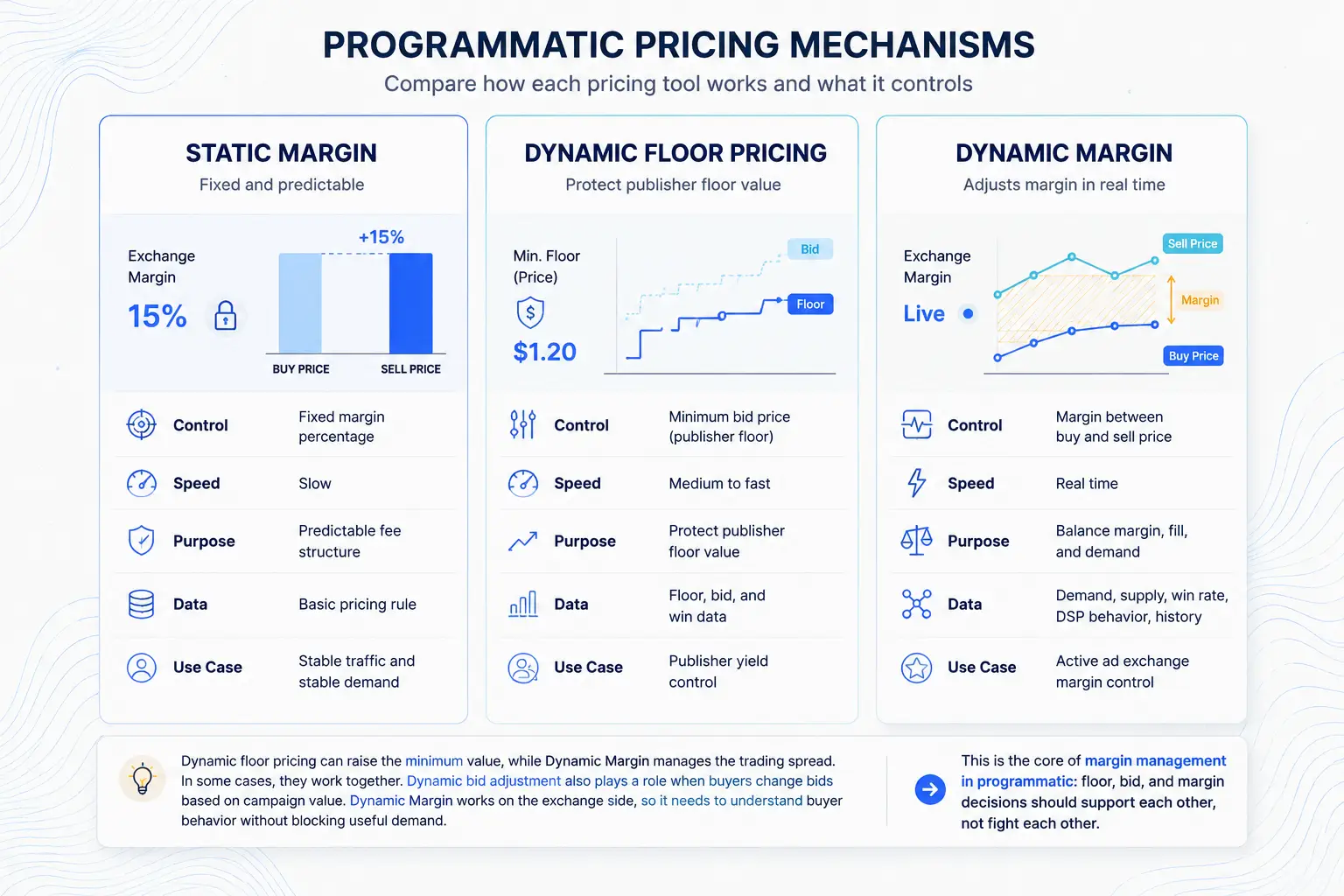
Pricing in programmatic can get confusing because several tools sound similar. Static margin, dynamic floor pricing, and Dynamic Margin all affect revenue, but they work differently.
Static margin sets a fixed exchange margin. Dynamic floor pricing changes the minimum price publishers accept for inventory. Dynamic Margin changes the exchange margin between supply and demand based on market signals.
| Parameter | Static Margin | Dynamic Floor Pricing | Dynamic Margin |
| Main control | Fixed margin percentage | Minimum bid price | Margin between buy and sell price |
| Reaction speed | Slow | Medium to fast | Real time |
| Main purpose | Predictable fee structure | Protect publisher floor value | Balance exchange margin, fill, and demand |
| Data used | Basic pricing rule | Floor, bid, and win data | Demand, supply, win rate, DSP behavior, history |
| Best use case | Stable traffic and stable demand | Publisher yield control | Active ad exchange margin control |
Dynamic floor pricing can help with floor price optimization, but it does not solve every margin problem. A floor can raise minimum value, while Dynamic Margin manages the trading spread. In some cases, the two can work together.
Dynamic bid adjustment also plays a role when buyers change bids based on campaign value. Dynamic Margin works on the exchange side, so it needs to understand buyer behavior without blocking useful demand.
This is the core of margin management in programmatic: floor, bid, and margin decisions should support each other, not fight each other.
Making Dynamic Margin Work for You
The process works better when each step has clear inputs and goals.

Step 1. Analyze and Adjust
Start by reviewing current margin performance across traffic sources, formats, GEOs, and demand partners. Look for segments where fill rate drops after margin changes. Also review where RPM stays flat even though bid density is strong.
Use BidsCube analytics to compare past performance with current results. This gives the Dynamic Margin Tool enough context to make smarter decisions.
Step 2. Monitor and Modify
Dynamic Margin reduces manual work, but the team still needs to monitor outcomes. Watch fill rate, RPM, win rate, bid rate, and no-bid reasons. If one DSP starts bidding less after margin changes, review the segment before scaling the rule.
Use these checks to protect partner quality and supply path optimization. Good automation still needs human review.
Step 3. Enjoy the Benefits
Once the system learns from enough data, the exchange can trade with fewer manual pricing changes. Publishers can protect revenue during demand spikes. Advertisers can access inventory at prices closer to real market value.
This can make ad trading less labor-intensive and more stable across changing market cycles.
Step 4. Integrate With A/B Testing
Test Dynamic Margin against static margin on a defined share of traffic. Keep one traffic group on the old setup and one group on the Dynamic Margin Tool. Compare RPM, fill rate, bid rate, win rate, and advertiser retention over the same period.
Do not test everything at once. Start with one format, one GEO group, or one demand source.
| Step | Action | Tool | Expected Result |
| 1 | Review historical margins and traffic results | BidsCube analytics | Clear performance baseline |
| 2 | Track live auction outcomes | Real-time reports | Faster issue detection |
| 3 | Apply Dynamic Margin to selected traffic | Dynamic Margin Tool | Better pricing response |
| 4 | Run controlled A/B test | Static vs. dynamic comparison | Proof of revenue impact |
| 5 | Scale winning setup | Platform rules and reports | More stable yield control |
- For teams running a white label ad exchange, this setup can make pricing work less reactive.
- For publishers managing supply directly, BidsCube SSP can support inventory control and reporting.
- Buyers can also work through BidsCube DSP when they need campaign-side control.
Conclusion
Dynamic Margin helps ad exchanges move away from rigid pricing rules and toward market-aware trading. It reads auction signals, compares them with historical results, and applies margin changes automatically. This helps publishers protect RPM, advertisers avoid poor price conditions, and exchange owners engage programmatic yield management with less manual work.
The main point is simple: Dynamic margin within programmatic turns pricing from a fixed setting into a living system. If your platform still uses static margin rules across different traffic and demand conditions, there is likely room to improve.
BidsCube’s Dynamic Margin Tool is part of a broader programmatic setup for trading, reporting, and revenue control. Contact us to discuss your ad exchange setup.
Our tech staff and AdOps are formed by the best AdTech and MarTech industry specialists with 10+ years of proven track record!

FAQs
What Is Dynamic Margin in Programmatic Advertising?
Dynamic margin within programmatic advertising is an automated way to adjust exchange margin based on live auction data and historical trading signals. It helps the platform react to demand, supply, win rate, and partner behavior.
What Is the Definition of Dynamic Margin in Ad Exchange?
The definition of dynamic margin in AdExchange is an automated pricing method that changes margin between the buy-side and sell-side price according to market conditions. It differs from static margin because the rule changes as auction data changes.
How Does Dynamic Margin Optimization Work?
Dynamic margin optimization works by reading bid requests, checking market and historical data, calculating the best margin, applying that margin automatically, and sending results into a feedback loop.
What Is the Difference Between Dynamic Margin and Dynamic Floor Pricing?
Dynamic floor pricing adjusts the minimum price a publisher will accept. Dynamic Margin adjusts the exchange margin between the buyer price and seller revenue.
How Does Dynamic Margin Help Publishers Increase Ad Exchange Revenue?
Dynamic Margin can raise margin during strong demand and lower margin when demand weakens. This helps protect RPM, fill rate, and long-term demand activity.
What Is a Dynamic Ad Allocation Tool?
A dynamic ad allocation tool uses real-time data to decide how ad opportunities should be priced, routed, or prioritized. Dynamic Margin works as one such tool because it applies margin logic based on current auction conditions.


