



For many publishers, a large share of traffic does not stick around. A user comes to the page, skims through the answer and bounces away from the page. In that visit, it would last for 10, 15, or 25 seconds. Many ad stacks still like to assume the user scrolls, lazy loaded units trigger and that the user stays there just long enough for viewability and bidder response timing to align. That mismatch is where revenue leaks start.
Table of Contents
That is why monetize short-session users is its own optimization task. It is not just a “traffic quality” issue. It is a setup issue, a timing issue, and a placement issue.
If your page, auction, and ad formats are built for longer visits, short-dwell traffic will underperform even when user intent is genuine. This is the core problem behind short session traffic monetization.
What Are Short-Session Users and Why They Matter
Visitors who are short-session users spend less than 30 seconds on a page and typically only produce a single pageview before bouncing off will be kept you in mind. These typically are from push traffic, Telegram, social links, direct traffic, and other instant click environments where the user wants an answer now.
That pattern makes them common on news pages, utility content, deal pages, creator-driven landing pages, and answer-first blog articles.
These users matter because they can still be valuable. A short visit does not always mean weak intent. In many cases, it means the visitor found the needed information fast, then left. That behavior showed up clearly in a Reddit discussion where a publisher saw session duration below 1 minute, time on page near 4 minutes, and a bounce rate around 90%. After checking the replies, the poster concluded that users were landing on one article, getting the answer, and leaving, which explained the gap.
Publishers often ask how to monetize high-bounce traffic because this audience can still drive useful impressions if the stack is built for the first screen, not the fifth. The real question is not whether the traffic is “bad.” The real question is whether the monetization model respects the visit length.
Why Traditional Ad Setups Fail for Short Sessions
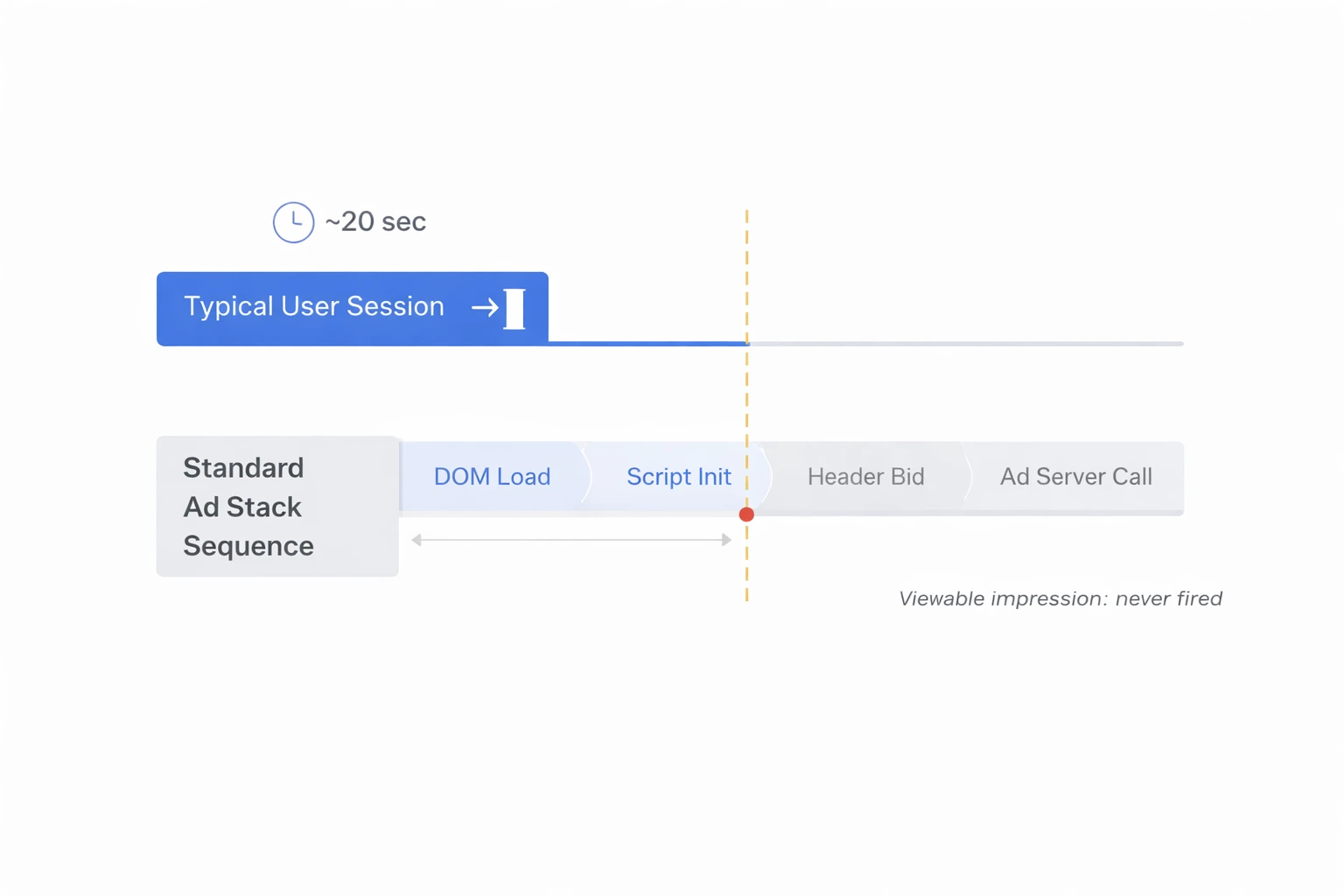
Most standard ad setups fail because they load too late. Google Ad Manager notes that lazy loading can improve page speed and reduce resource use, but warns that if an ad loads too late, the user may scroll past it or leave before it becomes viewable. That tradeoff matters much more when the whole session lasts only a few seconds.
Viewability creates another problem. Google Ad Manager states that a display impression counts as viewable only when at least 50% of the ad is visible for one continuous second. If a visitor bounces in ten seconds, and the ad slot loads late or sits too low, the page may fire an impression, but it may never become viewable enough to attract stronger demand.
Header bidding can also work against short visits when the timeout is too long. Prebid explains that header bidding delays the ad server call just long enough to collect bids without causing revenue to suffer. In other words, the timeout has to balance bid collection against page speed and user patience. On a short session page, that balance gets tighter because the auction may still be waiting while the user is already gone.
The result shows up in the same places again and again:
| Stack Element | What Happens on Short Visits | Revenue Impact |
| Lazy-loaded below-the-fold units | The user leaves before the slot loads | Fewer paid impressions |
| Strict viewability thresholds | The ad never stays visible long enough | Weaker demand, and lower CPMs |
| Long bidder timeout | The auction drags past user attention | Lower fill rate |
| Heavy scripts and passbacks | The page slows down | Higher bounce, and weaker eCPM |
Google also points out that faster pages help ads load faster, and fewer passbacks can improve viewability. That matters because short visits leave almost no room for delay. If the first impression does not load fast, there may not be a second chance.
This is why publishers trying to monetize low session duration traffic should stop treating all impressions equally. On these pages, the first visible ad matters far more than the total number of declared slots in the layout.
Reddit Case: Publishers on Short-Session Revenue Problems
The Reddit thread in r/juststart is useful because it shows the issue in plain language. The original poster said average session duration was under one minute while average time on page was close to four minutes, which looked wrong at first glance.
One commenter asked about bounce rate and said the gap usually indicates a high bounce rate. The poster later shared that bounce rate was about 90%, and that most visits came to answer one question, then ended there. They also said they monetized the traffic with display ads and affiliate links.
That discussion matters because many publishers misread short sessions as broken traffic when the real issue is measurement and setup. A page can still serve a purpose, satisfy the user, and generate revenue even if the visit ends fast. The problem starts when the ad stack assumes the user will behave like a deep-scroll reader. That is where short session ad revenue gets squeezed.
Best Monetization Strategies for Short-Session Users
Short-session users do not give you much time to work with. Every second between page load and first visible ad is money left on the table. These four strategies help you close that gap.
Prioritize Above-the-Fold Ad Placements
The simplest fix is often the most important one. Put a strong ad unit where the user can see it early. Google’s viewability guidance makes the reason clear: Depending on screen size and ad position, some ads may never actually be seen even when they count as impressions. On short visits, a below-the-fold unit is often too far away to matter.
That does not mean stuffing the top of the page with noise. It means placing one meaningful, clean unit near the top content area, where it can load fast and earn a real chance to be seen. The first screen has to do more work on short-session pages than on long-read pages.
Use Sticky and Anchor Ad Formats
Sticky and anchor units often work well for high-bounce audiences because they stay in view as users scroll. That gives the ad more time to meet viewability standards than a unit buried in a slow-scroll path. Google’s Active View framework is built around what portion of the ad is visible and how long it stays visible, so formats that remain on screen longer can help when sessions are short.
Still, the format has to match the page. A sticky unit can help on mobile or quick-answer pages, but an aggressive format can also push the user away. Use anchor, inline, or sticky placements with restraint. The goal is to improve exposure time, not punish the visit.
Reduce Bidder Timeout to Match Session Length
This is one of the most practical fixes in header bidding environments. Prebid explains that publishers delay the ad server call just long enough to gather bids, without delaying so long that revenue is reduced. That sentence matters because some sites use a single timeout logic across all page types, even when one section has long reads, and another has fast exits.
Short pages need a tighter auction window. You are not waiting for every bidder. You are trying to get enough qualified bids before the user disappears. This is a core part of ad optimization for short sessions. It is also where page-level logic can outperform one-size-fits-all auction settings. Prebid also notes that pre-auction processes can eat into bidder response time, which makes slow configurations even riskier on the first pageview.
Switch to Contextual Over Behavioral Targeting
When a visitor comes in, reads one page, and leaves, you often have less behavioral depth to work with. That makes contextual matching more useful. IAB Europe’s guide on contextual advertising says the move away from third-party cookies has pushed contextual methods back into focus, especially as privacy-first approaches gained weight across the market. The guide also frames contextual as a practical solution in environments where user-level tracking is less available or less reliable.
That fits short-session traffic well. If the user landed on a page about betting rules, AI tools, football scores, or mobile game tips, the page itself already carries a strong signal. You do not need a long browsing history to make the visit monetizable. In many cases, the content topic is the cleanest targeting asset you have.
Want more control over short-dwell traffic?
Review BidsCube SSP, BidsCube DSP, and White-Label AdExchange to test demand paths, layout strategy, and reporting logic.
For outside validation, see Clutch and G2.
How to Optimize CPM Revenue for High-Bounce Audiences
To improve revenue from these visits, focus on speed, visibility, and demand fit. That is where programmatic advertising becomes useful, but only if the setup is built for short dwell behavior. A slow auction with too many calls can cancel out the value of a strong audience. A fast auction with better layout discipline can do the opposite.
For SSP selection, focus on practical questions.
- How fast do auctions close?
- How clear is the reporting on fill, viewability, timeout, and bid loss?
- Can you tune page-level settings for traffic that tends to bounce fast?
- Can you see enough detail to separate long-read content from quick-answer content?
Those questions matter more than generic feature lists when you are dealing with short dwell traffic.
Format choice also matters. A strong mix for short visits usually includes:
- one above-the-fold inline unit;
- one anchor or sticky unit on mobile;
- carefully tested interstitial logic, only where it does not break the page experience;
- fewer low-value below-the-fold units that rarely become viewable.
This is the real work behind short session ad optimization. You are not trying to win with more slots. You are trying to win with faster, more visible, more realistic slots.
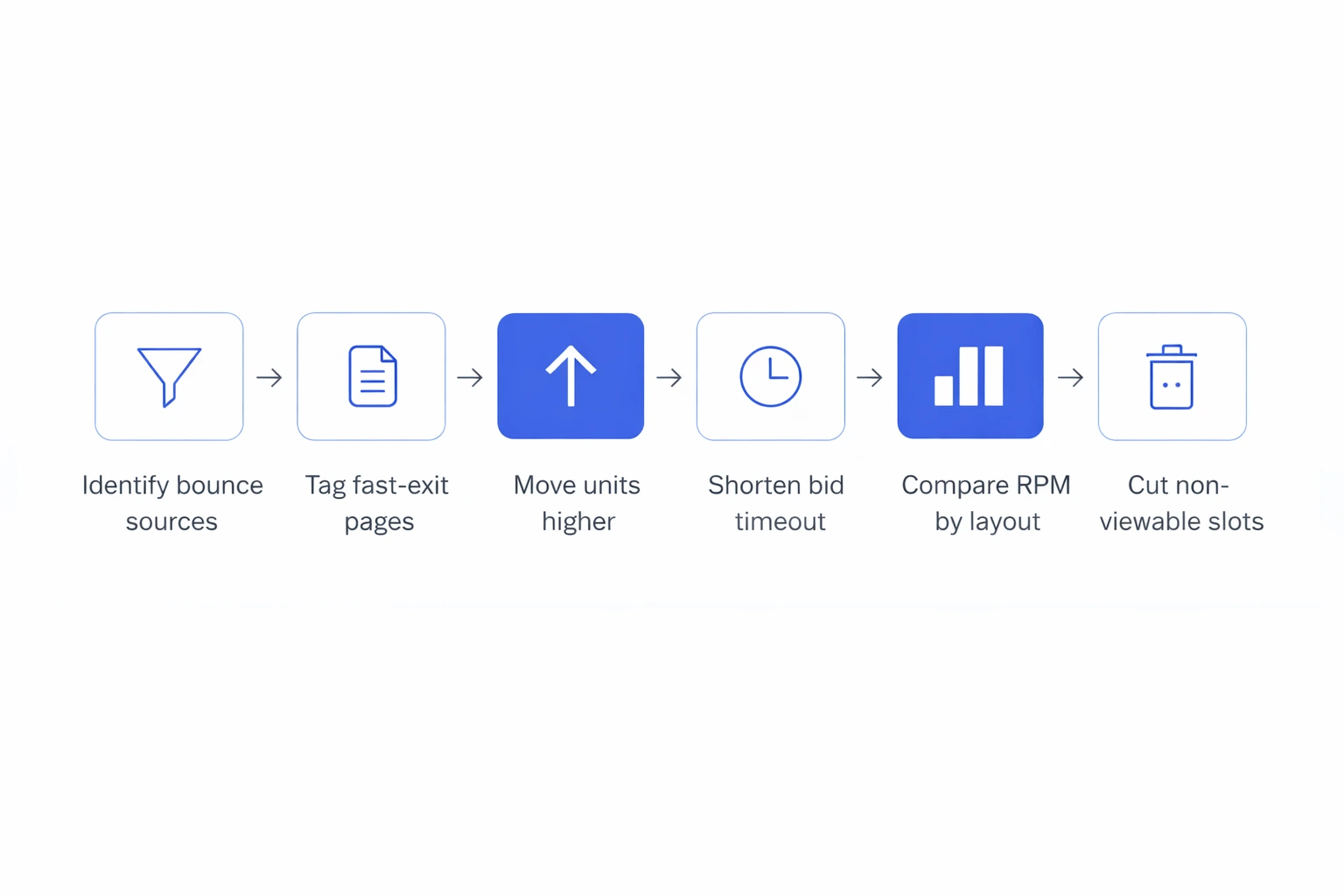
A useful workflow looks like this:
- separate traffic sources with high bounce patterns;
- identify pages where sessions stay under 30 seconds;
- move key monetization units higher;
- shorten bidder timeouts for those pages;
- compare RPM, fill, and viewability before and after;
- cut units that do not render or do not become viewable.
That process is how website monetization for bounce traffic becomes a system instead of a guessing game. It also helps teams stop blaming traffic quality for losses caused by slow layouts and weak auction timing.
Our tech staff and AdOps are formed by the best AdTech and MarTech industry specialists with 10+ years of proven track record!

Conclusion
Short-session traffic is not worthless traffic. It is fast traffic.
That difference changes how publishers should think about layout, demand, and auction timing. If you want stronger results, stop optimizing those pages like long-read pages. Put one important unit in view early. Use sticky or anchor formats where they fit. Trim bidder timeout to the session reality. Lean on contextual signals when behavioral depth is thin. That is the cleanest path to better short session traffic monetization.
The upside is simple. Once the stack matches the visit length, short users can become profitable users. That is how publishers monetize short-session users without wrecking the page experience or chasing unrealistic pageview depth.
FAQ
Can short-session users generate meaningful ad revenue?
Yes. Short-session users can generate meaningful ad revenue when the first ad loads fast, sits in a visible position, and has enough time to meet viewability standards. Google’s viewability guidance shows why early placement and speed matter so much on short visits.
What ad formats work best for short-session traffic monetization?
As a rule of thumb above-the-fold inline units, sticky placements, and anchor ads perform better. Monetizing high bounce traffic is typically at its best with a format that earns viewable time but does not stop the page or crowd the content in the way.


