



Brand safety in programmatic advertising is now a media quality issue, not just a PR concern. For teams reviewing infrastructure and controls, BidsCube is a useful starting point because better supply setup often shapes how well brand safety rules work in practice.
Table of Contents
- In IAS’s 2025 Industry Pulse Report, 49% of media experts said brand suitability is their top media quality priority.
- The same study found that 31% were most concerned about ads appearing next to risky content or misinformation, 24% flagged deepfakes, and 22% pointed to ad fraud.
The pressure is also showing up at the investment level. IAB Europe’s 2025 programmatic study found that media quality, including fraud, brand safety, viewability, and transparency, became the biggest barrier to programmatic investment for all stakeholder groups.
In this article, I explain what does brand safety in programmatic advertising even mean, which risks are most important and how advertisers can save their placements, reputation and media quality without losing reach too much.
What Is Brand Safety in Programmatic Advertising?
Brand safety of your brand in programmatic buying is going to be whether you can get control over the sites where the ads show up, about what other content is surrounding those ads, and whether that impression is generated from a real and acceptable environment. It includes everything from content avoidance, fraud screening, supply quality, and policy enforcement across DSPs, SSPs, ad exchanges, and verification layers.
IAB Europe’s quality guide places brand safety, brand suitability, ad fraud, privacy, user experience, and viewability within a single quality framework, which is the right way to think about them.
A useful distinction matters here. Brand safety is the floor. It blocks clearly unacceptable content. Brand suitability goes further, letting each advertiser define the acceptable risk by topic, context, and tone. IAB Tech Lab notes that the GARM standard introduced a shared vocabulary across 11 content categories and 4 risk levels, helping move the market away from vague, custom rules.
Common content categories to avoid or control include:
- Explicit or harmful content: adult sexual content, graphic violence, terrorism, self-harm, and content that causes injury.
- Illegal or deceptive content: counterfeit products, illegal drugs, illegal downloads, malware, spyware, scams, copyright infringement, and illegal gambling.
- Toxic or polarizing content: toxics or polarizing content such as hate speech, abusive language, extremist and conspiracy rhetoric and misinformation content.
- Low-control environments: unmoderated UGC, clickbait clones, low-quality pages designed to drive ad yield.
Those categories are aligned with the risk controls we see commonly in the industry used by verification vendors as well as suitability frameworks. For example, IAS points to a number of additional core brand risk categories, including adult content, alcohol, gambling, hate speech, illegal downloads, illegal drugs, offensive language and violence.

SSPs and DSPs help enforce these rules in real time. A DSP can apply pre-bid filters, contextual targeting rules, blocklists, and brand suitability thresholds before the bid ever happens. An SSP can support seller controls, inventory quality checks, supply-path transparency, and fraud screening, thereby strengthening brand control on both the buy and sell sides.
Brand safety tools in programmatic usually work best when they are layered, not used one at a time.
| Brand Safety Tool | Function | Who Benefits |
| Whitelists and blocklists | Allow approved domains or apps, and exclude risky sites, apps, or keywords | Advertisers, agencies |
| Pre-bid brand suitability filters | Prevent bidding on content that fails safety or suitability rules before the auction | Advertisers, DSP teams |
| Post-bid verification | Confirm where the ad ran, detect violations, and support reporting or make-goods | Advertisers, agencies, publishers |
| IVT and fraud detection | Detect bots, spoofing, injected impressions, and other invalid traffic | Advertisers, publishers, SSPs |
| Supply-path curation | Limit buying to trusted sellers and cleaner inventory paths | Advertisers, agencies, publishers |
The core idea is simple: brand safety tools in programmatic should reduce risk before the impression, verify quality after delivery, and give teams enough reporting to refine policy over time.
Top Brand Safety Challenges in Programmatic Today
It is speed, scale, and content complexity that are the key brand safety challenges today. Avoiding bots in programmatic is a real-time chess match: programmatic systems can deliver ads to millions of inventory across the Internet in milliseconds, but so can harmful content, fake traffic, and/or weak controls over supply.

1. Real-World Events and Crisis Coverage
People-focused challenges such as geopolitical conflict, natural disasters, public safety incidents, and economic shocks pose a hard brand safety challenge, since despite brand safety measures, the same keyword may appear in credible journalism, exploitative content, and outright disinformation.
While blanket exclusions can prevent brands from risky placements, they also limit safe reach on trusted news pages. And that is the reason, more advertisers are avoiding hard keyword blocking and working towards brand suitability rules which is more about context, tone and level which is less about one word triggers.
2. AI-Generated Misinformation and Deepfakes
Deepfakes and AI-generated content have moved from edge cases to everyday media risks.
Google’s 2025 Ads Safety work also shows how fast the problem is growing: it permanently suspended more than 700,000 advertiser accounts tied to AI-generated public figure impersonation scams, and reported a 90% drop in complaints about that scam type after policy and enforcement changes.
For advertisers, the challenge is not only fake content itself. It is also detection lag. By the time a harmful creative, cloned video, or scam landing page is flagged, impressions may already be served and screenshots may already be circulating.
3. Brand Safety vs Reach
This remains one of the biggest operational trade-offs in programmatic. Tight controls improve protection, but they can also shrink available inventory, push up CPMs, and overblock quality publishers. IAB Europe’s 2025 report makes the tension clear: media quality is now the leading barrier to programmatic investment, yet the same report points to contextual targeting and first-party identifiers as the most practical direction forward in a lower-cookie environment.
The goal is not maximum blocking. The goal is precision. Good teams use page-level or video-level context, smarter exclusion logic, and regular review of blocked inventory so they can protect the brand without cutting off too much useful reach.
4. Ad Fraud and Invalid Traffic
Fraud still drains budgets and weakens trust in reporting. TAG’s 2025 U.S. Ad Fraud Savings Report showed that if the industry did not have any anti-fraud standards, the amount of invalid traffic loss rate would be around $11.78 billion for the year 2025. For those standards, it took actual losses down to approximately $979 million, an 92% decrease, a savings of approximately $10.8 billion.
That is a strong result, but it also shows the scale of the problem. Fraud detection, MFA site filtering, and ad fraud prevention are not optional quality extras. They are part of the base operating model for safe programmatic buying.
Brand Safety Strategies for Programmatic Advertisers
The best programmatic brand safety strategies combine policy, technology, and supply discipline. No single control solves the full problem, especially when campaigns run across open exchange, PMPs, in-app inventory, video, and CTV.
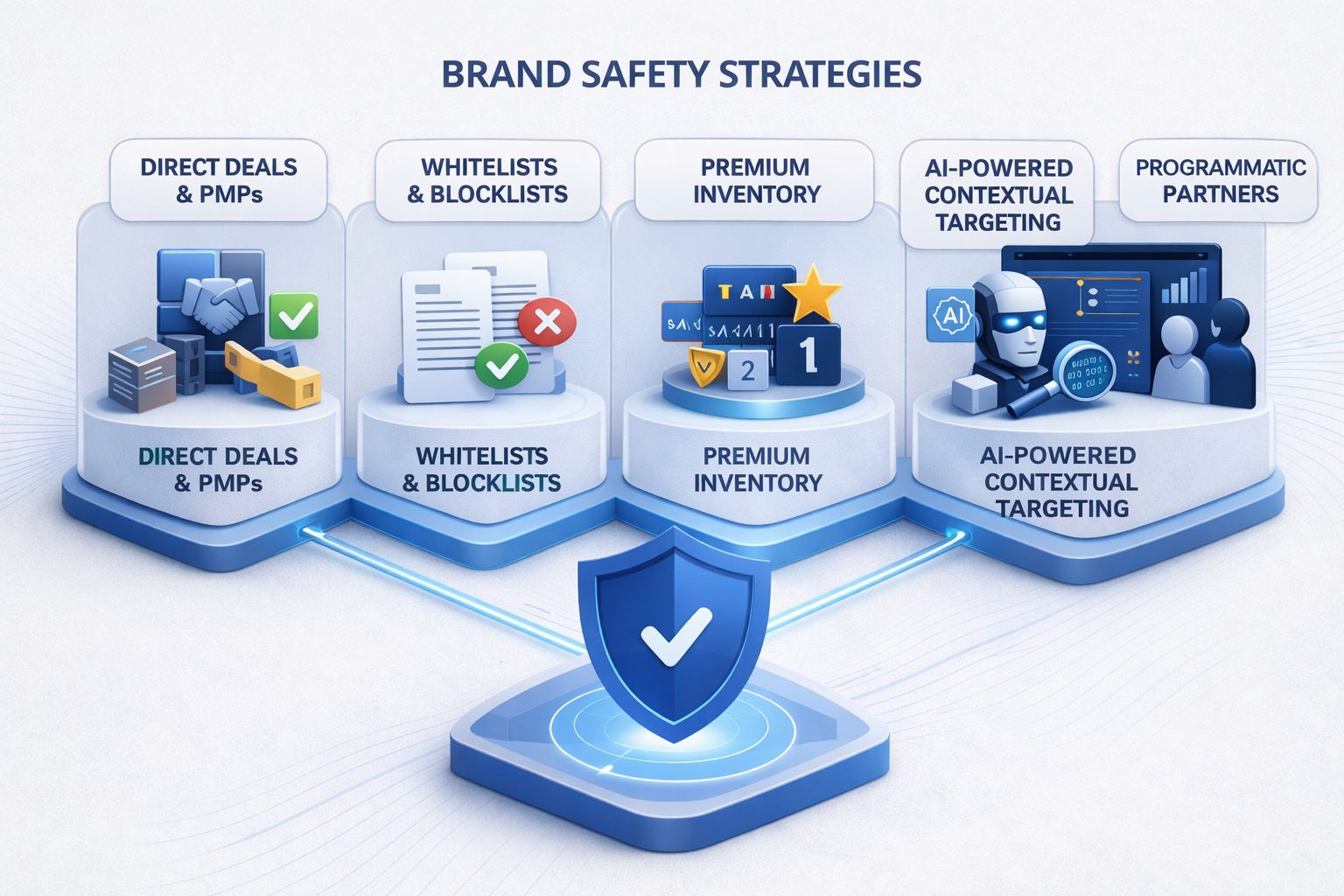
1. Direct Deals and Private Marketplaces
Direct deals and PMPs eliminate uncertainty because the buyer has more insight about the publisher, the inventory, and the transaction terms. They offer brands greater control over content placement and media sales and standards.
They’re not an absolute guarantee, but they do reduce exposure to low-quality long-tail supply. For regulated categories, brands that are hypersensitive in this area, or campaigns associated to hard compliance, this approach works well.
2. Whitelists, Blocklists, and Brand Suitability Rules
Whitelists and blocklists still matter because they give teams a clear first layer of control. The problem is that they age fast, and static lists can block too much or miss new risks. The stronger version of this strategy is to combine approved seller lists with dynamic brand safety in programmatic rules based on risk levels, not just keywords. That gives marketers better control over news, opinion, UGC, and sensitive topics that need nuance.
3. Premium Inventory and Supply Path Curation
Premium inventory is typically associated with more stringent editorial oversight, less fraud controls and reporting more predictable. In addition to that, supply-path curation adds another layer, as it eliminates the weak intermediaries whilst also narrowing down the path of buying to the routes that are trusted.
That being said, it does not remove all risk, but it can add transparency, minimize waste, and enable cleaner viewability standards and safety controls. It is particularly useful for brands seeking improved media quality, but not at the all-in direct deals level.
4. Contextual Targeting and AI-Powered Brand Safety Tools
This is one of the most important updates for 2026. Contextual targeting now does more than scan a few keywords. Modern systems analyze page meaning, sentiment, visual signals, audio, and risk level to decide whether an impression fits the brand.
IAS also notes that advanced machine learning is helping advertisers detect and classify multimedia content, including deepfakes and misinformation, which is why this strategy now sits at the center of many programmatic brand safety strategies.
5. Work With a Reputable Programmatic Partner
A strong programmatic partner will not eliminate every risk, but it can centralize controls and make them easier to manage. That includes safer supply setup, clearer policy execution, better fraud screening, more structured reporting, and tighter workflow between buying and verification. If you want more control over inventory and transaction logic, BidsCube’s white-label ad exchange is a useful starting point to review. You can also check public feedback on Clutch and G2.
| Strategy | Pros | Cons | Best For |
| Direct deals and PMPs | Better control, known sellers, stronger transparency | Higher cost, less scale | Sensitive brands, regulated sectors |
| Whitelists, blocklists, and suitability rules | Fast to apply, clear policy logic | Needs maintenance, can overblock | Brands with strict content rules |
| Premium inventory and supply-path curation | Cleaner supply, better quality, stronger trust | CPMs can rise | Quality-focused campaigns |
| Contextual targeting and AI-powered verification | More precise, adapts to page-level nuance, helps with deepfakes | Tool cost, setup effort, ongoing tuning | Large or always-on programmatic campaigns |
| Reputable programmatic partner | Centralized control, operational support, better reporting | Results depend on partner quality | Teams that need infrastructure plus execution support |
A practical next step is to audit how many controls you already use before the bid, during delivery, and after the campaign. Most weak setups do too much after the fact and not enough before the auction.
Conclusion
Brand safety in programmatic advertising has become a core media quality issue because risky content, fake traffic, deepfakes, and weak supply paths can all damage campaign performance and brand trust at the same time. The strongest response is not one rigid rule set, but a layered model that combines suitability policies, contextual targeting, fraud controls, cleaner supply, and reliable verification.
That is why the best programmatic brand safety strategies focus on both prevention and proof. If your team wants tighter control over placements, policies, and inventory quality, a better supply setup is usually the first place to start.
Our tech staff and AdOps are formed by the best AdTech and MarTech industry specialists with 10+ years of proven track record!

FAQ
What Is Brand Safety in Programmatic Advertising?
In programmatic advertising, brand safety means how to limit ads from appearing next to content that is harmful, misleading, or not appropriate, as well as reducing fraud and low-quality inventory. Simultaneously, it safeguards brand reputation, media efficiency, and campaign reporting.
Why Is Brand Safety Important in Digital Advertising?
Brand safety as unsafe placements can trust, waste spend, and cloud performance data. Brand safety challenges nowadays extend beyond unsafe content, misinformation, and deepfakes to include invalid traffic and low-quality supply paths, and today media quality has an impact on brand perception and ROI alike.
How Does an SSP Help With Brand Safety?
An SSP helps by filtering inventory, enforcing seller rules, limiting bad traffic, and improving supply transparency before impressions reach the auction. In practice, brand safety tools in programmatic work better when SSP controls are aligned with DSP filters, post-bid verification, and clear publisher standards.
What Are the Main Challenges of Brand Safety for Advertisers?
The main brand safety challenges for advertisers are risky news adjacency, AI-generated misinformation, deepfakes, ad fraud, and the trade-off between strict blocking and usable reach. Brand safety in programmatic is a type of layered safety that leverages contextual targeting, brand suitability rules and fraud controls to mitigate risk, without blocking excessive quantities of quality ad inventory.


