



TL;DR
- A lookalike audience is a new group of people who share traits with your best existing customers.
- It starts from a seed audience: buyers, leads, subscribers, or app installers.
- A DSP builds it in three stages: seed collection, signal matching, and tier segmentation.
- In programmatic, you upload your own data to the DSP. The model isn’t locked inside one platform.
- Marketing LTB reports lookalikes cut CPA by 20 to 50% compared to cold interest-based audiences.
- Without third-party cookies, first-party seeds like hashed emails and CRM lists matter more.
- Start with a narrow, clean seed. Prove it converts. Then widen.
Table of Contents
- What is a lookalike audience?
- How lookalike audiences are built: three stages
- Lookalike targeting vs other audience methods
- Why lookalike modeling is harder without third-party cookies
- How to set up a lookalike audience campaign: step-by-step
- Common lookalike audience mistakes
- Where lookalike targeting works best
- How BidsCube Can Help
- Summary
-
FAQs
- 1. What is a lookalike audience in programmatic advertising?
- 2. What is a seed audience?
- 3. How is a lookalike audience different from retargeting?
- 4. Does lookalike targeting still work without third-party cookies?
- 5. How big should a seed audience be?
- 6. Can a lookalike audience replace retargeting?
Every advertiser hits the same wall sooner or later. The warm audience runs out.
You’ve reached the people who bought, signed up, or clicked. Retargeting them again gives less and less. To grow, you need new people. But not just anyone. You want people who look like your best customers. That’s where lookalike audience targeting comes in. It’s one of the main ways to scale reach without losing relevance.
The difference is programmatic works a different way than Facebook or Google. There, the model lives inside a closed platform. In programmatic, the DSP builds the model from data you upload yourself. You own the seed. You can use it across the open web, apps, and CTV.
And it pays off. According to Marketing LTB’s Media Buying Statistics 2026, lookalike audiences deliver a 20 to 50% lower CPA on average than cold audiences built on interests.
What is a lookalike audience?
What is a lookalike audience? It’s a new audience a platform builds by finding people who share traits with a group you already have. You may also see it called an lal audience. Same thing, shorter name.
The group you start with is the seed audience. It’s your source of truth. That could be:
- people who bought in the last 90 days;
- qualified leads;
- newsletter subscribers;
- users who installed your app.
The platform studies the seed, finds the patterns, and then looks for strangers who match them. That process is called audience modeling. You can read a short definition in our lookalike modeling glossary.
How lookalike audiences are built: three stages
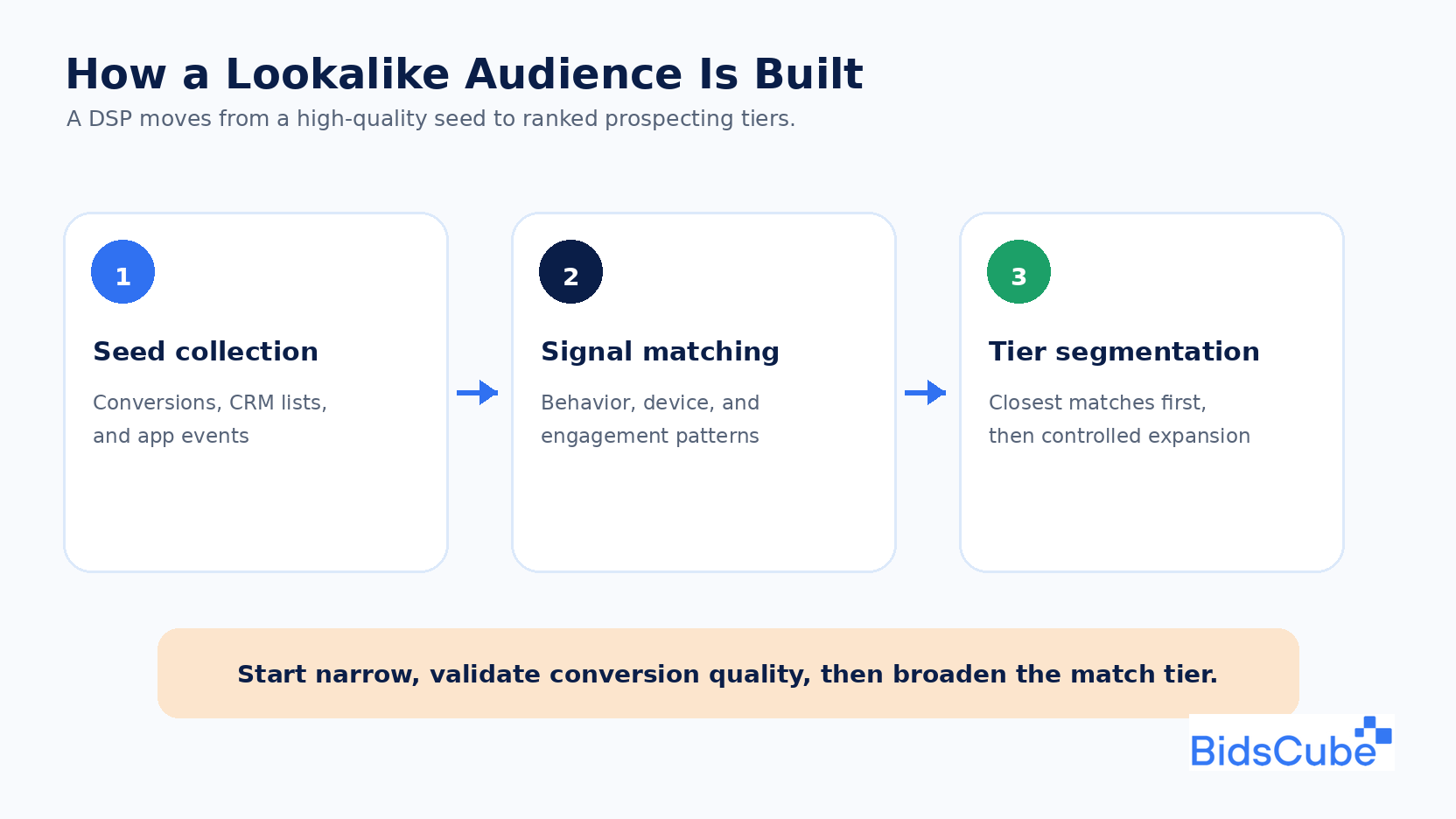
So, how does lookalike targeting work inside a DSP? It runs in three stages.
- Seed collection. First, the DSP gathers your seed. Data can come from a conversion pixel on your site, email lists, your CRM, or app-install events. A data management platform (DMP) can also feed segments in.
- Signal matching. The DSP then compares the seed too a broader user base that it sees on a daily basis. It examines the behavior, devices and engagement patterns.
- Tier segmentation. Finally, the DSP groups matches by how close they are. The top tier is a tight match with strong shared traits. Lower tiers are broader, with weaker signals. These are often called match tiers.
A tight tier gives you quality. A broad tier gives you scale. You pick the balance.
Lookalike targeting vs other audience methods
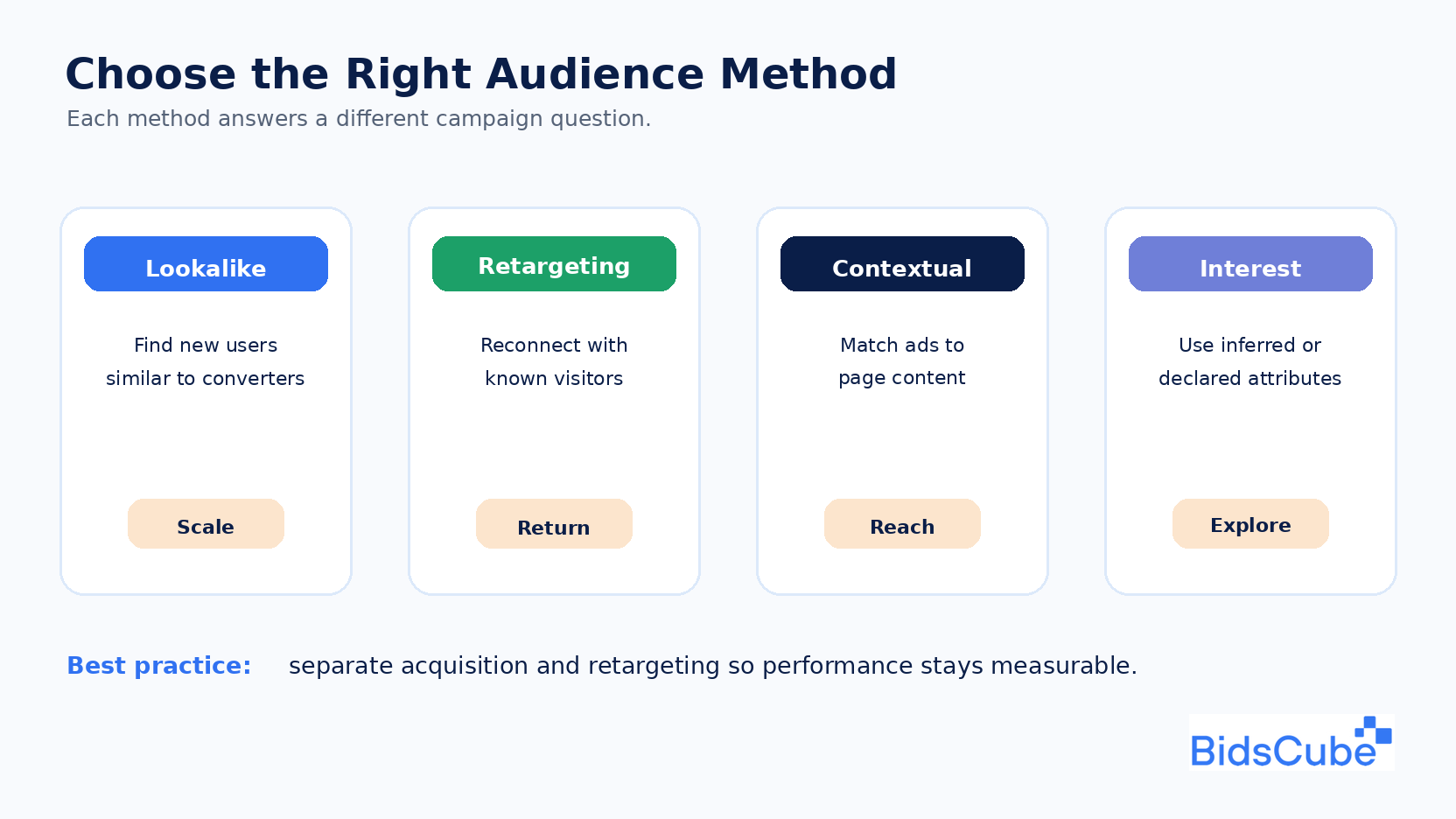
Lookalike audiences are one tool among several. Here’s how they compare:
| Method | Data basis | Best for |
|---|---|---|
| Lookalike | Shared traits with a seed audience | Scaling past your existing high-value group |
| Retargeting | Direct past interaction (a visit, a cart) | Bringing back people who already showed interest |
| Contextual | Page or content category, no user history | Privacy-safe reach and cold prospecting |
| Demographic / Interest | Stated or inferred user traits | Broad targeting by category |
Most strong campaigns mix them. Lookalikes find new people. Retargeting brings them back. Contextual fill some hole where IDs are missing.
Why lookalike modeling is harder without third-party cookies
A lookalike model is only as good as the DSP’s view of users. If the DSP can’t recognize people, it can’t match them. That’s the problem on the open web today. Safari and Firefox block third-party cookies. Cookie sync match rates were never high to begin with. When IDs drop, matches get fuzzier. Our guide on cookie syncing explains why.
The answer is better seed data. First-party data now carries most of the weight:
- Hashed emails. Encrypted email addresses from your customers.
- CRM lists. Customer records uploaded straight into the DSP, also called CRM matching.
- App and server-side events. Signals you collect yourself, with consent.
These IDs don’t depend on browser cookies. They give the model a cleaner starting point. Our article on 1st-party audiences covers how to build them. So does lookalike audience advertising still work in 2026? Yes. It simply relies on your data more heavily than ever before.
Have a strong customer list? Turn it into a lookalike audience with the BidsCube DSP and start reaching new buyers.
How to set up a lookalike audience campaign: step-by-step
Here’s a simple way to launch lookalike audience targeting programmatic campaigns:
- Pick a clean, specific seed. Use buyers from the last 90 days, not all site visitors. A sharp seed gives a sharp model.
- Make sure the seed is big enough. The model needs enough people to learn from. A few dozen users won’t cut it. Aim for at least a few thousand matched IDs where you can.
- Start with a narrow tier. Test the closest match tier first. Confirm it converts. Then expand to broader tiers.
- Add geo and device filters on their own. The model looks at behavior. It doesn’t care about location or device. Set those filters separately.
- Refresh the seed often. Customer behavior changes. Make sure you update your seed every month or two, just so that the model isn’t learning stale patterns.
That’s seed audience targeting in practice. Better input, better output.
Common lookalike audience mistakes
Three mistakes come up again and again.
- Seeding with all site traffic. Bots, bounces, and random visitors blur the signal. Use one clear conversion event instead.
- Starting with the broadest tier. It is easy to want to go wide for scale. If the broad tier fails, but you wouldn’t have known whether the seed or the tier failed. Prove it narrow first.
- Mixing lookalike and retargeting in one campaign. Now, if both run together, you are not able to identify which brings users. Break them out into new campaigns or line items.
Quick side note. Some teams expect lookalikes to work like magic on day one. They rarely do. A week or two of data is pretty much nothing; reserve your judgment about the model until then.
Where lookalike targeting works best
When it comes to lookalike audience targeting, you will hit the bullseye when there are clear actions to model. E-commerce and subscriptions.
- E-commerce and subscriptions. Purchases and registrations are a seed crystal, house. The model knows exactly what “good” looks like.
- App installs. Start with your first installers. Then scale to people who look like them.
- Lead generation. Build the seed from qualified leads, not every form fill. Junk leads teach the model the wrong lesson.
How BidsCube Can Help
The BidsCube DSP supports lookalike targeting built on your own first-party data.
- Upload your own segments. Bring hashed emails, CRM lists, or pixel audiences.
- Build lookalikes from your seed. The DSP finds new users who match your best customers.
- Control the reach. Choose tighter or broader match tiers.
- Layer filters. Add geo, device, and format targeting on top.
- Track results in real time. See CPA and conversions by tier.
Your campaigns can reach inventory across web, app, and CTV. Publishers connect that supply through the BidsCube SSP. BidsCube has 10+ years in programmatic and 230+ clients. Read their reviews on Clutch.
Summary
When your warm audience runs dry, similar audience groups help you grow without guessing. Garbage in, garbage out, so keep the seed clean and specific. As cookies dwindle, first-party data is your best input for lookalike modeling. Begin narrow, test, and widen once hold up.
Talk to BidsCube about building modeled audiences from your own data.
Our tech staff and AdOps are formed by the best AdTech and MarTech industry specialists with 10+ years of proven track record!

FAQs
1. What is a lookalike audience in programmatic advertising?
It’s a new audience the DSP builds from people who share traits with your seed audience. The above is a simple programmatic description.
2. What is a seed audience?
It’s the starting group the model learns from, like recent buyers or qualified leads. Good seed audience targeting stems from one single conversion action.
3. How is a lookalike audience different from retargeting?
Retargeting is an ad campaign that targets people who have interacted with you before. Lookalikes enable you to connect with new similar audiences. So what are lookalike audiences for? Forgeing outside of the circles you’ve already forged.
4. Does lookalike targeting still work without third-party cookies?
Yes, but it depends more on first party data e.g. hashed emails, CRM lists lookalike audience advertising now performs best when seeded with your own data.
5. How big should a seed audience be?
Big enough for the model to find patterns. Some started with a few thousand matched users. You can use smaller seeds, but tend to be less stable.
6. Can a lookalike audience replace retargeting?
No. They do different jobs. An lal audience finds new people. Retargeting brings back warm ones. If you’re asking how does lookalike targeting work next to retargeting, the answer is side by side, in separate campaigns. Most lookalike audience targeting programmatic plans run both. And if you’re still wondering what are lookalike audiences good for, think of them as your growth engine.
This Article's Ad Tech terms


