



- It is all about programmatic display, where buyers can reconfigure their bids, budgets, audiences and creative while a campaign is live.
- By using a DSP, you can gain access to inventory on thousands of different websites, applications, SSPs, and ad exchanges.
- Rather than paying one fixed price for a broad package of impressions, auction pricing enables advertisers to find the value of every impression.
- Check Level reports for viewability, quality delivery, brand safety, and wasted spend are supported at the impression level.
- This benefits publishers by providing demand diversity as multiple buyers can compete for the same inventory.
- Display can be dugester with video, native, CTV, audio, and mobile inventory with cross-channel buying.
- The outcomes rely on clean data, supply checks, clear measurement, and active campaign management.
Table of Contents
- 1. Real-Time Optimization and Granular Targeting
- 2. Access to Scale Across the Open Web
- 3. Cost Efficiency Through Auction-Based Pricing
- 4. Transparency and Reporting
- 5. Cross-Channel and Cross-Device Reach
- 6. Better Yield and Demand Diversity for Publishers
- 7. Automation That Reduces Manual Workload
- Key Benefits of Programmatic Display Advertising: Side of the Market
- Considerations to Balance Expectations
- How BidsCube Can Help
- Final Thoughts
-
FAQs
- What Are the Main Benefits of Programmatic Display Advertising?
- How Does Programmatic Display Advertising Benefit Publishers?
- Is Programmatic Display Advertising Cost-Effective for Small Budgets?
- How Does Real-Time Optimization Work in Programmatic Display?
- What Reporting Data Do Programmatic Display Platforms Provide?
- Can Programmatic Display Ads Reach Multiple Devices and Channels?
Programmatic display is no longer an experimental buying model. It has become a standard way to buy and sell visual inventory across websites and apps. That is why benefits of programmatic display ads is a hot topic now.
This change occurred because automated trading addresses well-defined problems for both sides of the market. Advertisers require reach, targeting, price control & quicker decisions. Publishers could use more demand, higher yield, and less repeatable toil..
The IAB Internet Advertising Revenue Report for 2025 shows the scale of this market. U.S. display advertising generated $81.6 billion, up 9.8% year over year, and represented 27.7% of total digital advertising revenue. Total digital ad revenue reached $294.6 billion, an increase of 13.9%.
This article explains how automated display creates measurable value for buyers and sellers. It also covers the limits teams must consider before they treat every platform report as proof of success.
1. Real-Time Optimization and Granular Targeting
And unlike traditional media deals, which can tie up prices, placements, audiences, and creatives for the entirety of a campaign. With programmatic buying, teams can still make many of those adjustments, but as delivery is happening.
A DSP can adjust bids based on the location, device, browser, content category, audience segment, time, frequency, and creative version. Weak placements can also be paused, or budget can be moved between campaign lines, without having to create a new insertion order.
This speed is one of the main programmatic display ads advantages for advertisers. This means that instead of waiting for a report at the end of the week or month, decisions can be based on today or even current performance.
Granular targeting also restricts the general expenditure towards individuals who barely relate to the current proposal. A campaign could use a mixture of first-party audiences, contextual categories, retargeting groups, geographic parameters and device filters.
Real-time changes still need limits. Teams have to determine what actions will be invoked by metrics, execution size, and test length.
See the Buying Controls
Review the BidsCube DSP for real-time bidding, targeting, retargeting, bidstream data, filtering, and campaign reporting.
2. Access to Scale Across the Open Web
A direct display plan requires advertisers to contact publishers, negotiate terms, approve placements, and manage separate reports. This becomes difficult across hundreds of properties.
Programmatic buying connects the advertiser with many supply sources through one DSP account. The DSP is connected to a wide variety of sites and apps via any number of SSP, ad exchanges, private marketplace deals, or other approved connections. Buyers maintain an ability to apply allowlists, blocklists, contextual rules, geographic filters, and quality thresholds.
The practical gain is reach without a separate negotiation for every placement. Publishers receive the same benefit in reverse. An SSP can make their inventory available to many DSPs and buyers without a separate manual sales process for each campaign.
This open-web access also lets advertisers compare publisher groups, supply paths, formats, and pricing models. For a wider view of connected trading, read How Programmatic Ecosystems Benefit the Advertising Market.
3. Cost Efficiency Through Auction-Based Pricing
Programmatic display often uses real-time bidding. Buyers evaluate an individual impression and submit a price within the auction window.
The price depends on auction rules, competition, floor prices, inventory quality, and buyer value. This differs from a fixed rate across many placements.
A buyer may bid more for a high-viewability impression shown to a target customer. The same buyer may bid less, or not bid, when the user, context, or device does not fit the campaign.
Smaller budgets can be supported by auction access. An organization may start small, test multiple segments, and increase spending after it has identified a repeatable result.
Cost efficiency does not mean chasing the lowest CPM. Cheap inventory can bring weak attention, invalid traffic, or poor conversion quality. Buyers should compare cost with the business goal.
Publishers gain when several eligible buyers value the same impression. Competition improves the clearing price for scarce audiences, the best content, and the highest quality placements. Programmatic display ads benefits their full potential when teams looking at the cost per qualified visit, lead, sale, or revenue outcome, as opposed to CPM only.
Learn the trading basics. Read Programmatic Advertising 101 for the roles of DSPs, SSPs, exchanges, auctions, and inventory rules.
4. Transparency and Reporting
Programmatic platforms can provide detailed information about campaign and inventory performance. The available detail depends on the vendor, integration, reporting settings, and contract.
Advertiser reports may include:
- Domain or app
- Placement and ad size
- Bid, win, and clearing price
- Device and geography
- Frequency and viewability
- Conversion events
- Brand safety or fraud flags
This detail lets buyers remove one weak app, lower bids for a placement type, or separate mobile web results from in-app results.
Publishers can review bid rate, win rate, fill, CPM, RPM, demand partner activity, and revenue by inventory segment. The top programmatic metrics help teams compare price floors, formats, traffic sources, and demand connections.
Transparency needs more than dashboard totals. Teams need consistent definitions, known fees, exportable data, and reconciliation rules.
BidsCube lists real-time data, filtering, bidstream access, and an issues inspector within its DSP. Its SSP provides reports on ad performance and revenue metrics. Its White Label AdExchange lists real-time reports and bidstream access.
5. Cross-Channel and Cross-Device Reach
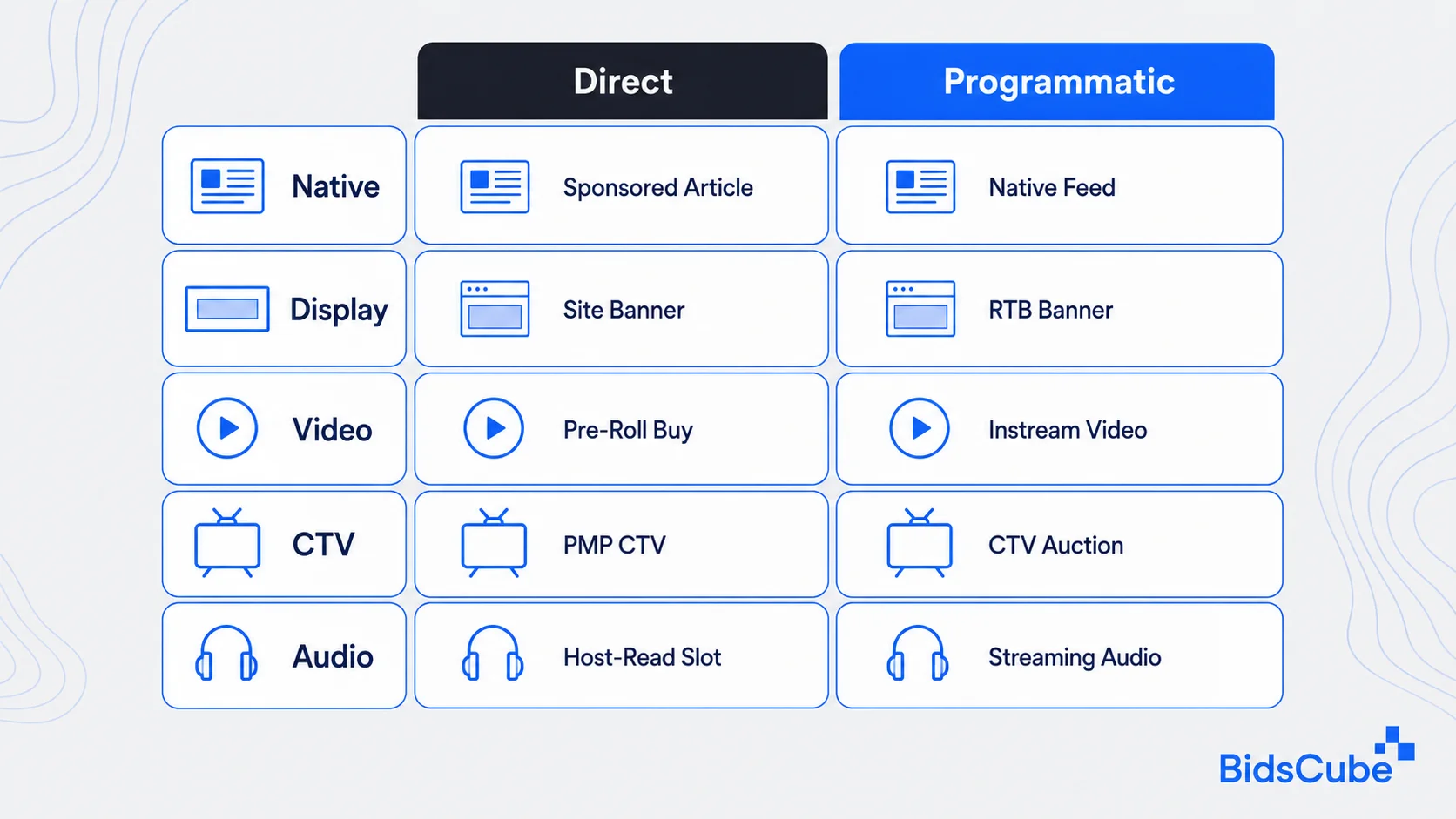
Programmatic buying can connect several formats inside one media plan. For example, the same campaign could use display for scale, native for in-feed discovery, video for product consideration, CTV for living room awareness, and audio for attention-scarce moments.
All environments need appropriate creative, dimensions, pacing and CTAs. The main gain is coordinated reach. Teams can keep one campaign theme while changing the message for the device and stage of the customer journey.
Supported identity signals may also help with frequency and sequence across several contacts. Privacy rules and signal loss limit exact cross-device matching. Teams should not claim person-level certainty when the data does not support it.
Publishers with several inventory types can reach more buyer budgets. Display can also support a wider media plan with video, native, CTV, and audio.
6. Better Yield and Demand Diversity for Publishers
A publisher that depends on one buyer or network has limited price competition. Programmatic selling can invite bids from several DSPs, agencies, brands, and trading partners for each eligible impression. Buyers value location, content, device, time, and audiences differently.
An SSP helps the publisher manage demand connections, price floors, formats, inventory rules, reports, and quality controls. Header bidding and other auction setups can bring several sources into competition before the final ad-server decision.
Publishers should measure more than gross CPM. A partner can show a high bid but add little net revenue because of low win rates, timeouts, fees, discrepancies, or weak fill.
Useful publisher metrics include:
- Net CPM and RPM
- Bid density and fill rate
- Viewability and page latency
- Revenue per session
- Demand concentration
- Discrepancy rate
Demand diversity also reduces dependence on one commercial relationship, but each connection must add new demand rather than another path to the same buyer.
Check publisher yield. Review the BidsCube SSP and the Publisher Checklist for Boosting Programmatic Revenue.
7. Automation That Reduces Manual Workload
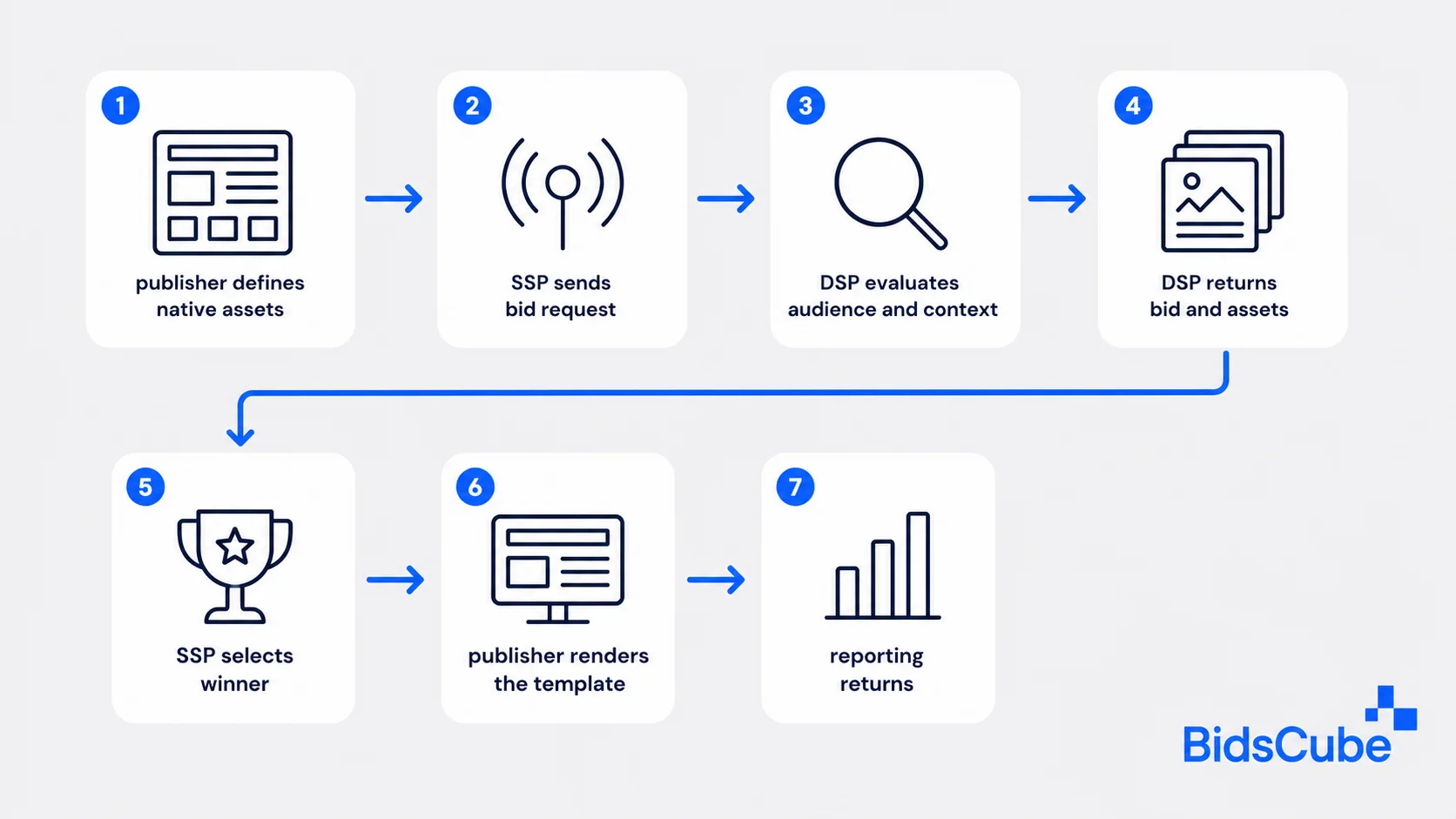
Direct buying is a chore of emails to get contracts, insertion orders, creative approvals, the tasks of setting up a placement, pacing checks, reports, invoices and paying them down.
Programmatic platforms automate much of the transaction. The auction selects an eligible ad. Campaign rules manage bids and budgets. Reporting systems record delivery, while platform workflows support billing and account management.
Advertisers can reuse campaign structures and reports. Publishers can manage demand and inventory through one system.
Automation does not remove human responsibility. Teams still need to check tracking, creative quality, supply paths, privacy requirements, financial discrepancies, and unusual performance.
Automation should move teams from repetitive auction tasks toward strategy, quality review, data interpretation, and partner selection.
Programmatic display ads advantages appear when software handles high-volume transactions, while people set the rules and investigate exceptions.
Key Benefits of Programmatic Display Advertising: Side of the Market
The seven advantages affect advertisers and publishers in different ways.
| Benefit | For Advertisers | For Publishers |
| Real-time optimization | Adjust bids, budgets, audiences, and creative | Adjust floors, demand paths, and inventory rules |
| Open-web scale | Reach many sites and apps through one platform | Connect inventory with many buyers |
| Auction pricing | Value each impression against the campaign goal | Create price competition |
| Transparency | Review placement, cost, quality, and conversions | Review bids, revenue, fill, and partner activity |
| Cross-channel reach | Coordinate formats and devices | Sell more inventory types |
| Demand diversity | Compare several supply paths | Reduce dependence on one buyer |
| Automation | Reduce setup and reporting work | Reduce manual trafficking and billing work |
The programmatic display ads benefits go beyond cheap media. Advertisers gain control and reach, while publishers gain auction competition and operating tools.
Considerations to Balance Expectations
The advantages of programmatic display advertising do not remove risk. Open inventory can include invalid traffic, unsuitable content, weak placements, or misleading apps and domains.
Advertisers need supply checks, allowlists, viewability thresholds, fraud detection, and brand safety controls. Publishers should scan creatives, review demand partners, and investigate unusual activity.
Transparency also varies by vendor. Some platforms provide domain, app, auction, and bidstream detail. Others offer aggregated reports or limit raw-data access.
Teams should confirm which fees appear in reports, how viewability and invalid traffic are measured, which partners can resell inventory, and how discrepancies are handled.
The second set of advantages of programmatic display advertising appears only when teams can verify the platform data. Automation can repeat a poor setup just as quickly as a good one.
How BidsCube Can Help
BidsCube provides connected products for advertisers, publishers, agencies, ad networks, and platform operators.
- The BidsCube DSP supports real-time bidding across sites and apps. Its current product page lists real-time data, filtering, bidstream access, issue inspection, targeting, retargeting, location controls, and user-segment options.
- Advertisers can use these tools to manage bids, audiences, budgets, placements, and performance reviews. The BidsCube advertiser solution also covers inventory quality, campaign controls, and reporting.
- The BidsCube SSP supports publisher inventory management, real-time bidding, reports, and white-label configuration. The publisher solution also covers demand access, inventory control, and monetization workflows.
- The BidsCube White Label AdExchange connects supply and demand through oRTB and VAST workflows. Its product page lists real-time reports, bidstream access, a global block list, user sync, troubleshooting tools, and support for banner, video, native, audio, CTV, desktop, and mobile inventory.
Combined with above, they address auction buying, multi-partner access, live data, various formats, quality controls, yield management & automation.
Teams can also review BidsCube on Clutch during vendor checks.
Final Thoughts
Automated display is valuable when teams apply it to drive scale decisions better. Buyers can value impressions, adjust campaigns, and review delivery while campaigns run. Publishers can invite more demand, manage yield, and reduce repetitive sales work.
Results become measurable when both sides use clear quality rules, consistent reports, and business metrics. Use BidsCube to connect buying, selling, and marketplace workflows. Contact us for more detailed information.
Our tech staff and AdOps are formed by the best AdTech and MarTech industry specialists with 10+ years of proven track record!

FAQs
What Are the Main Benefits of Programmatic Display Advertising?
The key benefits of programmatic display advertising include real-time control, granular targeting, open-web reach, auction pricing, detailed reporting, cross-channel delivery, publisher demand competition, and less manual work. Results still depend on inventory quality, data accuracy, measurement, and platform transparency.
How Does Programmatic Display Advertising Benefit Publishers?
Programmatic display enables publishers to connect an inventory with multiple buyers and demand platforms. Less competition can lead to improved yield, while real-time reports keep publishers informed about their CPM, RPM, fill, viewability, and partner performance.
Is Programmatic Display Advertising Cost-Effective for Small Budgets?
Since open auctions need not have minimum commitments as part of direct deals, programmatic display is open to smaller budgets. Small advertisers need to keep the tighter objectives, iso targeting, frequency cap and learn conversion tracking
How Does Real-Time Optimization Work in Programmatic Display?
You receive live campaign data and apply decisions to bids, budgets, audiences, placements and creative delivery. Then, based on cost, reach, engagement, conversions, viewability, or other campaign metrics, media buyers can approve or tweak.
What Reporting Data Do Programmatic Display Platforms Provide?
Reporting can include impressions, spend, bids, wins, CPM, domain, app, placement, device, geography, frequency, viewability, clicks, conversions, and brand safety signals. Available detail depends on the platform, supply partners, integrations, and data-access agreement.
Can Programmatic Display Ads Reach Multiple Devices and Channels?
Programmatic campaigns can reach desktop, mobile web, apps, CTV, and other connected environments when the chosen platforms and partners support them. Teams can also combine display with video, native, audio, and other formats under one media strategy.


