



- Curation packages selected inventory with data signals before buyers bid.
- A curator sits between publishers and advertisers to build curated deals.
- Curated packages usually reach buyers through a deal ID.
- Curation can use first-party data, contextual targeting, supply quality filters, and brand safety rules.
- Publishers can raise inventory value without sending raw user data to buyers.
- Advertisers can reduce waste, improve viewability, and buy cleaner supply paths.
- Privacy-safe programmatic curation matters more as third-party cookies and user-level signals become less reliable.
Table of Contents
Open RTB gave advertisers scale. It also gave them a lot of noise.
Buyers now deal with duplicated auctions, weak placement quality, long supply paths, and inventory that looks cheap until waste shows up in the report. Publishers face their own version of the problem. They want better CPMs, but they do not always want to hand full control of their audience data to outside buyers.
For companies that need control over trading rules, demand access, and reporting, BidsCube provides AdTech infrastructure for sell-side, buy-side, and marketplace workflows.
That is why curation has become one of the most useful topics in programmatic advertising. IAB Australia describes curation as a tactic where sellers use SSP capabilities to select and group premium, brand safe ad inventory, then enrich it with audience data and better setup before buyers receive it through DSPs.
Google’s Privacy Sandbox guidance also reminds site owners that third-party cookies may be blocked by browser rules, user settings, flags, or enterprise policy. That means buyers and sellers still need plans that work when cookie signals do not show up.
Our experts at BidsCube note that the curation works because it moves quality control earlier in the buying path. Buyers stop sorting through the whole open market, and publishers get a cleaner way to sell value.
What Is Programmatic Curation?
It is the process of selecting, filtering, enriching, and packaging ad inventory before it reaches the buyer’s DSP. The package can include publisher supply, audience signals, contextual signals, brand safety rules, and supply path controls.
A curator builds that package. The curator can be an SSP, data company, publisher group, agency, retail media network, or AdTech partner. The curator does not simply resell impressions. The curator adds a layer of judgment, data, and control.
In plain English, the curator says: “Here is a group of impressions that fit this buyer’s goal better than the open exchange.”
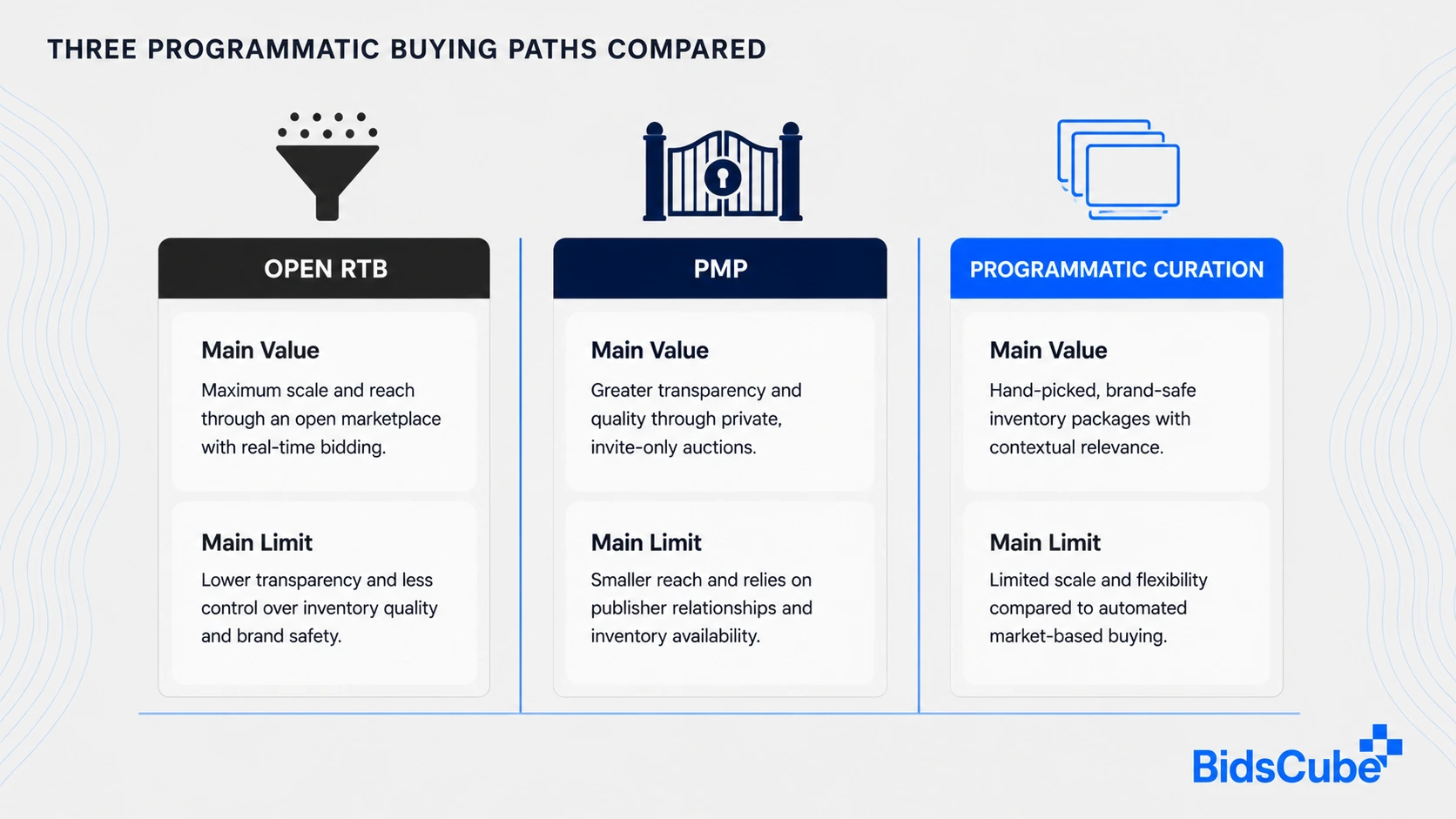
That makes curation programmatic different from a broad open auction. In open RTB, many buyers can bid on many available impressions. In curation, selected inventory is grouped into a clearer deal, often with stronger rules.
| Buying Method | How It Works | Main Value | Main Limit |
| Open RTB | Inventory enters an open auction through exchanges or SSPs. | Broad reach and fast access. | More noise, longer supply paths, and weaker control. |
| PMP | A publisher offers private access to selected buyers. | More control than open auction. | Often tied to one seller or a narrow deal setup. |
| Programmatic deal curation | A curator packages inventory with audience, context, quality, or supply path rules. | Cleaner buying path with added data and quality logic. | Depends on curator quality and clear deal setup. |
IAB Australia also says curation brings targeting closer to supply, increasing reach for buyers and control and transparency for publishers.
The takeaway is simple. Curation is not just a prettier PMP. It is a way to add data and quality control before the buyer spends.
How Curated Media Buying Works: Step by Step
Curation sounds abstract until you look at the path from publisher supply to advertiser bid. The flow is not hard. The curator sits near the supply side and packages what the buyer should see.
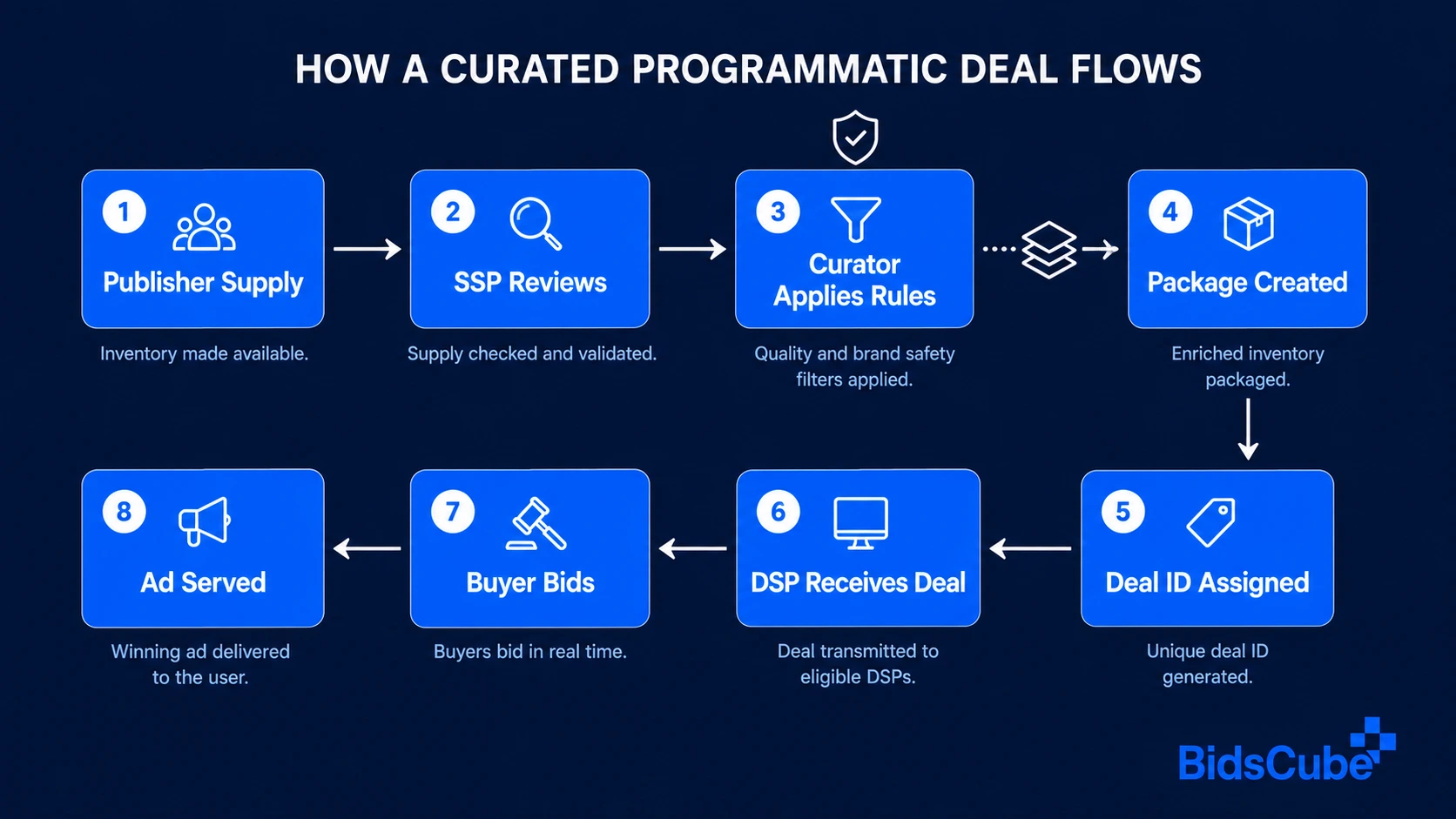
A basic curated deal works like this:
- Publisher provides inventory through an SSP.
- Curator reviews inventory, rules, and available signals.
- Curator applies first-party data, contextual targeting, quality filters, or brand safety rules.
- Curated package is created.
- Package is assigned to a deal ID.
- DSP receives the deal and evaluates impressions.
- Buyer bids through the DSP.
- Ad is served if the bid wins and matches the deal rules.
First-party data plays a major role. A publisher may know which users read finance content every week, which users follow travel guides, or which users return to product reviews before buying. That data can make inventory more valuable without exposing raw user records.
Contextual targeting also matters. A curator can group supply around topics, page types, sentiment, content categories, or live events. This helps when audience IDs are weak or unavailable.
The deal ID is the technical bridge. IAB UK defines a deal ID as a unique identifier that lets buyers access specific inventory packages or curated marketplaces through programmatic buying.
According to our experts, the deal ID is where many curated campaigns succeed or fail. If the setup is clear, buyers understand what they are buying. If the setup is messy, the deal becomes another black box with a better name.
Types of Programmatic Deal Curation
Not all curated deals solve the same problem. Some focus on audience quality. Some focus on content. Others focus on safe supply paths and lower ad tech tax.
The main types include:
| Type | What It Does | Typical Use Case |
| Audience curation | Selects inventory based on audience data. | Reaching high-intent users, loyal readers, or category buyers. |
| Contextual curation | Selects inventory based on content topic, page meaning, or environment. | Buying around finance, sports, travel, health, or B2B themes. |
| Quality and brand safety curation | Filters inventory by quality, fraud risk, page type, or brand safety rules. | Protecting brand reputation and reducing low-quality supply. |
| Supply-path curation | Shortens the buying path and reduces duplicated supply. | Cutting hop count, fees, and unclear reseller paths. |
Audience curation works well when the publisher or data partner has strong first-party data. It lets buyers reach better segments without relying only on third-party cookies.
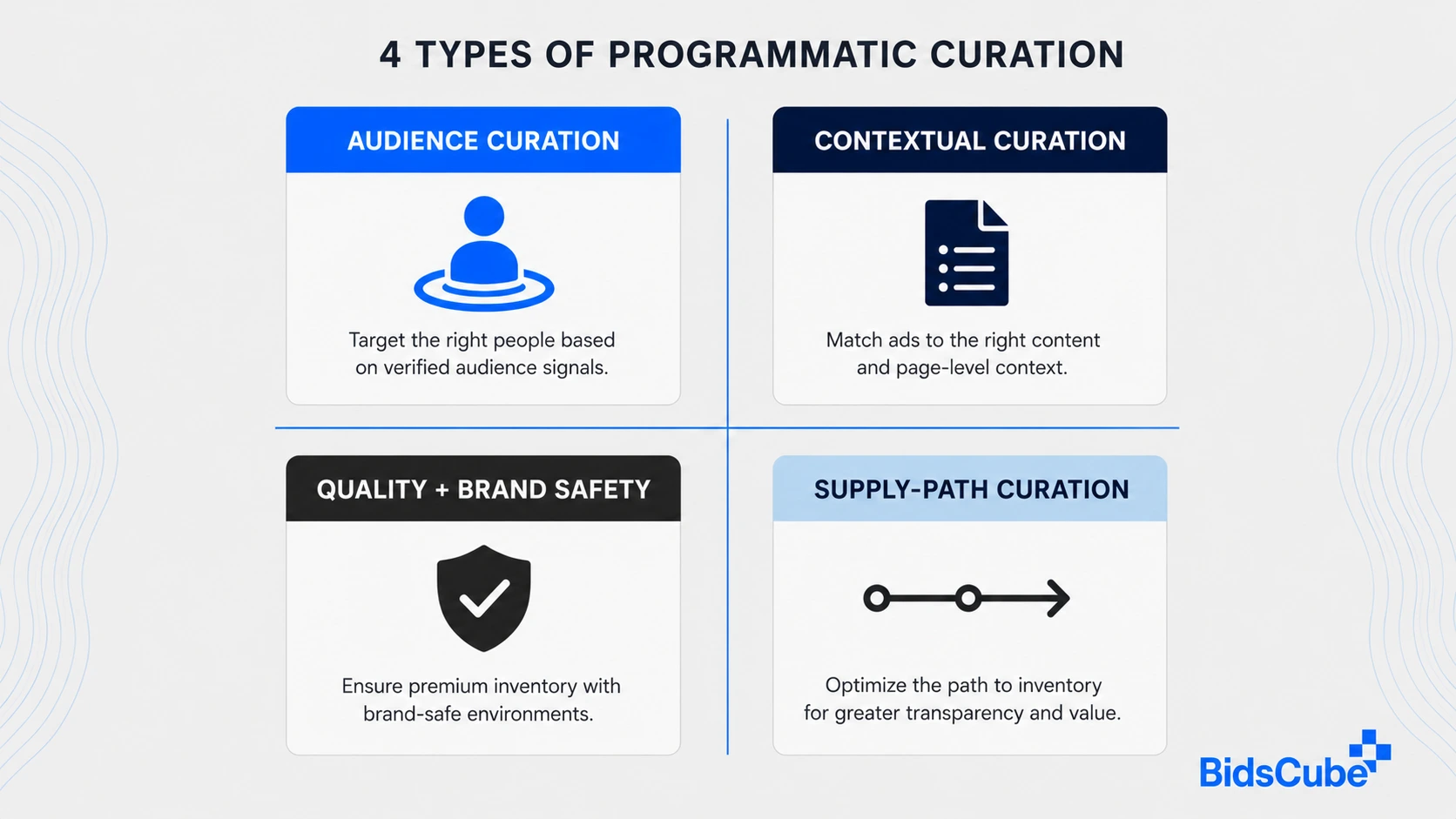
Contextual curation works well in cookieless settings. It lets buyers use content meaning and page context instead of user tracking.
Quality and brand safety curation works well for advertisers that cannot risk poor placements. The curator can block weak domains, unsafe content, suspicious apps, and poor viewability.
Supply-path curation, often called SPC, focuses on the route itself. It helps buyers reduce unnecessary hops, hidden fees, and repeated access to the same impression.
The best curated setup often mixes two or more types. A CPG brand may want grocery content, family audiences, known publishers, and a shorter supply path optimization in one deal.
Privacy-Safe Programmatic Curation
Privacy-safe programmatic deal curation is gaining attention because many teams need targeting that does not depend on old cross-site tracking. The idea is simple: target through approved packages, clean context, publisher data, and deal rules instead of passing raw user data across the market.
This does not mean every curated deal is automatically compliant. GDPR and CCPA still require lawful data collection, consent where required, clear purposes, and safe handling. But curated deals can reduce data exposure when the publisher or curator keeps sensitive data inside controlled systems.
Key privacy points:
- Less raw data movement: Buyers can access a curated audience package without receiving personal user records.
- Stronger use of context: Contextual targeting can group inventory by topic, not identity.
- First-party data stays closer to the owner: Publishers can sell audience value while keeping direct control of data.
- Cleaner consent logic: Curated packages can follow consent rules set by publishers, SSPs, and approved partners.
According to our experts, privacy-safe does not mean “no data.” It means the data has a clear source, purpose, permission path, and use case.
That is why privacy-safe programmatic deal curation works well with first-party data plans. It gives publishers a way to turn trust into media value without spraying user data across the bidstream.
Benefits of Curated Media Buying for Publishers
Publishers need more than fill rate. They need control, higher value, and a way to sell their audience without giving away the business.
- Curated deals can raise CPM. The curator adds value through audience data, context, quality checks, or supply path rules. Buyers may pay more for inventory that carries stronger signals.
- Publishers get better control over who buys their inventory. Instead of letting every buyer enter through open RTB, curated deals can limit access to approved demand.
- Curation can improve supply path transparency. Fewer hops make it easier to see where the money goes.
- Publishers can monetise first-party data without handing raw data directly to advertisers. This protects audience trust and business value.
- Curation can support privacy duties. When data stays closer to the publisher or approved curator, the publisher can apply stronger controls.
- Curation can improve advertiser relationships. A publisher that sells clearer packages can have better renewal conversations with buyers.
For publishers building this model, BidsCube SSP can support monetization workflows, inventory controls, and demand connections.
The publisher takeaway is clear. Curation turns inventory into a product, not just an impression stream.
Benefits of Curated Programmatic Deals for Advertisers
Advertisers want scale, but not at any cost. Wasted impressions, low viewability, unsafe placements, and hidden fees can make open-market buying look better than it is.
Curation helps buyers in several ways.
First, advertisers get access to higher-quality inventory. The curator removes poor supply before the campaign spends.
Second, targeting can improve without full dependence on third-party cookies. Curated deals can use first-party data, contextual targeting, and quality signals.
Third, brand safety improves because the curator applies rules before the bid. This is better than only reacting after bad placements appear.
Fourth, the supply path can get shorter. Fewer intermediaries can lower ad tech tax and reduce unclear fees.
Fifth, viewability and CTR can improve when inventory is selected for quality and context. The buyer starts with a cleaner pool.
Sixth, campaign setup becomes easier for teams that do not want to build every publisher, data, and inventory rule from zero.
For buy-side teams, BidsCube DSP can support campaign activation, targeting logic, and reporting across programmatic supply. Advertisers can also use guides like BidsCube’s article on programmatic metrics to connect curated deals with performance checks.
The advertiser takeaway: curation helps buyers spend less time filtering junk and more time testing strategy.
How BidsCube Can Help
Curated media depends on clean paths between sellers, buyers, data, and deal rules. That is where infrastructure matters.
- BidsCube White-Label AdExchange can support companies that want their own marketplace layer for supply and demand connections.
- BidsCube SSP can support publisher monetization, inventory control, and demand access.
- BidsCube DSP can support buyer-side campaign activation and reporting.
For vendor review, teams can also check BidsCube on Clutch as part of due diligence.
Curation is useful when it makes the buying path clearer, not just more expensive. The best curated deals explain the inventory, the signal, the buyer value, and the rules behind access. When those pieces line up, publishers can sell quality, and advertisers can cut waste.
Roman Vasyukov, CEO and Founder, BidsCube.
According to our experts, the next stage of curated media will depend on better deal setup. IAB Tech Lab released a Deals API specification for public comment in late 2025 to improve how SSPs and DSPs sync deals, reduce manual entry errors, and increase transparency for sellers, packagers, and curators.
Final Remarks
Programmatic curation matters because open buying alone cannot solve every quality, privacy, and supply path problem. Curation gives publishers a way to package inventory with data and control. It gives advertisers a cleaner path to vetted supply and useful signals. The real value comes when the curator adds clear rules, not just another layer.
As programmatic buying moves further into cookieless, privacy-aware, and deal-based models, curation will likely become part of the standard media plan. The winners will be the teams that can explain what is inside the deal, why it is valuable, and how it performs. Need support building curated deals, private marketplaces, or cleaner programmatic paths? Contact us to talk with BidsCube.
Our tech staff and AdOps are formed by the best AdTech and MarTech industry specialists with 10+ years of proven track record!

FAQs
What Is Programmatic Curation?
It is the process of packaging selected ad inventory with data, context, quality rules, or supply path controls before buyers access it through a DSP.
What Is Privacy-Safe Programmatic Curation?
Privacy-safe programmatic deal curation uses first-party data, contextual targeting, and controlled deal setup to reduce dependence on third-party cookies. The model can limit raw user data sharing when the publisher or curator keeps data inside approved systems.
How Does Curation Programmatic Work?
Curated programmatic buying works when publishers provide inventory, a curator applies audience or quality rules, a deal ID is created, and buyers bid through a DSP. The deal ID connects the curated package to the buyer’s campaign setup.
What Is the Difference Between Programmatic Deal Curation and PMP?
A PMP usually gives selected buyers private access to publisher inventory. Programmatic deal curation can go further by combining inventory with data, context, supply path rules, and quality logic across one or more sellers.
Who Is a Curator in Programmatic Advertising?
A curator is the party that selects, filters, packages, and enriches inventory before it reaches buyers. The curator can be an SSP, publisher group, data company, agency, or AdTech partner.
What Are the Main Types of Programmatic Deal Curation?
The main types of programmatic deal curation are audience curation, contextual curation, quality or brand safety curation, and supply-path curation. Each type solves a different problem in programmatic buying.


