



Most people enter the programmatic space through only one door. A publisher looks at yield. An advertiser looks at buying tools. An agency looks at media execution. That is why the terms get mixed up fast. So the stack provides 3 core layers, where each layer is responsible for managing a different piece of the deal. All of that and more will marry together to help you make effective decisions, but missing that can lead you into the wrong tool, reading performance data the wrong way, disconnecting pricing, inventory or demand access.
Table of Contents
- What Is a DSP (Demand-Side Platform)?
- What Is an SSP (Supply-Side Platform)?
- What Is an Ad Exchange?
- Reddit Case: Industry Discussion on DSP, SSP, and Exchange Roles
- DSP vs SSP vs Ad Exchange: Full Comparison
- How DSP, SSP, and Ad Exchange Work Together
- How BidsCube Powers All Three Layers
- Conclusion
- FAQ
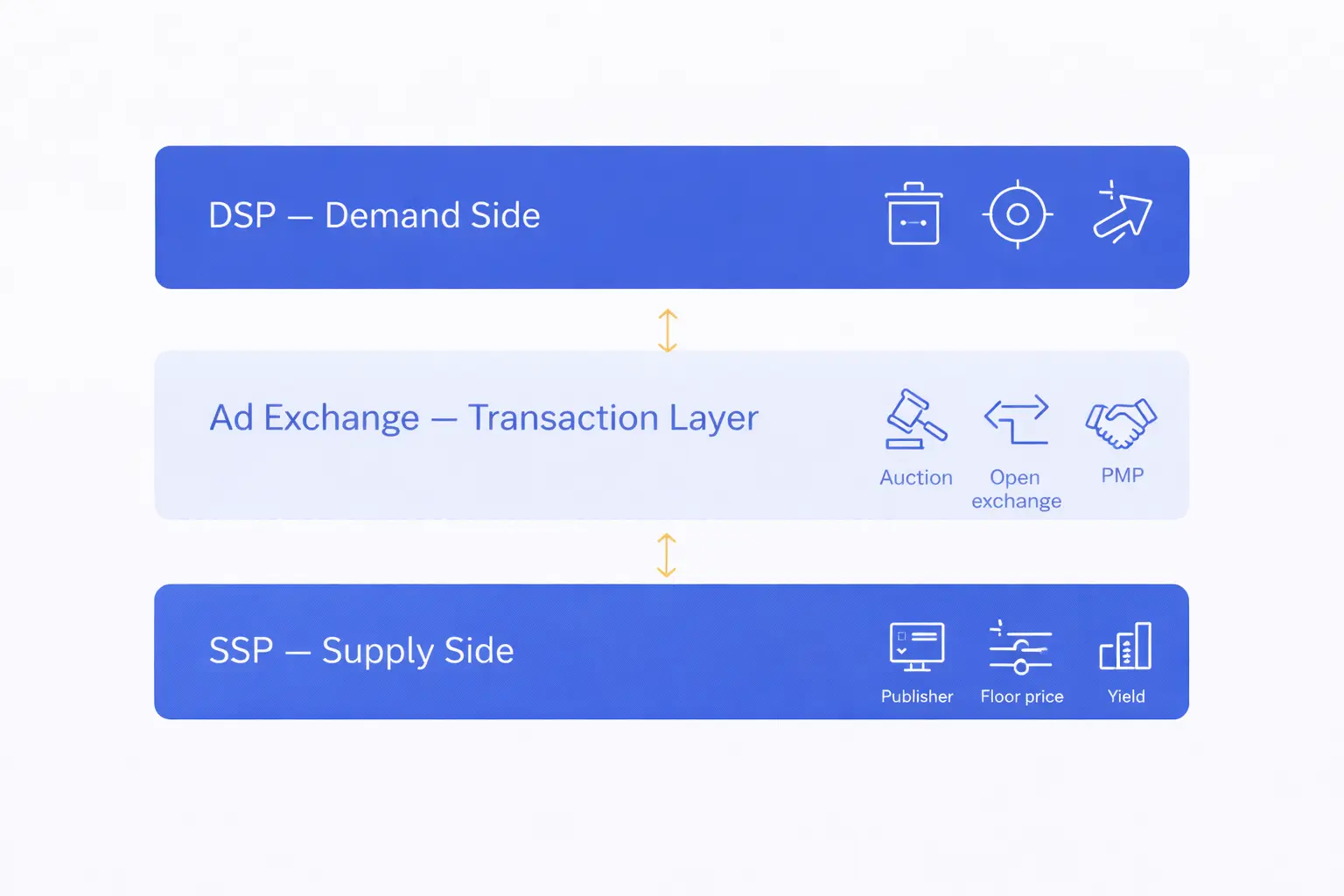
On a fundamental level, a DSP is for buyers, SSP for publishers and an Ad Exchange is where the two sides conduct their auctions. That is the skeletal architecture for DSP, SSP and Ad Exhange, its also the easiest way to explain it without drowning another brain in jargon. When teams talk about Ad Exchange vs DSP vs SSP, they are usually trying to map one problem to one layer of the stack.
What Is a DSP (Demand-Side Platform)?
Demand side platform (DSP) are computer programs that allow advertisers to purchase digital advertising inventory from publishers, SSPs, and exchanges. Amazon Ads describes DSP as technology that automates buying digital advertising in real time across publishers, SSPs, and exchanges, with controls for audience, placement and price.
DSPs are used by advertisers, agencies, and trading desks. They look at the bid opportunities, compare them with targeting rules and budgets and decides whether it bids out or not? Amazon added that DSPs are using RTB to purchase impressions in milliseconds. That effectively means the DSP is not on the publisher page itself.
This matters because many people asking about DSP, SSP, and Ad Exchange think the DSP is just a place to upload a campaign. It is more than that. A DSP helps buyers apply strategy at scale. It controls audience targeting, bid logic, pacing, and reporting. That is one part of the DSP, SSP and Ad Exchange picture that advertisers usually understand first.
What Is an SSP (Supply-Side Platform)?
An supply side platform is software that helps publishers manage and sell their inventory. Amazon Ads defines an SSP as programmatic software for publishers that facilitates the sale of impressions by connecting publishers to multiple exchanges, DSPs, and ad networks at once. That is why the SSP is the main sell-side operating layer.
The SSP handles core publisher controls such as floor prices, yield optimization, demand partner access, and ad delivery logic. Amazon also points to supply path optimization as a core SSP function. It says SSPs help publishers find the right demand sources based on latency, unique demand, bid rates, and available ad space. It also highlights analytics and ad inventory management as key parts of the platform.
This is where many publisher-side questions about SSP vs DSP vs Ad Exchange begin. A publisher does not need a DSP to manage inventory. A publisher usually needs an SSP to route demand, manage rules, and improve yield. Buyers optimize media spend. Publishers optimize inventory value.
What Is an Ad Exchange?
An Ad Exchange is the marketplace layer between buyers and sellers. Amazon Ads describes an Ad Exchange as the place where advertisers, agencies, publishers, SSPs, and DSPs can bid on inventory from many publishers. IAB Tech Lab defines real-time bidding as a way of transacting media where an individual impression is put up for bid in real time through a programmatic auction. That is the core job of the exchange.
The exchange does not replace the DSP or the SSP. It connects them. Buyers come in through DSPs. Sellers often come in through SSPs. The exchange sits between them and helps move bid requests and bid responses through the auction. Amazon also draws a line between open exchanges and private marketplaces, where PMPs restrict participation to selected buyers and publishers.
This is why Ad Exchange vs DSP vs SSP is not a question of which term is “better.” It is a question of role. The DSP buys. The SSP manages and sells. The exchange transacts. Once you see that, the phrase how DSP, SSP and Ad Exchange work together stops sounding abstract and starts sounding practical.
Reddit Case: Industry Discussion on DSP, SSP, and Exchange Roles
A Reddit thread in r/adops shows how working practitioners explain the stack when someone asks for the simple version. One commenter wrote that a DSP is a platform that allows buyers to bid on inventory for campaigns, an SSP is a platform aimed at publishers that finds buyers through auctions, and an exchange is a platform that offers both DSP and SSP functions. The same commenter also warned that these terms are loose and open to argument.
That comment is useful because it reflects the real market. The clean textbook definitions still help, but vendor products often combine roles. That is why people keep searching DSP vs SSP vs Ad Exchange even after years in AdTech. The labels overlap in product marketing, but the functional difference still matters when you choose infrastructure.
DSP vs SSP vs Ad Exchange: Full Comparison
The easiest way to clear up the confusion is to compare all three layers side by side. This table gives a practical view of the DSP, SSP and Ad Exchange difference in a format teams can actually use during planning.
| Category | DSP | SSP | Ad Exchange |
| Primary role | Buys impressions for advertisers | Manages and sells publisher inventory | Runs the marketplace where impressions are auctioned |
| Direction of transaction | Demand side to available supply | Supply side to connected buyers | Between buy side and sell side |
| Who uses it | Advertisers, agencies, trading desks | Publishers, media owners, monetization teams | DSPs, SSPs, agencies, publishers, intermediaries |
| Auction participation | Evaluates bid requests and places bids | Sends inventory into auction and applies sell-side rules | Facilitates the auction itself |
| Key features | Audience targeting, bid logic, pacing, reporting | Floor pricing, yield optimization, supply path decisions, reporting | Open auction access, PMP support, transaction layer |
If someone on your team still asks about Ad Exchange vs. DSP vs. SSP, this is the answer to hand out. It also helps explain why the odd search phrase programmatic advertising DSP, SSP, add exchange keeps showing up in briefs. People know the three terms belong together. They just do not always know where each one starts and stops.
How DSP, SSP, and Ad Exchange Work Together
The Programmatic Flow from Impression to Revenue
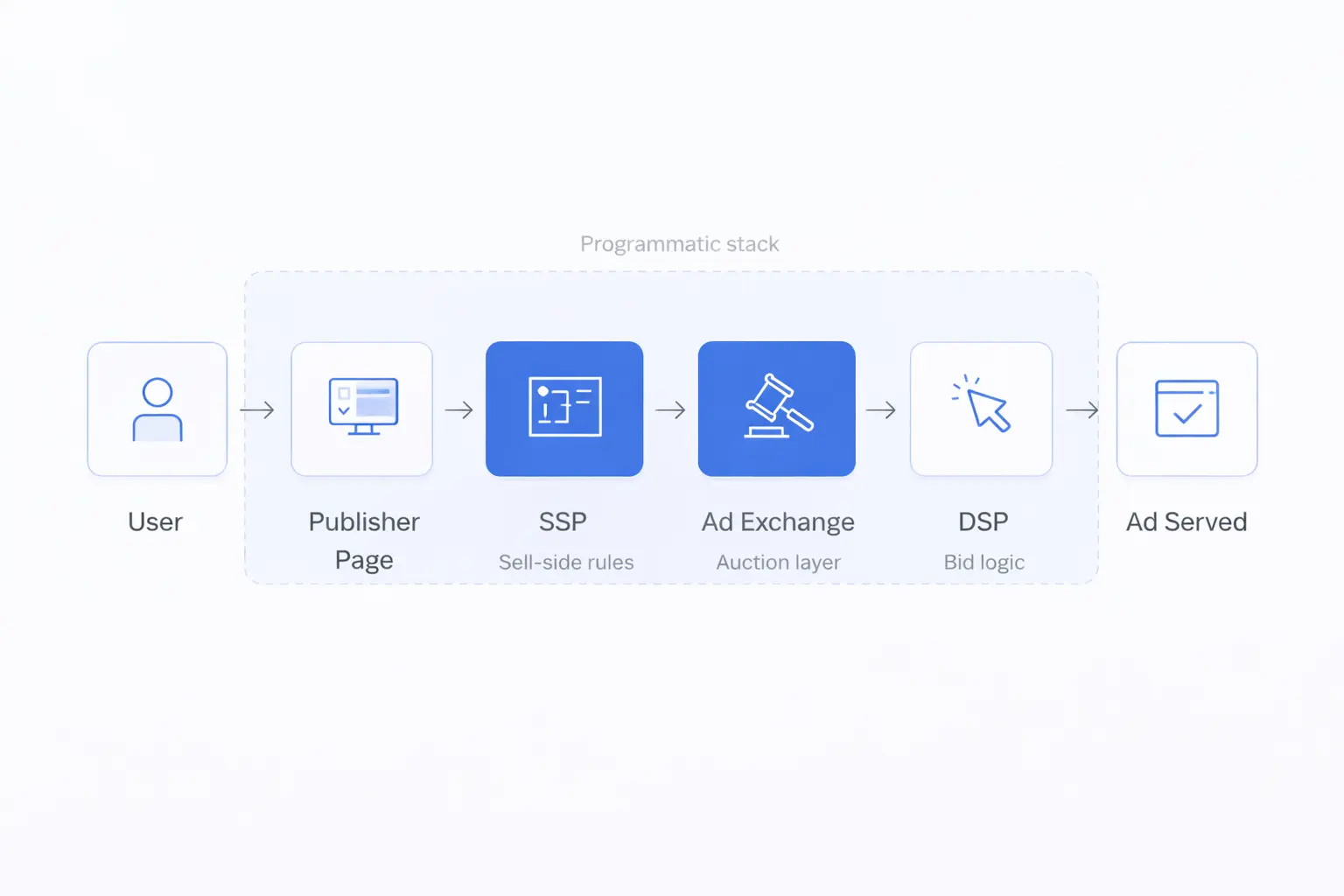
Amazon lays out the lifecycle in a simple order. A user loads a page; the publisher ad server announces inventory through the SSP; the DSP receives the bid opportunity; the advertiser side evaluates it; and the ad is served if the bid wins. IAB Tech Lab’s RTB definition fits neatly into that flow because each impression is auctioned in real time.
How Publishers Connect to Buyers Through the Stack
Publishers do not usually connect directly with every advertiser. They use an SSP, which then connects to exchanges, DSPs, ad networks, or all three. Google Ad Manager’s Open Bidding documentation states that publishers can invite third-party SSPs to compete for inventory in a single real-time auction, and that the ad server can call all yield partners at once. That is a good example of how the stack can be arranged to improve competition and yield.
Why Infrastructure Choice Affects Revenue
Infrastructure choices affect latency, competition, transparency, and control. Google says Open Bidding reduces some of the latency historically associated with header bidding by moving communication server-to-server. Amazon says SSPs help publishers choose demand sources based on latency and bid rates.
Those details are not technical trivia. They affect what bids reach the auction, how fast they arrive, and how much revenue a publisher actually captures. This is also the point where programmatic advertising DSP, SSP, add exchange becomes more than a keyword string. It becomes a revenue map. If one layer is weak, the whole chain feels it.
How BidsCube Powers All Three Layers
BidsCube positions itself as a stack provider across the main layers of programmatic infrastructure.
- DSP focuses on real-time data and filtering, bidstream data access, targeting controls, and campaign auto-rules.
- SSP brings real-time reports, header bidding support, price floor control, and traffic redirection.
- White-Label Ad Exchange highlights real-time reports, bidstream access, VAST and oRTB support, and platform-level controls, including a global block list.
That matters if a company wants to build more of its own stack rather than rely solely on closed platforms. In that context, BidsCube can be positioned as a practical answer to teams studying how DSP, SSP and Ad Exchange work together. For outside validation, BidsCube also points buyers to Clutch and G2.
Conclusion
The cleanest way to understand DSP vs SSP vs Ad Exchange is to think in layers. The DSP is the buy-side control layer. The SSP is the sell-side control layer. The exchange is the marketplace layer between them.
Once those roles are clear, teams make better decisions. Publishers know when they need stronger sell-side controls. Advertisers know when they need buyer-side reach and targeting. Agencies know where auctions happen, and why supply path choices matter. That is the real value in understanding SSP vs DSP vs Ad Exchange.
Our tech staff and AdOps are formed by the best AdTech and MarTech industry specialists with 10+ years of proven track record!

FAQ
What is the difference between a DSP, SSP, and Ad Exchange?
With a DSP helping advertisers buy media, an SSP helping publishers sell and manage inventory, and an Ad Exchange acting as the market space where those transactions take place. That is the core DSP, SSP and Ad Exchange difference.
Do publishers need a DSP or an SSP?
Most publishers need an SSP first, because the SSP handles inventory control, pricing, yield logic, and demand connections. A DSP is usually a buyer-side tool, so publishers only need one if they also plan to run buy-side activity. That is one practical answer to the question of SSP vs. DSP vs. Ad Exchange.


