



Ad Exchange and SSP are often confused and mixed up in discussions because both sit on the sell side of digital advertising, both deal with auctions, and end up appearing in the same vendor stack. In practice, publishers, agencies and Ad Ops teams still want to know about SSPs vs. Ad Exchanges as the labels cover more of the same ground than they once did. Even so, the roles are not identical. The easiest way to frame Ad Exchange and SSP is this: One is mainly the marketplace layer, and the other is mainly the publisher control layer. That is the starting point for understanding the difference between Ad Exchange and SSP.
Table of Contents
The overlap is real but the distinction is still useful to help delineate its types. There is an exchange where buyers and sellers can trade impressions via an auction. An SSP exists to help publishers manage inventory, pricing, demand connections, and yield. Once you separate the marketplace function from the publisher management function, the rest of the article becomes much easier to follow.
What Is an Ad Exchange?
An Ad Exchange is a digital marketplace where advertising inventory is bought and sold through real-time bidding. Amazon Ads defines an Ad Exchange as technology used in programmatic media buying and selling, and describes it as a marketplace where advertisers, agencies, publishers, SSPs, and DSPs can bid on inventory from many publishers. IAB Tech Lab describes RTB as a process where an individual impression is put up for bid in real time through an on-the-spot auction.
An Ad Exchange is essentially an online platform that facilitates the buying and selling of online media advertising inventory from multiple ad networks, namely real-time bidding. An Ad Exchange, per Amazon Ads technology in the programmatic media space, is a marketplace for many advertisers/agencies/publishers/SSPs/DSPs that can bid on inventory from tonnes of publishers. According to IAB Tech Lab, RTB is defined as a system of a single impression that is up for real-time bidding competition via an instant auction.
In practical terms, the exchange is the place where bid requests and bid responses meet. Buyers, usually through DSPs, bid on impressions. Sellers, usually through SSPs or exchange-connected inventory sources, make those impressions available. Intermediaries can also sit in the chain, depending on how the supply path is set up. That is why an exchange is best understood as a trading layer, not as a full publisher operating system.
Open marketplaces are open to any buyer or seller, while private marketplaces are only for a limited amount of select parties. Amazon Ads makes the differentiation itself, saying this: “Open exchanges give broad access, while private exchanges (PMPs) provide carefully curated environments with a selection of publishers and buyers.”
What Is an SSP (Supply-Side Platform)?
A supply side platform is a delivery stage that is responsible for enabling publishers or other inventory owners to manage, sell and optimise ad space. An SSP (Supply Side Platform) is a programmatic software that allows publishers to sell pixels (advertising impressions) by running a connection to a wide range of Ad Exchanges, DSPs, and ad networks concurrently.
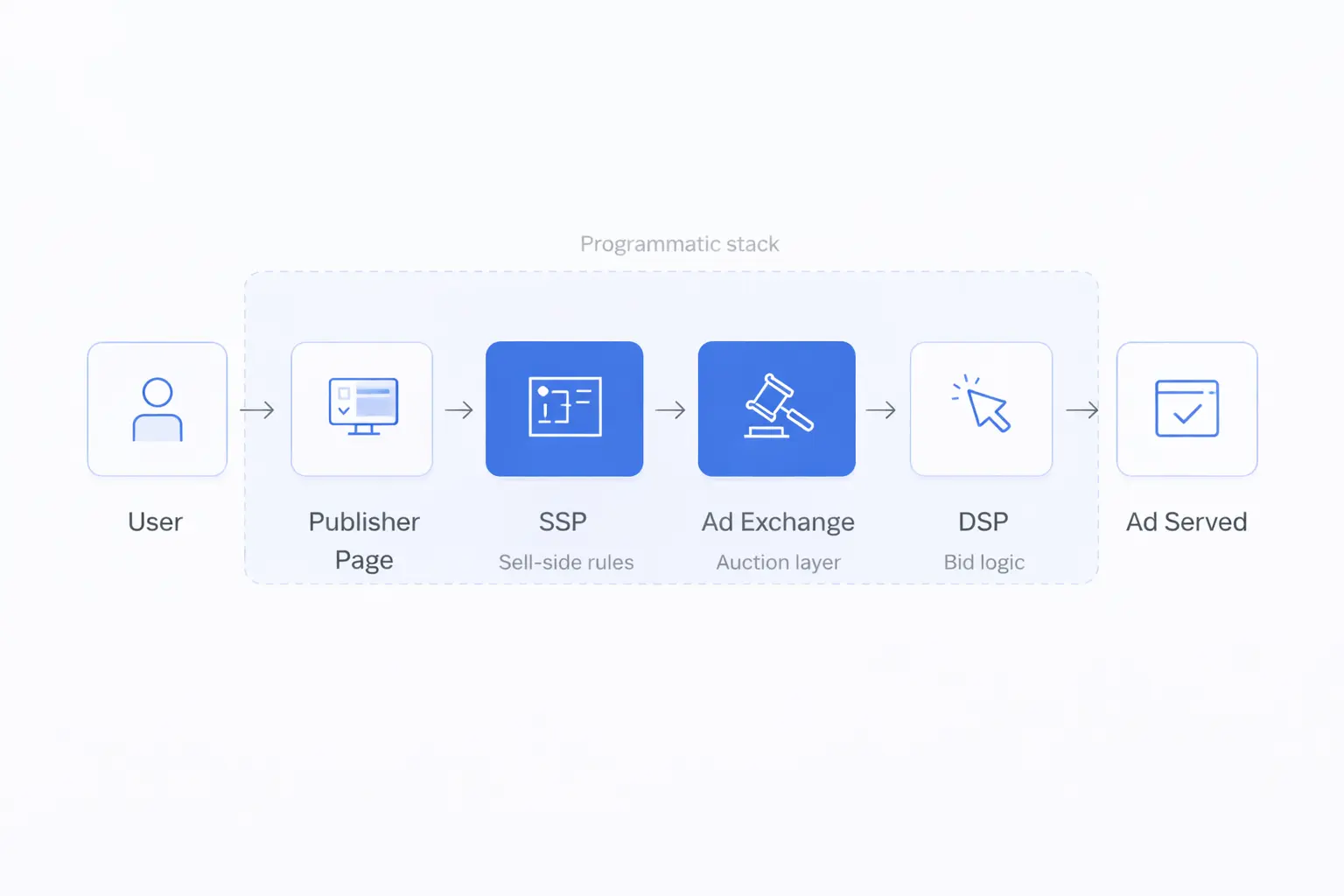
The SSP gives publishers the tools to control how inventory reaches demand. That usually includes floor pricing, demand partner connections, traffic routing, and yield logic. Amazon’s SSP guide says publishers can set pricing and auction criteria, while Google Ad Manager explains that third-party SSPs can compete for inventory in a single real-time auction through Open Bidding.
This is also where the waterfall versus header bidding discussion matters. Google explains that mediation can call partners in sequence, while Open Bidding calls yield partners at once. Prebid defines header bidding as a method by which a publisher can collect bids from various sources and have them compete more directly with the ad server. To simply explain it, a typical waterfall requests demand in sequence, while header bidding allows demand to compete in parallel, earlier in the stream.
If an exchange is the marketplace, then the SSP is the publisher-side machinery that determines how to enter that marketplace, what rules apply and what demand paths are allowed to compete. That is where SSP vs Ad Exchange becomes more than a naming issue.
Reddit Case: Ad Ops Professionals on Exchange vs SSP Confusion
The Reddit thread in r/adops captures the confusion well. One commenter said, “There is no difference,” then argued that the term SSP came from an earlier period when some exchanges positioned themselves as publisher defenders against many ad networks. Another commenter called the term SSP a misnomer and said they are all Ad Exchanges.
That thread does not prove the terms are identical. It proves that the market blurred them. In many real stacks, a company may offer exchange access, sell-side controls, reporting, and even buyer-facing tools in one package. That is exactly why teams keep asking how Ad Exchange differs from SSP. The labels overlap in vendor branding, but the underlying functions still matter when you choose infrastructure.
Ad Exchange vs SSP: Side-by-Side Comparison
The simplest way to clear this up is to compare an Ad Exchange and an SSP side by side. That view also helps when you need to explain SSP vs Ad Exchange programmatic to a team that sees both terms in sales decks, but needs to know which tool does what.
| Category | Ad Exchange | SSP |
| Role in ecosystem | Marketplace where impressions are auctioned | Publisher-side platform that manages and sells inventory |
| Primary users | DSPs, agencies, advertisers, publishers, intermediaries | Publishers, media owners, monetization teams |
| Auction type | Open auction, and sometimes private marketplace deals | Sends inventory into auctions, sets rules, pricing, and connections |
| Transparency | Varies by platform, deal type, and path | Usually stronger on publisher controls, floor logic, and demand routing |
| Use cases | Buying and selling impressions across many parties | Yield optimization, floor pricing, header bidding, inventory management |
This table is also a good reminder that Ad Exchange with SSP are linked parts of one process, not two unrelated products. One helps transact. The other helps publishers control how that transaction happens.
When to Use an Ad Exchange vs an SSP
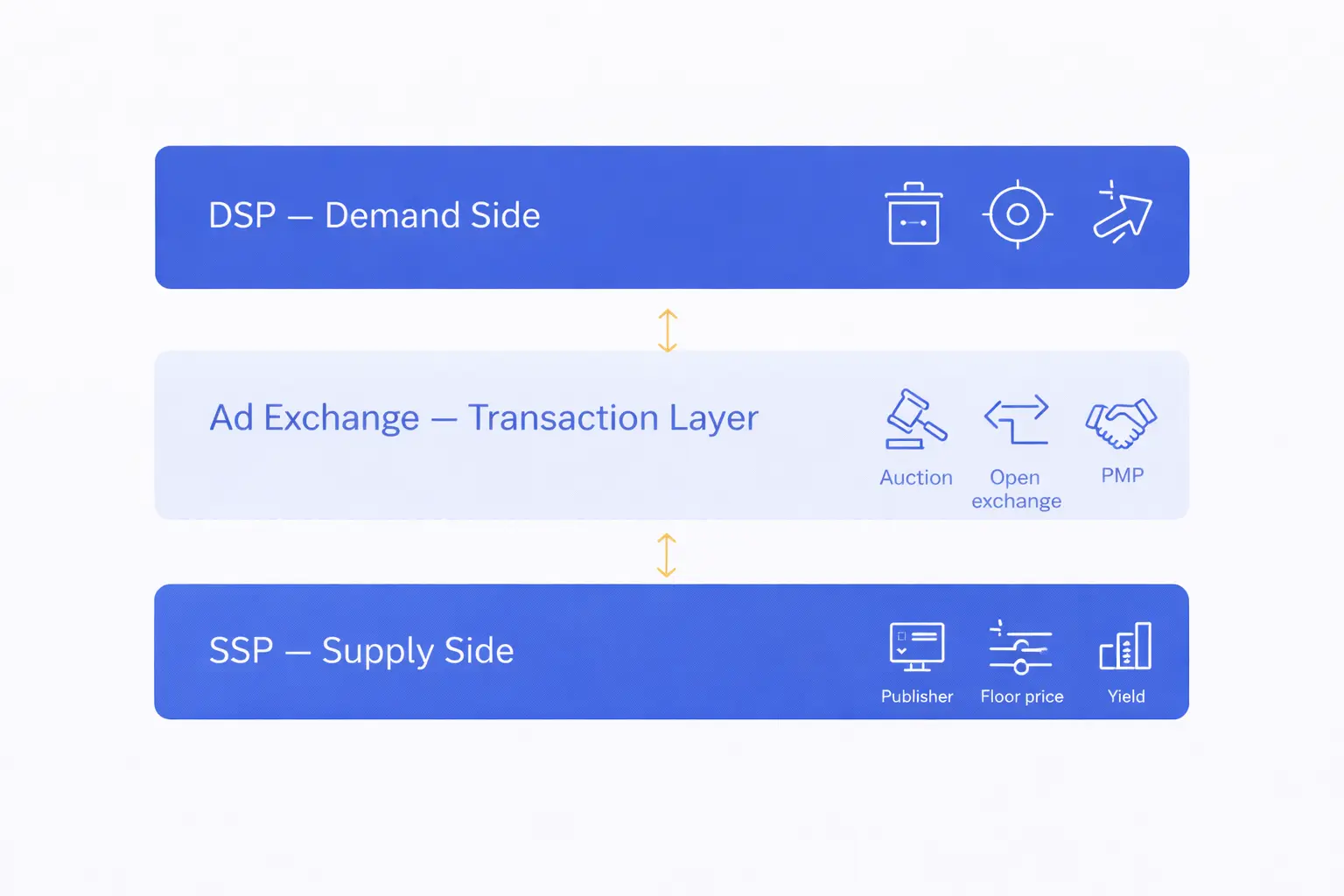
Knowing what each tool does is one thing. Knowing which one you actually need is another. The answer depends on which side of the transaction you are on
Use Cases for Publishers
Publishers usually need an SSP first. The SSP manages inventory rules, price floors, routing, and demand connections. If a publisher wants stronger yield control, reporting, or header bidding logic, the SSP is often the main operating layer. That is why the publisher-side view of SSPs vs. ad exchanges usually starts with control, not just access to an auction.
A publisher may still rely on exchange access through that SSP. In other words, the publisher does not always choose one and ignore the other. Often, the SSP is the tool the publisher actively uses, while the exchange is one of the markets the SSP connects to. That is a useful way to think about SSP and Ad Exchange in day-to-day monetization work.
Use Cases for Advertisers and Agencies
Advertisers and agencies usually approach the market from the demand side. They care more about DSP access, audience buying, deal terms, and supply quality. From that angle, the exchange matters because it is the transaction layer, while the SSP matters because it shapes the quality, visibility, and path of the supply they buy. That is where SSP vs Ad Exchange programmatic becomes a supply-path question, not just a glossary question.
When You Need Both
Many businesses need both functions. Publishers need SSP controls, but they also need access to exchange demand. Agencies may buy through a DSP, but still care about which SSPs and exchanges sit behind the supply path. In modern stacks, the useful question is often not “exchange or SSP?” but “which layer do we need to control directly?” That is another way to understand the difference between Ad Exchange and SSP without pretending the market has clean lines everywhere.
How BidsCube Fits Into This Infrastructure
BidsCube positions itself as a provider of sell-side, demand-side, and marketplace tools in a single stack.
- SSP indicates publishers can watch bids in real time, set price floors, redirect traffic, and use header bidding integrations.
- White-Label AdExchange highlights real-time data, bidstream access, and platform-level controls such as a global block list.
- DSP presents real-time filtering, bidstream access, targeting options, and campaign controls. That makes BidsCube relevant in discussions about programmatic advertising, where a company wants more direct control over the stack, not just access to a single layer.
In practical terms, BidsCube is useful here because it shows how the market now bundles roles that used to be explained more separately. If you need publisher-side controls, the SSP is the obvious starting point. If you need a marketplace layer for routing and exchange logic, the White-Label AdExchange fits that need. If you also need buyer-side activation, the DSP adds that layer.
For outside validation, you can review the company on Clutch and G2.
Conclusion
To put it most simply, Ad Exchange is the place, and SSP is the publisher control layer. If you want a working definition instead of an academic-perfect one, that is the cleanest Ad Exchange and SSP comparison.
The market still blurs the labels, which is why people keep asking how Ad Exchange differs from SSP. But the distinction still matters when you choose tools, design a supply path, or explain roles to a team. Since SSP’s help publishers with how they manage and optimize inventory while the exchange helps buyer and seller to transact impressions, the answer to Ad Exchange or SSP becomes much easier.
Our tech staff and AdOps are formed by the best AdTech and MarTech industry specialists with 10+ years of proven track record!

FAQ
What is the main difference between an Ad Exchange and an SSP?
Functional is the primary difference between Ad Exchange and SSP. Ad Exchange, the marketplace for buying and selling impressions, while SSP is the publisher facing side of the system that manages the inventory, pricing, and demanding connections.
Can a publisher use both an Ad Exchange and an SSP?
Yes. In fact, many publishers do. The SSP is often the tool the publisher operates directly, while the exchange is one of the transaction environments that SSP connects to. That is why both often appear together, and why SSP and Ad Exchange should be seen as connected layers rather than mutually exclusive choices.


