



If you think push traffic is just “extra clicks,” you are leaving money on the table.
Push traffic behaves differently from almost every other channel. It does not wait, it does not browse, and it does not forgive slow pages. A user clicks, scans, and decides in seconds. That makes it one of the most reactive traffic sources you can get, but also one of the easiest to waste.
Table of Contents
- What Is Push Notification Traffic and Why It's Valuable
- Why Push Traffic Is Different from Standard Display Traffic
- Reddit Case: Developers and Publishers on Push Traffic Monetization
- Best Monetization Strategies for Push Notification Traffic
- How to Increase RPM for Push Notification Audiences
- Conclusion
- FAQ
To monetize push notification traffic, you need to treat it as its own system. That means separating how you attract clicks, how you handle the landing experience, and how you run monetization. If one of these breaks, revenue drops fast.
There are platforms that help publishers manage this balance by giving more control over demand routing and auction behavior, which becomes critical when sessions are short and every impression counts.
This article will cover how push traffic operates, why it does not act the same way as other media and how you can transform it into a stable and scalable revenue stream, while at the same time make sure that your audience is not put in danger.
What Is Push Notification Traffic and Why It’s Valuable
Push notification traffic comes from users who subscribed to receive updates. These users already interacted with your site before, which makes them different from cold traffic. You are not trying to “win” their attention from scratch.
There are two main types:
- Web push notifications. Browser-based alerts that drive users back to your site
- App push notifications. Used inside mobile apps, often tied to in-app engagement
For publishers, web push is the main driver of traffic and monetization because it connects directly to content pages and ad inventory. App push often stays inside closed ecosystems, while web push feeds your open web monetization model.
Why push traffic has high value
Push traffic is based on consent. The user opted in, which creates a stronger signal than a search query or social scroll.
That leads to:
- Higher click intent;
- Faster decision making;
- Better conversion potential.
At the same time, that value comes with pressure. The user expects relevance. If the notification overpromises, or the landing page underdelivers, the session ends instantly.
This is why push notification traffic monetization can produce strong results even with lower volume. You have fewer sessions but each one has greater intent. This provides much more value as a normal strategy than traffic enabled at all costs, optimizing to capture every last drop of value without irreparably damaging trust.
Digital advertising is experiencing growth as global ad spending forecast to top $700 billion by the end of 2026, according to Statista. Publishers need better traffic sources, not just more traffic, as competition grows.
The trade-off
If push traffic is potent, but replete with restrictions. The same properties that render it valuable also make it fragile.
- Users expect relevance. People opted in for a reason. If notifications feel generic or misleading, trust drops fast, and future clicks become less likely.
- Sessions are short. Push users do not browse. They arrive with intent, scan quickly, and leave if the page does not deliver immediately. You often get one chance to capture value.
- Overuse leads to unsubscribes. Bloated notification sending, delivering low-value content, etc. amplifies unsubscribe(s). When a user chooses to unsubscribe, you lose that traffic source.
That is why push traffic works best when treated as a precision channel. It rewards relevance and speed, not volume.
Why Push Traffic Is Different from Standard Display Traffic
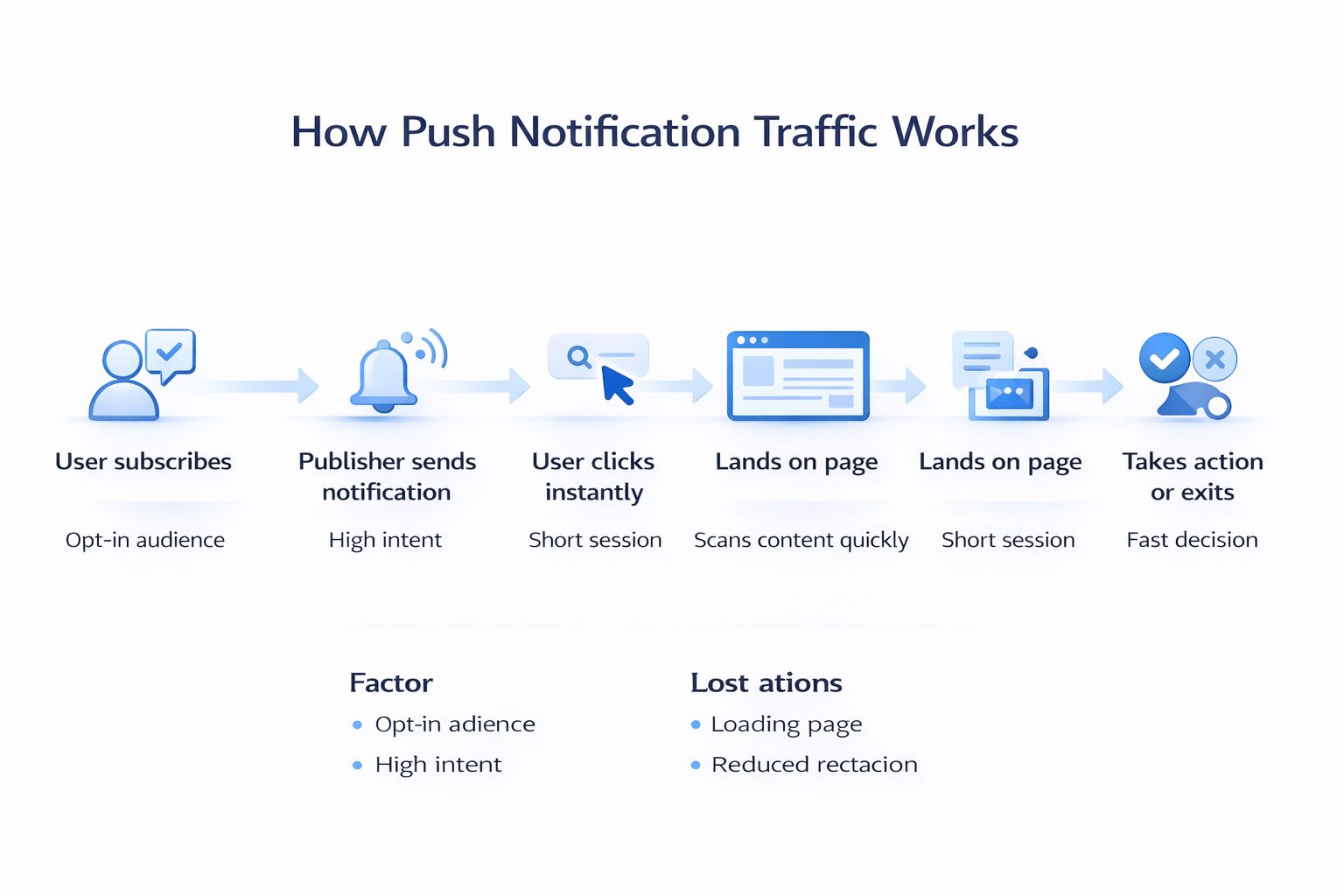
Push traffic does not act like organic, social or referral. It condenses the user journey into a single rapid interaction. There is no browsing phase, no comparison step, and almost no patience. The user clicks, checks if the page delivers, and makes a decision within seconds.
Short sessions, high engagement
Push users:
- Land with a purpose;
- Scan content quickly;
- Leave if the page does not deliver.
This creates short sessions, but not low-quality ones. High intent, small window of time. You are not competing for attention, you are racing against time.
According to Deloitte, user attention spans in digital environments continue to shrink, especially on mobile devices. That trend directly affects push traffic, where decisions happen even faster.
Click-to-page patterns
The notification sets the expectation before the user even lands. It acts as a promise.
If the landing page does not match:
- Bounce rate spikes;
- Viewability drops;
- Revenue drops.
Even small mismatches can break the session. A vague headline, a slow load, or content that does not match the message can end the visit immediately.
Push traffic is less forgiving than search traffic because users did not “hunt” for the result. They reacted to it. If the reaction is not rewarded, they leave.
Impact on monetization metrics
Push traffic directly affects how monetization works:
- Viewability drops if users do not scroll far enough.
- Ad impressions per session decrease because fewer pages are loaded.
- Completion rates fall for formats that require time, like video.
This creates a different optimization challenge. You cannot rely on long sessions or multiple page views. You need to capture value early, often within the first screen.
This is why push traffic ad revenue depends heavily on page design, not just demand. Strong demand helps, but if the page loads slowly or places ads too low, the opportunity is gone before the auction even matters.
Reddit Case: Developers and Publishers on Push Traffic Monetization
A discussion on Reddit gives a useful look at how publishers actually test push traffic monetization in the real world, outside of theory and vendor claims. The thread focuses on sponsored push notifications as a revenue stream, and the responses show both the upside and the risks of relying on this channel.
Several patterns appear in real use:
- Some publishers use sponsored push as a direct revenue stream;
- Others warn about user fatigue from too many notifications;
- Many emphasize testing frequency and content,
One commenter summed it up clearly:
“Push can make money, but if you overdo it, people unsubscribe fast.”
Another user pointed out the balance between value and volume:
“It works if the content matches what people expect. Otherwise clicks drop quickly.”
These comments highlight something many guides skip. Push is not just a technical channel. It is behavioral.
The key insight is clear. Push traffic is not just a traffic source. It is a relationship with your audience.
- If you push too often, you lose users.
- If you push too little, you lose revenue opportunities.
The real goal is not maximum volume. It is consistent engagement. Publishers who treat push as a long-term channel, not a quick revenue hack, tend to get more stable results over time.
Best Monetization Strategies for Push Notification Traffic
Push traffic needs a structured approach. Random monetization setups rarely work.
Native and Push Ad Networks for Monetization
Push-focused networks can help you start fast.
They:
- Match demand to short sessions
- Optimize for quick conversions
- Offer ready-made formats
This works well for early-stage website monetization for push audiences, but limits control.
Combining Push Subscribers with Programmatic Demand
To scale, you need programmatic advertising.
This approach:
- Increases competition between buyers
- Improves pricing consistency
- Reduces dependency on one partner
To build this setup:
- Use SSP for supply-side control.
- Add buyers through DSP.
- Test demand mixes via White Label AdExchange.
This setup helps stabilize push notification publisher revenue over time.
According to McKinsey & Company, programmatic ecosystems can increase monetization efficiency by optimizing auctions in real time, especially when multiple demand sources compete.
CPM Optimization for Push Landing Pages
Push pages must monetize fast. There is no warm-up phase, and there is no second chance. If the page does not load quickly and show value immediately, the session is gone before ads even have a chance to compete.
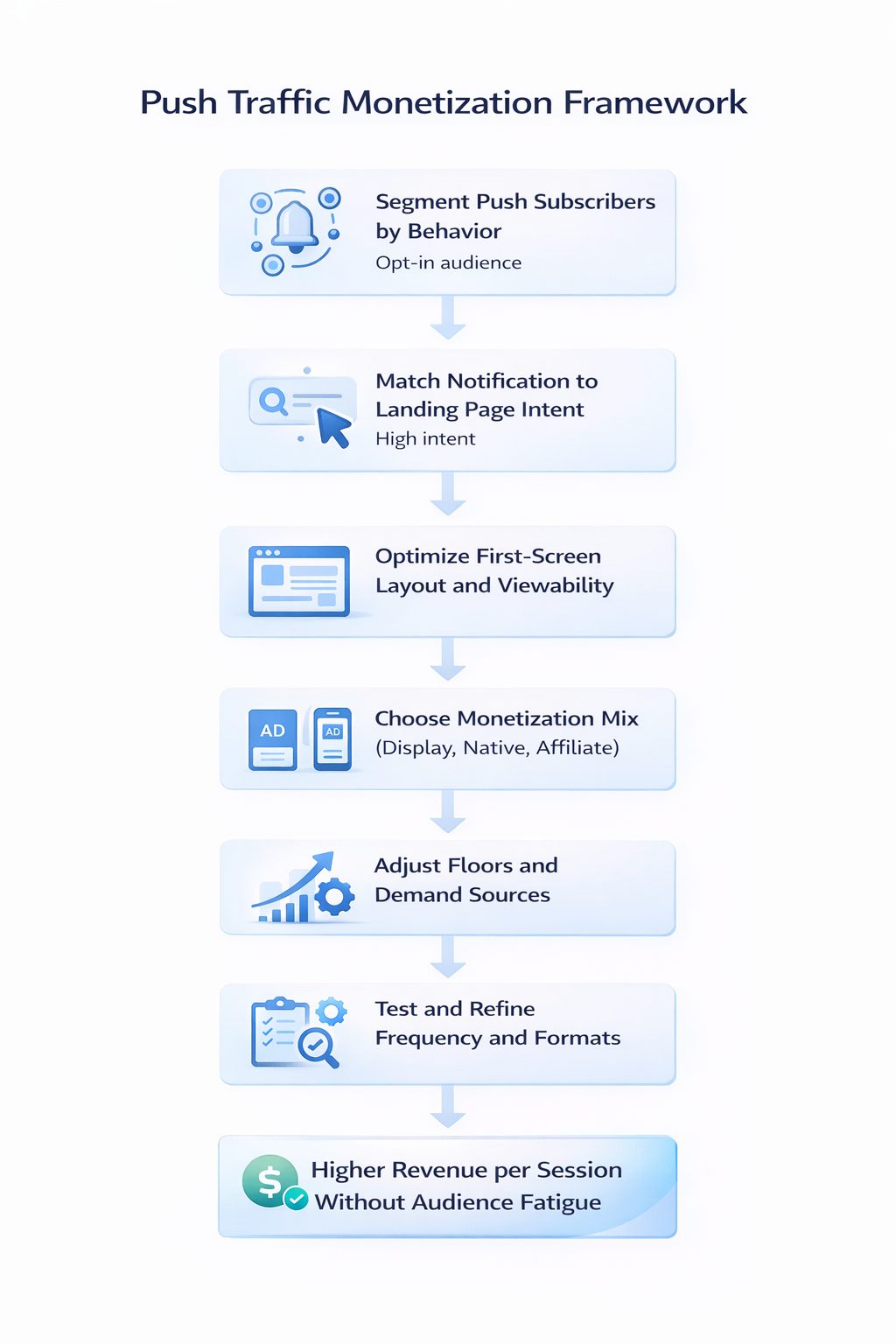
That is why CPM optimization for push traffic starts with timing, not just pricing.
Focus on:
- One strong above-the-fold unit. Place a high viewability ad where it is visible without scrolling
- Fast ad rendering. ensure ads load as early as possible without blocking content
- Clean layout. Keep the page readable and focused on the core message
Avoid:
- Heavy scripts. They slow down load time and delay ad requests
- Delayed loading. Ads that load too late never get seen
- Excessive ad density. Too many placements reduce performance and can hurt user trust
Even a 1–2 second delay can cut revenue. With push traffic, that delay often means the difference between a viewable impression and a missed opportunity.
A practical way to approach this is to treat the first screen as your primary revenue zone. Everything important, both content and monetization, should be visible and functional immediately.
Analyze Subscriber Segments Before Monetization
Not all users behave the same, even within push traffic. Treating your audience as one group leads to missed revenue and inefficient demand matching.
Segment by:
- Country. CPMs vary significantly by geo
- Device. Mobile and desktop sessions behave differently
- Behavior frequency. Frequent users vs occasional visitors
- Content category. News, deals, guides, or entertainment
This improves push traffic monetization strategy because you match demand to user value instead of applying one setup to everyone.
For example:
- High-frequency users may need lower notification volume but better content relevance
- High-value geos may justify higher floors and stronger demand competition
- Mobile users may require faster, lighter pages to keep impressions viewable
Segmentation helps you avoid two common problems:
- Under-monetizing valuable users
- Overloading low-value users and losing them
Push traffic rewards precision. It is not about how many users you bring back, but how effectively you use each visit.
How to Increase RPM for Push Notification Audiences
Push traffic needs a different optimization mindset. If you are figuring out how to monetize push subscribers, start by aligning notification intent with landing page content and monetization setup, so each click has a clear path to revenue.
Key levers to improve revenue
- Header bidding for landing pages. More demand sources increase auction pressure.
- Frequency capping. Too many notifications reduce long-term value.
- Page speed optimization. Slow pages kill short sessions.
- Ad placement strategy. Prioritize viewable positions early.
Practical checklist
- Track revenue per session, not just RPM
- Measure impressions per visit
- Monitor unsubscribe rates
- Test notification timing
This is where push traffic demand optimization becomes critical, because improving revenue is not just about adding more ads, but about matching demand, user behavior, and page performance in one system.
Table: Push traffic monetization checklist
Use this checklist to quickly evaluate how well your push traffic setup performs. It helps you spot weak points across traffic quality, monetization, demand, and user behavior without digging through multiple reports.
| Area | What to Monitor | Common Issue | Fix |
| Traffic quality | Click-through rate | Misleading notifications | Align message with page |
| Monetization | RPM, revenue per session | Low impressions | Improve above-the-fold ads |
| Demand | eCPM, fill rate | Weak buyer competition | Add more demand sources |
| User behavior | Bounce rate, session time | Fast exits | Improve page speed |
| Retention | Unsubscribe rate | Overuse of push | Apply frequency caps |
When one area underperforms, it tends to pull the others down with it. Tackle the problems one at a time, addressing the biggest bottlenecks first, and you will experience more consistent increases in push traffic revenue.
Conclusion
Push traffic is not just another source. It is a different type of user behavior compressed into a short session.
If you try to monetize it like display traffic, you will lose revenue. If you treat it as a high intent, fast decision channel, you can build a stable stream of push traffic ad revenue.
To make it work, focus on:
- Fast pages;
- Clear message-to-page match;
- Strong demand setup.
If you want to monetize push notification traffic effectively, think less about volume and more about efficiency per visit.
FAQ
Can push notification traffic generate strong ad revenue?
Push notification traffic can generate strong ad revenue because it comes from opted-in users with higher intent. Revenue depends on how well the landing page matches the notification and how fast ads load.
What is the best way to monetize push notification subscribers?
The best way to monetize push subscribers is to combine targeted notifications with optimized landing pages and multiple demand sources. This approach improves both pricing and consistency in revenue.


