



The in-app advertising market has a credible market share of mobile media. This is a central part of how advertisers find users, how publishers capture mobile attention and how ad tech platforms segment performance across devices.
Table of Contents
What matters now is not just whether brands advertise in apps, but how they do it. More spend is shifting into app environments because of how much mobile time people dedicate there and due to the fact that app inventory tends to contain higher engagement signals compared to standard mobile web placements.
- For advertisers, growth in the in app advertising market means increased premium mobile inventory and more choice of formats.
- For publishers and app owners, that translates to more ways to monetize without depending on a single ad unit or a weak demand source.
If we look ahead, the in app advertising market appears poised for substantial growth, with a projected annual growth rate of 10.1% anticipated between 2025 and 2027. This trajectory will lead to the market reaching $462.3 billion by 2027.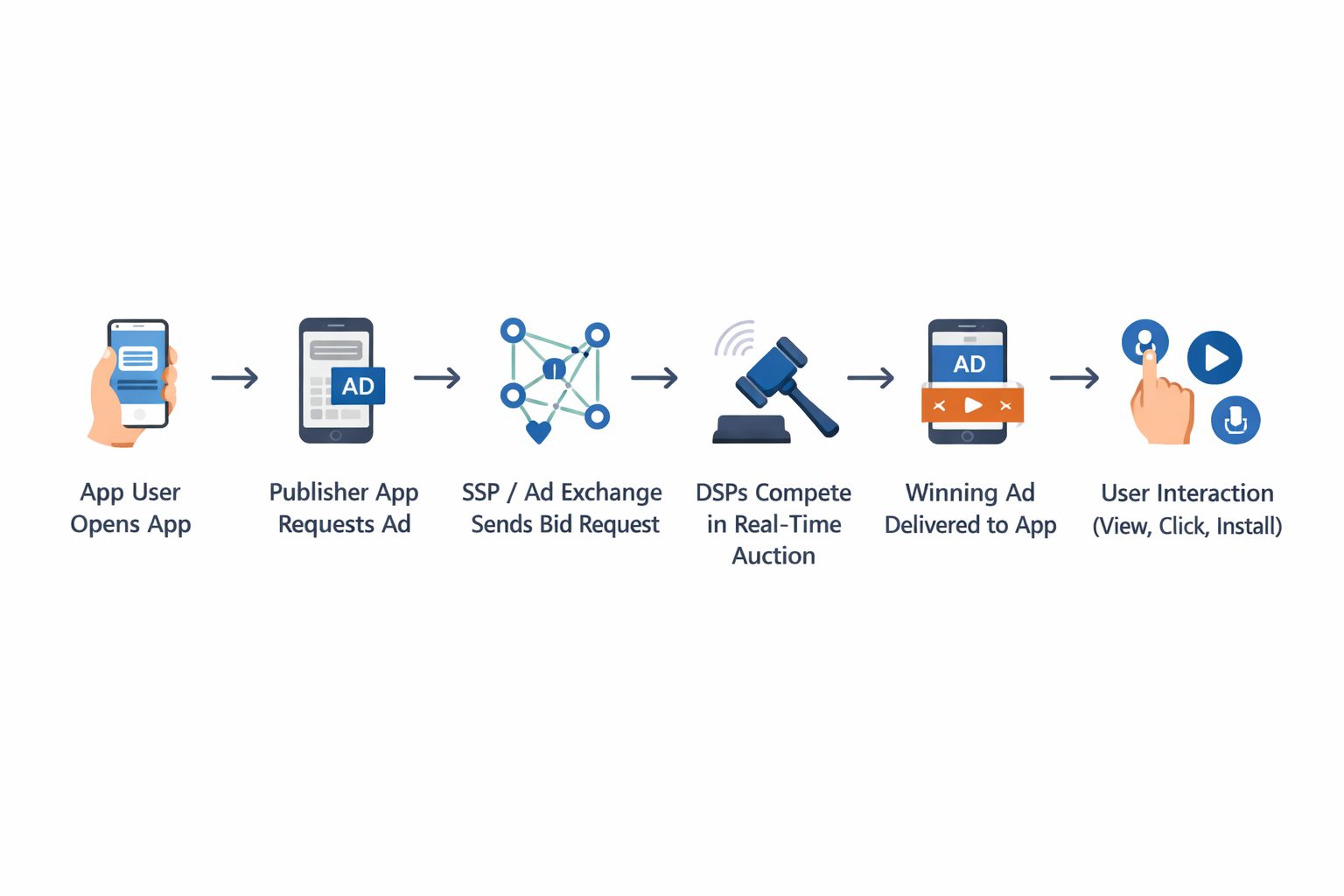
In App Advertising Market Overview
The old market section leaned too much on hype. A better reading is more analytical. The in-app advertising market continues to grow due to the fact that users engage with a sizeable share of their mobile time inside apps, rather than browsers, and because app environments enable a wide array of monetization formats (e.g. banners vs rewarded video). What the growth means in and of itself, operationally: more competition for quality app inventory, more pressure on creative performance, and greater value in well-structured auction setups.
Recent market estimates point in the same direction. Mordor Intelligence says the global in app advertising market is expected to grow from $387.76 billion in 2025 to $418.73 billion in 2026, with continued growth toward 2031. It also reflects increased pressure on measurement, quality of formats and privacy-safe targeting.
- For advertisers, a booming in app advertising market gives them a larger space to scale up campaigns within their active environments
- For publishers, this means more powerful monetization potential if not just ad density but also placement logic and buyer access are adequately managed.
A few practical implications follow from that growth:
- more app inventory enters the auction every year;
- premium placements get more competitive;
- video and rewarded formats keep gaining attention;
- analytics and creative testing become more important;
- weak monetization setups become easier to spot.
The mobile app market is witnessing tremendous growth, which is partially driven by the rise in in-app usage and a significant increase in advertising budgets.
Types of In-App Advertising Formats
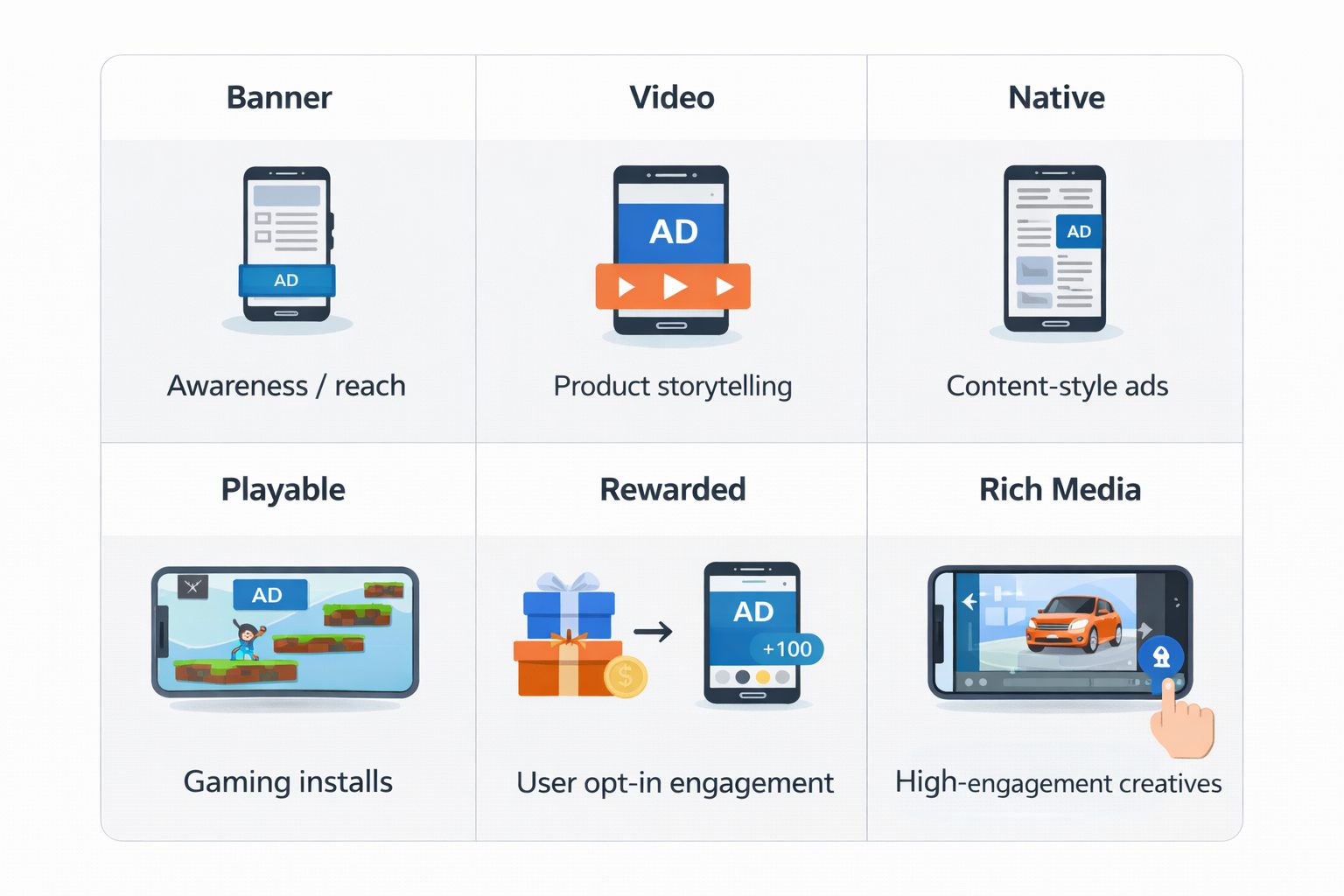
Advertising is one of the crucial components to attract users and monetizing your app at its best. To help you find your way through the dense forest of in-app advertising, let’s break down the most prominent formats available to you.
#1. Banner Ads
The most recognized app format is the banner ads. They typically appear at the top or bottom of the screen and remain visible as a user navigates through an app. Practically speaking, this is usually the most widely known type of in-app display advertising example as formats are dependent on visual placements within an application with limited space. Banners are cheap to roll out and easy to scale, but they can also experience low attention if their placement is weak or creative forgettable.
Best use case: broad reach, low-friction monetization, and simple awareness campaigns.
#2. Video Ads
Depending on the structure of the app, video ads can also be pre-roll, interstitial video, rewarded video or in-feed video. Video can be more compelling than a static display, but it asks more of the creativity and user attention. That makes it a much better storytelling, installation and product demonstration format than a long-term low-friction exposure play.
Best use case: app install campaigns, product storytelling, and higher-attention placements.
#3. Native Ads
Native ads are built to flow with the visual structure of the app that surrounds them. They sometimes show up in feeds, content lists, recommendation modules or sponsored placements that look more like the app’s normal design language. This can also work in the form of in-app display advertising, when the app works with card-based layouts, though native tends to be less interruptive than a traditional banner.
Best use case: feed-based apps, content apps, and placements where design continuity matters.
#4. Playable Ads
Playable ads provide a sneak peek of an app or game to users before they download. They are very interactive, and also often used in gaming where a mini-demo helps qualify interest before the click. They require more production effort, but they can improve conversion quality because users get a better sense of the experience before downloading.
Best use case: gaming user acquisition and interactive product trials.
#5. Rewarded Ads
Rewarded ads now provide a tangible value exchange to users — they typically offer a reward in return for watching or interacting with the ad. That reward can be virtual currency, additional lives, content permission or any other in-app advantage. The format works because the user opts into the tradeoff. It usually performs best when the reward feels meaningful and the ad load stays controlled.
Best use case: games, loyalty-driven apps, and monetization flows where user choice matters.
#6. Rich Media Ads
Rich media includes interactive or animated formats that go beyond static display. That can be swipeable units, dynamic overlays, expandable placements or motion-led creative that bridges standard display and full video. While rich media can drive engagement, this only works when the design is lightweight and relevant. Heavy, awkward units usually do the opposite.
Best use case: product showcases, higher-engagement campaigns, and premium app placements.
In-App Advertising Examples
The stage of advertising was claimed by novel and creative marketing schemes, captivation of audience attention, transformations in the way brands find make contact with their consumer. Then, we will look at some incredible examples of in-app advertising that broke technology and imagination barriers.
Burger King: “Burn That Ad”
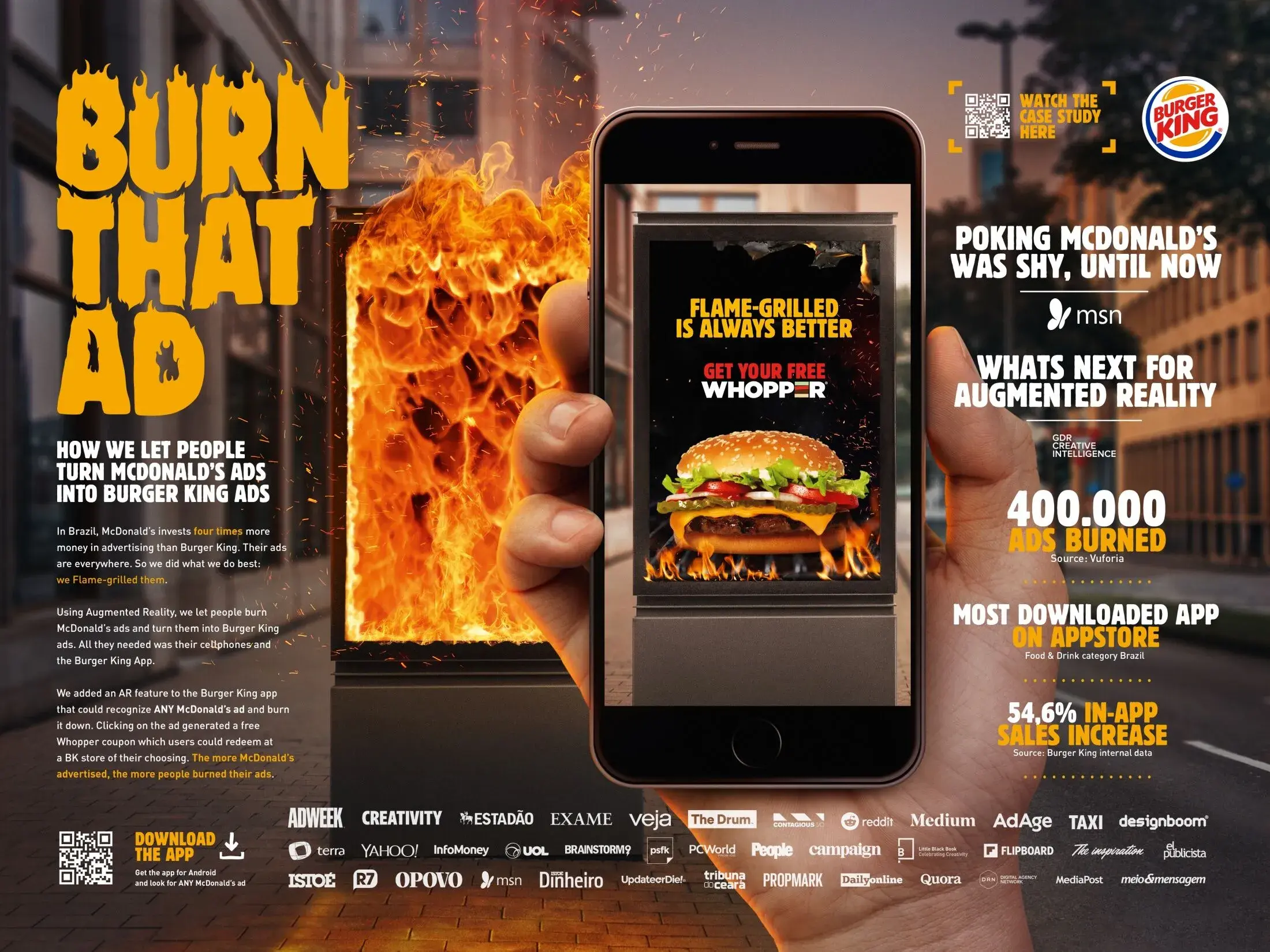
Format: augmented reality in-app activation
Goal: drive engagement and app participation using a playful mobile experience
Result: Burger King used its app to let users virtually burn competitor ads and claim a free Whopper, turning mobile interaction into a branded stunt with direct reward logic.
Gorillaz “Humanz” App

Format: location-based mobile experience with augmented reality and exclusive content
Goal: promote a new album through an immersive app-led fan experience
Result: The app connected users to hundreds of virtual locations and exclusive content, helping the campaign win a Golden Lion at Cannes.
Levi’s Geo-Targeted App Promotion
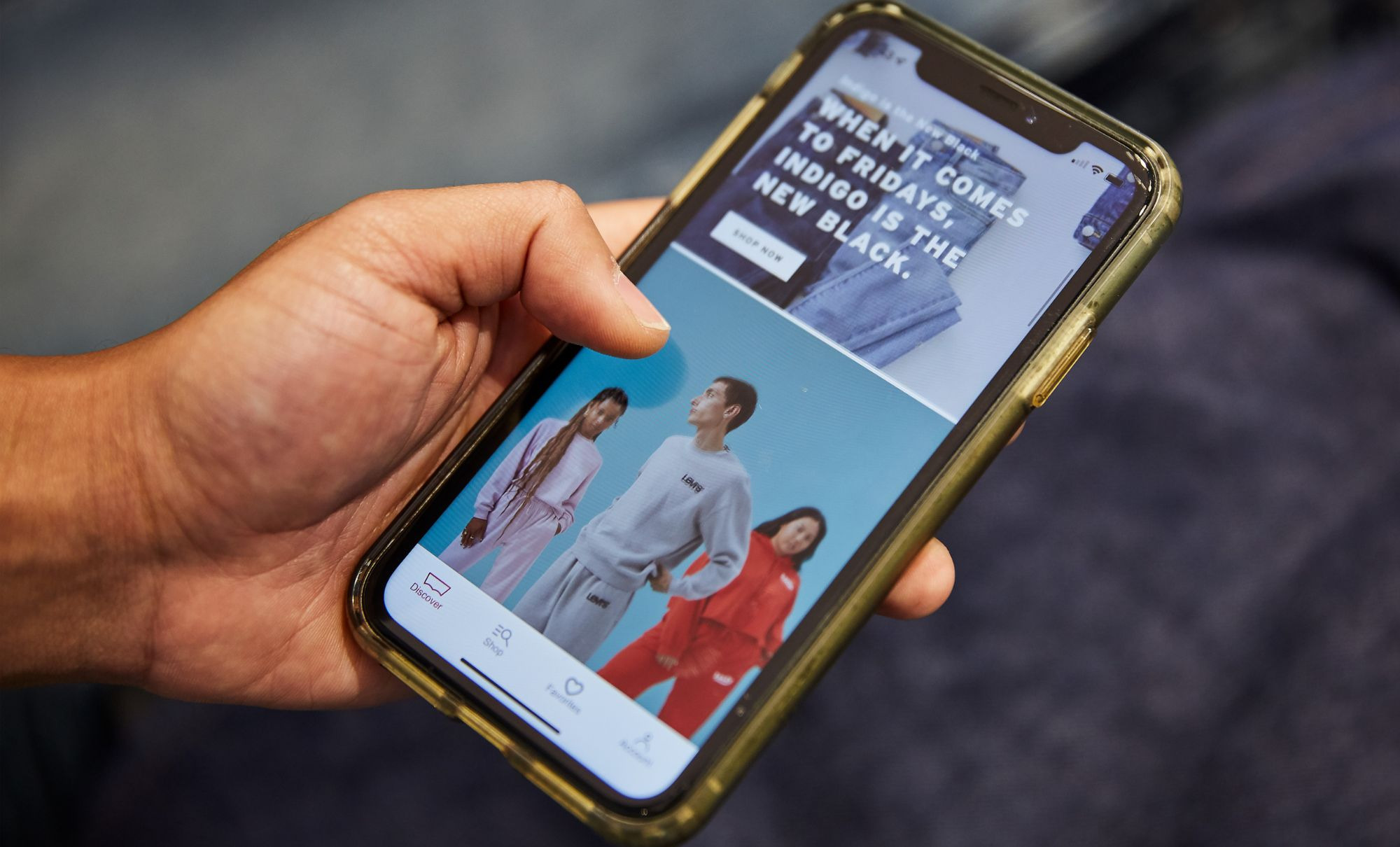
Format: opt-in, geo-targeted mobile advertising
Goal: connect with users through localized offers and subscription-led engagement
Result: Levi’s used location-aware mobile advertising to build a more relevant message flow for Boost Mobile users.
Nivea Protects
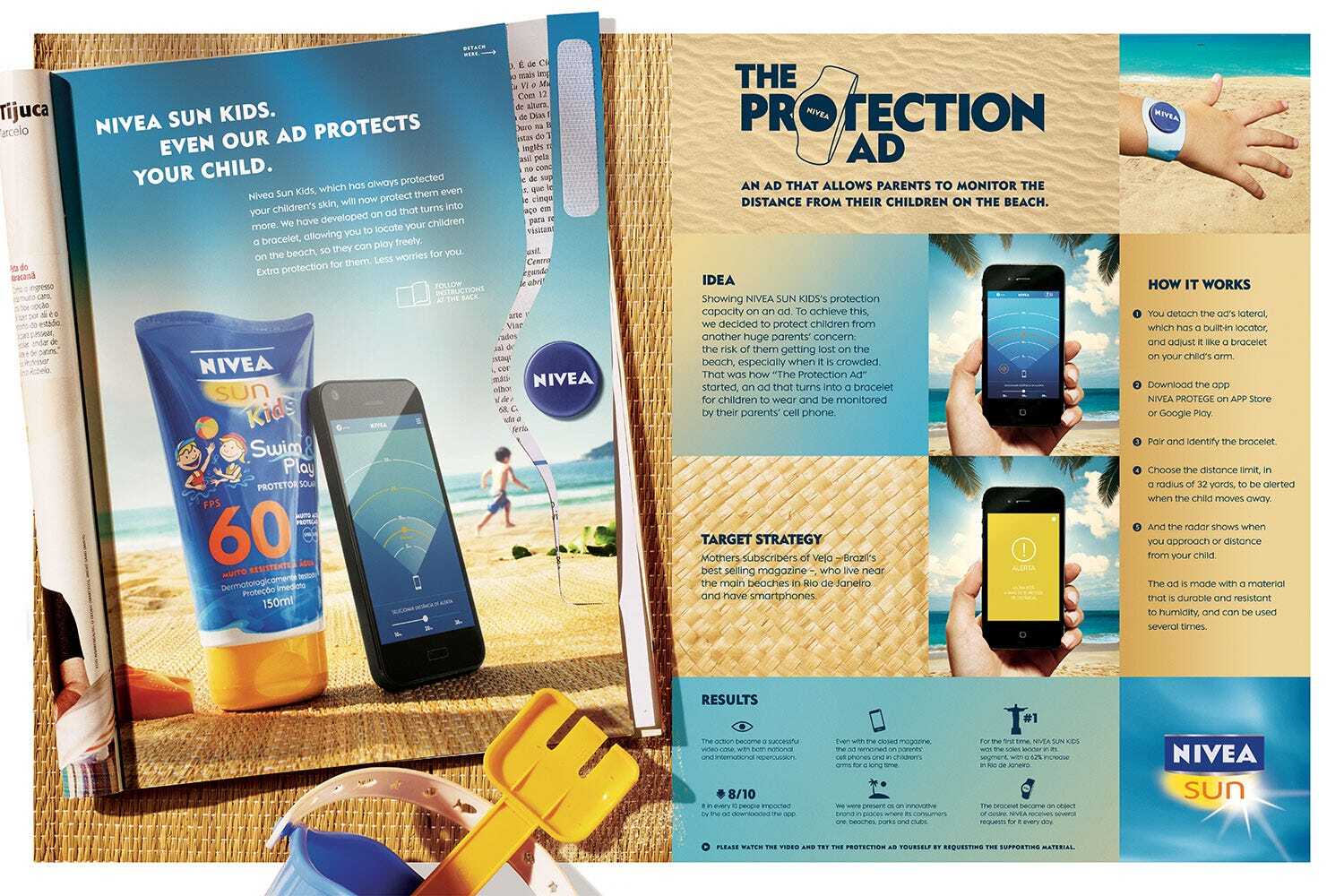
Format: app-based utility campaign linked to a real-world wearable item
Goal: connect family safety with brand utility and app downloads
Result: The campaign reportedly lifted sales in Rio de Janeiro and drove strong emotional recall through a practical mobile use case.
Advantages of In-App Advertising
The advantages of in-app advertising are practical. They are not magic, and they do not apply equally to every app or every campaign.
- First, apps usually hold user attention better than mobile websites because the session starts with a clear intent.
- Second, app environments enable a wider range of formats such as rewarded, playable and native flows that are more challenging to execute well on mobile web.
- Third, it is often possible to tie together your creativity, user behavior and monetization logic in a tighter fashion in app campaigns. Neue apps uz fresh processing provide greater opportunities for measuring and optimizing your feed programs thru seed-based event monitoring without any structured inventory controls.
This does not mean every app monetizes well. It means a well-structured app inventory gives advertisers and publishers more control than weak mobile web placements usually do.
In-App Advertising Pricing Models
The payment structure for in-app advertising is triggered when the user clicks the ad. This means advertisers paying a fee for each impression, click or conversion Calculating the exact cost of in-app advertising is complicated because there are so many ways to price ads — as well as other factors that can drive prices up or down. For running a successful advertising campaign, choosing the right pricing model to underpin all your strategic choices is paramount.
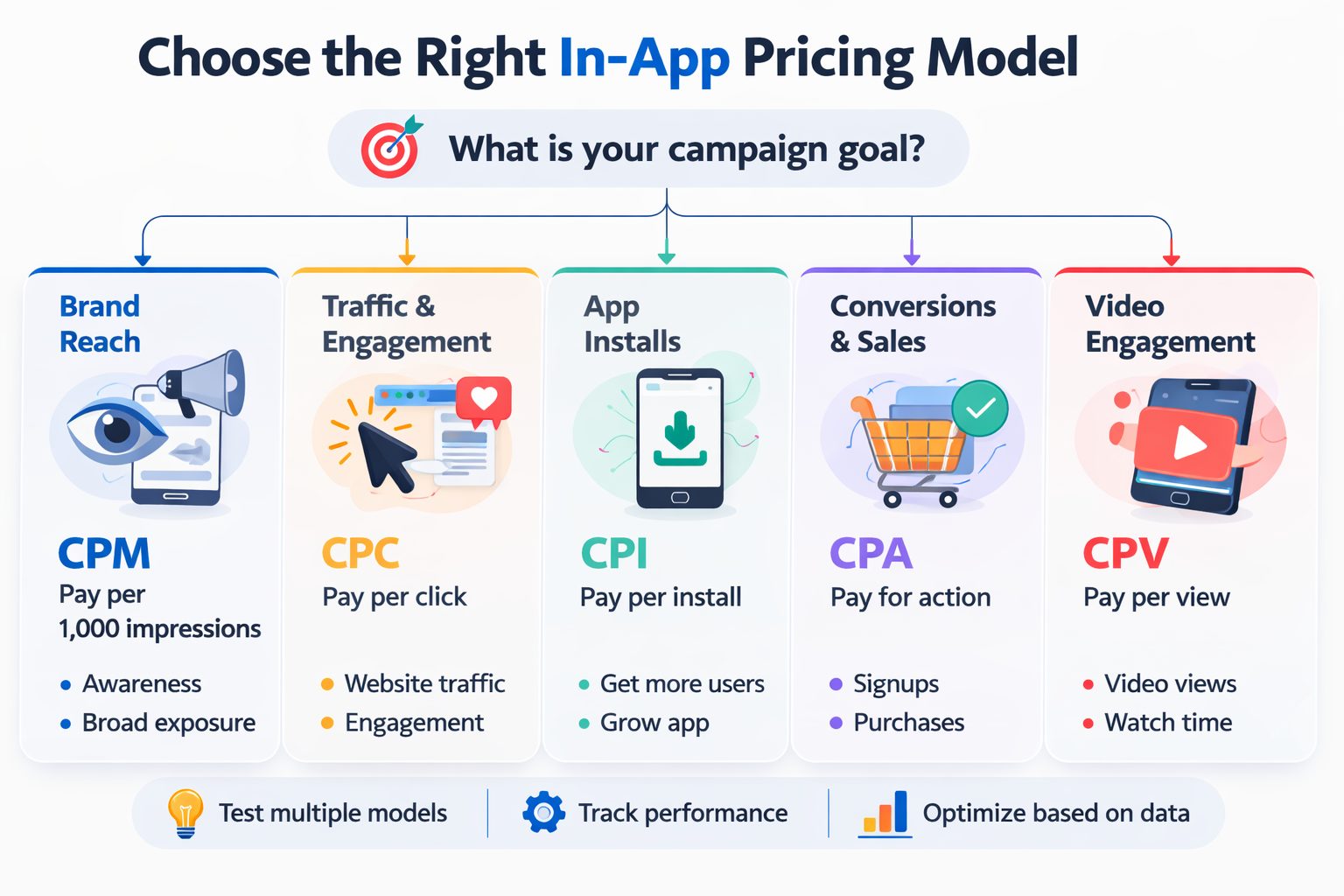
- CPM: pay per 1,000 impressions. Best for reach and awareness.
- CPC: pay per click. Best when traffic matters more than view count.
- CPA: pay when a target action happens, such as signup or purchase.
- CPI: pay per install. Common in app growth campaigns.
- CPV: pay per video view. Common in video-led app campaigns.
The right model depends on the goal. A brand campaign may prefer CPM. An install campaign may prefer CPI. A performance campaign may prefer CPA. Good buyers often test more than one. Good publishers understand how each model changes inventory value.
In-App vs Mobile Web Advertising: Key Differences
Different in-app and mobile website advertising have their respective advantages, so your decision should be based on various factors like your marketing goals, target audience and budget. Here are a few reasons why there can be an edge of in-app advertising over the mobile website advertisement in certain situations:
- Mobile app usage typically surpasses mobile website usage, leading to higher user engagement, higher click-through rates, and improved interaction with in-app advertisements.
- For mobile websites too, ad-blocking software represents an ongoing challenge that can undermine the effective delivery of traditional display to users. On the other hand, in-app ads have less barriers and can reach their target audiences.
- In addition, in-app advertisement provide a gold mine of valuable information as it has opt-in. It also allows advertisers to utilize data such as user’s device type, GPS location, age, gender, wireless carrier etc.
- In-app advertising platforms usually provide comprehensive tracking and measurement features that let advertisers analyze user behavior, conversion rates, and other performance metrics more in depth. These data allow the marketers to optimize their campaign to achieve better results.
In-app advertising occurs in the app software environment and is typically measured through SDK integrations, app events, and platform-level permissions. Because mobile web advertising runs within a browser, it is more reliant on browser behavior, website tags and browser-based identity signals.
The Advertising ID on Android is referred to by Google as a user-resettable and user-deletable advertising identifier. On iOS, Apple claims that App Tracking Transparency requires all apps to ask permission before tracking users’ activity across other companies’ apps and websites for advertising purposes. Those platform-based rules govern app advertisers’ approaches to targeting, attribution and measurement today.
The practical differences look like this:
| Factor | In-App | Mobile Web |
| Environment | Inside app | Inside browser |
| Signals | SDKs, app events, platform rules | Browser events, tags, web sessions |
| Identity controls | ATT, Advertising ID, app-level permissions | Browser privacy settings and web consent flows |
| Format flexibility | Rewarded, playable, native, video | Mostly standard web formats |
This is why in-app display advertising often behaves differently from mobile web banners. The environment changes the measurement, the user attention pattern, and the available format mix.
Mobile In-App Advertising Best Practices
Keep the intro simple: good in-app advertising comes from fit, not from forcing more ads into the screen.
Here are the basics that matter most:
- Match the format to the app session, not just the campaign brief.
- Keep ad load under control so monetization does not destroy retention.
- Use rewarded and playable formats where the app experience supports them.
- Review placement quality, not just eCPM.
- Split reporting by geography, device, app version, and audience type.
- Test creatives continuously and optimize using analytics, not gut feel.
That last point deserves emphasis. Creative testing matters more in apps because small design changes can shift completion rate, click behavior, and retention quickly. Use analytics to compare creative variants, session timing, post-click quality, and user drop-off, then keep the winners.
If you want a stronger monetization or buying setup behind these formats, BidsCube’s white label ad exchange, DSP, SSP, and white label video ad server give teams more control across the app supply chain. For outside validation, review BidsCube on Clutch and G2.
Our tech staff and AdOps are formed by the best AdTech and MarTech industry specialists with 10+ years of proven track record!

FAQ
What Is In-App Advertising?
In-app advertising refers to digital advertisements that are displayed inside of a mobile application. They are either ads shown to users when using an app (enabling advertisers to target payers in active sessions and helping owners monetize their use).
What Are the Most Popular In-App Advertising Formats?
The best known types include banners, video, native, playable, rewarded and rich media ad formats.
How Does In App Display Advertising Work?
In app display advertising is about serving visual ad units in-app experiences often integrated via SDK and employing automated buying systems. For example, in app display ad formats often encompass banners or even a more native-style based placements depending on how the application layout is setup.
What Pricing Models Are Used in In-App Advertising?
In-app advertising includes some of the most common pricing models which are CPM, CPC, CPA, CPI and CPV. Depending on the goal, whether a campaign is attempting to purchase reach, clicks, installs, actions or video views — and of course what information is already available, the correct model can then be established.
How Is In-App Advertising Different From Mobile Web Advertising?
In-app advertising occurs within app experiences and is influenced by in-app events, SDK integrations and these platform-level controls like Android Advertising ID and Apple’s App Tracking Transparency. Mobile web advertising occurs inside the browser, which means the signal set, format mix and measurement environment are different.


