



- Programmatic display buys inventory on the open web, connecting advertisers & publishers through intermediaries such as DSPs, SSPs, and RTB auctions.
- Social ads are restricted to closed platforms like Meta, TikTok, LinkedIn, and X.
- Buyers have more control over publishers, supply paths, and placement reporting with programmatic display.
- Social platforms have strong behavioral and interest signals from behavior occurring on their own products.
- Programmatic display usually works well for open-web reach, retargeting, private deals, and stringent brand safety requirements.
- Social ads that align with fast launches, social proofs, and feed-native ads.
- Many media plans use both, but each channel needs a separate job and measurement plan.
Table of Contents
- What Is Programmatic Display Advertising?
- What Are Social Ads?
- Main Differences Between Programmatic Display and Social Ads
- When Programmatic Display Fits Better
- When Social Ads Fit Better
- Can You Combine Programmatic Display and Social Ads?
- How BidsCube Can Help
- Final Thoughts
-
FAQs
- What Is the Difference Between Programmatic Display and Social Ads?
- Is Social Media Advertising a Form of Programmatic Advertising?
- When Should I Use Programmatic Display Instead of Social Ads?
- Can I Run Programmatic Display and Social Ads in the Same Campaign?
- Which Channel Offers Better Targeting: Programmatic Display or Social Ads?
- Does Programmatic Display Reach Audiences Outside Social Media Platforms?
Paid social is taking a larger share of US media budgets. MarketingCharts reports that paid social spending is forecast to rise 14.6% to $110.5 billion in 2026. Display spending is projected to reach $58.9 billion after 4.8% growth.
Those numbers one channel is not better than another. Consequently, they illustrate that marketers are purchasing two disparate and separate types of media. The decision tree between programmatic display vs social ads essentially boils down to: where ads can be seen, what audience signals a buyer can leverage, who owns the auction, and what level of placement insight is gifted to the buyer.
What Is Programmatic Display Advertising?
The automation of purchasing visual ad inventory through a demand-side platform (DSP), a supply-side platform (SSP), and an ad exchange is referred to as programmatic display advertising. A publisher serves an impression, a buyer evaluates it, and a view of RTB auction picks the winning bidder in milliseconds.
The DSP has the ability to access inventory on the open web, and can utilize first-party data, contextual signals, geographic configurations, device rule creation, retargeting lists, frequency caps, and private marketplace deals.
This is the main technical difference in programmatic display advertising vs social media ads. Programmatic buying connects independent demand and supply systems. Social buying happens inside one company’s advertising system.
For a broader look at automated and manual media buying, read Programmatic vs Non-Programmatic Advertising.
What Are Social Ads?
Social ads are paid placements sold inside social platforms. Meta, TikTok, LinkedIn, and X each run their own ad account, audience tools, auction rules, creative formats, and reporting.
These platforms can build audiences from follows, video views, clicks, profile information, engagement, and other activity that happens inside their products. A lookalike audience can then find users who resemble an advertiser’s customer list or another seed group.
The tradeoff is access. A buyer cannot take Meta’s audience graph and use it as an independent open-web data source. The same applies to placement logs and auction mechanics. This is why the social media advertising vs programmatic comparison is also a walled garden versus open web comparison.
Main Differences Between Programmatic Display and Social Ads
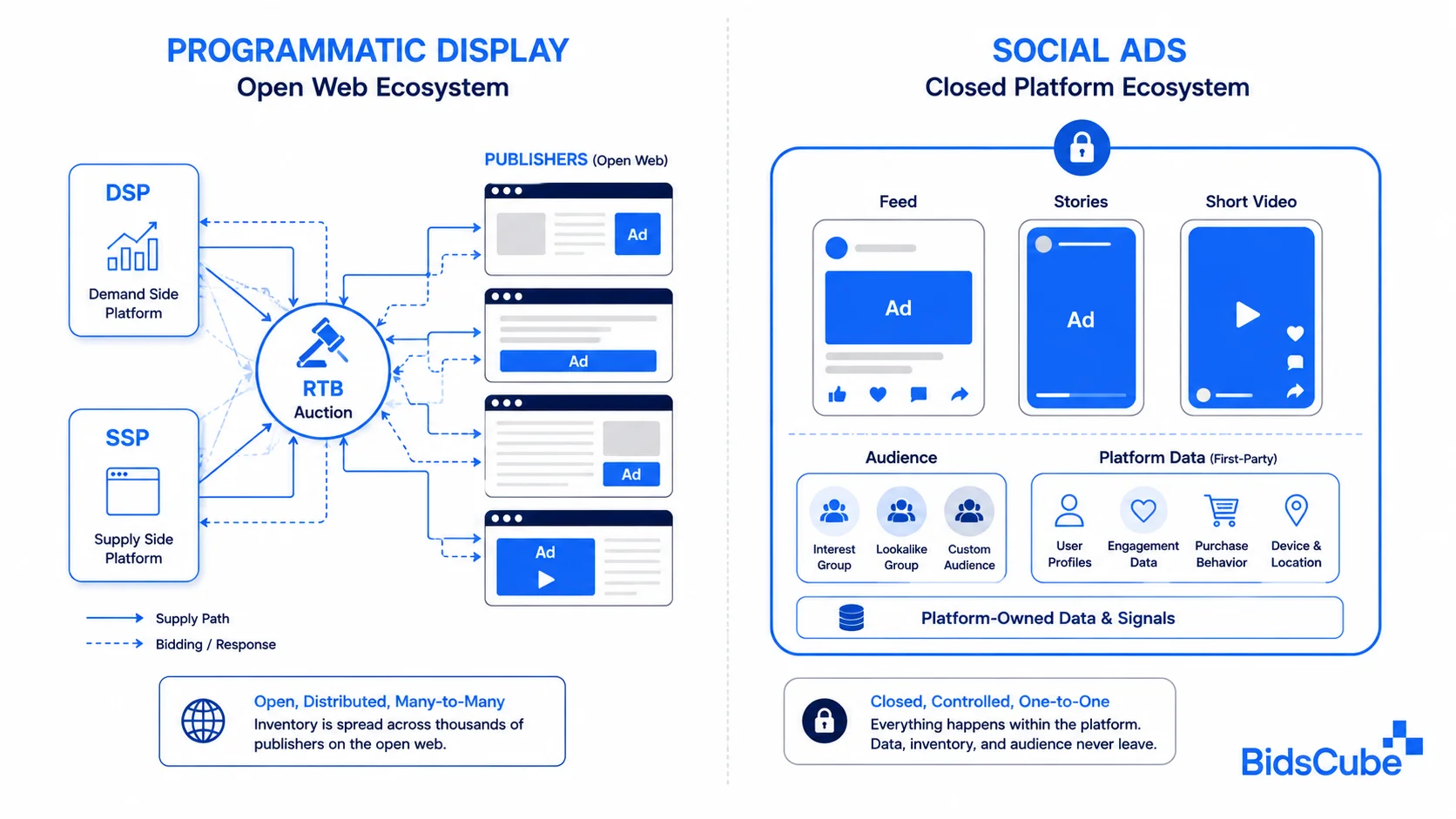
The social ads vs programmatic display comparison starts below the creative layer. Inventory, audience data, auction rules, and reporting differ before the first ad appears.
| Parameter | Programmatic Display | Social Ads |
| Inventory access | Open web through SSPs, exchanges, and private deals | Inventory owned or controlled by one social platform |
| Targeting data | First-party data, contextual signals, DSP or DMP segments, device, geography | Platform behavior, interests, engagement, profile data, lookalike audiences |
| Buying model | RTB plus private and direct programmatic deal types | Auction inside the platform ad account |
| Creative formats | Banner, rich media, native, and supported video | Feed-native ads, stories, reels, short video, cards |
| Placement reporting | Can include domain, app, supply path, and impression-level fields | Depends on what the platform reports |
| Brand safety | Allowlists, blocklists, content rules, PMPs, verification partners | Platform moderation and available placement controls |
| Setup | DSP access, supply connections, campaign configuration | Usually simpler through a self-serve platform |
| Reach | Independent publishers across sites and apps | Users inside the chosen platform |
A low CPM can still buy the wrong audience or poor placements. Price alone will not settle the choice.
Compare Media Buying Models
BidsCube has a separate breakdown of buying tools and channel fit in Media Buying Platforms Compared.
When Programmatic Display Fits Better
Programmatic display is usually the stronger choice when the campaign needs reach beyond a few large platforms.
A national advertiser may want coverage across news, business, sports, weather, and specialist publishers. A DSP can buy those impressions without separate deals with every site.
Retargeting is another common case. An advertiser can use approved first-party data to reach previous visitors while they browse other sites or apps. Frequency caps matter here. Seeing the same banner twenty times does not make the offer twenty times more convincing.
The programmatic display advertising vs social media ads decision also shifts toward programmatic when placement control matters. Buyers can review domains, apps, sellers, viewability, and supply paths, depending on the platform and connection. Third-party verification can add another check.
Private marketplace deals can provide access to selected publisher inventory without a fully manual media deal. See Direct vs Programmatic.
When Social Ads Fit Better
Social ads make sense when the platform itself is part of the campaign idea.
A product built for short video may fit TikTok or Reels better than a standard banner. Comments, likes, shares, creator posts, and saves can also add social proof that open-web display does not reproduce in the same way.
Speed is another reason. A marketer can open an ad account, choose an audience, upload creative, set a budget, and launch without arranging SSP access or learning a DSP.
Platform behavior can be useful too. Someone who watches several videos about running shoes is giving the social platform a direct behavioral signal. That signal may be harder to reproduce elsewhere.
The platform still decides what inventory exists, what data can be used, and what reports the advertiser receives.
Can You Combine Programmatic Display and Social Ads?
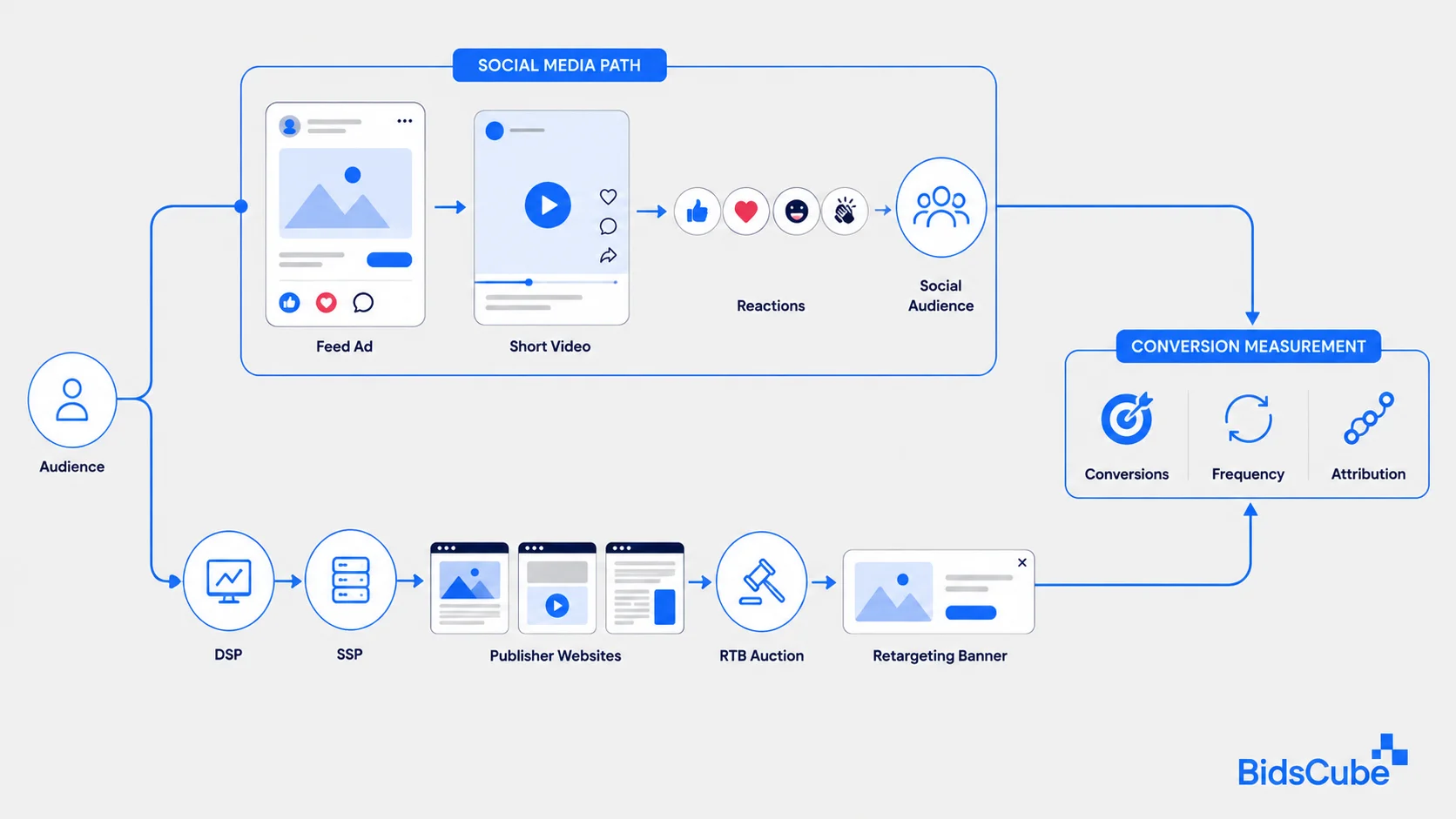
Yes. The channels can cover different moments in the same campaign.
Social may introduce a product through short video or creator-led content. Programmatic display can pick up later with open-web reach or retargeting after a site visit. The reverse can work too. A display campaign can create initial awareness, while social ads give interested users a place to watch demos, read comments, or interact with the brand.
The second social ads vs programmatic display question is not which one wins. It is which task belongs to each channel.
The same applies to social media advertising vs programmatic. Keep one conversion definition across both channels, then decide how to handle duplicated reach, assisted conversions, and frequency. Otherwise, each platform can claim the same sale.
A cross-channel plan should define:
- The job of each channel
- Audience ownership and permitted data use
- Conversion windows
- Frequency rules
- Reporting fields
- How credit is assigned when both channels touch the same buyer
See Cross-Channel Campaigns That Work for a fuller channel-planning example.
Take Buying Outside the Walled Garden
Use BidsCube for Advertisers to review open-web buying options alongside your social media plan.
How BidsCube Can Help
BidsCube gives advertisers a programmatic buying path outside closed social platforms. The BidsCube DSP supports banner, video, native, audio, and connected TV inventory across desktop and mobile. Its current product page lists more than 55 campaign settings, real-time data, retargeting, frequency caps, device rules, geo settings, and PMP deals.
The DSP added US Metro targeting and Reach and Frequency reporting for in-app campaigns in August 2026.
Companies that want a branded trading platform can look at the BidsCube White Label AdExchange. It supports banner, video, native, audio, and connected TV formats, plus real-time reporting and bidstream data access.
Start with BidsCube for the product lineup. Independent client feedback is available on the BidsCube Clutch profile.
Final Thoughts
Be careful not to arbitrarily split a media budget between them just because both are available to you! Give each one a job.
Programmatic display offers an ideal solution for open-web reach, retargeting, publisher choice, private deals, and granular supply controls. Social ads make sense as they are designed for campaigns around platform behavior, social proof, short-form creative, and rapid self-service purchases.
The second programmatic display vs social ads comparison should happen after real campaign data arrives. Compare reach, frequency, conversion quality, placement quality, and cost against the same business target. Then move budget based on what the numbers say.
Our tech staff and AdOps are formed by the best AdTech and MarTech industry specialists with 10+ years of proven track record!

FAQs
What Is the Difference Between Programmatic Display and Social Ads?
Programmatic display is the purchase of inventory throughout independent publishers through a range of DSPs, SSPs, and exchanges. For social, ads are run inside a platform that owns the inventory, audience data, auction, and reporting.
Is Social Media Advertising a Form of Programmatic Advertising?
Media buyers mostly consider social platforms as closed platforms that employ automated auctions instead of custom programmatic buying. Social companies keep the inventory and audience data on their system.
When Should I Use Programmatic Display Instead of Social Ads?
Use programmatic display when you require open-web reach, first-party retargeting, publisher-level controls, private marketplace access or supply reports.
Can I Run Programmatic Display and Social Ads in the Same Campaign?
Yes. Assign a different role for each channel and share the conversion rules. This makes it easier to have numbers reported that can be compared without duplicating the same sale.
Which Channel Offers Better Targeting: Programmatic Display or Social Ads?
Neither wins in every case. Social platforms has indeed solid signals on user actions inside their products, on the other side, programmatic display can correlate 1st party, contextual, device, geography and supply of data.
Does Programmatic Display Reach Audiences Outside Social Media Platforms?
Yes. Sum it up → Programmatic display allows you to reach users on independent websites, apps, and publisher inventory connected through SSPs and ad exchanges.


