



Significantly improving the efficiency of advertising ecosystems is a dream of almost every digital publisher. It’s great when the commercial space embedded in a website generates the maximum financial benefit by displaying ads.
Table of Contents
- Header Bidding in a Nutshell
- How Does Header Bidding Work? Step-by-Step
- History of Header Bidding
- What Makes Header Bidding Different
- Types of Header Bidding
- Benefits of Header Bidding for Publishers
- Challenges (and How to Fix Them)
- Implementation Checklist
- When to Use Header Bidding
- Key Takeaways
- FAQ
And one of the most effective ways to do so is header bidding. Header bidding is known variously as advance or pre-bidding. It is great to display ad inventory to many demand partners, and competition can increase the amount of ad revenue.
Header Bidding in a Nutshell
Keep in mind that this is a more contemporary progression to waterfall. Header bidding is a sophisticated programmatic advertising technique that allows publisher to offer their inventory to ad exchanges simultaneously so as not to have sell it through the sequential waterfall model.
Header bidding ensures that the publisher’s inventory is simultaneously available to all advertisers wanting to buy it. And the winner is determined by fair bidding. This technology enables the publisher to achieve the maximum income through first- or second-price auctions.
Embedding code snippets (JavaScript) in a site’s head section allows publishers to generate a bid request using browser resources. The auction is triggered primarily by the page header. Afterward, bids are filtered based on unique criteria, allowing the most profitable ad to be shown to the user.
How Does Header Bidding Work? Step-by-Step
Ad Monetization Publishers that are looking to optimize ad revenues should know how header bidding works. It all happens in milliseconds, but it includes multiple handoffs between publishers, advertisers and ad tech platforms.
The Auction Sequence
Here’s header bidding explained in a clear, sequential process:
- User visits the webpage — When a visitor loads a page, the header bidding script initiates before the main content loads.
- Bid requests sent simultaneously — The wrapper sends bid requests to all connected demand partners (DSPs, ad exchanges, SSPs) at once.
- Demand partners respond — Each partner evaluates the impression opportunity and returns a bid within the timeout window.
- Bids collected and ranked — The wrapper collects all responses, filters invalid bids, and identifies the highest offer.
- Winning bid sent to ad server — The top bid competes against direct-sold campaigns in the publisher’s primary ad server.
- Ad creative renders — The winning creative displays to the user.
This simultaneous approach ensures every demand source has equal opportunity to bid, unlike sequential waterfall auctions. For a deeper technical breakdown, Amazon’s header bidding guide provides additional implementation details.
History of Header Bidding
Initially, there was almost no alternative to the waterfall method in the world of digital advertising.
Let’s imagine we have traveled back to the 2000s using a time machine. What will we see if we take a closer look at the process of ad trades?
In the realm of ad tech, publishers (also known as the “supply side”) curate a roster of eligible advertisers (the “demand side”) who can bid on available ad space, commonly referred to as ad inventory. Subsequently, this inventory is auctioned off in a step-by-step ‘waterfall’ order, with each partner passing it on to the next until it’s finally sold.
However, the chain-like process can result in high latency due to the possibility that partners pass the inventory along. Additionally, the initial advertiser in the chain who places a bid may not necessarily yield the highest revenue for the publisher. The efficiency and profit from this technique must be considered low. By the late 2000s, significant changes ripened, leading to the emergence of Header Bidding.
Back in 2009, header bidding technology debuted, but it wasn’t without flaws. The early stages of header bidding were riddled with problems, including the lack of industry standards, insufficient cooperation among providers, and incomplete solutions.
Despite the presence of competitors, this tool increased its Ad Tech industry expansion thanks to several factors:
- it is a free tool that anyone can use.
- technology flexibility;
- can be used on PC, smartphones, laptops, and tablets;
- available in different formats (video, displays, native);
- excellent technical support;
- technology provides rapid growth;
- many additional functions and opportunities for analytics of the tool.
What Makes Header Bidding Different
Now that you are acquainted with pre-bidding, it will be natural to compare this technology with the waterfall method in more detail. After all, it is one of the most actively used algorithms.
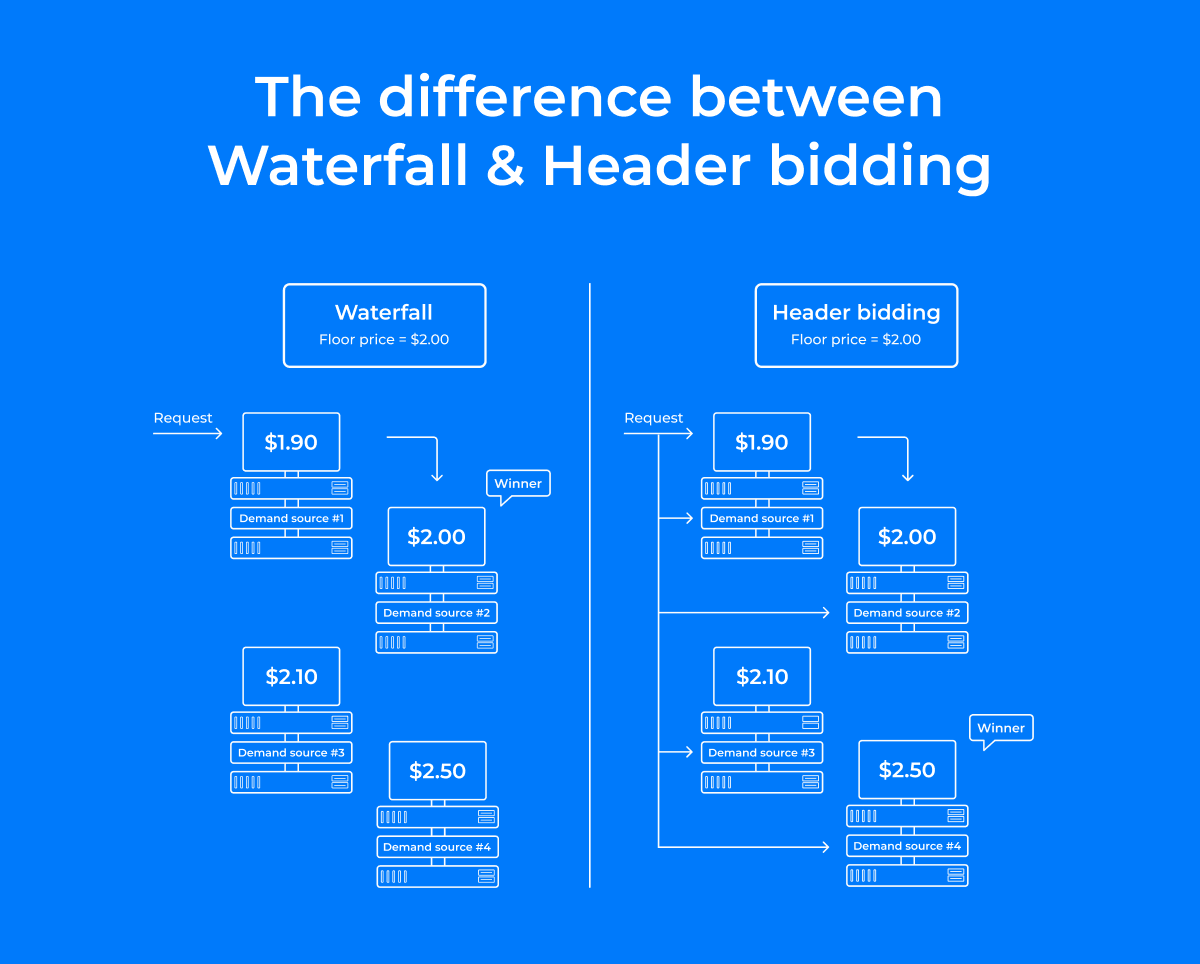
The technology aims to help all publishers increase their advertising revenue in both cases. Some of them seem similar or even identical. But the waterfall method has a severe drawback. It is the linearity of the trading system used. As a result, the technology is noticeably inferior to the more modern pre-bidding.
It’s easy to explain. For example, in waterfall bidding, the winner is the first bidder to exceed the specified minimum. But there needs to be more opportunity to get the highest price possible.
But there is an alternative – it’s pre-bidding. Since bids are made simultaneously, the highest bidder is chosen as the winner. It brings significant benefits to the publisher.
Types of Header Bidding
When exploring what is header bidding, publishers must choose between implementation methods. Each type offers distinct advantages depending on technical resources and latency tolerance.
Client-Side Header Bidding
Client-side header bidding executes entirely within the user’s browser. The JavaScript wrapper sends requests directly from the visitor’s device to demand partners.
Advantages: Higher cookie match rates, simpler setup, full transparency into bid responses.
Disadvantages: Browser limitations on concurrent requests, potential latency impact, device performance dependency.
Server-Side Header Bidding
Server-side (S2S) header bidding moves auction logic to external servers. The browser sends one request to a server, which then communicates with all demand partners.
Advantages: Faster page loads, unlimited demand partners, reduced browser strain.
Disadvantages: Lower cookie match rates (approximately 40-60% reduction), less transparency, server dependency.
Hybrid Approach
Many publishers combine both methods — running high-value partners client-side for cookie matching while moving others server-side. This balanced header bidding definition in practice optimizes both yield and performance.
| Comparison | Client-Side | Server-Side | Hybrid |
| Page speed impact | Higher | Lower | Moderate |
| Cookie match rate | 90%+ | 40-60% | 70-80% |
| Partner limit | 5-8 recommended | Unlimited | Flexible |
| Setup complexity | Low | Medium | High |
| Best for | Smaller sites | High-traffic publishers | Enterprise publishers |
Benefits of Header Bidding for Publishers
The header bidding definition centers on the mechanics of simultaneous auctions, but the real value lies in measurable business outcomes. Publishers implementing this technology typically see significant revenue improvements.
Revenue and Yield Optimization
Header bidding creates true competition for every impression. When multiple ad exchanges compete simultaneously, CPMs naturally increase.
Transparency and Control
Publishers gain complete visibility into:
- Individual bidder performance and win rates
- Actual bid values from each demand partner
- Latency contribution per bidder
- Fill rate by partner and ad unit
Improved Fill Rates
By exposing inventory to all partners simultaneously, unfilled impressions decrease significantly. Every bid request reaches maximum demand, eliminating the “pass-back” inefficiencies inherent in waterfall systems.
These benefits explain why header bidding has become the industry standard for programmatic monetization.
Challenges (and How to Fix Them)
While how header bidding works seems straightforward, implementation introduces technical challenges. Understanding these obstacles helps publishers prepare effective solutions.
Latency Management
Problem: Multiple bid requests increase page load time, potentially harming user experience and Core Web Vitals scores.
Solution: Set aggressive timeouts (200-400ms), limit client-side partners to 5-8, and consider server-side integration for additional demand. A robust video ad server can help manage video-specific latency concerns.
Technical Complexity
Problem: Wrapper configuration, adapter maintenance, and troubleshooting require specialized knowledge.
Solution: Use managed solutions or partner with experienced ad tech providers. Regular audits ensure optimal configuration.
Bid Discrepancies
Problem: Differences between SSP-reported bids and actual ad server revenue create reconciliation challenges.
Solution: Implement bid validation, monitor discrepancy rates by partner, and address outliers promptly.
Proactive management of these challenges ensures header bidding delivers maximum value without compromising site performance.
Implementation Checklist
Before launching header bidding, publishers should complete essential preparation steps. This checklist ensures smooth deployment and optimal results. With header bidding explained through practical steps, implementation becomes manageable.
Pre-Launch Requirements
- Audit current ad stack and identify integration points
- Choose initial demand partners (start with 3-5 proven SSPs)
- Configure timeout settings (300ms recommended starting point)
- Set price floors by ad unit and geography
- Establish A/B testing framework for performance comparison
- Create monitoring dashboards for key metrics
- Document fallback procedures for technical issues
Post-Launch Optimization
- Monitor latency impact weekly
- Review bidder performance monthly
- Test new demand partners quarterly
Publishers seeking implementation support can explore solutions from providers recognized on Clutch for ad tech expertise.
When to Use Header Bidding
If you’re evaluating what header bidding is in practical terms, the best question is “Will more competition improve my yield without harming speed?”
Good fit
- You sell meaningful programmatic volume and have multiple demand sources.
- Your inventory has enough scale for partner testing and optimization.
- You can invest in monitoring (latency + revenue + viewability) and iteration.
When to wait
- Your site struggles with performance already or has fragile ad rendering.
- You rely heavily on direct deals and haven’t locked down ad-server priority logic.
- You can’t support ongoing bidder governance (it’s not a set-and-forget system).
For publishers meeting ideal criteria, header bidding typically becomes the foundation of programmatic strategy. Review user feedback on G2 to understand real-world implementation experiences.
Key Takeaways
Header bidding is an advanced ad-serving software technology that enables publishers to offer their inventory to multiple advertising networks or exchanges simultaneously, unlike the step-by-step waterfall method.
Our tech staff and AdOps are formed by the best AdTech and MarTech industry specialists with 10+ years of proven track record! 
According to recent statistics, over 80% of top websites in the United States and approximately 50% of publishers in the country can generate higher revenue per 1,000 ad impressions with header bidding. Although header bidding emerged in 2009, it had several limitations. The advantages of this ground-breaking technology are: higher publisher yield, better fill rate, greater transparency and control over how much gets paid to the publisher.
Are you a publisher looking to maximize your revenue?
Request a free demo of BidsCube SSP and discover the power of Header Bidding or Header Bidding & RTB combination.
FAQ
How many bidders should I start with?
Start with 5–8 strong bidders per placement so you can measure lift and latency cleanly. Add partners only when incremental revenue beats the added page cost.
What timeout should I set?
Set a conservative timeout first, then tune by device. Many publishers begin in the 600–1,200 ms range for client-side and adjust after measuring bid response curves and page performance.
Does header bidding hurt Core Web Vitals?
It’s possible, if client-side requests and JS execution don’t have any constraints on them. Bidder caps, reduce timeouts (on slower devices), defer non-critical work, consider server-side / hybrid for heavy placements etc.
Can I run header bidding with direct deals?
Yes. Direct deals can stay in your ad server and still win via priority rules. The key is aligning floors and line-item priorities so direct revenue goals stay protected.
Client-side vs server-side: what should I pick?
If you’re asking how does header bidding work differently by type: client-side favors match rate and simplicity, while server-side favors scale and browser performance. Hybrid often wins when you keep “must-match” partners client-side and shift the rest server-side.


