



- In header bidding, multiple SSPs can bid for ad space before the publisher ad server ultimately makes a decision.
- Google Open Bidding works server-to-server inside Google Ad Manager.
- Client-side bidding can enable higher identity match rates, but it may create browser work.
- By reducing client-side load, Open Bidding can simplify trafficking, billing, and reporting.
- Publishers have more control over partners, timeouts, auction rules and analytics with header bidding.
- Not every publisher will have a higher net RPM under either model.
- A hybrid often works best when every demand path proves incremental value.
Table of Contents
- What Is Header Bidding?
- What Is Open Bidding (Google)?
- How Each Auction Works: Step-by-Step Comparison
- Header Bidding vs Open Bidding: Comparison Table
- Which Setup Earns Publishers More?
- How BidsCube Can Help
- Final Thoughts
-
FAQs
- What Is the Difference Between Header Bidding and Open Bidding?
- Which Earns More Revenue: Header Bidding or Open Bidding?
- Does Open Bidding Replace Header Bidding?
- Can Publishers Use Header Bidding and Open Bidding Together?
- Why Does Header Bidding Usually Have Higher CPMs?
- What Is a Unified Auction in Programmatic Advertising?
The open bidding vs header bidding debate starts with the one common goal that every publisher has: To maximize revenue from every page view, without affecting speed, viewability, or ruining the reader experience.
The old waterfall logic was replaced by header bidding most of the time. Rather than chaining demand partners together, a wrapper allows multiple SSPs to bid in competition for serving by the ad server.
For context, first read Header Bidding vs. Waterfall: Key Differences.
Just a few months after this, Google set out Exchange Bidding (now Open Bidding), a server-side approach using Google Ad Manager. Each of these systems drives more competition, with different auction paths and control for the publisher.
Header bidding had already reached broad adoption by March 2019.
- EMARKETER reported that 79.2% of the top 1,000 sites selling programmatic inventory used it at that point.
- Statista has continued to track adoption in later measurements.
The practical question is which setup produces the highest net RPM after fees, timeouts, match-rate losses, latency, and operating costs. A comparison of open bidding and header bidding must use publisher revenue, not the largest visible bid.
What Is Header Bidding?
Header bidding is a programmatic auction method that collects bids from several SSPs and exchanges before the main ad server makes its decision.
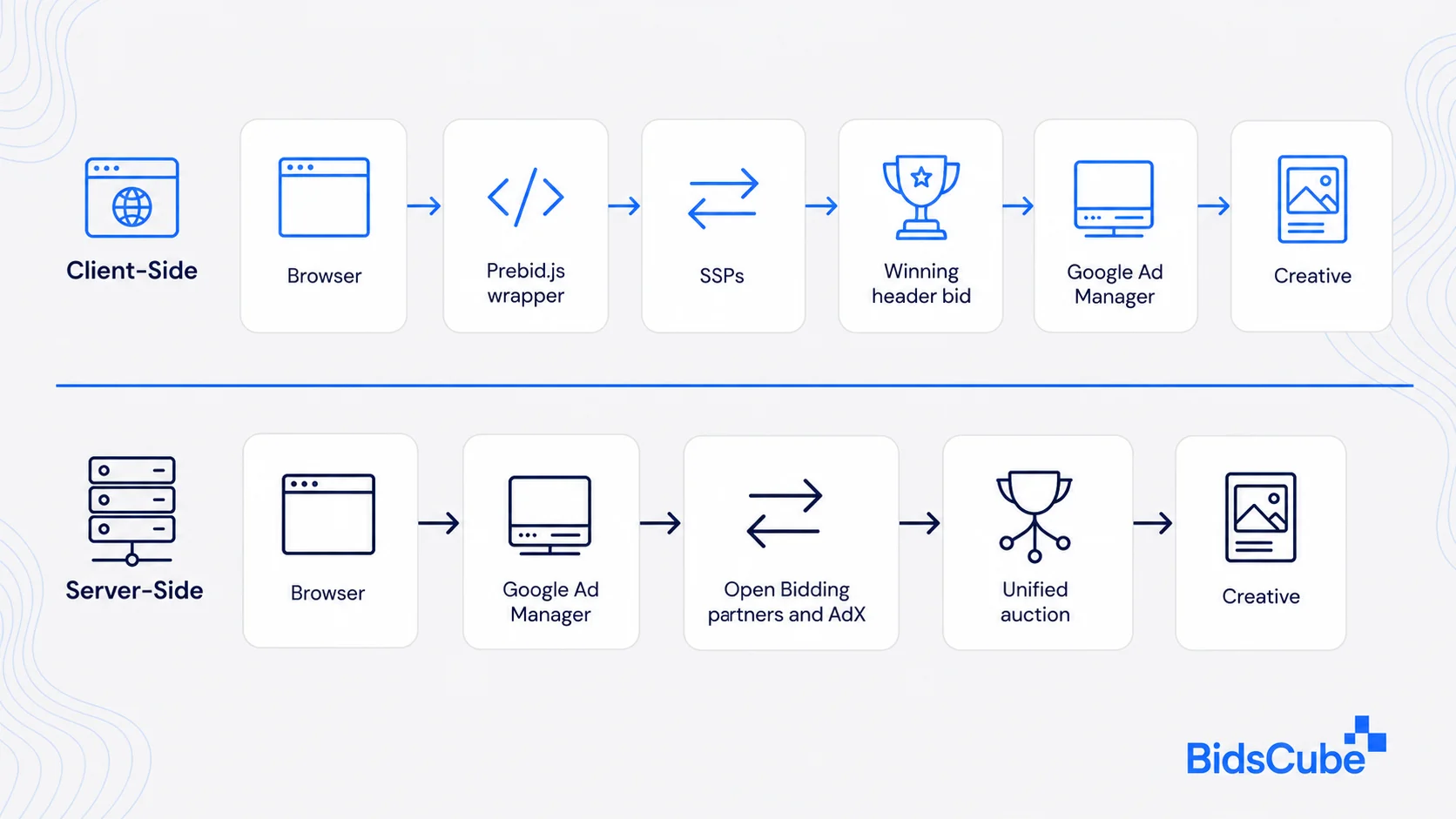
In a client-side setup, a JavaScript wrapper runs in the browser. Prebid.js is the best-known open-source option. The wrapper calls selected bidders in parallel, collects responses within a fixed timeout, and passes price data to the ad server.
Prebid.js pauses the ad server call, requests bids, and passes bid data to the ad server. It supports more than 300 demand sources and more than 50 analytics adapters.
Publishers can also use Prebid Server. Many keep strong partners client-side and move other bidders server-side.
A wrapper gives the publisher control over:
- Demand partners and auction timeout
- Ad units, sizes, and price granularity
- Floor price and identity rules
- Analytics adapters
Header bidding creates an earlier auction whose result can compete with direct campaigns, Google demand, and other eligible line items. Read Header Bidding and Prebid Explained before selecting bidders, timeouts, and analytics tools.
What Is Open Bidding (Google)?
Open Bidding is a Google Ad Manager feature that lets approved third-party exchanges and SSPs bid through a server-to-server connection.
Google Ad Manager identifies eligible yield partners, requests bids, and compares the responses with Ad Exchange and qualifying line items in a unified real-time auction.
Publishers manage the setup through yield groups and apply targeting for inventory, format, geography, platform, and other criteria.
The main operational benefits include:
- Fewer bidder calls from the browser
- Centralized trafficking and reporting
- Standard consolidated billing
- Direct competition with Google demand across web, app, and video
Open Bidding now works for publishers using Ad Exchange in Google Ad Manager. Publishers must accept the terms, complete a bidder agreement, and receive approval. Some teams use the phrase continuous open bidding for always-on server-side competition. Google does not use this as the official product name.
How Each Auction Works: Step-by-Step Comparison
Both models increase competition for publisher inventory, but they route bid requests differently. Header bidding starts outside Google Ad Manager, while Open Bidding runs inside it.
Header Bidding Auction Flow
Header bidding collects bids from several SSPs before the ad server makes its final choice. The wrapper manages bidder calls, response timing, and bid values.
- A user opens a publisher page.
- The wrapper identifies eligible ad units and bidders.
- It sends parallel requests to several SSPs.
- Each SSP runs its own demand auction and returns a bid.
- The wrapper accepts valid responses received before the timeout.
- Bid values pass to the ad server.
- The ad server compares the strongest header bid with other eligible demand.
- The winning creative loads.
A server-side wrapper follows similar logic, but the browser sends one request to the auction service. That service contacts the selected bidders and returns their responses.
Open Bidding Auction Flow
Open Bidding moves third-party bidder requests into Google Ad Manager. Google compares eligible partner bids with Ad Exchange and other qualifying demand in one auction.
- A user opens a page or app.
- The request goes to Google Ad Manager through the relevant tag or SDK.
- Ad Manager finds eligible yield groups and line items.
- It sends server-to-server bidding requests to approved bidders.
- Each partner returns its strongest bid.
- Ad Manager compares those bids with Ad Exchange and eligible line items.
- The highest qualifying net bid wins.
- Ad Manager returns the creative.
Google sends one request to an eligible partner even when several matching yield groups include the same bidder. Partners cannot see competing bids before the auction closes.
Header Bidding vs Open Bidding: Comparison Table
The table below compares auction location, browser load, identity access, publisher control, fees, demand access, and payments. Results vary by setup, so publishers should compare net revenue, latency, and reporting detail.
| Parameter | Header Bidding | Open Bidding |
| Auction location | Browser, server-side wrapper, or hybrid | Server-side inside Google Ad Manager |
| Browser impact | Can rise as client-side bidders and scripts are added | Usually lower because Ad Manager handles bidder calls server-side |
| Identity access | Client-side bidders often have better browser cookie access | Server-to-server identity matching may be weaker for some bidders |
| Publisher control | Direct control over bidders, timeout, wrapper rules, and analytics | Google controls the central auction and bidder onboarding |
| Transparency | Wrapper and bidder analytics can provide detailed bid data | Google reports bidder performance, but it controls the auction mechanics |
| Fees | No Google Open Bidding fee, but SSP, wrapper, hosting, and service fees may apply | Standard payments are net of Google’s revenue share |
| Setup | Requires wrapper work, ad server mapping, testing, and upkeep | Easier to manage after a bidder receives approval |
| Demand access | Broad choice of wrapper adapters and SSP partners | Limited to bidders available through Google |
| Payments | Publisher usually manages separate partner contracts | Google usually handles payment under the standard model |
Open Bidding Direct Pay is a beta option for eligible Ad Manager 360 publishers and supported SSPs. Google charges a flat CPM fee instead of its usual revenue share.
The open bidding vs header bidding comparison also changes by implementation.
Audit the Monetization Stack
Review BidsCube for Publishers to compare demand access, reporting, ad quality, and inventory controls.
Client-side Prebid and Prebid Server do not produce identical results, and each Open Bidding partner brings different demand.
Which Setup Earns Publishers More?
There is no universal winner. The answer depends on audience, geography, format, browser, consent rate, SSP mix, page design, and Google Ad Manager settings.
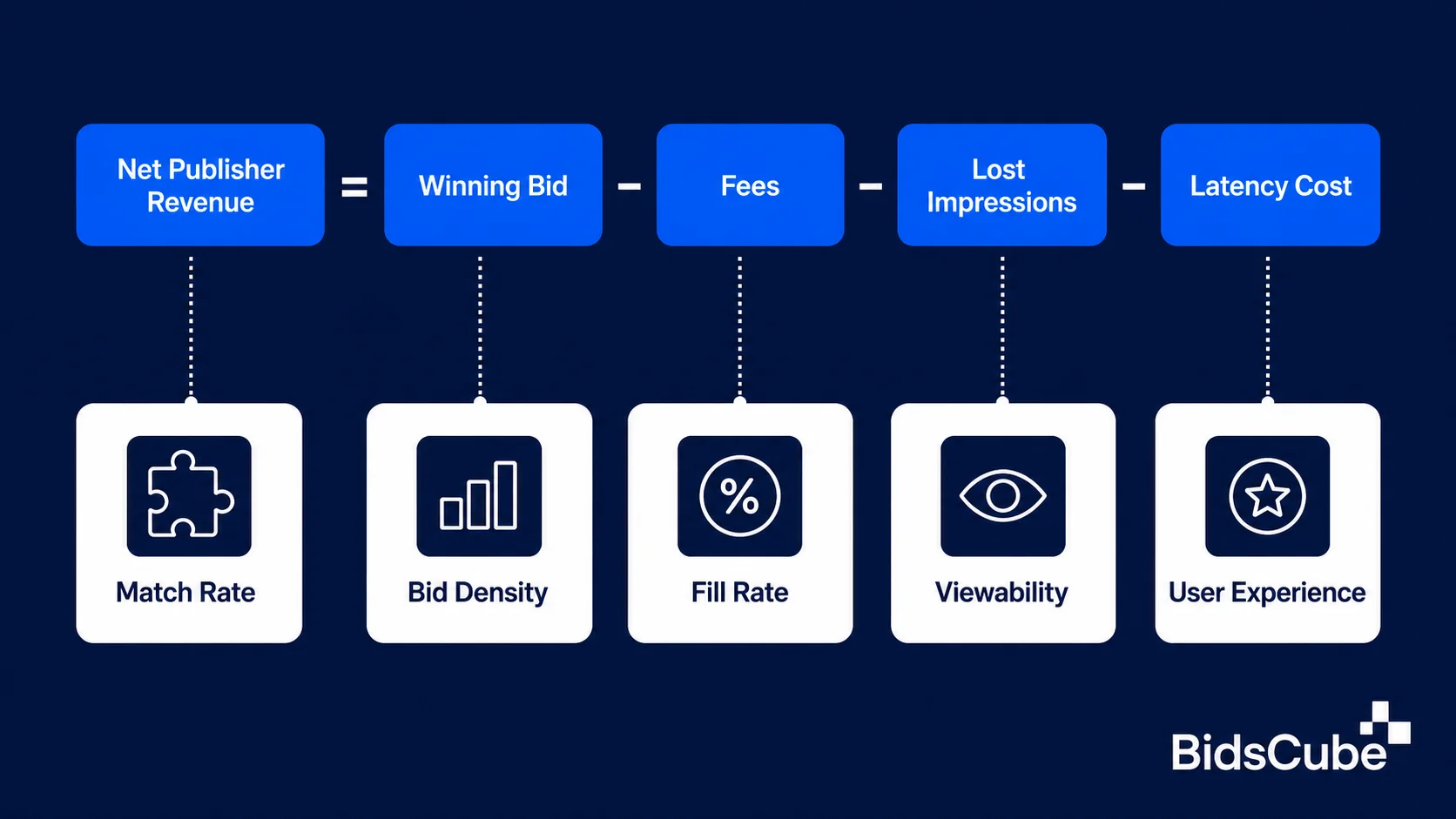
Client-side header bidding can produce stronger bids for browser inventory because bidders may access supported browser identifiers more directly. Prebid notes that server-side bidders can bid less often or at lower CPMs when user matching becomes weaker.
Client-side bidding does not always earn more. A large wrapper can delay calls, miss timeouts, reduce viewability, and burden the device. Several SSPs may also reach the same buyers.
Open Bidding can win when lower browser load helps more auctions finish on time. Google also handles bidder calls, reports, policy checks, and standard payments.
However, standard Open Bidding revenue is reported after Google’s revenue share. Google selects the winner based on net expected value to the publisher, rather than the highest gross exchange bid alone.
Publishers choosing header bidding or open bidding should test:
- Net RPM and net CPM
- Bid, win, and fill rates
- Timeout rate and latency
- Viewability
- Revenue per session
- Ad quality incidents
A high CPM with weak fill can lower RPM. Faster delivery and better viewability may earn more at a lower CPM. Net yield also depends on partner fees, infrastructure costs, payment terms, and the share of the sell-side stack the publisher controls. Read The Real Economics of SSP Ownership for a closer look at those cost factors.
Why a Hybrid Setup Is Often Optimal
Many publishers use both systems. They keep valuable client-side connections and move other demand server-side.
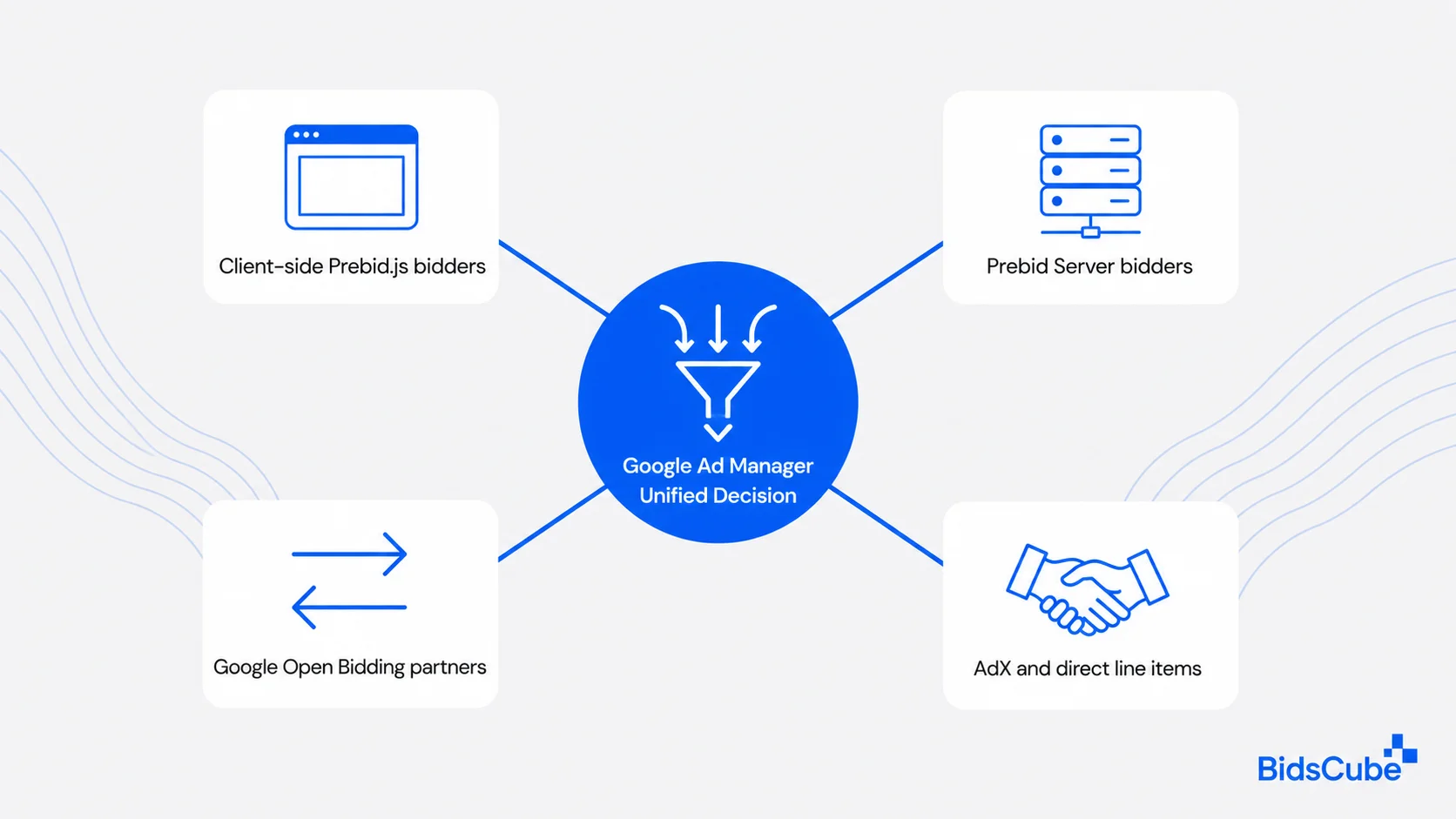
In a typical hybrid, selected SSPs bid through Prebid.js. Other partners may run through Prebid Server or Google Open Bidding. Google Ad Manager compares the strongest header bid with AdX, eligible Open Bidding demand, and qualifying direct campaigns.
This structure can provide:
- Better identity access for selected bidders
- Lower browser load for server-side partners
- Broader SSP and Google demand
- Separate paths for web, app, and video
Hybrid does not mean adding every bidder. Several SSPs may route the same advertiser, creating duplicate auctions without new demand.
Remove partners that add little net RPM, miss timeouts, or produce poor creatives. Split results by geography, browser, device, and format.
The open bidding or header bidding choice becomes a routing decision: client-side, server-side, or removed. Read Why Hybrid Does Not Always Mean Better for the operational tradeoffs.
How BidsCube Can Help
BidsCube provides an SSP for publishers. The BidsCube SSP supports banner, video, native, audio, desktop, mobile, and connected TV inventory. BidsCube materials also list header bidding, OpenRTB, VAST, SDK, and tag-based connections.
Publishers can connect BidsCube through a wrapper and compare its demand with current partners. BidsCube states that its Prebid.js adapter supports side-by-side testing, while bidstream exports and reports can support custom yield analysis.
The SSP provides real-time reports, inventory controls, demand connections, and traffic routing for tracking RPM, fill, and bid density.
A direct BidsCube Open Bidding connection should not be assumed. Google’s current online onboarding list does not show BidsCube. Eligibility depends on Google and current account options.
BidsCube can still operate alongside Open Bidding through a wrapper or OpenRTB path. Its header bid can compete in Google Ad Manager against AdX, Open Bidding partners, and direct demand.
When evaluating open bidding and header bidding, publishers should ask every SSP:
- Does the connection add unique demand?
- What fees apply?
- Which regions and browsers perform best?
- What bid-level data can the publisher export?
- How does the partner handle consent, matching, and timeouts?
Read Which Publishers Benefit Most From BidsCube SSP and review BidsCube on Clutch during vendor checks.
Expert View
Auction results can differ by browser, device, geography, and demand partner. Dmitriy Iliashenko explains why publishers should test multiple connection paths rather than using a single setup for all traffic.
Publishers should test auction paths by browser, device, and geography. A bidder may deserve a client-side connection in one segment and a server-side path in another.
Dmitriy Iliashenko, Chief Technology Officer at BidsCube
This testing approach helps publishers assign each bidder to the route where it performs best. Some partners may benefit from client-side access, while others may work better through server-side bidding.
Final Thoughts
The choice between open bidding or header bidding has no fixed winner. Header bidding can provide more control and stronger client-side match rates, while Open Bidding can reduce browser work and make operations easier inside Google Ad Manager.
A hybrid can earn more when publishers keep only productive partners and judge every path by net RPM. Start with controlled tests, track latency and ad quality alongside revenue, and remove demand paths that do not add incremental value. Review the BidsCube SSP to test programmatic demand and measure publisher yield in real time. Contact us for more insights from our experts.
Our tech staff and AdOps are formed by the best AdTech and MarTech industry specialists with 10+ years of proven track record!

FAQs
What Is the Difference Between Header Bidding and Open Bidding?
Header bidding is an SSP independent wrapper that allows publishers to gather bids from SSPS before the ad server fires. It uses server-to-server calls directly inside Google Ad Manager to show open accounts of third-party bidders compared to Google demand, called Open Bidding.
Which Earns More Revenue: Header Bidding or Open Bidding?
When more accurate identity matching boosts bid rates and CPMs, client-side header bidding can earn an even higher number. Open Bidding can earn more when reduced browser load, fewer timeouts, and easier operations outweigh its fees and match-rate limits.
Does Open Bidding Replace Header Bidding?
Open Bidding does not replace header bidding in every publisher stack. The two models can serve different partners and compete through Google Ad Manager.
Can Publishers Use Header Bidding and Open Bidding Together?
Using both systems in one monetization setup is possible for publishers. Google Ad Manager can compare the winning header bid with AdX, approved third-party bidders, and eligible direct line items.
Why Does Header Bidding Usually Have Higher CPMs?
Client-side header bidding may produce higher CPMs because bidders can access supported browser identity signals more directly. By browser, consent status, geography, bidder and the slow elimination of third-party cookies, the result differs.
What Is a Unified Auction in Programmatic Advertising?
A unified auction compares eligible demand sources at the same decision point instead of placing them in a fixed waterfall. Google Ad Manager compares third-party yield bids, Ad Exchange demand, and eligible line


