



With third-party cookies disappearing, marketers need new ways to target audiences. This guide covers real-world strategies like first-party data and contextual ads that respect user privacy while driving results.
Table of Contents
- Why Third‑Party Cookies Are Vanishing
- The Impact on Digital Marketing Without Cookies
- Alternative Tracking Methods for Advertisers
- First‑Party Data: A Lifeline in a Cookieless World
- Contextual Advertising as a Solution
- Privacy‑First Strategies for Advertisers
- Expert Insight
- Measuring Success in a Cookieless Environment
- Final Thoughts: Thriving Without Third‑Party Cookies
-
FAQ
- What is cookieless advertising and how does it differ from traditional cookie‑based advertising?
- What practical alternatives exist for targeting and measuring effectiveness without third‑party cookies?
- How can I collect and use first‑party data to run effective campaigns in a cookie‑free environment?
- How legal and privacy‑compliant are solutions like universal ids, privacy sandbox or device fingerprinting?
- How can I retarget audiences and track conversions without cookies, and which tools help achieve this?
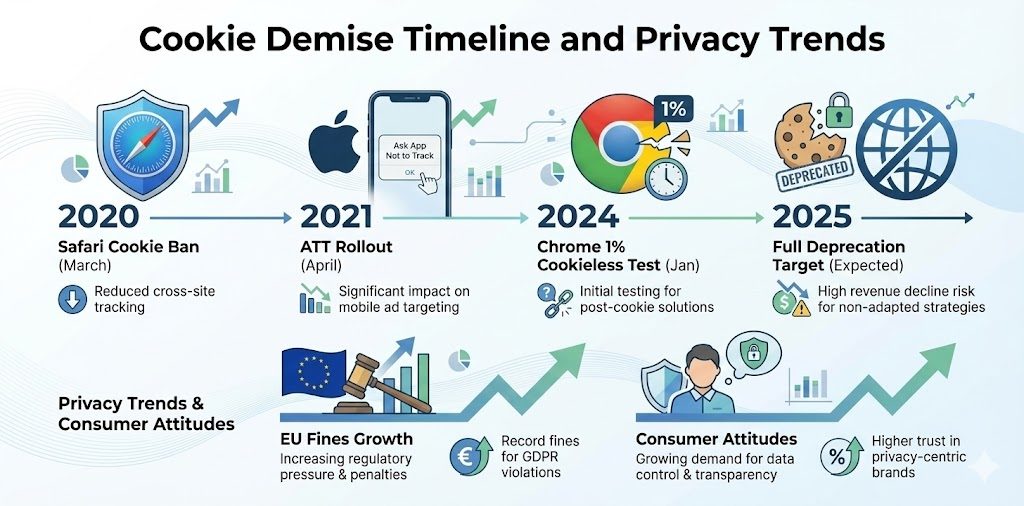
Marketing without third party cookies is an artform. The advertising industry faces a major transformation because major browsers have decided to eliminate third-party cookies. Chrome plans to delete all cookies from user devices through a 2025 deadline after testing this feature with 30 million users, although Safari and Firefox already disable cookies by default.
- Studies estimate that publishers would experience a loss of 20–60% in their advertising revenue when replacement solutions do not perform as expected.
- The public has started to express their opinions because more than 79% of U.S. adults want better control over their personal data and nearly 40% of global population uses browsers which block cookies.
In this new reality, marketers must find ways to target and measure campaigns without third‑party cookies.
This guide explains how to handle the difficulties of operating without cookies while describing new tracking solutions and privacy-focused methods which maintain performance. The final section will teach you to advertise without cookies through first-party data and contextual signals and demonstrate how to establish trust while achieving your business objectives.
Why Third‑Party Cookies Are Vanishing
Growing Privacy Concerns and Regulations
Third‑party cookies have enabled advertisers to track users throughout the internet while they create extensive user profiles without obtaining any form of permission. The regulatory response included the implementation of strict data protection regulations which included the General Data Protection Regulation (GDPR) in the EU and California’s Consumer Privacy Act (CCPA). The GDPR enforcement authority has issued €5.88 billion in penalties through 2025 while maintaining the authority to impose penalties that reach up to 4% of worldwide business revenue.
Browser and Platform Changes
Safari and Firefox started blocking cookies by default when they first implemented this feature. Google has also joined this trend because Chrome currently tests cookie deprecation on 1% of traffic while it plans to activate this feature for all users during late 2025. The operating systems and browsers which focus on privacy protection prevent devices from revealing their identifiers and stop fingerprinting activities.
The App Tracking Transparency (ATT) framework from Apple for iOS devices needs users to authorize cross-app tracking activities. The marketing industry now needs to abandon its dependence on third-party cookies because these cookies no longer function for audience identification or targeting or measurement purposes.
Consumer Sentiment
User trust is at an all‑time low. Surveys show only about one‑third of consumers believe brands use their data responsibly, yet 71% still expect personalised marketing. Consumers are bombarded by consent banners the average person sees three or more cookie notices each week leading to frustration and “banner blindness.” Marketers must therefore balance personalisation with respect for privacy to maintain brand credibility.
The Impact on Digital Marketing Without Cookies
Targeting Challenges
Through cookies advertisers gain the ability to track users between different websites while they can also use cookies to show targeted ads based on previous site visits and create new audience segments that match existing customer profiles. Without cookies, impression matching becomes harder.
Early tests reveal CPMs (cost per thousand impressions) can drop by 30% for cookieless Chrome traffic and 60% on Safari, indicating fewer bidders and lower competition. Some publishers fear revenue declines of up to 60% if measurement and targeting alternatives don’t mature.
Attribution and Measurement Gaps
Multi‑touch attribution models that depended on third‑party cookies are breaking. The blocking of cookies by Safari led advertisers to report decreased conversion rates although their sales numbers remained unchanged. The absence of cross-site identifiers makes it challenging to monitor how users move from viewing ads to making purchases which impacts both advertising budget management and advertising performance evaluation. Advertisers need to discover fresh measurement approaches which include probabilistic modelling and clean-room solutions.
Rising Costs and Opportunities
First‑party data collection and advanced analytics require investment. Small brands face challenges when building data infrastructure because they need to spend money on this development but giants like Google and Meta and Amazon already have user consent which gives them an advantage. The cookieless shift presents organizations with both negative impacts and positive prospects.
Brands which establish direct connections with customers while protecting their privacy information will develop stronger customer loyalty and obtain trustworthy customer data and achieve market distinction. The advertising method which uses website content instead of user browsing records has become popular again while delivering better advertising results than Behavioural Targeting does.
Alternative Tracking Methods for Advertisers
The decline of cookies requires marketers to select new tracking solutions which deliver both operational effectiveness and user privacy protection. The table below compares common methods used to deliver cookieless ads and measure results. Each approach has advantages and limitations.
| Approach | Description | Advantages | Limitations |
| First-Party Daata | Information collected directly from users via logins, subscriptions, surveys, and purchases. | Highly accurate and consent‑based; improves retention by 2.9× and ROI by 1.5× when used well; compliant with privacy laws. | Requires a value exchange (e.g., loyalty perks); limited scale if audience base is small; requires robust data governance. |
| Contextual Targeting | Serves ads based on page or content context rather than user history. AI analyses keywords, sentiment, or topics to match ads to relevant content. | Doesn’t rely on personal data; offers higher engagement, better recall and cost efficiency; 79% of consumers prefer contextual ads. | Less precise for niche products; depends on accurate page classification; limited cross‑site sequencing. |
| Server-Side Tracking (S2S) | Moves tracking logic from browsers to servers. Events are sent from the website server directly to analytics platforms, bypassing the user’s device. | Improves data quality by 41% and ensures 67% of B2B businesses maintain measurement after cookie loss; centralises consent enforcement. | Implementation complexity; still requires user consent; cannot follow users across unrelated sites. |
| Universal IDs / Hashed Emails | Alternative identifiers created from hashed email addresses or phone numbers. Examples include Unified ID 2.0, RampID, and other login‑based IDs. | Enable cross‑site targeting within participating networks; provide higher match rates than cookies; can reduce advertiser ad spend waste. | Depend on opt‑in login systems; patchy adoption (only 32% of buyers use Privacy Sandbox tools); still face regulatory scrutiny. |
| Privacy Sandbox (Topics, Protected Audience API) | Google has launched a program which aims to replace third-party cookies with interest cohorts and remarketing audiences that users can store directly on their devices. | The system functions to stop tracking of specific users while it shows appropriate advertisements to users who remain anonymous. | The tests revealed that publishers would experience longer page loading times and their revenue would decrease by as much as 60% but the number of users who adopted this change remains minimal and the overall result remains unknown. |
| Device Fingerprinting | Identifies users based on device attributes (browser, OS, fonts). Often used when cookies are blocked. | Works behind the scenes; can identify repeat visits without cookies. | Considered intrusive; requires explicit consent; flagged by regulators as risky; may soon be restricted. |
First‑Party Data: A Lifeline in a Cookieless World
Third‑party cookies made it easy to rent an audience. Now brands must build their own audience targeting without cookies. First‑party data is information collected directly from customers with their permission. It includes email sign‑ups, purchase history, loyalty program participation, and behavioural signals on owned channels (website, app, social). When used responsibly, first‑party data improves customer retention and marketing ROI.
Collecting First‑Party Data Ethically
- Value Exchange: The company should provide valuable rewards to customers who share their data through discounts and exclusive content and personalized services.
- Clear Consent: The process requires users to understand which data points the system collects together with the purposes of data collection and all subsequent usage procedures. The system should prevent users from encountering dark patterns and should present legal terms in a clear and simple manner.
- Data Minimisation: Collect only what you need. The practice of collecting more data than needed creates two major problems which include higher storage expenses and elevated risks for non-compliance.
- Security and Compliance: The system requires secure storage of data while it must honor all requests for user opt-out selection. The systems must follow all requirements from GDPR and CCPA and every other applicable local privacy law.
Using First‑Party Data for Targeting
The collected data should be used to create customer segments which focus on customer behavior patterns (high-value buyers and frequent browsers and infrequent purchasers). The segments need to connect with the messaging and creative elements. The system should send re-engagement emails to subscribers who have not active for some time by showing them individual product suggestions. The integration of CRM data with BidsCube DSP enables you to run programmatic campaigns through segment activation while you control bidding parameters and campaign frequency and performance tracking.
Contextual Advertising as a Solution
The advertising method known as contextual advertising existed before cookies became popular and it now receives increased interest from users. The system operates by matching advertisements to the information which appears on web pages instead of tracking user activities. A running shoe advertisement appears on a fitness article while a hotel advertisement displays on a travel blog.
AI technology in modern contextual systems enables them to analyze both tone and sentiment and identify specific topics. Research indicates that this approach generates 50% better click-through rates while it boosts purchase intent by 63%. The consumer market shows preference for this approach because 79% of users find contextual advertisements relevant and these ads generate 30% better conversion results.
Marketers can achieve the highest contextual impact through:
- Aligning Creative to Content: Tailor visuals and copy to complement the environment. Show a nutritious recipe banner next to an article on healthy eating rather than a generic brand ad.
- Testing Formats: The research should use contextual display and video and CTV placements to determine which format produces the best results. AI‑driven contextual targeting enables systems to detect optimal viewing times for sports drink advertisements which should appear immediately following workout scenes on screen.
- Combining Signals: Blend first‑party data with contextual signals. The system enables users to match page content with their target audience segments which include regular customers for creating messages that match their needs while protecting their personal information.
If you run your own video campaigns, a white‑label video ad server like BidsCube’s Video Ad Server can power contextual video delivery across websites and connected TV while keeping your brand front and centre.
Privacy‑First Strategies for Advertisers
Advertisers need to use privacy-friendly methods which deliver results in order to succeed under cookieless browsing conditions. The following section presents functional methods which users can apply.
- Prioritize transparency and consent. Make opt‑in and data usage clear. The system should use basic terminology instead of using deceptive consent messages. Research indicates that users develop trust issues because they must respond to numerous pop-up messages which appear throughout their weekly activities. The system should provide users with specific selection options between marketing email reception and analytics tracking while respecting their chosen preferences.
- Lean into first‑party data. The system should promote users to create accounts and purchase subscriptions and join loyalty reward programs. The organization should focus on obtaining zero-party data which users provide voluntarily through surveys and interactive experiences. Organizations which dedicate resources to first-party data acquisition achieve improved customer maintenance and enhanced marketing return on investment.
- Embrace contextual targeting. Use AI‑driven systems to align ads with content and sentiment. Contextual ads offer a privacy‑safe, high‑performance alternative to behavioural targeting. They also improve brand safety and fit across web, app, audio, and CTV.
- Test alternative identifiers. Evaluate Universal IDs, hashed emails, and Privacy Sandbox proposals. Adopt them where they complement first‑party data strategies. Remember that adoption is still low (only 32% of buyers are using Google’s Privacy Sandbox tools) and performance varies. Monitor evolving regulations.
- Focus on user experience. Limit ad frequency, shorten load times, and avoid intrusive formats. A smooth experience keeps users engaged and reduces ad‑blocker usage.
Expert Insight
Roman Vasyukov, CEO and Founder of BidsCube, believes the path forward lies in connecting technology with long‑term business outcomes. He notes:
Great programmatic partners do more than provide technology. They help you connect the dots between data, creative and business outcomes.
This mindset is vital for the privacy‑first era: delivering relevant ads means aligning first‑party insights, contextual signals and measurement frameworks in a transparent, user‑centred manner. To evaluate technology partners, look for vendors with strong privacy credentials and positive peer reviews; browse BidsCube’s profile on Clutch and independent reviews on G2 before making a decision.
Measuring Success in a Cookieless Environment
Without cookies, measurement must adapt. Consider these tactics:
- On‑Site Event Tracking: Use server‑side analytics and conversion APIs to capture actions like purchases, sign‑ups, and scroll depth. Platforms like Meta’s Conversions API or Google’s Enhanced Conversions send hashed data directly to ad platforms.
- Incrementality Testing: Run hold‑out experiments where a portion of your audience doesn’t see ads. Comparing conversions between exposed and control groups reveals the true lift of your campaigns.
- Clean Rooms: Organizations should use privacy-safe data-cleaning environments (Google Ads Data Hub and Amazon Marketing Cloud) to study combined performance metrics which maintain complete user privacy.
- Media Mix Modelling (MMM): Use statistical models to evaluate channel performance through analysis of time-based sales information. The MMM system operates without requiring user-level signals to perform its functions for extended planning periods.
- Contextual Analytics: Measure engagement signals specific to contextual placements, such as viewability, attention time, and content affinity. Tools built into a Supply‑Side Platform (SSP) like BidsCube SSP offer contextual performance metrics for publishers and advertisers.
Final Thoughts: Thriving Without Third‑Party Cookies
The deprecation of third‑party cookies is not a crisis but a catalyst. It forces the industry to move beyond intrusive tracking and embrace privacy‑centric innovation like audience tarketing without cookies. By investing in first‑party data, contextual intelligence, and transparent communication, marketers can deliver targeted ads without cookies that respect users and drive results. Brands that adapt early will be better positioned for whatever comes next whether that’s new laws, new browsers, or emerging ad formats.
For those building their own advertising stack, BidsCube offers a modular suite to help you advertise without cookies while maintaining control over the technology. Explore the White‑Label AdExchange for branded marketplace trading, the DSP for audience activation, the SSP for monetisation, and the White‑Label Video Ad Server for seamless video delivery. To learn more about machine learning in the cookieless era, check out this insightful piece on Forbes.
Our tech staff and AdOps are formed by the best AdTech and MarTech industry specialists with 10+ years of proven track record!

FAQ
What is cookieless advertising and how does it differ from traditional cookie‑based advertising?
The advertising system of cookieless advertising operates by delivering advertisements which do not need third-party cookies for their delivery. The system tracks users through site context signals which include page content and your website’s first-party data about customer past purchases. The traditional cookie-based advertising system tracks users through small browser files which enable it to create extensive user profiles. Cookieless approaches both protect user privacy and prevent cross-site tracking while needing organizations to develop alternative measurement techniques.
What practical alternatives exist for targeting and measuring effectiveness without third‑party cookies?
The available alternatives for businesses include first-party data activation and contextual targeting and server-side tracking and universal IDs and privacy-sandbox APIs. First‑party data and contextual signals serve as the fundamental elements which enable targeting operations. The system uses server-side events together with incrementality tests and clean-room analysis and media mix models for measurement instead of depending on cross-site cookies.
How can I collect and use first‑party data to run effective campaigns in a cookie‑free environment?
Organizations should offer valuable rewards to customers who provide their information through newsletters and loyalty programs while enabling customers to make straightforward consent decisions and maintaining their data protection systems at high security levels. Organize customer data through CRM tools which help you divide your audience into different segments. Your company should activate segments by using your own channels for email and SMS communications and running programmatic campaigns through a DSP. Organizations must respect all opt-out requests while performing scheduled updates to user consent preferences.
How legal and privacy‑compliant are solutions like universal ids, privacy sandbox or device fingerprinting?
Universal IDs that use hashed login information can maintain compliance through proper consent procedures and secure data management practices yet they remain vulnerable to future changes in legal requirements. The Privacy Sandbox APIs maintain privacy protection through their design structure but researchers continue to test these APIs while experts question their ability to generate revenue. The practice of device fingerprinting qualifies as an invasive method which faces legal challenges from regulatory bodies so you must seek legal advice before implementation and users must provide direct permission for its use.
How can I retarget audiences and track conversions without cookies, and which tools help achieve this?
The new cookieless environment requires businesses to use their own customer information together with universal IDs from logged-in systems and privacy‑sandbox remarketing APIs for retargeting purposes. The marketing strategy includes two segmentation methods which are on-site segmentation for sending browse abandonment emails and contextual retargeting for displaying ads about products that match previous user views. The tracking system of conversion data operates through server-to-server integration and clean room technology. The implementation of these methods becomes possible through tools which include BidsCube DSP and Google Enhanced Conversions and Facebook Conversions API while maintaining privacy law compliance.


