



Without cookie sync, an SSP and a DSP may fail to recognize the same user during a bid request. The SSP sees its own user ID, the DSP sees another ID, and the advertiser may pay for impressions with weaker audience context. That affects targeting, frequency capping, retargeting, and campaign measurement.
Table of Contents
Without cookie sync, an SSP and a DSP may fail to recognize the same user during a bid request. The SSP sees its own user ID, the DSP sees another ID, and the advertiser may pay for impressions with weaker audience context. That affects targeting, frequency capping, retargeting, and campaign measurement.
This is why cookie syncing still matters in programmatic advertising. Even as the market moves toward first-party data, Universal IDs, and privacy-friendly signals, many real-time bidding setups still rely on user ID matching between adtech platforms.
There is one more reason SSPs should care. Chrome still controls a large part of web browsing. StatCounter reported Chrome at 70.25% of global browser share in May 2026. At the same time, Google has kept third-party cookies available in Chrome settings while continuing work on Privacy Sandbox tools. Safari and Firefox already restrict many third-party cookie workflows, so SSPs now need both classic matching and new identity paths.
BidsCube added SSP cookie sync because our SSP partners kept facing the same practical issue: demand partners could not always connect supply-side IDs with their own buying-side IDs fast enough. Better sync logic gives both sides cleaner matching before auction decisions happen.
BidsCube now supports flexible sync setups for SSP partners. The feature helps partners work with demand sources that need stable user ID mapping, while keeping consent and privacy controls in the integration flow.
What Is Cookie Syncing? Clear Definition
Cookie sync, also called cookie matching, is the process of sharing and matching user identifiers between adtech platforms. The goal is simple: one platform maps its user ID to another platform’s user ID, so both systems understand that they are dealing with the same browser or user.
For example, an SSP may know a browser as ssp_user_123, while a DSP knows the same browser as dsp_user_789. These IDs do not match by default. A sync process creates a mapping between them.
The concept depends on the basic HTTP cookie mechanism, which you can read about here: HTTP cookie (Wikipedia). In advertising, the same idea supports auction logic, audience activation, and real-time bidding (Wikipedia).
BidsCube supports this flow through BidsCube SSP, where SSP partners can connect user IDs with demand partners in a controlled way.
On the technical level, the sync usually happens through an HTTP redirect. The SSP cookie sync loads a pixel or tag, sends its user ID to the DSP through a redirect URL, and the DSP stores the received ID next to its own ID in a match table.
ResearchGate’s cookie synchronization study found that CSync can increase the number of domains that track a user by a factor of 6.75. This is why cookie matching and synchronization can improve addressability, but also why privacy controls matter.
| Component | What It Does | Why It Matters |
| SSP user ID | Identifies the browser on the supply side | Lets the SSP pass identity in a bid request |
| DSP user ID | Identifies the browser on the demand side | Lets the DSP apply audience and campaign logic |
| Sync pixel | Starts the redirect flow | Connects both systems before auction use |
| Match table | Stores paired IDs | Lets platforms reuse the mapping later |
| Consent signal | Shows whether matching is allowed | Keeps the process aligned with privacy rules |
Understanding Cookie Syncing at BidsCube
This section gives a practical overview of cookie syncing inside BidsCube. The purpose is not to add another tag for the sake of more tracking. The purpose is to give SSP partners a clean way to pass identity to demand partners when consent and browser settings allow it.
Here is how does cookie sync work inside a typical BidsCube SSP setup.
- The publisher page loads an ad placement connected to BidsCube SSP.
- The SSP checks whether user consent allows ID matching.
- If sync is allowed, the SSP loads a sync pixel for the connected DSP.
- The browser follows an HTTP redirect that includes the SSP user ID.
- The DSP reads or sets its own ID and returns a response.
- The mapping is stored in the match table.
- During the next auction, the SSP sends its known ID in the bid request.
- The DSP checks the match table and decides whether to bid, how much to bid, and which audience logic applies.
BidsCube supports two practical methods: SSP-initiated sync and BidsCube-initiated sync.
| Parameter | SSP-Initiated Sync | BidsCube-Initiated Sync |
| Who starts the redirect | The SSP partner starts the call from its side | BidsCube starts the call from the BidsCube SSP flow |
| Best fit | SSPs with existing sync logic and their own tag rules | SSPs that want BidsCube to manage the sync sequence |
| Main technical action | SSP calls the BidsCube or DSP sync endpoint with its user ID | BidsCube loads the partner sync pixel after consent checks |
| Control level | More control for SSP engineering teams | Easier setup for partners with fewer internal adtech resources |
| Consent handling | SSP passes consent state into the sync call | BidsCube checks and uses consent data before firing sync |
| Main benefit | Fits mature SSP infrastructure | Reduces integration work for SSP partners |
A simple user journey shows the difference. Without syncing cookies, a user visits a publisher site, enters an auction, and the DSP may treat the user as unknown. With mapping in place, the same DSP can recognize the user ID, apply the right segment, avoid overserving, and submit a more accurate bid.
This also affects the value of supply. Known users usually give buyers more confidence than unknown impressions. That can help SSP partners improve auction quality, especially when they connect several DSPs through BidsCube DSP or the BidsCube ecosystem.
Benefits of Implementing Cookie Sync

Syncing cookies on BidsCube offers several advantages. Better ad targeting is the most obvious one, but the value goes further than that.
Improved Ad Targeting
By synchronizing cookies, adtech platforms can more accurately recognize users across different environments. This supports more precise targeting and more relevant ad delivery.
Here is how it works in practice. A DSP can apply a travel, retail, or automotive audience segment only when it recognizes the user in the bid request. If mapping is missing, the DSP often has to bid with less context or skip the impression.
This is the core value of cookie sync in programmatic advertising: fewer unknown users and stronger bid decisions.
Enhanced Data Accuracy
Cookie synchronization keeps user identifiers consistent across platforms. This reduces data gaps between the SSP, DSP, ad server, and analytics tools.
A common example is frequency capping. If two systems use different IDs for the same browser, the user may see too many ads. With mapping, the advertiser can limit repeated impressions with more confidence.
Increased Ad Efficiency
By improving targeting and data accuracy, syncing cookies helps advertisers spend budget on impressions that match campaign rules. That does not guarantee a fixed ROI lift, but it gives the buying side better signals before each auction.
For SSPs, this can improve demand quality. A DSP with a matched user may value the impression differently than a DSP looking at anonymous traffic.
More Relevant User Experience
Syncing cookies can also reduce irrelevant ad repetition. If a person has already seen a campaign several times, synced identity helps the DSP avoid showing the same message again.
This does not make every ad perfect. It simply gives the ad stack a better chance to avoid waste, repetition, and weak targeting.
BidsCube partners often use sync reporting to spot where matching works, where it fails, and where partner setup needs adjustment. The most practical gains usually appear in fewer unknown bid requests, cleaner partner matching, and better control over audience-based demand.
| Metric | Before Sync | After Sync |
| Matched bid requests | Lower share of known users | Higher share of mapped users |
| Frequency control | Fragmented across platforms | More consistent cookie sync DSP and SSP records |
| Retargeting availability | Limited when DSP cannot recognize the user | Stronger when user ID mapping exists |
| Bid confidence | Lower for unknown users | Higher when audience logic applies |
| Reporting clarity | More identity gaps | Cleaner partner-level diagnostics |
How Cookie Sync Works: A Step-By-Step Technical Overview
This section explains how syncing cookies works in a more technical way. The process can vary by partner, but the main sync cookies process usually follows four steps.
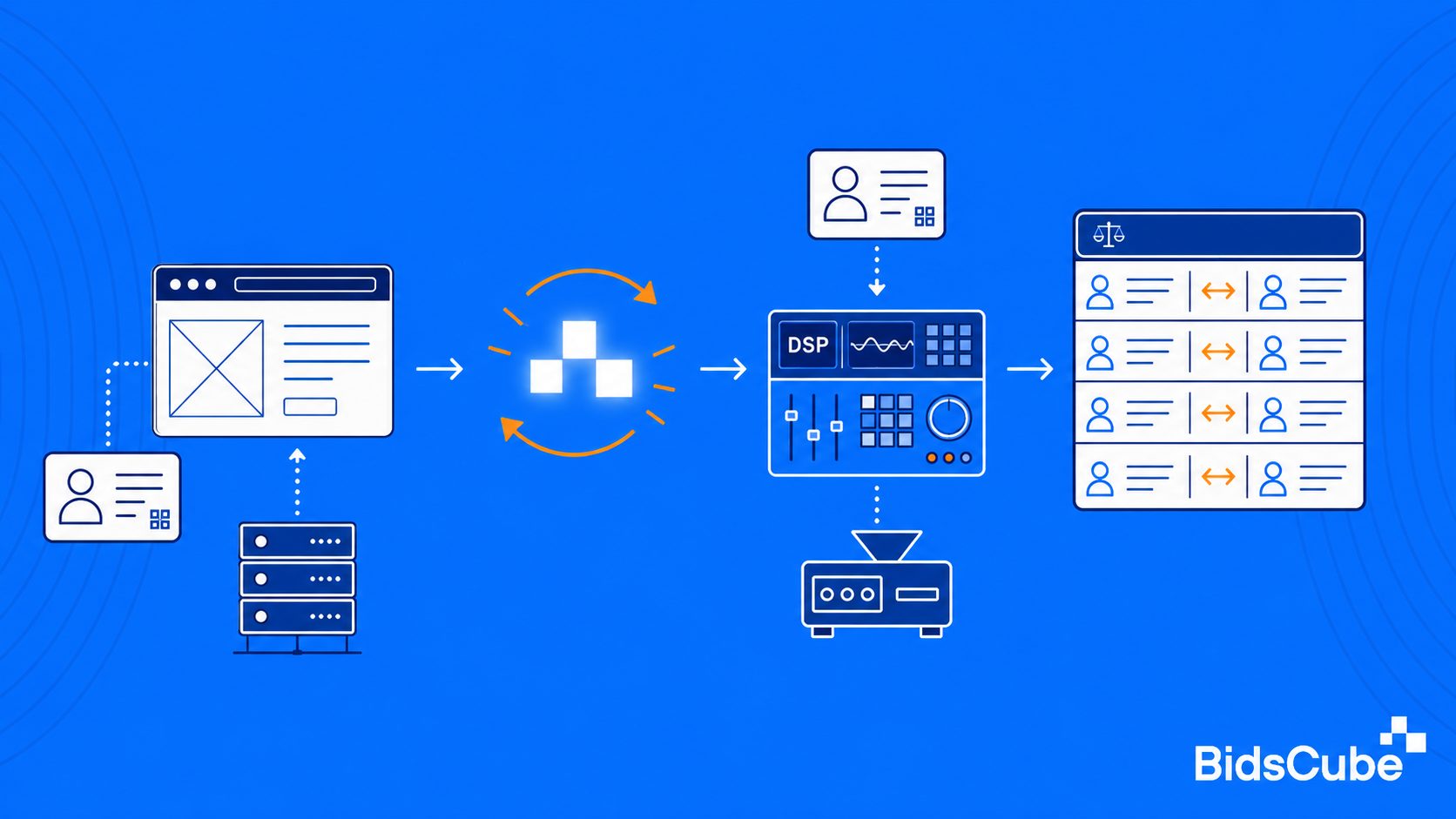
- The user visits a publisher’s website, and the SSP loads a pixel.
The SSP either sets or reads its own user ID. The pixel runs only when the setup and consent rules allow it. - The SSP sends an HTTP redirect to the DSP with its own user ID.
The redirect includes the SSP ID as a parameter. The DSP endpoint receives that ID and checks whether it already has its own cookie for the same browser. - The DSP matches its ID with the SSP ID and stores the mapping.
This is the user ID mapping stage. The DSP stores {SSP ID: DSP ID} or a similar pair in its match table. - The next time the SSP sends a bid request, the DSP already knows the user.
The SSP passes its ID in the auction call. The DSP checks the mapping, finds its own user record, applies targeting rules, and bids if the impression matches campaign logic.
In SSP DSP cookie matching, the match table is the working memory of the relationship. It does not need to expose the DSP’s full user profile to the SSP. It only needs enough mapping to let both sides speak about the same browser in later auctions.
BidsCube supports both SSP-initiated and BidsCube-initiated flows. SSP-initiated sync fits partners that already control their own pixel load order, partner list, and timeout logic. BidsCube-initiated sync works better when the SSP partner wants BidsCube to manage the sync call as part of platform integration.
Need to connect SSP user IDs with demand partners without rebuilding your whole stack?
Review BidsCube SSP or contact the team to discuss the best sync method for your setup.
Security and Privacy Considerations
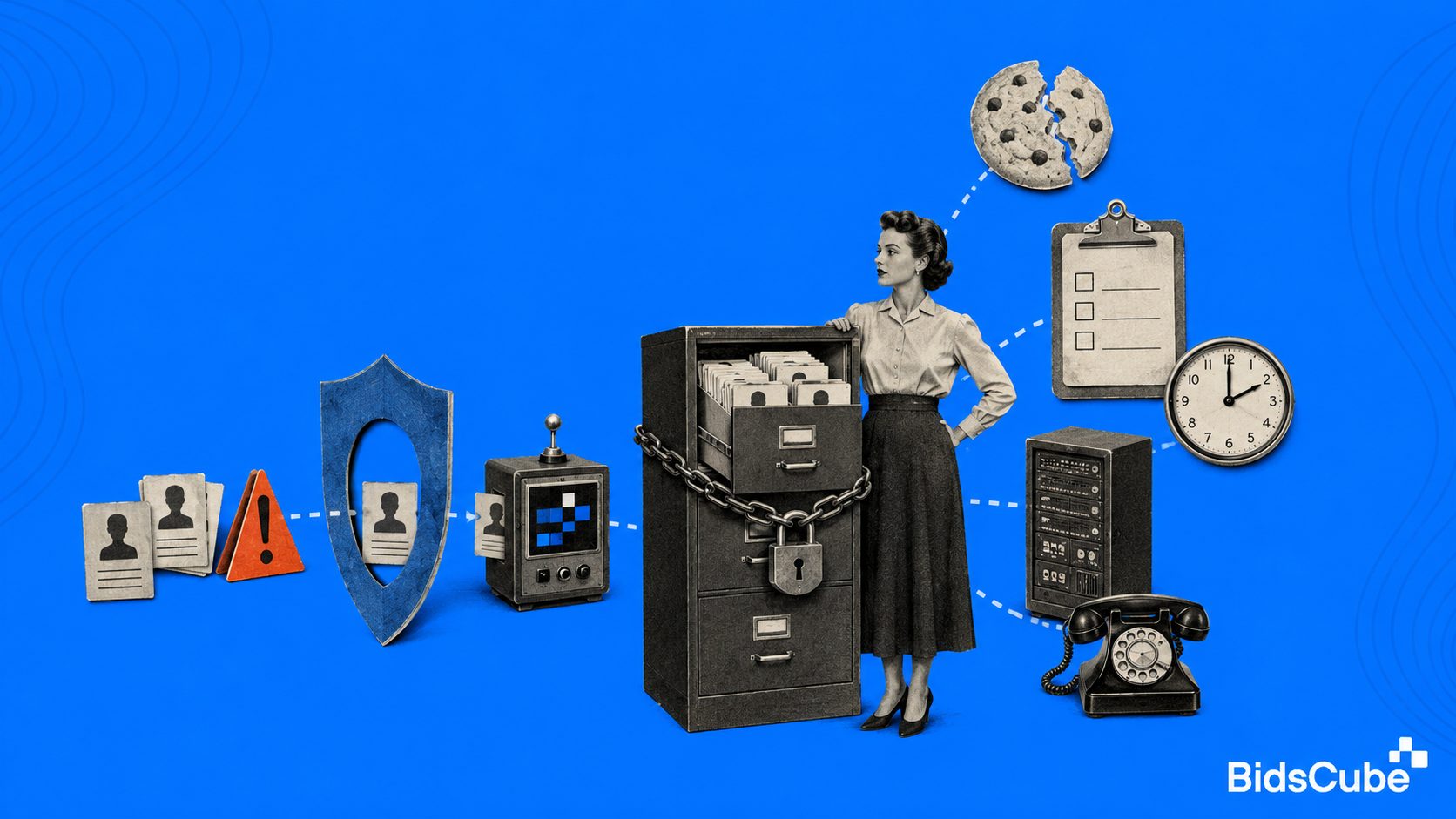
Cookie sync privacy is essential because the process moves user identifiers between platforms. SSPs need a clear consent workflow, safe data handling, and partner-level controls before they activate sync at scale.
Data Privacy Compliance
SSPs must handle user data according to the relevant privacy laws, including GDPR and CCPA where they apply. This includes secure ID transfer, access control, retention rules, and clear records of processing.
User Consent
SSPs must confirm that users gave explicit consent for tracking and data sharing before firing sync pixels. A Consent Management Platform (CMP) helps collect, store, and pass this signal into the ad stack.
BidsCube can use consent strings in the integration flow, so sync calls run only when the consent state allows them. This prevents partners from firing ID matching calls before permission exists.
TCF 2.0 Compliance
TCF 2.0 gives adtech vendors a common way to communicate consent and purpose signals across platforms. SSPs should pass the correct consent string in sync and auction requests, especially when data moves through a white-label Ad Exchange or other multi-partner infrastructure.
Cookie Lifetime Audits
SSPs should audit cookie lifetime, partner sync windows, and browser behavior. Safari ITP, Firefox tracking controls, and Chrome user settings can reduce cookie availability. If a match table uses stale records, targeting and measurement may become inaccurate.
Server-Side Tracking And Alternatives
Traditional browser sync depends on third-party cookies. Server-side tracking can reduce page latency and move part of the ID matching work to server infrastructure. Still, it does not remove the need for consent, partner governance, and clean first-party data strategies.
Support and Troubleshooting
If you encounter any issues or require further assistance during the integration process, the BidsCube support team is available to help. The team can guide SSP partners through endpoint setup, consent string checks, pixel testing, redirect validation, and partner-level debugging.
Support can include email, chat, and a dedicated manager, depending on your cooperation model. This matters during the first sync rollout because even small URL, consent, or timeout errors can reduce the match rate.
Conclusion
Cookie syncing helps SSP partners connect their users with demand-side systems before auction decisions happen. Better matching can improve targeting, retargeting, frequency control, and reporting quality across the programmatic chain.
The best setup depends on your platform maturity. Some SSP partners should use SSP-initiated sync, while others will move faster with BidsCube-initiated sync.
To implement syncing cookies on your SSP, contact the BidsCube team and review the integration path that fits your infrastructure. For social proof, you can also check BidsCube на Clutch.
Our tech staff and AdOps are formed by the best AdTech and MarTech industry specialists with 10+ years of proven track record!

FAQs
What Is Cookie Sync In Programmatic Advertising?
It is the process of matching user IDs between platforms, such as an SSP and a DSP. This helps the buying side recognize users and make better targeting decisions.
How Does Syncing Cookies Improve Ad Targeting?
Syncing cookies reduces the number of unknown users in bid requests. When the DSP recognizes the user, it can apply audience data, make more accurate bid decisions, and improve CTR or ROI over time.
Is Cookie Sync GDPR Compliant?
Cookie sync GDPR compliance depends on explicit user consent, proper CMP setup, and correct consent signal transfer. BidsCube supports TCF 2.0 based consent logic in integrations where partners pass the required consent data.
What Is The Difference Between SSP-Initiated And BidsCube-Initiated Syncing Cookies?
SSP-initiated sync means the SSP starts the redirect and controls the sync call. BidsCube-initiated sync means BidsCube starts the sync flow after the required checks, which can reduce work for the SSP partner.
Does Syncing Cookies Work Without Third-Party Cookies?
Traditional syncing cookies does not work the same way without third-party cookies. Alternatives include server-side ID matching, first-party data, Universal IDs, and contextual targeting.


