



- B2B purchasing almost always works through a number of people, with divergent priorities.
- That lets programmatic campaigns target companies, roles, content topics and known account activity.
- The firmographic targeting filters companies on things like industry, size, revenue, location, etc.
- While intent data can help establish what accounts are researching relevant topics, it does not equate to purchase readiness.
- Account-based marketing aligns appropriate media signals to named company lists.
- The strong measurement connects advertising activity to qualified leads, opportunities, pipeline, and revenue.
- You can activate audiences, retarget, negotiate private deals, get reports, and set up a white-label agency via BidsCube DSP.
Table of Contents
- What Is B2B Programmatic Advertising?
- How B2B Programmatic Targeting Works: Step by Step
- Key Data Sources and Components
- Benefits of B2B Programmatic Ads
- Challenges of B2B Programmatic Advertising
- Best Practices to Reach Decision-Makers at Scale
- How BidsCube Can Help
- Final Thoughts
-
FAQs
- What Is B2B Programmatic Advertising?
- How Does B2B Programmatic Targeting Work?
- What Data Is Used to Reach B2B Decision-Makers?
- What Is Account-Based Marketing in Programmatic Advertising?
- What Are the Main Challenges of B2B Programmatic Campaigns?
- How Do You Measure Success in B2B Programmatic Advertising?
Buying decisions within the B2B programmatic advertising world rarely depend on one person. A typical buying committee arms business users, technical experts, procurement teams, finance leaders, security reviewers, and senior decision-makers.
Every individual is looking at the offer from a different perspective. Most technical teams focus on integrations and security. Finance could view costs and expected value. Senior leadership may be more concerned with business impact and implementation risk.
Programmatic media gives advertisers the ability to target multiple people within a target company across the web, on apps, on video, on native placements, and in any number of other potential venues. This enables teams to target accounts and roles rather than demographic types.
However, most programmatic systems first developed around consumer advertising. Teams searching for programmatic advertising B2B tools often need added firmographic, intent, identity, and CRM data before they can define a useful business audience.
This is where the market is heading. EMARKETER forecasts that display will account for more than half of all U.S. B2B digital ad spending for the first time in 2026. The outlook suggests that more B2B display advertising will be focused on awareness both demand generation and the sales pipeline.
What Is B2B Programmatic Advertising?
Programmatic advertising in B2B utilizes automated media purchasing to target companies and business audiences. When account, user, context, device, and campaign rules match, a demand-side platform, or DSP, checks available impressions and bids.
It works for everything from awareness, lead generation, account based marketing, content promotion to retargeting. Connected publishers and exchanges for advertisers purchases supply for display, video, native, CTV, audio, and mobile.
Programmatic advertising for B2B does not replace LinkedIn ads, search campaigns, email or sales outreach. It creates additional open-web reach and provides marketers with a few more avenues to remain top of mind during a lengthy purchasing cycle.
See how content, automation, media, and sales activity work together in a B2B digital marketing strategy.
How B2B Programmatic Targeting Works: Step by Step
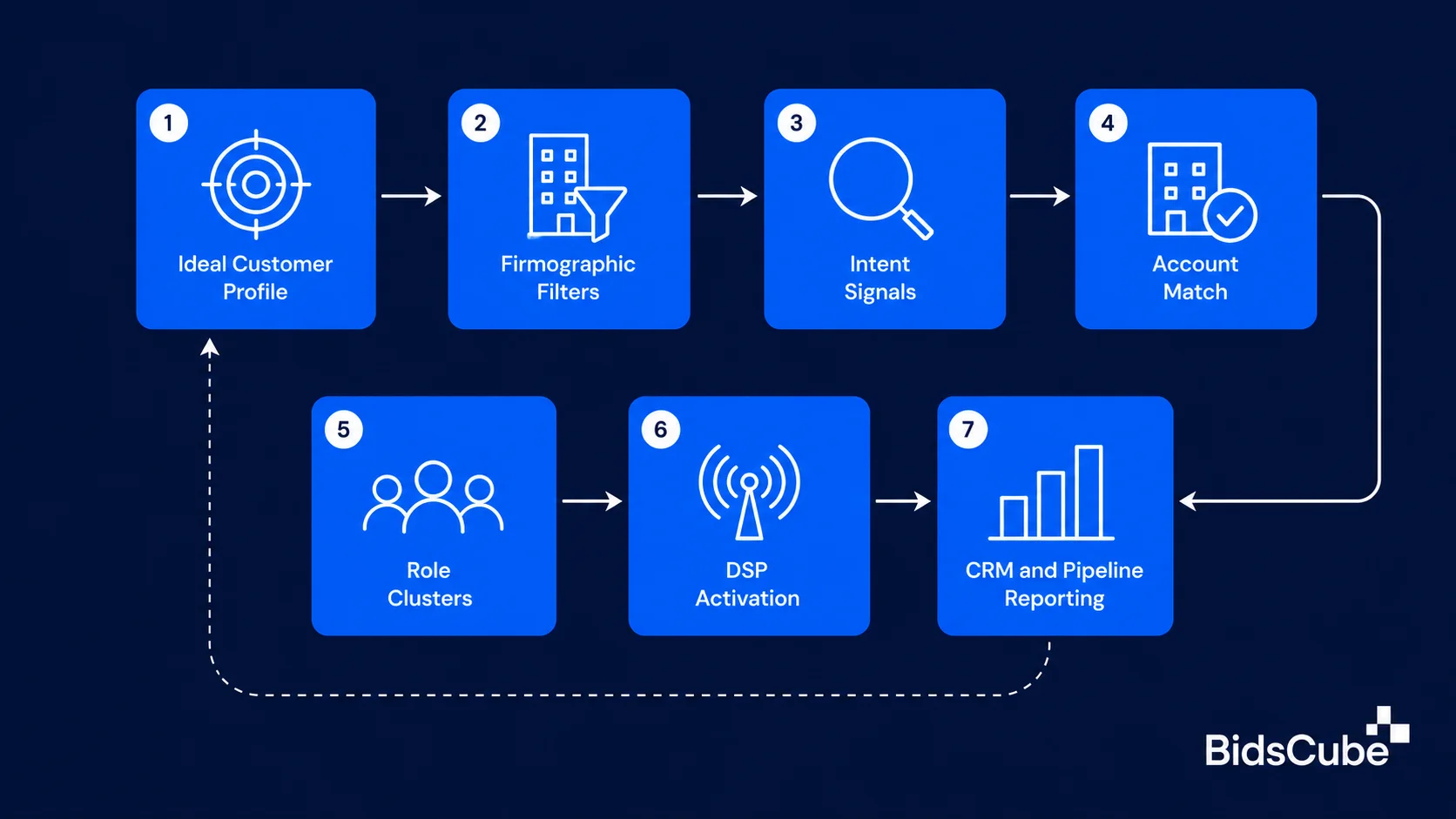
B2B targeting usually combines several data layers. No single signal provides a complete view of an account or buying group.
Step 1: Define the Ideal Customer Profile
Start with the companies most likely to buy. The ideal customer profile may include:
- Industry
- Employee count
- Annual revenue
- Company location
- Business model
- Technology use
- Growth stage
Firmographic targeting turns these business traits into campaign filters. It helps teams avoid spending money on companies outside the target market.
Advertisers should also divide accounts into tiers. A list of 50 strategic accounts needs different bids, messages, and reports from a broader list of 5,000 possible customers.
Step 2: Add Intent Data
Intent data looks for signals that a company or user is researching a topic. These signals are the information fetched from publisher content, review sites, content downloads, contextual data, bidstream activity and specialized providers.
For instance, a cybersecurity company might focus its attention on accounts that searched for ransomware protection, cloud security, or access management. Some SaaS services may ask you to provide interest in a migration, workflow tools, or competing product categories.
That is not what intent data signals is a buying decision. A given signal may be created by a consultant, a student, a competitor, or even a customer. Intent should be a prioritization tool for marketers, not a sales readiness proof point.
Step 3: Match Target Accounts
Account-based marketing (ABM) starts with a named list of target companies. Activation partners may match those companies with IP ranges, device identifiers, publisher login data, business email records, or other approved signals.
The DSP can then bid when an impression matches a target account. Match rates vary because remote work, mobile devices, shared networks, privacy rules, and incomplete records reduce identification accuracy.
Always review the matched audience before launch. A list may contain 1,000 accounts, but only a portion may produce usable advertising signals.
Step 4: Add Job and Role Data
Job-title and department targeting help distinguish technical evaluators from financial approvers or executive sponsors. Specialized providers may classify audiences by:
- Seniority
- Department
- Job function
- Skills
- Professional interests
- Likely buying role
Exact job titles often create gaps. One company may use “Head of Infrastructure,” while another uses “Director of Platform Engineering” for a similar position.
Role clusters usually work better than one title. Group technical users, business leaders, procurement teams, financial approvers, and executives by their likely role in the decision.
Step 5: Activate and Sequence the Campaign
The final audience moves into a B2B DSP or connected activation platform. The advertiser then applies geography, device, content, inventory, frequency, budget, and brand-safety rules.
Creative should change as the account moves through the funnel:
- Introduce the business problem.
- Explain the product category.
- Present research, guides, or comparisons.
- Offer case studies and technical proof.
- Support demos, proposals, and sales conversations.
With every step, a new layer of specificity is introduced, but the goal should be to keep your audience as broad as possible to activate. The best campaigns bring together account, intent, role, and first-party signals with specific bids, messages, and measurement rules.
Key Data Sources and Components
A campaign is only as useful as the data behind its audience.
- ABM platforms. Build target account lists, score engagement, connect CRM activity, and prepare segments for activation.
- Firmographic providers. Supply company size, location, revenue, industry, ownership, and technology information.
- Intent providers. Identify research behavior around selected topics, products, categories, or competitors.
- First-party data. Includes CRM contacts, website activity, email engagement, webinar attendance, product use, and sales activity.
- Specialized B2B platforms. May include built-in company, role, and professional data.
- General DSPs. Often need data uploads, external providers, DMP partners, or ABM integrations.
- Measurement systems. Connect impressions and engagement with leads, opportunities, pipeline, and closed revenue.
Teams comparing B2B programmatic advertising vendors should ask where each segment comes from and how often it updates. They should also review consent, match methods, geographic coverage, and reporting detail.
IAB Tech Lab guidance explains that OpenRTB can carry contextual and audience signals, although the two data types serve different purposes. This matters when campaigns combine page content with known account or audience segments.
Connect awareness to retention. Read Digital Marketing for SaaS for a full-funnel view of acquisition, onboarding, expansion, and retention.
Benefits of B2B Programmatic Ads
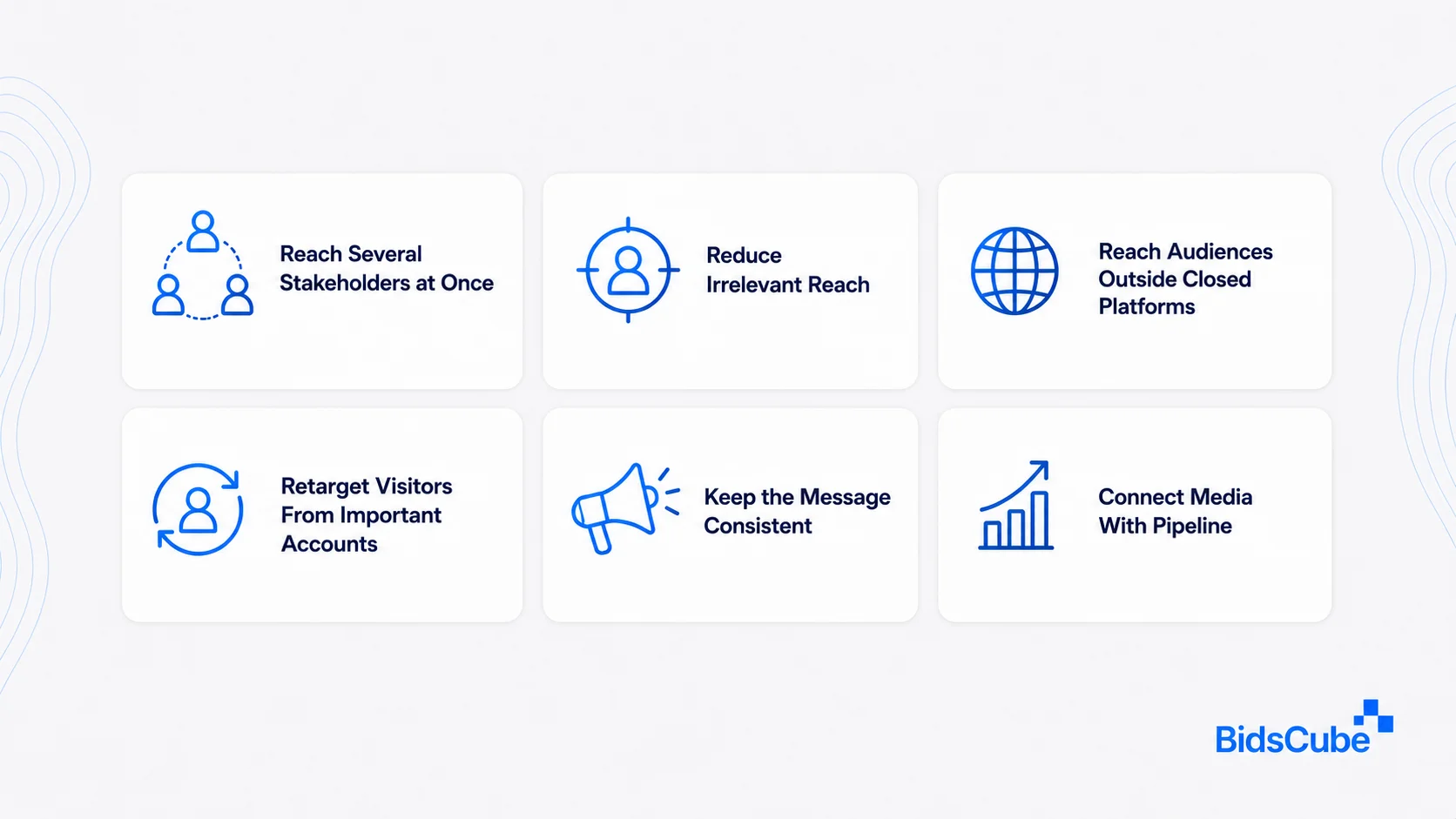
B2B programmatic ads help teams reach several people inside one account across the open web. They can reduce wasted impressions, support retargeting, keep messaging consistent, and connect media activity with pipeline results.
Reach Several Stakeholders at Once
A programmatic campaign can deliver to technical, financial, operational, and executive audiences from one account. This wider reach matters because the most visible contact is not always the final decision-maker.
LinkedIn B2B Institute research describes a hidden buyer gap. Marketers often focus on product experts who download content and attend webinars, while other buying-group members remain less visible. These hidden buyers may focus on risk, trust, cost, or business fit.
Reduce Irrelevant Reach
Company, role, context, intent, and first-party filters can remove a large part of the market that does not fit the ideal customer profile. No data source offers perfect accuracy. Account-led targeting still leaves advertisers in a better position than when they were solely using gender, age, interests or location targeting.
Reach Audiences Outside Closed Platforms
Apart from this, LinkedIn ads and Google Ads continue to serve as effective B2B channels. A programmatic advertising B2B campaign vastly increases your ability to get in front of users who spend their time consuming relevant content across industry publications, non-competing websites, mobile apps, video channels, native inventory, and private deals.
The goal is not to replace every closed platform. The goal is to reach target accounts while they research business problems across the wider web.
Retarget Visitors From Important Accounts
Retargeting can separate target-account visitors from general site traffic. A known account may receive a case study, technical guide, webinar invitation, or implementation page based on previous activity.
Frequency limits remain essential. A long sales cycle does not justify showing one person the same banner every day for several months.
Keep the Message Consistent
B2B buyers discover a company through display ads, search, content, events, email, or sales outreach. A coordinated program keeps the market position consistent across these contacts.
Creative can change by stage and role, but the core message should remain clear.
Connect Media With Pipeline
B2B measurement can go beyond CTR and CPL. Marketers can compare advertising activity with:
- Engaged target accounts
- Qualified leads
- Sales meetings
- Created opportunities
- Pipeline value
- Win rate
- Closed revenue
This type of pipeline attribution gives marketing and sales a more useful view than click-based reporting alone.
The growth of B2B display advertising makes this measurement more important. A larger media budget needs a clear connection to account progress and sales outcomes. Use Top Programmatic Metrics That Define Campaign Success to connect delivery data with quality, conversion, and revenue metrics.
Challenges of B2B Programmatic Advertising
B2B programmatic campaigns usually have smaller audiences, unreliable data, and long buying journeys. With implications for reach, CPM, attribution and account matching, careful testing and realistic expectations are necessary at this scale.
- Smaller audience pools. Narrow account lists create fewer available impressions and often lead to higher CPM than broad B2C campaigns.
- Uneven provider quality. Firmographic and intent data can become outdated or classify the same business differently across providers.
- Long sales cycles. A buyer may see an ad months before an opportunity appears, which makes standard conversion windows less useful.
- Remote and hybrid work. IP-based targeting then becomes less reliable since employees work from home, travel or use virtual private networks.
- Privacy limits. There are consent rules, data protection laws, platform policies and internal governance that need to be adhered to by advertisers.
- Complex attribution. Several people and channels may influence one purchase, so last-click reporting can give a distorted view.
Teams should not solve limited scale by expanding the audience until the account strategy loses meaning. Add new accounts in planned tiers, and report each tier separately.
Best Practices to Reach Decision-Makers at Scale
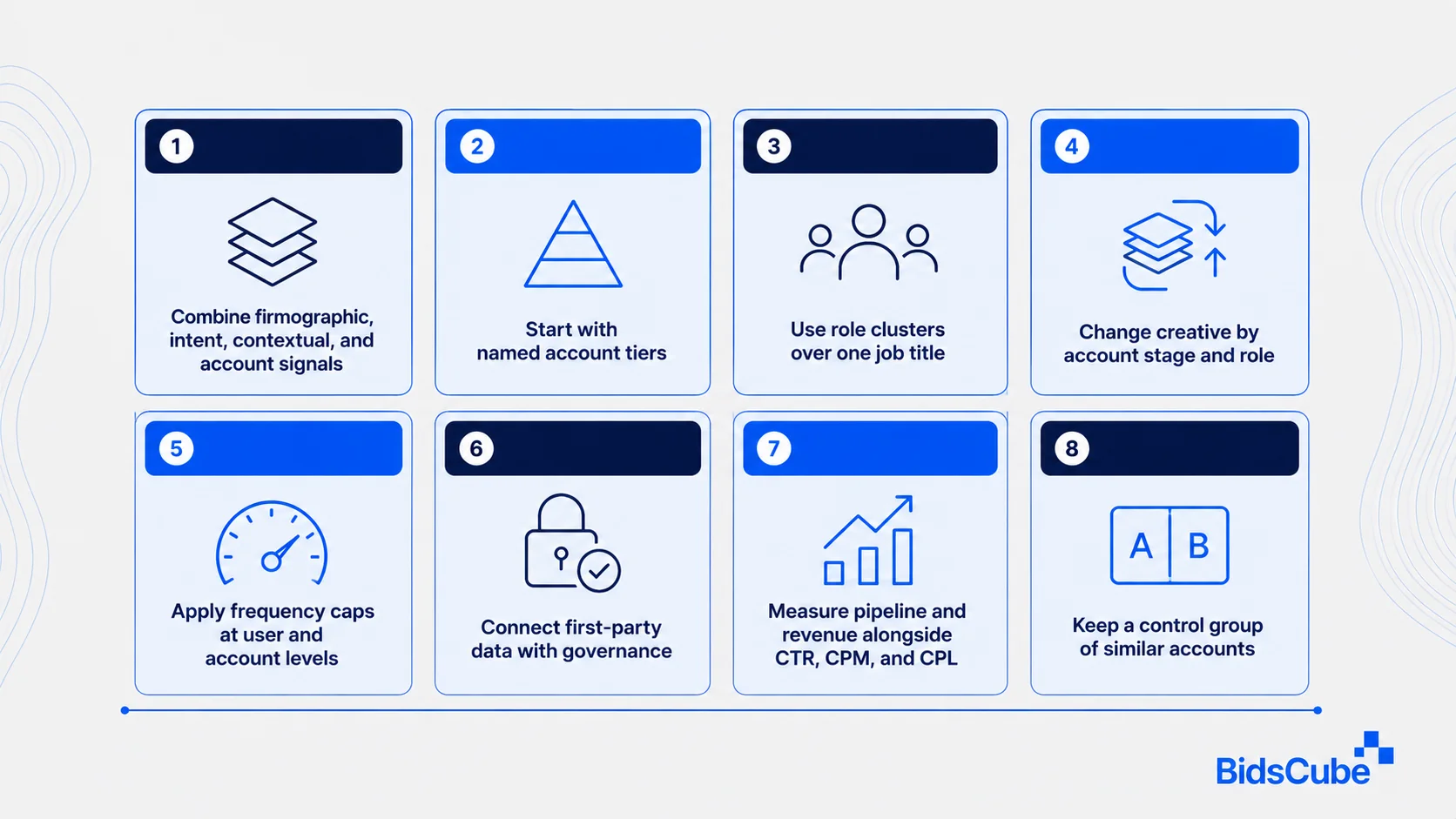
Reaching decision-makers requires more than adding audience filters.
- Combine firmographic targeting, intent data, contextual signals, account lists, and retargeting.
- Start with named account tiers instead of one broad industry segment.
- Use role clusters rather than one exact job title.
- Change creative based on account stage and buying-group role.
- Apply frequency caps at both user and account levels where possible.
- Connect first-party data with clear permissions and governance.
- Measure opportunities, pipeline, and revenue alongside CTR, CPM, and CPL.
- Keep a control group of similar accounts when campaign size allows it.
A strong programmatic advertising for B2B plan starts with a few clear segments. Extra data does not help when the team cannot explain how each signal changes bids, creative, or measurement.
How BidsCube Can Help
The BidsCube DSP can be used for any kind of banner, video, native, audio, CTV campaigns, desktop and mobile as well. That page now offers real-time bidding, audience management, first-party segment uploads, DMP partner data, retargeting, user-ID and IP controls, IAB category targeting, device filters, frequency caps, PMP deals, budget controls, and bidstream data access.
These controls can support B2B campaigns when the advertiser brings a clear account strategy and suitable data. BidsCube does not replace a CRM, ABM platform, or specialist firmographic provider. It provides the media-buying layer where approved segments, inventory rules, budgets, and creative become active campaigns.
The BidsCube solution for advertisers also lists brand-safety tools, anti-fraud integrations, trusted supply, API reporting, raw data access, automation rules, and real-time analytics.
Agencies can use the white-label model to operate a branded B2B DSP for several clients. They can set platform roles, margins, reports, supply partners, campaign rules, and audience workflows around their service model.
When agencies compare B2B programmatic advertising vendors, they should separate the buying engine from the business data layer. BidsCube can provide the customizable DSP, while the agency connects its selected CRM, ABM tools, account lists, DMP partners, and data providers.
A recent BidsCube DSP lead-generation case study reported a 239% month-over-month increase in form submissions. Retargeting generated 180% more submissions than prospecting. The July 2026 case covers retail rather than B2B, so it shows the prospecting and retargeting workflow, not a direct B2B benchmark.
Teams can also review BidsCube on Clutch during platform and partner checks.
Expert View
Roman Vasyukov explains why B2B campaigns need shared account priorities before launch. Marketing and sales must agree on who to reach, which roles matter, and how success will be measured.
B2B media works when marketing and sales agree on the accounts, roles, and outcomes before campaign launch. Programmatic gives the team scale, but the account strategy decides whether that reach has value.
Roman Vasyukov, CEO and Founder of BidsCube
The quote highlights a simple point: reach alone does not make a B2B campaign useful. Account selection, role mapping, and agreed sales goals give that reach a clear purpose.
Final Thoughts
B2B media must reach several stakeholders, support a long decision process, and connect activity with sales outcomes. Programmatic can add account-level reach beyond search and social platforms when the campaign combines reliable data, controlled frequency, role-based creative, and pipeline reporting.
Use BidsCube when the strategy needs open-web inventory, private deals, detailed data access, or a white-label buying platform. Contact us for a detailed action plan.
Our tech staff and AdOps are formed by the best AdTech and MarTech industry specialists with 10+ years of proven track record!

FAQs
What Is B2B Programmatic Advertising?
B2B advertising leverages automated media buying to land on the desks of the company and other professional audiences using account, role, context, intent, and first-party signals. A DSP places a bid on relevant impressions and takes into account targeting, budget, quality, and frequency rules set by the advertiser.
How Does B2B Programmatic Targeting Work?
B2B targeting brings together an ideal customer profile with firmographic filters, lists of named accounts, signals of intent, role data, data on website activity and the context of the media. While a DSP enables matched audiences activity, a CRM and marketing systems follow the journey of a prospect/customer account from engagement to sales progress.
What Data Is Used to Reach B2B Decision-Makers?
Examples of segmentation techniques: company size, industry, technology used, company revenue, location, job function, seniority, topics of research interest publisher co. Compliance with privacy rules, consent requirements, platform policies, and company governance must be ensured for every data use.
What Is Account-Based Marketing in Programmatic Advertising?
Account-based marketing (ABM) is a type of marketing that starts from a named list of targeted companies on which to activate media. Programmatic systems find approved signals to those accounts and push role based messages across connected inventory.
What Are the Main Challenges of B2B Programmatic Campaigns?
Here are the top challenges you face, such as small pools of audiences, high CPM, uneven data across providers, low match rates, privacy issues, remote challenges, lengthy sales cycles and attribution. By allowing for tiers of accounts, multiple vetted signals, controlled experiments and reporting that is integrated with the CRM, such risks may be mitigated.
How Do You Measure Success in B2B Programmatic Advertising?
Evaluate performance on matters such as engaged accounts, qualified leads, meetings, opportunities, pipeline value, win rate, sales-cycle movement and revenue. Supporting diagnostic metrics; use CTR, CPM, viewability, frequency and CPL.


