



A DSP ad exchange relationship connects buyer decisions with a marketplace auction. The DSP represents the advertiser, while the exchange brings eligible supply and demand together. A DSP SSP ad exchange setup also includes an SSP, which manages publisher inventory and selling rules.
Table of Contents
- Understanding Ad Exchange vs DSP
- What is an Ad Exchange?
- What is a Demand-Side Platform (DSP)?
- Key Differences Between Ad Exchange vs DSP
- Control and Customization
- Targeting and Automation Capabilities
- Transparency in Pricing and Operations
- Comparison Table Ad Network vs Ad Exchange vs DSP: Where Each One Fits
- Benefits of Using Ad Exchange
- 1. Brand Ownership and Flexibility
- 2. improved Data Control and Privacy
- 3. Increased Revenue Opportunities
- 4. Customizable Inventory and Pricing Control
- 5. Direct Relationships with Partners
- Compare the right platform
- Benefits of Using a DSP
- 1. More Direct Media Buying Process
- 2. Real-Time Bidding and Audience Targeting
- 3. Access to Diverse Inventory
- 4. Advanced Analytics and Reporting
- 5. Cost Efficiency and Budget Control
- Which Platform is Best for Your Business?
- Factors to Consider
- Use Cases for Ad Exchange vs DSP
- Bidscube White Label Ad Exchange and DSP Solutions: A Complete Programmatic Offering
- Bidscube Ad Exchange: Empowering Efficient Ad Trading
- 1. Cost-Effective Solution
- 2. Advanced Optimization Tools
- 3. Scalability
- 4. 24/7 Support and Expertise
- Bidscube DSP: Customize Your Programmatic Ad Buying
- 1. Real-Time Reporting and Precise Targeting
- 2. Customization and Brand Ownership
- 3. Integration Flexibility and Scalable Features
The ad network vs DSP question depends on control and inventory access. A DSP exchange connection gives buyers auction access, while an ad network packages supply. Teams comparing DSP vs ad network models should review fees, reporting, targeting, and supply visibility.
A DSP ad exchange setup helps advertisers reach marketplace supply through campaign rules. The ad network vs DSP choice affects supply visibility, targeting control, and reporting. A DSP SSP ad exchange relationship assigns separate roles to the buyer, publisher, and marketplace. An ad DSP account remains buyer-focused.
What’s the difference between an Ad Exchange and a DSP? This article breaks down the critical distinctions between these two vital advertising platforms. Understand the control, customization, and automation features to decide which is right for your business.
Understanding Ad Exchange vs DSP
Now, let’s look at both Ad Exchanges and DSPs.
What is an Ad Exchange?
An Ad Exchange is a customizable platform allowing publishers and advertisers to connect directly, facilitating real-time bidding for ad space. It enables complete control over inventory, data, and relationships with demand-side partners. This solution empowers businesses by letting them create a branded marketplace, unlike third-party exchanges, where visibility and control are limited. For a broader introduction to the intermediary role, see what is an ad network.
What is a Demand-Side Platform (DSP)?
A DSP software solution automates buying ad space across multiple ad exchanges. It uses algorithms to manage real-time bids on ad inventory and optimize targeting for advertisers. Unlike ad exchanges, DSPs focus on streamlining the media-buying process, using data and automation to maximize campaign effectiveness. The SSP vs DSP comparison explains how the publisher-side role differs from the buying role.
Key Differences Between Ad Exchange vs DSP
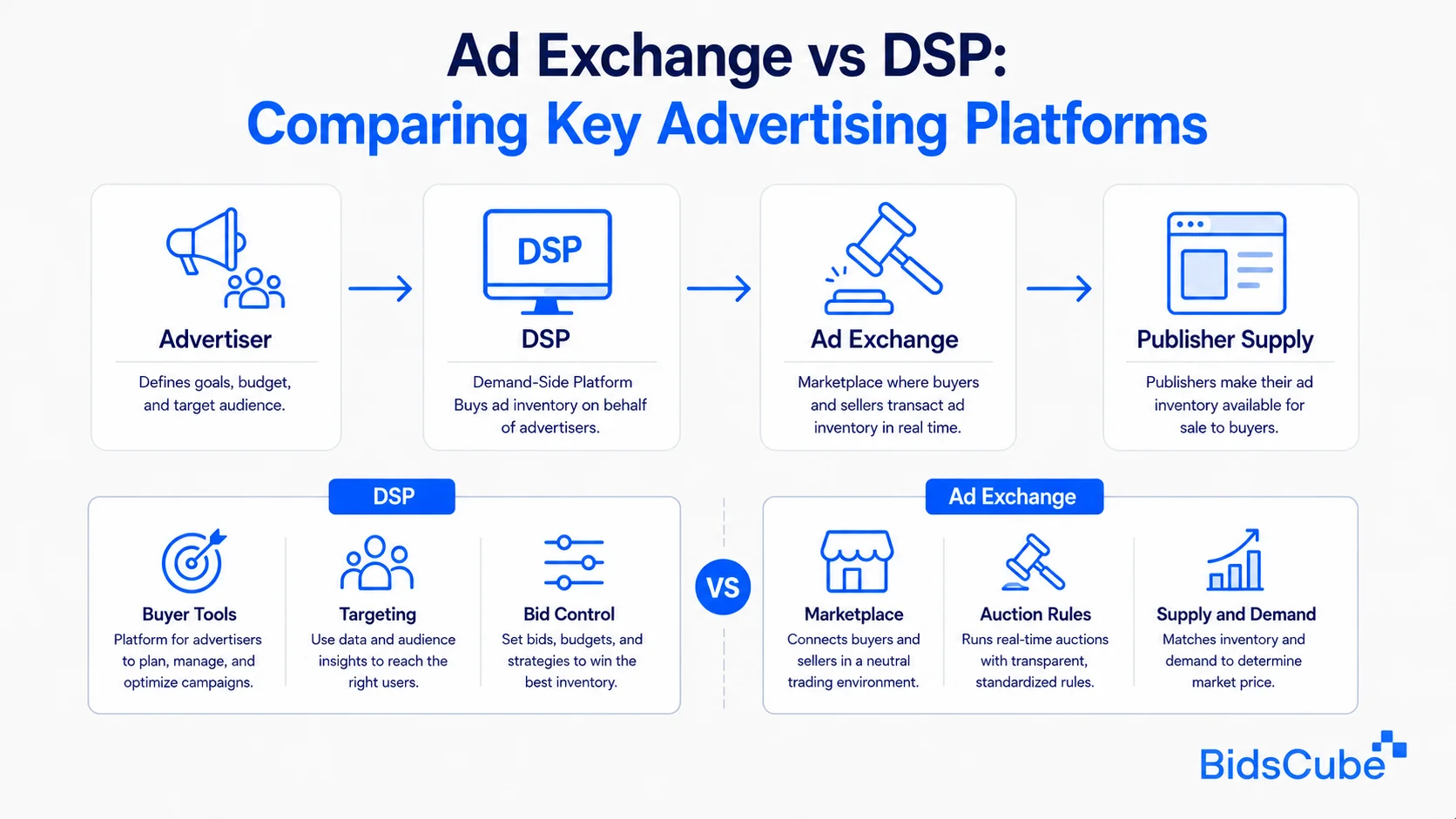
To mark the difference between DSP vs Ad Exchange, there are several key factors to consider. Basically, it is all about the following:
- The degree of control you have over the product as well as its customization.
- The precision of targeting and automation.
- The level of transparency of pricing and given operations.
Control and Customization
An Ad Exchange, businesses enjoy total control over branding, inventory, and pricing, which is ideal for maintaining transparency. In contrast, DSPs offer less customization but provide automated tools to optimize bidding, making them better suited for advertisers focused on efficiency and scale.
Targeting and Automation Capabilities
DSPs excel in advanced audience targeting and real-time optimization, enabling advertisers to target specific user segments precisely. White-Label Ad Exchanges offer broader access to demand partners but lack the same level of granular targeting automation.
Transparency in Pricing and Operations
Ad Exchanges provide greater pricing and data control transparency, as users can manage all aspects of the transaction. DSPs may obscure some transaction details, especially when third-party data is involved.
Comparison Table Ad Network vs Ad Exchange vs DSP: Where Each One Fits
An ad network aggregates inventory from several publishers and sells it in packages. An ad exchange operates a marketplace where eligible buyers and sellers trade inventory. A DSP helps advertisers set targeting, bids, budgets, creatives, and campaign rules.
The ad network vs ad exchange vs DSP comparison comes down to commercial role. An ad network acts as an intermediary, an exchange runs the market, and a DSP acts for the buyer. A DSP vs SSP vs ad exchange comparison adds the publisher side: the SSP manages supply, while the exchange connects transactions.
| Parameter | Ad Network | Ad Exchange | DSP |
|---|---|---|---|
| Main role | Packages publisher inventory | Runs a marketplace for supply and demand | Buys media for advertisers |
| Primary customer | Advertisers and agencies | Publishers, SSPs, DSPs, and networks | Advertisers and agencies |
| Inventory access | Curated or packaged supply | Auction and deal-based marketplace supply | Supply reached through exchanges and SSPs |
| Control | Defined by the network offering | Marketplace and deal controls | Campaign, bid, audience, budget, and creative controls |
| Transparency | Varies by network and package | Depends on marketplace rules and reporting | Depends on supply path and reporting access |
Read ad network vs ad exchange and how DSP, SSP and ad exchange fit together for related platform comparisons.
Benefits of Using Ad Exchange
Ad Exchanges offer many advantages for businesses seeking greater control and customization in their advertising efforts. By owning and tailoring your ad exchange platform, you can improve your brand presence, data management, and operational efficiency.
1. Brand Ownership and Flexibility
An Ad Exchange allows you to fully customize the platform to reflect your brand identity, giving you complete control over your marketplace. This level of branding flexibility ensures a unique user experience.
A digital marketing agency can design their ad exchange interface with their own logos and color schemes, providing clients with a smooth brand experience that reinforces the agency’s identity.
2. improved Data Control and Privacy
With an Ad Exchange, you retain ownership of all data, ensuring better compliance with privacy regulations such as GDPR. This is particularly advantageous for businesses prioritizing data security and transparency.
Imagine a healthcare publisher managing sensitive user information; owning the data through a white-label solution helps them maintain strict privacy standards and build trust with their audience.
3. Increased Revenue Opportunities
Operating your ad exchange eliminates the need for intermediaries, allowing you to capture more revenue from ad transactions. You can reduce fees and increase profit margins by directly connecting advertisers and publishers.
An online magazine could boost its advertising income by using a white-label ad exchange to connect directly with advertisers interested in their niche audience, bypassing third-party fees.
4. Customizable Inventory and Pricing Control
An Ad Exchange lets you set your own rules for inventory access and pricing models. You can prioritize certain types of ads, control ad quality, and adjust pricing to match your business goals.
A premium content website might set higher prices for ad placements during peak traffic times, maximizing revenue while ensuring ads align with their brand values.
5. Direct Relationships with Partners
By managing your own ad exchange, you can build stronger, direct relationships with advertisers and publishers. This fosters better communication, collaboration, and long-term partnerships.
Consider an app developer who uses a white-label ad exchange to work closely with select advertisers, ensuring that the ads displayed improve the user experience rather than detract from it.
Compare the right platform
Use the BidsCube platform comparison to match inventory access, buying goals, reporting needs, and operational control with the right programmatic role.
Benefits of Using a DSP
DSPs offer a range of advantages for advertisers aiming to optimize their digital advertising campaigns. By leveraging automation and data-driven strategies, DSPs improve efficiency, targeting precision, and overall campaign performance.
1. More Direct Media Buying Process
A DSP automates many aspects of the ad-buying process, from bidding to reporting, allowing advertisers to manage campaigns across various platforms efficiently.
Instead of negotiating deals with multiple publishers individually, a marketing manager can use a DSP to purchase ad space across numerous websites with just a few clicks.
2. Real-Time Bidding and Audience Targeting
A DSP’s real-time bidding (RTB) feature lets advertisers bid on ad impressions as they become available. This ensures they pay the best price for their target audience. Additionally, DSPs use data-driven insights to target audiences precisely, maximizing campaign ROI.
Imagine an outdoor gear company able to target ads specifically to users who have recently searched for hiking equipment, bidding on these impressions in real time to capture high-intent customers.
3. Access to Diverse Inventory
DSPs provide access to various ads from multiple ad exchanges and networks. This broad reach allows advertisers to extend their campaigns to a wider audience without managing multiple relationships.
An app developer can showcase their new game on various platforms – mobile apps, websites, and even smart TVs – all through a single DSP interface.
4. Advanced Analytics and Reporting
DSPs offer detailed analytics and reporting tools that help advertisers track campaign performance and make data-driven decisions. Metrics like impressions, clicks, conversions, and cost per acquisition are readily available.
An e-commerce retailer can analyze which ad creatives lead to the most sales and adjust their strategy accordingly.
5. Cost Efficiency and Budget Control
By automating the bidding process and optimizing bids in real time, DSPs help advertisers get the most value from their ad spend. They can set budget limits and bidding strategies to control costs effectively.
Consider a small business that sets a daily budget cap on their DSP to ensure they don’t overspend, while still reaching their target audience efficiently.
Which Platform is Best for Your Business?
To maximize impact, select your advertising platform wisely. The right choice can make or break your marketing strategy’s success. The decision between an Ad Exchange vs DSP depends on your business’s specific needs, priorities, and resources.
Factors to Consider
When choosing between an Ad Exchange and a DSP, consider the following factors:
- Control and Customization
- Ad Exchange: Offers complete control over branding, inventory, and pricing.
- DSP: Provides less customization but excels in automation and efficiency.
- Scalability and Automation
- Ad Exchange: Suited for businesses that prioritize control over rapid scaling.
- DSP: Ideal for those looking to scale quickly with automated targeting and real-time bidding.
- Data Privacy
- Ad Exchange: Allows you to retain ownership and control over your data, improving transparency and compliance with privacy regulations.
- DSP: May involve third-party data, offering less transparency in data ownership.
- Resources and Expertise
- Ad Exchange: Managing and maintaining the platform demands greater internal expertise and resources.
- DSP: Automates many aspects of the ad-buying process, requiring less manual intervention.
You need to choose between DSP vs Ad Exchange based on your needs and resources. However, you also need to consider how much control you want to have and what expertise you must have to act on that control.
Use Cases for Ad Exchange vs DSP
Nothing speaks better of a particular technology or tool than its use cases. These are examples of when DSP vs Ad Exchange can be used in various scenarios.
- Direct Publisher Connections. Ideal for publishers and networks aiming to establish direct relationships with advertisers.
- Brand-Centric Businesses. Suited for companies that want full control over branding and user experience.
- Data-Sensitive Organizations. Perfect for businesses that prioritize data ownership and need to comply with strict privacy regulations.
- Advertising Agencies. Great for agencies managing multiple client campaigns needing advanced targeting.
- Large Advertisers. Beneficial for advertisers running large-scale, data-driven campaigns.
- Efficiency Seekers. Ideal for businesses looking to automate the media-buying process to save time and resources.
The verdict:
- Ad Exchange is ideal for publishers and networks looking to establish direct connections with advertisers.
- DSPs are more suited for agencies and large advertisers who want to run data-driven campaigns with sophisticated targeting capabilities.
Bidscube White Label Ad Exchange and DSP Solutions: A Complete Programmatic Offering
Bidscube offers two reliable solutions in programmatic advertising: a reliable White-Lavel Ad Exchange platform and a highly customizable DSP. These solutions enable businesses to manage their advertising operations efficiently, scale quickly, and tap into premium demand and supply channels. Here’s a closer look at how both platforms can benefit your business.
Bidscube Ad Exchange: Empowering Efficient Ad Trading
1. Cost-Effective Solution
For companies looking for a comprehensive ad exchange solution without the high costs, Bidscube’s Ad Exchange offers an affordable starting price of just $300 per month. This is significantly lower than the high costs of developing an in-house ad exchange, which can exceed $1 million annually.
2. Advanced Optimization Tools
Bidscube’s Ad Exchange has essential tools like traffic filtering, AI-based optimization, and bid discrepancy monitoring. These features ensure efficient ad trading and help boost return on investment (ROI) .
3. Scalability
Bidscube’s Ad Exchange is scalable to meet the needs of both small and large businesses. Whether you’re a startup using the Lite version or an established player needing advanced features such as private marketplace (PMP) capabilities, the platform grows with your business.
4. 24/7 Support and Expertise
With a team of over 40 account managers available around the clock, Bidscube ensures that its clients receive personalized support, making smooth integration, troubleshooting, and campaign optimization.
- Speed and Efficiency: Bidscube processes up to 3.5 million ad requests per second, ensuring ultra-fast bid responses under two milliseconds, leading to reliable and effective ad trading.
- Direct Access to Premium Demand: Connect with top-tier companies like Huawei, Rakuten, and Baidu for premium ad demand and supply sources, ensuring better revenue opportunities.
- Proven Success: Bidscube has generated over $100 million in annual gross revenue and supports more than 250 active partners, demonstrating a solid track record of success.
Bidscube DSP: Customize Your Programmatic Ad Buying
1. Real-Time Reporting and Precise Targeting
Bidscube’s DSP enables businesses to customize their ad-buying strategies with real-time reporting and precise targeting. The platform automates ad-buying while giving advertisers complete control over their campaigns.
2. Customization and Brand Ownership
Bidscube’s DSP is a white-label solution, meaning businesses can rebrand the platform with their logos and color schemes, maintaining complete control over the look and feel of their ad-buying operations.
3. Integration Flexibility and Scalable Features
The DSP supports various integrations, allowing businesses to connect with premium publishers and advertisers easily. The fully scalable platform provides over 55 campaign settings that enable advertisers to adjust their approach based on performance goals.
- Rapid Deployment: Your white-label DSP can be launched in just two days, allowing you to quickly enter the programmatic advertising space without needing expensive in-house development.
- Cost Efficiency: Starting at $300 per month, Bidscube’s DSP provides an affordable, market-tested technology continuously upgraded to meet evolving advertising needs.
- Comprehensive Features: With advanced customization options, flexible scaling, and access to premium demand and supply partners, Bidscube’s DSP allows advertisers to optimize their campaigns and achieve superior results.
Bidscube’s Ad Exchange and DSP offer businesses a low-cost, all-in-one solution. It helps them optimize their programmatic ads. Whether you need an efficient ad exchange platform or a fully customizable DSP, Bidscube delivers advanced technology, scalability, and 24/7 expert support to help you succeed.
With proven results and access to premium demand channels, these platforms empower businesses to grow advertising revenue and improve campaign performance.
ConclusionBidsCube case studies show how partners apply programmatic technology in operating contexts.
Ad Exchanges vs DSPs are crucial in the programmatic advertising ecosystem. If control, transparency, and branding flexibility are your priorities, a Ad Exchange is the winner. However, a DSP is a better fit if your goal is to automate processes, use data for audience targeting, and scale efficiently. Evaluate your business needs to choose the best platform for your advertising strategy.
This Article’s Ad Tech terms
- Ad Exchange
- Return on Investment (ROI)
- Private Marketplace (PMP)


