



The broader AI economy is now measured in very large numbers. Global AI spending was reported to be around $1.5 trillion in 2025 and surpassing $2 trillion in 2026, according to predictive analytics projections applied a 24.5% compound annual growth rate (CAGR) to illustrate the accelerating pace of AI-powered decision systems scaling. That does not mean every ad platform is suddenly brilliant. It does mean AI in programmatic advertising has moved from a nice-to-have feature to a real operating layer in ad buying.
Table of Contents
- What Is AI in Programmatic Advertising?
- How AI Enhances Programmatic Advertising Today
- AI vs. ML: What’s the Difference in Ad Buying?
- The Future of AI in Programmatic Advertising
- Challenges of AI within Programmatic Advertising
- How Marketers Can Leverage AI for Programmatic Success
- Final Thoughts: AI and the Evolution of Digital Advertising
- FAQ
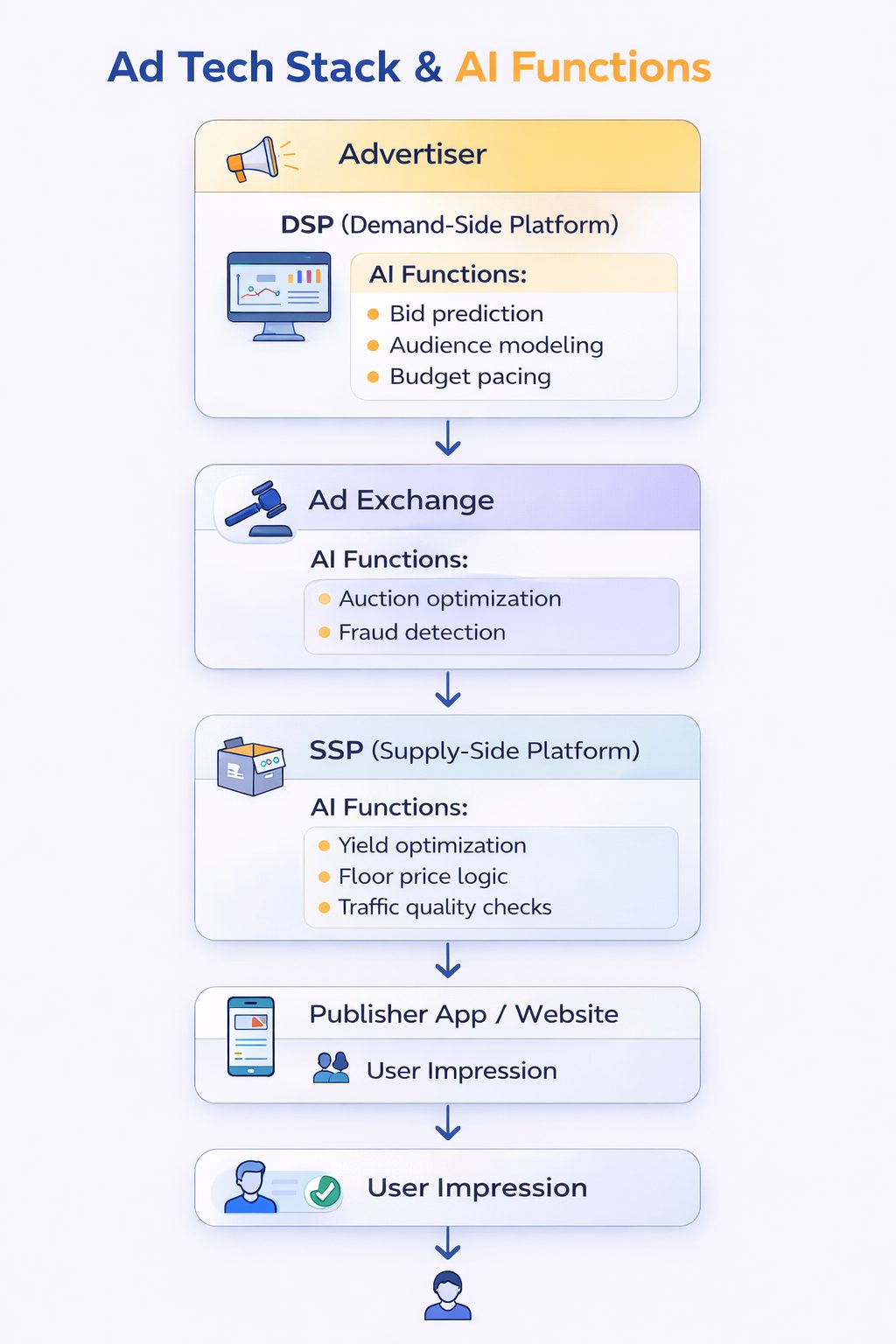
This matters on both sides of the auction. Buyers want better pricing, better targeting, and faster optimization. Sellers want higher yield, better traffic screening, and stronger decisioning inside the stack. That is where a strong DSP and SSP setup start to matter. The shift is no longer about simple automation. It is about programmatic AI, better modeling, and better control over how each impression is valued.
In this article, we will guide you through the basics of AI programmatic advertising. We’ll dissect its function, what it means for everyday campaigns and where it’s likely to take digital marketers in the years ahead.
What Is AI in Programmatic Advertising?
On a practical level, AI in programmatic advertising means using machine learning algorithms to assist in determining what you’re going to bid on, when you’re going to bid it, which audience you need to focus on then optimize delivery once the campaign is live. The objective is straightforward: higher valuation for every impression and lower spend wastage.
The difference today is technical depth. Modern AI for programmatic advertising is not only about broad targeting. It often includes bid shading, audience modeling, anomaly detection, pacing adjustments, and creative decision support. The Trade Desk describes this clearly: its platform AI calculates the value of each impression in a fraction of a second, analyzes historical clearing prices to help pay the right price, and updates audience strategy by removing weak segments and adding stronger ones.
How the Model Works at Bid Time
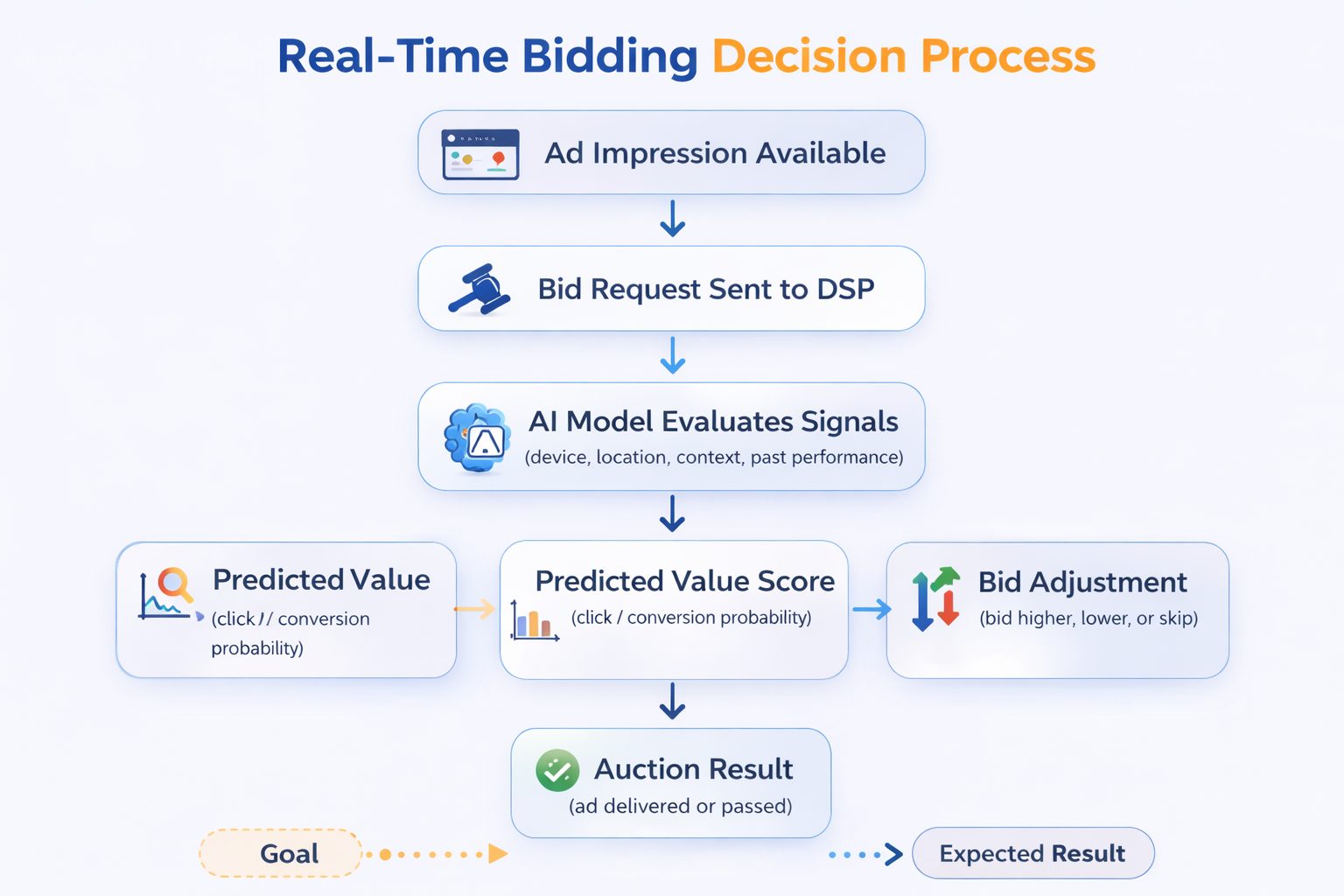
In case of real-time bidding, the model is getting multiple signals before ending of auction. Device, time, app or site context, prior performance, geography frequency and user or audience attributes where legally permissible are all included amongst those signals.
That is why machine learning in programmatic advertising matters. The system does not just follow one fixed rule. It learns from prior outcomes and adjusts toward better predictions over time. IBM defines machine learning as a subset of AI that learns patterns from training data and makes inferences on new data without explicit hard-coded instructions.
Where It Sits in the Stack
On the buy side, the model helps a DSP decide which impression is worth paying for. On the sell side, the model can help an SSP or exchange identify stronger demand paths, price inventory more intelligently, and flag suspicious activity faster. That is where programmatic advertising AI integration becomes more than a buzz phrase. It becomes part of yield logic, fraud checks, and buying efficiency
How AI Enhances Programmatic Advertising Today
The strongest benefits of AI in programmatic show up in three areas: pricing, audience decisioning, and operational control. This is also where the discussion needs more specificity than the old “smarter targeting” language.
Bid Shading and Price Efficiency
Bid shading is one of the clearest examples of programmatic AI working in day-to-day trading. In first-price auctions, buyers need to bid enough to win, but not so much that they overpay. The Trade Desk says its AI analyzes historical clearing prices across first-price auction environments so buyers can win impressions at more optimal prices and reduce wasted spend.
That kind of logic matters because it changes the economics of ad buying. Instead of paying the same way across all inventory, the platform learns where the likely clearing price sits and adjusts. This is one of the practical benefits of AI in programmatic that traders feel immediately.
Audience Modeling and Smarter Reach
Audience modeling is another strong use case. Rather than buying against a static segment and hoping it performs, the model keeps learning which user patterns and contextual combinations correlate with better results. The Trade Desk describes this as real-time audience optimization that drops underperforming segments and adds stronger ones. IBM also notes that machine learning can identify the most relevant audiences and predict which creative elements will resonate best.
This is a good example of machine learning in programmatic advertising doing more than simple targeting. It is not just finding “women 25 to 34” or “sports fans.” It is looking for combinations of signals that change performance probability.
Anomaly Detection and Safer Campaign Delivery
AI also helps detect when something unusual is happening. IBM explains anomaly detection as the use of machine learning to identify observations or events that deviate from what is normal, using supervised, unsupervised, or semi-supervised methods.
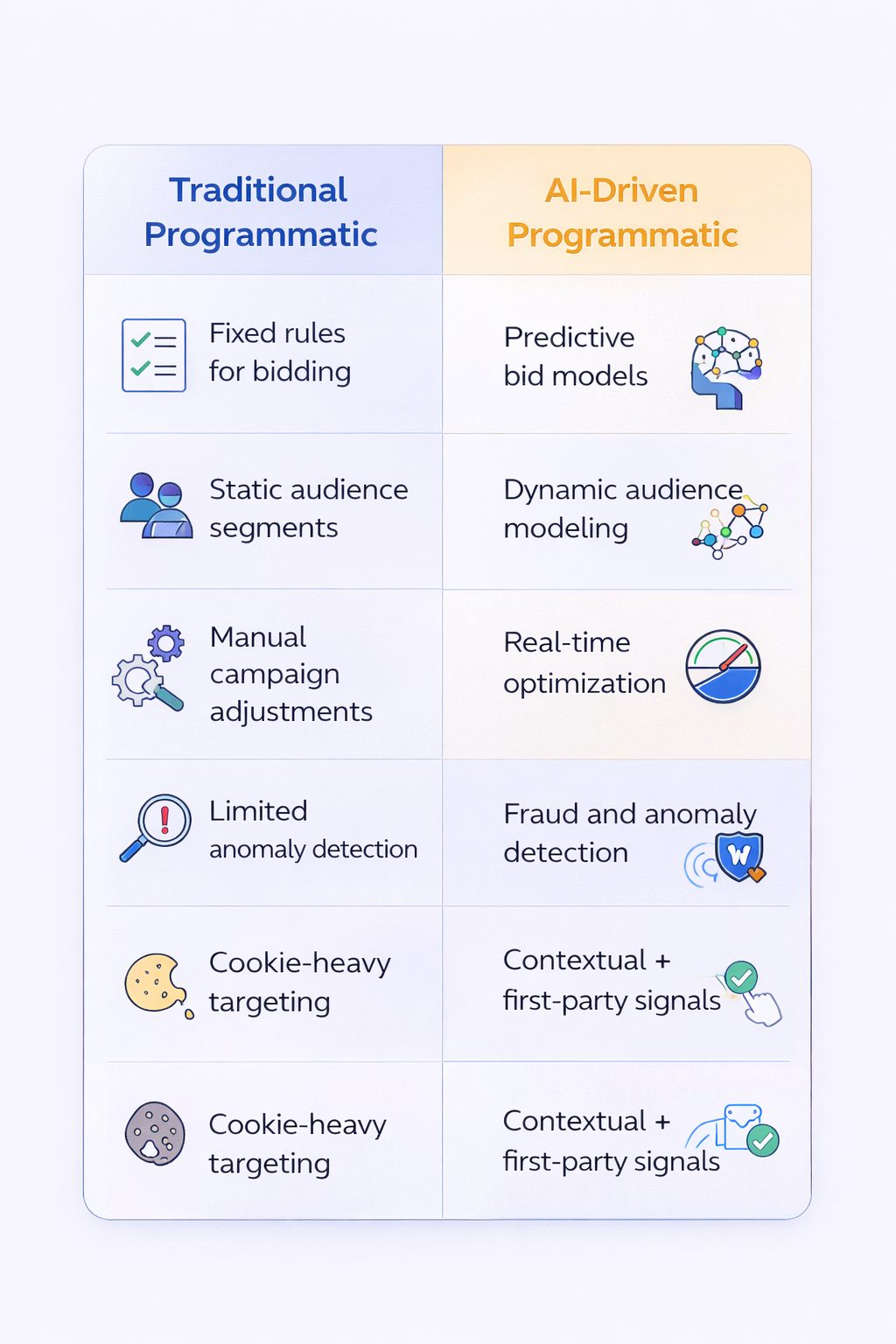
In ad buying, that can mean spotting sudden CPM spikes, unusual click patterns, strange traffic quality, unstable conversion rates, or delivery swings that suggest fraud or configuration problems. This is a less glamorous part of AI and programmatic advertising, but it is one of the most useful.
AI vs. ML: What’s the Difference in Ad Buying?
AI is the broader category. Machine learning is the part that learns from data patterns and updates predictions. IBM states it directly: machine learning is a subset of artificial intelligence.
In ad buying, AI may refer to the full decision layer around optimization, creative support, automation, and forecasting. ML usually refers to the modeling engine that predicts click likelihood, conversion probability, bid value, or risk.
| Term | What It Means | Ad Buying Example |
| AI | Broad intelligence and automation layer | Cross-channel optimization, creative support |
| ML | Pattern learning from data | Bid prediction, audience scoring, anomaly detection |
| Relationship | ML sits inside AI | ML powers many AI decisions |
Thus, it is no wonder that AI and programmatic advertising are most often mentioned in one breath, while ML specifically for programmatic pertains to the more or less predictive layer inside of bidding & optimization workflow.
The Future of AI in Programmatic Advertising
The next chapter of AI in programmatic advertising will be determined less by bigger models than by privacy, context and signal loss.
Personalization at Scale
We already see efforts to display relevant ads to niche audiences. Future systems might take it further by customizing entire ad creative in real time. They could alter colors, language, or even visuals based on the user’s interests. Marketers could confirm each impression feels unique and more aligned with the user’s expectations.
Voice and Visual Recognition
Generative AI has started to power ads featuring dynamically created images or voices. This may evolve further, giving advertisers a way to produce on-the-fly content for different audience segments. Imagine adjusting ad visuals based on the viewer’s device or region. By harnessing advanced recognition tools, campaigns could become increasingly adaptive.
Automated Cross-Channel Strategies
As more and more devices connect up, it becomes possible for marketers to unify campaigns across TV, mobile and desktop. For example, the AI could take budget away from channels that don’t perform and reallocate to those that lead to conversions.
Privacy-First Targeting
Deloitte’s 2025 marketing trends report says brands should “transform privacy into opportunity with first-party data” and use privacy-friendly strategies to build trust and value.
For programmatic teams, that means future growth in programmatic advertising AI integration will depend on how well platforms work with consented first-party data, clean room approaches, and transparent activation rules.
Contextual AI
Contextual targeting is getting a stronger role in a market with fewer durable identifiers.
That makes contextual AI one of the more credible AI trends for programmatic advertising. Instead of relying only on user-level tracking, models can score pages, apps, content themes, and real-time environments to decide whether the impression fits the campaign.
The Cookieless Ecosystem
The cookieless shift is already changing the market.
That means AI within programmatic advertising systems will need to do more with fewer old-style identifiers. Better contextual modeling, stronger first-party activation, and better probabilistic decisioning will likely matter more than legacy cookie matching.
Challenges of AI within Programmatic Advertising
A big part of the problem is that 15% of ad spend goes to purposefully-unethical websites, potentially compromising campaign quality. While the advantages are apparent, it’s also crucial to recognize any downsides. The implementation of programmatic advertising powered by AI may be subject to technical, ethical, or operational challenges. Understanding these challenges gives marketers greater perspective and helps plan for smoother implementations, as well as preventing costly missteps.
Below are key areas that can block success:
Data Quality Issues
Bad data produces bad decisions. If the training data is incomplete, stale, biased, or poorly labeled, the model can overbid on weak inventory or misread audience quality. IBM’s machine learning guide makes the role of feature quality and training data clear.
Privacy & Compliance Risks
Privacy rules are now part of the operating environment, not a legal footnote. Deloitte’s 2025 guidance makes privacy-friendly data strategy a core business issue, not just a compliance checkbox.
For ad tech, this affects consent, retention, sharing rules, data sourcing, and cross-border processing. Weak governance can quickly undermine the value of AI integration in programmatic advertising.
Over-Automation
Automation helps, but full autopilot can create blind spots. The Trade Desk itself stresses that AI works best when guided by human expertise, not when traders hand over every decision without oversight.
That is important. Over-automation can create spend drift, weak brand safety decisions, or a slow response to market changes that the model does not understand yet.
Infrastructure Costs
Good AI is not free. Training, scoring, storage, data pipelines, and monitoring all cost money. Smaller teams may feel this most when they try to build too much in-house too soon.
That is why many teams choose managed infrastructure or partner-led setup across a white label ad exchange or white label video ad server instead of trying to build every layer themselves.
How Marketers Can Leverage AI for Programmatic Success
AI systems are quickly becoming marketing staples. They provide a path to data-driven decisions and sharpened user targeting. Marketers who adopt these tactics can maximize their budget efficiency. Below are practical ways to use AI trends for programmatic advertising and align them with brand strategies.
Step 1. Start with Clear Goals
Plan with performance: define what success looks like before adding new tools or data feeds. Are you looking to boost click-through rates, conversions or brand visibility? Clarify your primary metric, so the AI engine understands where to optimize. This saves time and keeps you from working haphazardly.
Step 2. Use Predictive Models for Better Bidding
Various modules for ML are available out of the box on many platforms. These so-called modules predict user behavior and thus adjust bids in real time. In choosing a model that has been trained well, you can pay confirmation to the fact that your ads will display with greater frequency to those who seem likely to convert. It’s one rational approach for making sure your spend is targetted towards the audiences that matter most.
Step 3. Employ Creative Optimization
In addition to standard targeting, some advanced AI tools can tweak elements of the ad such as the headlines, images, or calls-to-action. Such as producing multiple variants of an ad and testing which one is the preferred one for each one of their user groups. This helps make ads relevant and may contribute to the increased performance of campaigns. It also takes away the guesswork of choosing a single creative layout for all.
Step 4. Monitor Performance Regularly
The process is heavily automated by AI, but human checks play a key role. Look at metrics such as viewability and conversion rates. Identify anomalies, such as spikes in costs or declines in engagement. Periodic human review can validate that the system is achieving your benchmarks and not going off chasing an obsolete trend.
A simple rollout looks like this:
- define the main outcome, such as CPA, ROAS, or completed view;
- apply ML-based bidding before adding creative automation;
- compare model performance against a controlled baseline;
- monitor anomalies, pacing, and inventory quality weekly;
- expand only after the first model proves value.
This is how teams get the real AI benefits in programmatic without turning the campaign into a black box. If you want product-level support, BidsCube’s DSP, SSP, white label ad exchange, and white label video ad server can support both buying and monetization workflows. For outside validation, check BidsCube on Clutch and G2.
AI trends for programmatic advertising give new perspectives for marketers to engage with audiences. With a well-defined roadmap, leveraging predictive models and tracking performance, marketing teams can implement AI in a sustainable and witchel fee.
Final Thoughts: AI and the Evolution of Digital Advertising
A marketing industry expert David Ogilvy once noted: “You can’t bore people into buying your product; you can only interest them in it.” AI aided with programmatic advertising mixes human creativity with smart algorithms. Such a combo makes campaigns sharper and more efficient. Every ad dollar lines up with what users like, all thanks to real-time insights.
AI and programmatic advertising can run more efficient campaigns. For marketers, every ad dollar also demonstrates alignment with user preferences and real-time insights at play, minimizing the guesswork. This collaboration also enables them to dedicate more time on strategic questions such as positioning or brand storytelling.
As in every problem, technology has processing hurdles that lie between us and a bright future, whether it is data privacy or cost. But with a careful thinking-out-of-the-box approach we can keep things on the track. And with time, we’ll probably end up with better alternatives specialized in splicing instant analytics with automated creative decisions. The hybrid model, empowered by AI would help build a strong audience connect while enabling better spend optimization.
As the channels digitalize, the opportunity for targeted advertising become more mainstream. The future looks bright. When implemented with care, programmatic advertising and AI will provide the map that marketers need to steer their way towards sustainable campaign performance within an ever-evolving landscape.
In short, it’s like having a superpower. AI finds your audience. Your story hooks them. Together, they make ads that don’t just show up – they stand out.
Our tech staff and AdOps are formed by the best AdTech and MarTech industry specialists with 10+ years of proven track record!

FAQ
What Is AI in the Context of Programmatic Advertising?
By automating the buying and selling of ad impressions in real-time according to user behavior, AI can help maximize advertising effectiveness while minimizing manual effort. It helps value impressions and adjust bids, model audiences, gain insights around quality and optimize delivery in real time.
How Does Machine Learning in Programmatic Advertising Improve Bidding?
ML applied to programmatic advertising achieves better bidding by learning what happened in past auctions, identifying user signals, and optimizing outcomes based on campaign performance. That assists the platform in predicting impression worth more effectively, supporting bid shading and minimizing wasted spend in first-price auctions.
What Are the Main Benefits of AI in Programmatic?
The primary AI enablers in programmatic are improved price efficiency, enhanced audience modeling, faster optimization and better anomaly detection. These improvements have been driven by systems that learn from data instead of being based purely on fixed rules or needing periodic manual edits.
How Does Programmatic AI Integration Affect Campaign Performance?
Programmatic advertising AI integration impact campaign performance by optimizing how inventory is valued, audience updates and spotting delivery issues. When the data is sound, and you hold some oversight through it all, the end result is often more efficient spend (assuming there are genuine Percentage of Voids targets involved) and resulting in more stable optimization.


